
Coil Folds Explained: How to Strengthen Bread Dough the Gentle Way

If you’ve ever handled a wet sourdough and thought, “This dough is too slack to shape, but I don’t want to rough it up,” coil folds are probably the technique you’ve been looking for.
A coil fold is a gentle dough-strengthening method used during bulk fermentation. Instead of kneading on the counter, you lift the dough in the middle so the ends tuck under themselves, then let gravity help the dough fold back into the container. That motion encourages gluten alignment, builds structure, and helps the dough hold more shape later on.
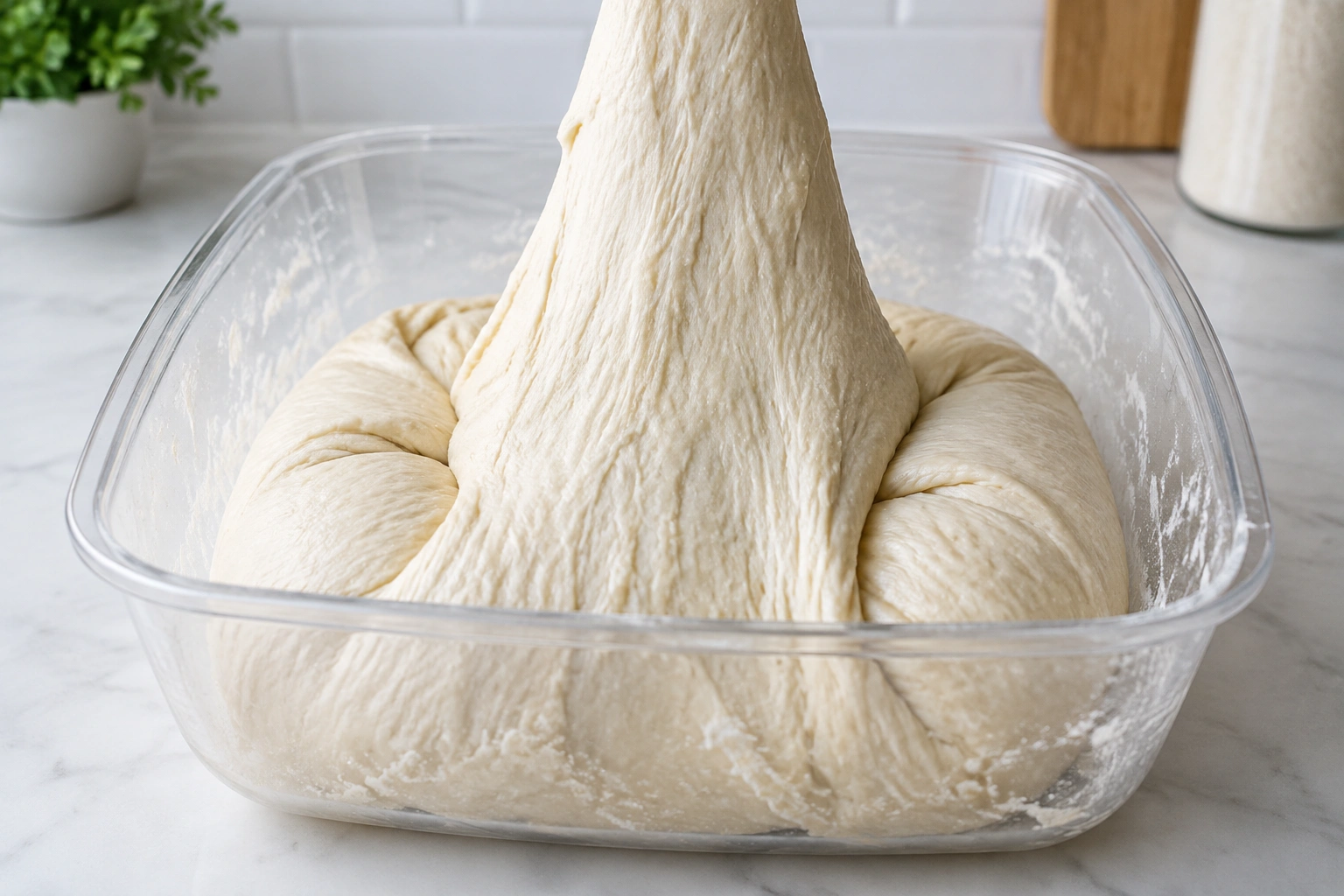
For home bakers, coil folds are especially useful when working with higher-hydration doughs that feel sticky, extensible, or delicate. For culinary students, they’re a good lesson in reading dough: you’re not just “doing a fold,” you’re watching how the dough responds and deciding whether it needs more development or more time.
What Coil Folds Are and Why Bakers Use Them
Think of coil folds as a way to organize dough that is still developing. During bulk fermentation, the dough is active: yeast is producing gas, enzymes are changing starches, and gluten is slowly becoming more extensible and stronger. A coil fold helps that structure along without the intensity of traditional kneading.
The key idea is simple: you’re not trying to force the dough into strength all at once. You’re giving it a controlled stretch and allowing it to fold over itself. That repeated alignment of the gluten network helps the dough become smoother, more elastic, and better able to trap gas.
A coil fold is especially helpful when the dough is soft enough that bench handling would be messy or disruptive. Because it stays in the container, it lets you strengthen the dough without flattening it out or tearing the surface. That makes it a practical choice for wetter doughs that need support, not force.
A useful way to think about it:
- Mixing combines ingredients.
- Folding develops structure more gently.
- Bulk fermentation is where fermentation and strength-building happen together.
If your dough is already strong and tidy, coil folds may be unnecessary. If it spreads, slumps, or tears easily, they can be a very practical intervention.
When Coil Folds Work Best
Coil folds shine in doughs that need strength without harsh handling.
They are often a good fit when:
- the dough is high hydration
- the dough feels slack or loose
- you want to preserve some of the gas already forming
- the dough is in early to middle bulk fermentation
- the dough needs structure, but not aggressive degassing
They are also useful when a dough is not developing gluten as quickly as expected.
That said, coil folds are not magic. If the dough is severely under-mixed, extremely weak, or already over-fermented, folding alone will not solve the problem. In those cases, the issue is bigger than technique.
A practical decision rule
Use coil folds when the dough is:
- wet enough that it resists direct handling
- still loose enough to spread after resting
- strong enough to lift as one mass, even if it’s soft
- early enough in bulk that the dough still has room to develop
Choose a different method if the dough is:
- very firm and needs faster development
- too weak to hold together at all
- already showing signs of over-fermentation, such as collapse or extreme slackness
Tools, Dough Conditions, and Prerequisites
You do not need special equipment for coil folds. A clear-sided container helps, but it is not essential.
What you’ll want
- A bowl or bulk fermentation container
- Clean, slightly damp hands
- A dough that has rested long enough to relax
- Enough room in the container for the dough to rise and fold
What the dough should look like before folding
You want the dough to be relaxed, not freshly mixed and tense. Right after mixing, many doughs are too stiff or uneven to fold well. Give the dough a little time first so the gluten can begin to organize.
Good signs that the dough is ready for a fold:
- it has spread slightly in the container
- the surface looks smoother than it did right after mixing
- it still feels soft, but not soup-like
- it can be lifted without immediately breaking apart
If you fold too early, the dough may tear because the gluten has not relaxed enough. If you wait too long, the dough may become so gassy or fragile that folding does more harm than good.
How to Do a Coil Fold Step by Step
The motion is easier to understand than to describe, but once you’ve done it a few times, it becomes very natural.
1. Wet or lightly dampen your hands
Sticky dough clings less when your hands are slightly wet. You do not need to soak them; just keep the dough from grabbing onto your fingers.
2. Slide both hands under the center of the dough
Reach under the middle of the dough, not the edges. Your goal is to support the dough from beneath so the center can rise while the ends stay in the container.
3. Lift the dough gently
As you raise the center, the ends of the dough should begin to peel away from the container and tuck under themselves. Gravity is doing part of the work here.
4. Let the dough fold under itself
Lower the dough back into the container so it lands with the folded ends underneath. The dough should look a little more organized and slightly taller.
5. Rotate the container if needed
Many bakers give the dough a quarter turn and repeat the motion from the other direction. This helps build even strength across the dough.
6. Stop before the dough resists
If the dough starts tearing, clinging too much, or refusing to fold cleanly, stop. That usually means you’ve done enough for that round.
A successful coil fold should feel controlled, not forceful. If the dough is stretching smoothly and folding under itself without ripping, you’re in the right zone.
What Properly Folded Dough Should Look and Feel Like
This is where many bakers level up: not by counting folds, but by learning to read the dough.
A dough that has responded well to coil folds usually becomes:
- a little taller in the container
- smoother on the surface
- less likely to spread immediately
- more elastic when lifted
- easier to shape later on
You may also notice that the dough feels more cohesive. At first, it may sag like a heavy batter. After a few folds, it should behave more like a unified mass with some spring.
Signs the fold worked
- The dough holds its shape a little longer after being lifted.
- The surface looks more taut.
- The dough tears less easily on later folds.
- The container shows less rapid spreading after each rest.
Signs the dough still needs help
- It puddles out almost immediately after folding.
- It tears before you can complete the motion.
- It looks rough and ragged instead of smoother.
- It feels weak no matter how carefully you handle it.
In other words, a good coil fold is not about making the dough “perfect” in one round. It’s about moving the dough from loose and disorganized to smoother and more structured over time.
How Many Coil Folds to Do and How Far Apart to Space Them
There is no universal formula for how many coil folds are enough. Dough strength depends on hydration, flour type, mixing, temperature, and fermentation pace.
That does not mean you’re guessing. It means you should use the dough itself as your guide.
A practical range
A useful rule of thumb is to start with one fold after the dough has relaxed and begun to show some activity, then repeat only if the dough still looks loose. For many home bakes, that means two to four folds total during the first half of bulk fermentation. Wet, weak doughs may benefit from more rounds; moderately strong doughs may need only one or two.
Instead of relying on a fixed clock, use dough behavior and room temperature together:
- Cool kitchen, slower dough: space folds farther apart, since the dough will relax more slowly.
- Warm kitchen, active dough: check earlier, because repeated handling can slightly warm the dough and fermentation may move faster.
- Very high hydration dough: expect the dough to need more time between folds before it shows real strength.
- Moderately strong dough: stop sooner once the dough starts holding shape.
A practical example schedule
If your dough is mixed in a room that feels warm and the dough is already moving well, you might do the first coil fold after the initial rest, then check it again about 45 to 60 minutes later. If it still spreads quickly, do another fold. If the dough is already smoother, taller, and less sticky-looking after that second round, you can usually give it a longer undisturbed rest instead of folding again.
If the dough is cooler and slower, you may wait a bit longer between folds. The point is not to hit a set number of minutes. The point is to fold when the dough has relaxed enough to benefit from it and to stop once the dough is clearly gaining strength.

A simple decision framework
Do another coil fold if:
- the dough still spreads quickly
- the surface looks loose or wrinkled
- the dough feels extensible but not yet strong
- it still tears too easily during handling
Stop folding if:
- the dough holds its shape better after resting
- the surface is smoother and more elastic
- the dough rises more confidently in the container
- the dough resists folding instead of collapsing
Trade-off to keep in mind
More folds can build more strength, but too many can make the dough overly tight or interfere with fermentation rhythm. Repeated handling can also warm the dough slightly, which may speed fermentation in a warm kitchen. That is not automatically bad, but it does mean timing matters.
Coil Folds vs. Stretch and Folds, Slap and Folds, and Kneading
Different dough-strengthening methods solve different problems. Choosing well saves time and prevents overhandling.
| Method | Best for | Gentleness | Speed of strength-building | Main trade-off |
|---|---|---|---|---|
| Coil folds | High-hydration, slack, delicate doughs | Very gentle | Moderate | Slower than more aggressive methods |
| Stretch and folds | General dough development, especially early in bulk | Gentle to moderate | Moderate | Can be a bit more disruptive than coil folds |
| Slap and folds | Doughs that need stronger, faster development | Less gentle | Fast | More handling, more degassing risk |
| Traditional kneading | Firmer doughs and early gluten development | Moderate to firm | Fast | Can be too rough for very wet doughs |
Quick choice guide
- Choose coil folds when the dough is very wet, slack, or delicate and you want to strengthen it in the container.
- Choose stretch and folds when the dough is moderately strong and can tolerate a bit more handling.
- Choose slap and folds when the dough is stronger, not overly wet, and needs fast gluten development.
- Choose kneading when the dough is firmer and can be worked on the bench without becoming messy or torn.
Coil folds vs. stretch and folds
Stretch and folds are often a great starting point for more basic doughs, especially early in the process. Coil folds tend to be gentler and are often preferred later in bulk or when the dough is wetter and more delicate.
If your dough can handle direct stretching without tearing, stretch and folds may be simpler. If the dough is too slack or fragile, coil folds usually give you more control.
Coil folds vs. slap and folds
Slap and folds can develop strength quickly, but they are much more assertive. They suit doughs that can tolerate vigorous handling. Coil folds are a better choice when you want to preserve gas and avoid rough treatment.
Coil folds vs. kneading
Traditional kneading is effective for many doughs, but very wet doughs often become messy and difficult to manage on the bench. Coil folds let you strengthen those doughs in the container, which is cleaner and usually gentler.
Practical Example: A Typical Sourdough Bulk Fermentation Schedule
Here’s a realistic home-baking scenario.
Imagine a sourdough dough at roughly 80% hydration. It feels loose after mixing and spreads across the container instead of sitting in a neat mound.
A practical approach might look like this:
- Mix the dough and let it rest.
- After the dough has relaxed and begun to show some activity, perform the first coil fold.
- Rest the dough for about an hour, then check how it behaves.
- If the dough still feels slack and spreads quickly, perform a second coil fold.
- Rest again.
- If the dough is still loose but improving, do a third fold.
- Stop folding once the dough holds together better, feels smoother, and shows clear structure.
This kind of schedule works because you are giving the dough time between folds to relax and reorganize. The rest periods matter as much as the folds themselves.
Common Mistakes to Avoid
Most coil fold mistakes come from rushing the dough or assuming every dough behaves the same.
Folding too early
If the dough has not relaxed yet, it may tear when lifted. Early folding can feel productive, but it often just stresses the dough.
Folding too aggressively
A coil fold should be controlled and smooth. If you yank the dough upward, you defeat the purpose of a gentle strengthening method.
Folding too often
More is not always better. Repeated handling can make the dough tighter than necessary and can alter fermentation timing.
Treating sticky dough as automatically weak
Sticky dough is not always underdeveloped. High hydration naturally feels tacky. Judge the structure, not just the feel.
Expecting folds to fix everything
If the dough was poorly mixed or is already over-fermented, coil folds may help only a little. They are a tool, not a rescue plan for every problem.
Troubleshooting Slack, Sticky, Extensible, or Tearing Dough
This is where coil folds become especially useful: they help you diagnose what the dough is telling you.
If the dough is slack and spreads fast
That usually means it needs more structure or more time. Try another coil fold after a rest. If it still spreads quickly after several rounds, the dough may simply need a longer bulk fermentation.
If the dough is sticky but holds together
That can be perfectly normal, especially in higher-hydration doughs. Sticky is not the same as weak. If the dough folds cleanly and gains shape, keep going.
If the dough is very extensible
Extensibility means the dough stretches easily. That can be useful, but if it stretches too far without resistance, it may need more strength before shaping. Another coil fold may help organize the gluten.
If the dough tears during folding
Tearing usually points to one of a few different problems:
- Too cold: the dough is tight and resistant, so it needs more time to warm and relax.
- Underdeveloped: the dough was not mixed enough or has not had enough folding yet.
- Too weak: the flour or hydration level may not support much more folding.
- Overproofed: the dough has gone too far in fermentation and is losing structure.
If the dough is cold, wait longer before trying again. If it seems underdeveloped but not fragile, give it one more gentle fold after a rest. If it is already very weak or overproofed, stop folding and let it finish bulk or move on to shaping as best you can.
If the dough still feels weak after several folds
At that point, more folds may not be the answer. The dough may need:
- more time
- better initial mixing
- a different folding method earlier in bulk
- a recipe adjustment for hydration or flour strength
If it is simply underdeveloped, one more rest period may be enough. If it is too weak to hold together, additional folds are more likely to tear it than improve it.
How to Know When to Stop Folding
Stopping at the right time matters just as much as folding correctly.
You can usually stop when the dough:
- looks smoother
- holds a more rounded shape
- resists spreading as quickly
- feels elastic without tearing
- has enough strength to move toward shaping
A useful rule is this: if each fold gives you less improvement than the one before, you’re probably nearing the point where the dough should be left alone.
That pause is important. Bulk fermentation is not just “rest time”; it’s where the dough continues to develop on its own. If you keep folding after the dough is already strong enough, you can slow down the process or make shaping harder.
When to Consult a Master Baker
If your dough repeatedly tears, collapses, or behaves unpredictably even after careful folding, the issue may be recipe balance rather than technique alone. A master baker can help you assess flour choice, hydration, mixing intensity, fermentation temperature, and bulk timing together instead of treating each problem in isolation.
Final Thoughts
The best folding method is the one that matches the dough you actually have, not the one you planned to use at the start. Coil folds are the right choice for soft, wet doughs that need gentle strengthening; stretch and folds work well when the dough is a little firmer; and more aggressive methods are better reserved for doughs that can take them.
If you want to compare this method with a more direct approach, you may also find our guide to the stretch and fold method helpful.