
How Long Fruit Can Sit Out Before It Needs to Be Chilled or Tossed

If you want the shortest safe answer: whole fruit can usually sit out longer than cut fruit, but cut, peeled, or mixed fruit should be treated like a perishable food and refrigerated within 2 hours. If the room is hot, the safe window gets shorter. And if fruit has been left out overnight after it was cut or mixed, the safest move is to throw it away.
That’s the rule I’d use in a busy kitchen when you need a fast decision:
– Whole fruit on the counter: usually fine for a while, depending on the fruit.
– Cut fruit, fruit salad, sliced melon, or peeled fruit: refrigerate within 2 hours.
– If it sat out in heat above 90°F: use a 1-hour limit for perishable food.
– If you’re unsure and it was out too long: discard it.
The reason is simple. Once fruit is cut, the exposed flesh warms faster, dries out, and becomes easier for bacteria or mold to grow on. A bowl of apples is not the same as a container of sliced peaches.
Quick guide: whole fruit vs. cut fruit
Here’s the practical difference that matters most.
| Fruit situation | Safe room-temperature guidance | What to do |
|---|---|---|
| Whole, uncut fruit | Often fine for a few days to about a week, depending on the fruit and storage conditions | Keep out if it’s a fruit that stores well on the counter |
| Cut, peeled, or sliced fruit | Refrigerate within 2 hours | Chill promptly |
| Cut fruit left out more than 2 hours | Not a safe hold time | Throw it out |
| Cut fruit left out in hot weather over 90°F | 1 hour max for perishable food | Discard if left longer |
| Fruit salad or mixed fruit tray | Treat like cut fruit | Refrigerate or discard based on time |
That table is the decision tool I’d want on a fridge door. Whole fruit is mostly a quality question at room temperature. Cut fruit becomes a food safety question.
The basic safety rule: whole fruit vs. cut fruit
Whole fruit has a natural protective barrier: the peel or skin. That outer layer slows moisture loss and helps keep contaminants away from the edible portion. That’s why apples, oranges, bananas, and pears can usually sit on the counter for a reasonable time without becoming unsafe right away.
Cut fruit is different. Once you slice through the skin, the interior is exposed to air, hands, utensils, and warm kitchen temperatures. That exposure speeds up spoilage, and it also gives microbes a better environment to grow.
A useful way to think about it:
- Whole fruit is often about ripening and quality.
- Cut fruit is about time and temperature.
That distinction matters when you’re meal prepping. A whole bowl of oranges can stay on the counter for snacks. A container of cut melon for tomorrow’s lunches should go straight into the refrigerator.
How the 2-hour rule applies to fruit
The 2-hour rule is the safest baseline for cut, peeled, or prepared fruit. Official food safety guidance says fresh fruit and vegetables should be refrigerated within 2 hours of peeling or cutting, and fruit left out longer than that should be thrown out. Unlock Food’s produce safety guidance gives the clearest version of that rule.
There’s one important temperature exception: when food is in the danger zone for bacteria growth, time matters even more. USDA food safety guidance says perishable food should not sit at room temperature for more than 2 hours, and 1 hour if the temperature is over 90°F. USDA food safety basics applies that rule to perishable foods in general, and cut fruit fits that practical category.
Here’s how I use that in real life:
- Cool kitchen, cut fruit on the counter: 2 hours max
- Hot kitchen, patio, or picnic: 1 hour max
- If it was out overnight: don’t try to rescue it
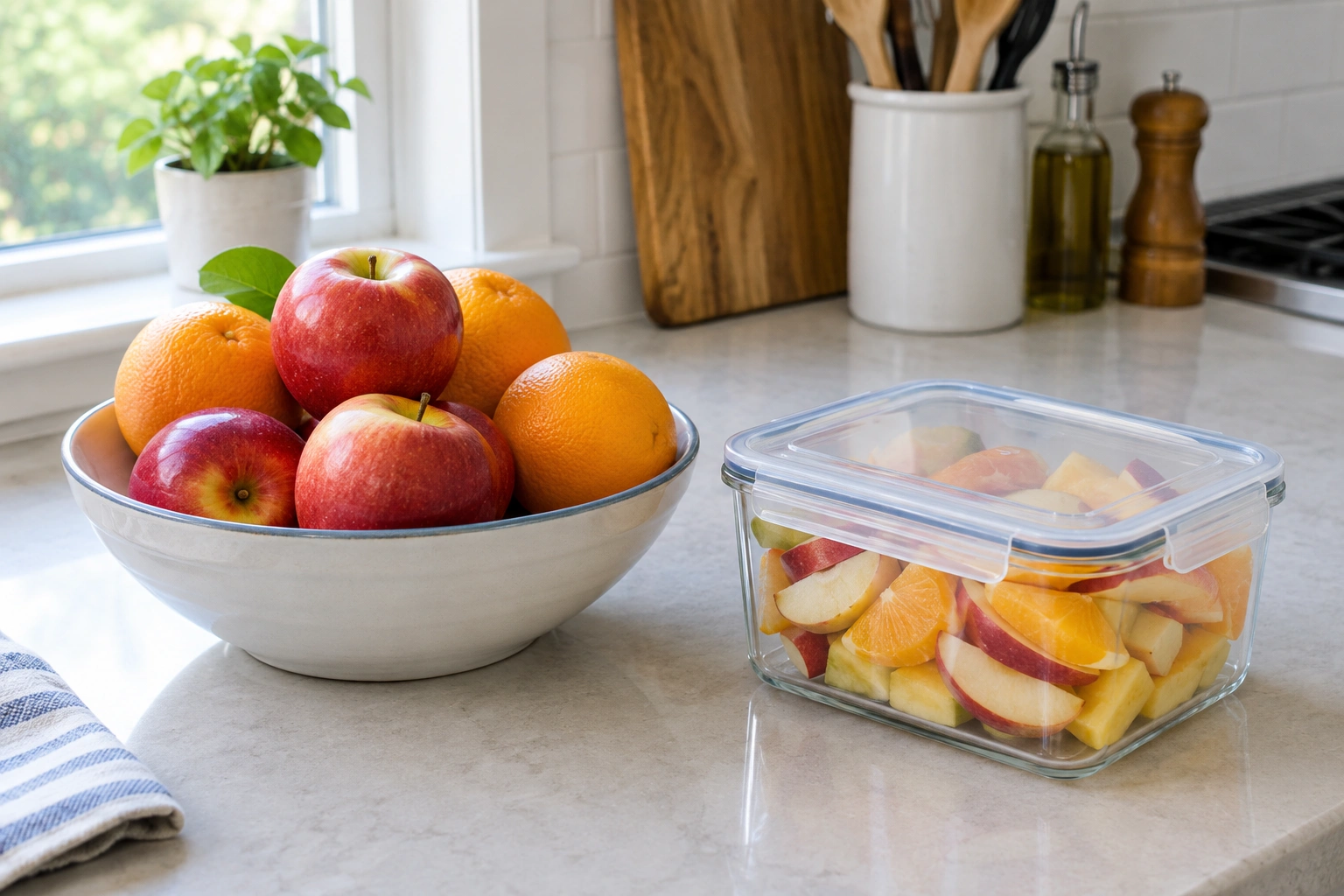
A common mistake is thinking fruit is “safe” because it doesn’t smell bad. Smell is not a reliable timer. Time and temperature are.
How long common fruits can sit out
Different fruits behave differently on the counter, mostly because of texture, moisture, and skin thickness. The following is best read as a quality guide for whole fruit, not a promise that every fruit stays perfect that long.
- Apples: usually hold well on the counter for several days
- Oranges, lemons, and limes: usually keep well at room temperature for a week or more in a cool, dry spot
- Bananas: often fine for a few days on the counter, though they ripen quickly
- Pears: similar to apples; they can sit out for several days as they ripen
- Avocados: can sit out while ripening, but once cut they become a different story
- Tomatoes: often kept on the counter for flavor, as long as they’re whole and uncut
That’s a storage-quality estimate, not a food-safety guarantee, so I would still check for damage, mold, or overripeness before using fruit that has been sitting out for several days.
If you’re deciding whether to keep fruit on the counter or move it to the fridge, ask one question: Is this fruit still whole and protected by its skin? If yes, counter storage may be fine. If no, refrigerate it.
Special cases: fruit salad, sliced melon, berries, and fruit trays
This is where people get into trouble, because these foods look harmless and are easy to leave out for guests.
Fruit salad
Fruit salad is cut fruit. Treat it like any other prepared perishable food. If it has been sitting out for more than 2 hours, it should be discarded. In hot weather, shorten that to 1 hour.
Sliced melon
Melon deserves extra caution because it is moist and often served in large cut surfaces. Watermelon, cantaloupe, and honeydew that have been cut should go back into the refrigerator promptly. If a melon tray has been out at a party for several hours, don’t keep “just a few pieces” for later unless the time stayed within the safe window.
Berries
Whole berries may last a little longer in the fridge than at room temperature, but once they are washed, cut, or mixed into a bowl, they need prompt chilling. Berries are soft, fragile, and easy to bruise, which makes them spoil faster once handled.
Fruit trays and buffet platters
If fruit is set out for guests, the safest approach is to serve smaller batches and refill from refrigerated backup. USDA guidance for cut produce displayed without refrigeration says it should be marked with the time and kept for a maximum of 4 hours if not in a refrigeration unit or surrounded by ice, with uneaten produce discarded at the end of that period. That’s a specific service-line exception for displayed produce, not a general home-storage rule.
For a party, I’d use this rule of thumb:
– Whole fruit on a platter: more forgiving
– Cut fruit on a platter: much stricter time limit
– Mixed fruit tray in a warm room: chill or discard quickly
What changes the safe time: temperature, humidity, and airflow
Room temperature is not one fixed number. A fruit bowl in an air-conditioned kitchen is not the same as fruit on a sunny patio table.
Warmth
Heat speeds up spoilage. The warmer the room, the shorter the safe sitting time for cut fruit. If the kitchen feels warm enough that you’d avoid leaving dairy out, you should be just as cautious with cut fruit.
Humidity
Moist air can make fruit feel sticky and encourage mold growth, especially on berries, grapes, and cut surfaces. Humidity doesn’t automatically make fruit unsafe faster by itself, but it does make spoilage more likely and more visible.
Airflow and sunlight
Direct sunlight warms fruit quickly. Poor airflow traps heat around bowls and trays. A fruit platter under a window or on a crowded buffet table will not hold as well as fruit stored in a cool, shaded area.
That’s why “it was only out for a while” can mean very different things depending on the room. A cool counter and a hot picnic table are not the same storage condition.
How to tell if fruit has gone bad
Use your senses, but don’t use them alone.
Signs to watch for
- Mold: fuzzy spots, especially on soft fruit
- Slime: slick or sticky film on the surface
- Off odor: sour, fermented, or unpleasant smell
- Discoloration: brown, gray, or dark patches beyond normal ripening
- Unusual softness: mushy areas, collapse, or leaking juice
- Fermentation: bubbling, fizzing, or a wine-like smell
If fruit has sat out too long, a clean appearance does not make it safe. Some spoilage is obvious; some is not. Time and temperature still come first.
A helpful habit: if you’re checking a container of cut fruit, look at the oldest piece, not the freshest-looking one. One bad piece can tell you the whole batch has been sitting in the danger zone too long.
What to do with fruit that has been sitting out
This is the decision framework I use.
If it is whole fruit
- If it still looks and smells normal, and it has only been out on the counter for a reasonable time, it can usually be used or stored as needed.
- If it is bruised, moldy, leaking, or heavily overripe, use it immediately in a safe way or discard it.
If it is cut, peeled, or mixed fruit
- Under 2 hours: refrigerate and use later
- Over 2 hours: discard
- Over 1 hour in hot conditions: discard
- Overnight: discard
If you want to repurpose it
Only repurpose fruit that stayed within safe time limits. For example, fruit that was cut for lunch and immediately refrigerated can be used later in yogurt, oatmeal, or a smoothie. Fruit that sat on the counter too long should not be “saved” by blending, freezing, or mixing into another dish. Those steps do not reverse unsafe time at room temperature.
Best practices for meal prep, leftovers, and party platters
The easiest way to reduce waste is to portion fruit the way you’ll actually use it.
For meal prep
Keep whole fruit whole until the day you plan to eat it. If you need sliced fruit for lunches, cut only what you can refrigerate right away. Use shallow containers so the fruit cools faster.
For family snacks
Leave out durable whole fruit like apples, oranges, or bananas if that encourages people to eat it. Keep cut fruit in the fridge and refill a small serving bowl as needed.
For parties
Put out smaller amounts of cut fruit and keep the rest chilled. If the event is long, swap in fresh trays rather than leaving one platter out for hours. If you are serving fruit in warm weather, build in a hard stop for the tray instead of letting people “finish it later.”
For leftovers
Once a fruit tray or salad has been on the table, do not assume it can go back into the fridge indefinitely. The time out of refrigeration is what matters.
For a broader look at how produce storage choices affect spoilage, you may also find our guide on what fruits and vegetables can be stored together without spoiling faster useful, especially if your counter and fridge are both crowded.
When to throw fruit away immediately
Do not keep fruit if any of these apply:
- It was cut, peeled, or mixed and sat out more than 2 hours
- It was cut fruit left out in heat over 90°F for more than 1 hour
- It was left out overnight
- It has visible mold
- It smells sour, fermented, or off
- It has a slimy texture
- It is leaking, collapsing, or badly discolored
- It was part of a buffet or picnic tray that exceeded safe time limits
When in doubt, discard it. That may feel wasteful, but it is cheaper than risking foodborne illness.
Frequently asked questions
Can whole fruit sit out overnight?
Usually yes, if it is whole and uncut, but quality may decline. Check for bruising, mold, or insect damage before eating.
Can cut fruit sit out overnight?
No. Cut fruit left out overnight should be discarded.
Does fruit salad follow the 2-hour rule?
Yes. Fruit salad is prepared cut fruit, so the 2-hour rule applies, and the limit is shorter in hot conditions.
Can I refrigerate fruit after it has been out for a while?
If it has been out less than 2 hours, yes. If it has been out longer than that, refrigeration does not make it safe again.
Which fruits are safest to leave on the counter?
Whole apples, oranges, bananas, pears, and similar uncut fruit are generally more counter-friendly than cut or mixed fruit.
What about berries and melon?
Treat them more cautiously once cut or washed. They belong in the refrigerator quickly.
Final practical rule
If fruit is whole, the counter is often fine for a while. If fruit is cut, peeled, or mixed, the refrigerator should be the next stop, not the last one. That one habit will save the most fruit, prevent the most waste, and keep the safest kitchen routine for a busy household.