
How to Choose a Baking Pan That Fits Your Air Fryer
Air fryers can do more than crisp fries and reheat leftovers. With the right pan, they can also handle small cakes, brownies, mini loaves, and individual bakes. The catch is that “fits” is about more than whether a pan slips inside the basket. A pan can be physically small enough and still bake poorly if it blocks airflow, sits too high, or is awkward to lift out safely.
If you want reliable results, think in terms of usable interior space, not the air fryer’s outside size or advertised capacity. That single shift makes pan shopping much easier.
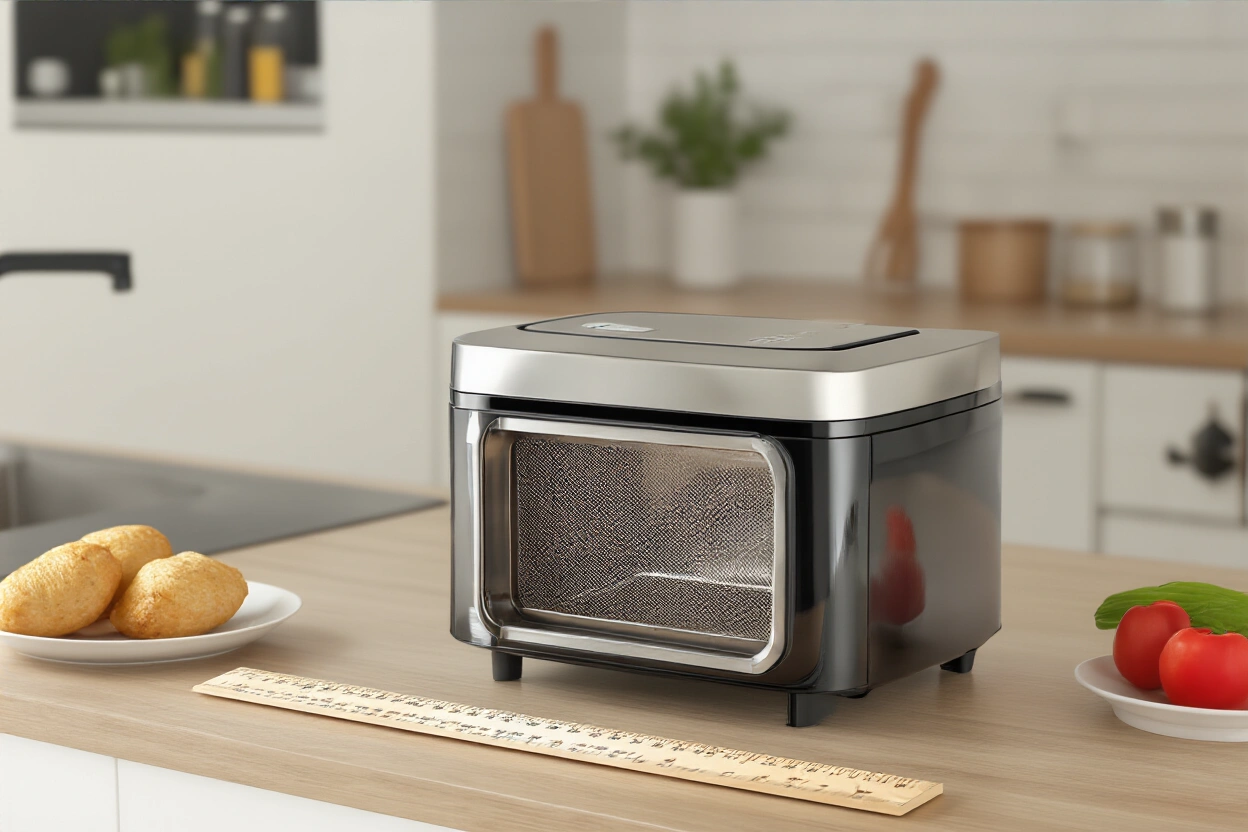
How to tell whether a pan will fit your air fryer
The simplest rule is this: the pan must fit inside the cooking chamber with room left around it for air to move. If the pan touches the sides too tightly, crowding can reduce circulation and make baking less even. If it sits too high, it may interfere with the basket, tray, or heating element.
That means the number on the box, such as 4-quart or 6-quart, is only a starting point. Two air fryers with the same capacity can have very different interior shapes. One may be wider and shallower; another may be narrower and taller. The pan that works in one may not work in the other.
For baking, the useful measurements are the inside width, depth, and height of the basket, tray, or rack area. Those are the dimensions that determine whether your pan will fit safely and whether hot air can move around it.
A practical fit rule: aim for at least about 1/2 inch to 1 inch of side clearance total around the pan, and roughly 1 to 2 inches of top clearance if the recipe will rise. Your air fryer manual overrides general advice, so if the manufacturer specifies different spacing or accessory limits, follow that first.
Measure the usable interior space of your air fryer
Before you buy anything, measure the space where the pan will actually sit.
Measure width and depth
Use a ruler or tape measure and measure the inside of the basket or tray from wall to wall. If the basket is round, measure across the widest usable point. If it is square or rectangular, measure the interior length and width.
Then look for the narrowest point, not just the widest one. Some baskets taper slightly, and some have rounded corners or handles that reduce usable room. A pan that fits at the top may scrape when you lower it into place.
Measure height
Measure from the cooking surface to the top of the basket or to the lowest point of the heating element area, depending on your model. This tells you how tall a pan can be before it becomes a problem. Height matters especially for springform pans, loaf pans, and recipes that rise.
A pan can be the correct width and still fail if the batter comes too close to the top. That is one of the most common mistakes when baking in an air fryer.
Check removable parts
If your air fryer uses a removable basket, tray, or rack, measure with those parts in their cooking position. Accessories, raised ridges, and handles can change the usable space enough to matter. If the manufacturer offers an accessory guide, use that first.
As a practical example, a shallow round cake pan may fit a basket-style air fryer easily, while a taller loaf pan may fit the same appliance only if the basket is removed or the recipe is scaled down.
Leave enough room for airflow and safe handling
A pan that fits with no space around it is usually not the best choice. Air fryers depend on circulation, so the pan should not pack the chamber wall to wall.
A useful rule is to leave visible room around the sides and enough clearance above the pan so hot air can move and the basket can still be handled without scraping. You do not need a large gap, but you do need some breathing room.
Why this matters:
- Better airflow helps the heat reach the batter more evenly.
- A little clearance makes it easier to lift the pan out with tongs, a sling, or oven mitts.
- Tight fit can make the pan wobble, catch on the basket, or tip when you remove it.
If you are choosing between two pans, the slightly smaller one is often the better baking choice. The extra space around it can improve browning and make cleanup easier.
A pan should also not force you to angle it sharply to get it in or out. If it only fits when tilted, it is usually too tight for practical use, even if it technically slides inside.
Choose the right pan shape for your air fryer style
The shape of the pan matters almost as much as the size. A good shape uses the available space efficiently without blocking circulation.
Round pans
Round pans often make sense in round or nearly round baskets because they follow the shape of the chamber. They are a natural fit for single-layer cakes, small cheesecakes, and some quick breads.
The trade-off is space efficiency. In a square basket, a round pan may leave unused corners. That is not always a problem, but it does mean you are not using the full footprint available.
Square pans
Square pans work well in square baskets because they use the space efficiently. They are especially useful for brownies and bar-style bakes, where a flatter batter layer is helpful.
In a round basket, a square pan may fit only if the basket is large enough and the corners do not interfere with airflow or movement. Even then, it can be harder to center neatly.
Loaf pans
Loaf pans are the most likely to run into length problems. They can work well in oven-style air fryers, but many basket-style models are too short or too narrow for a standard loaf pan.
If you want to bake quick bread or mini yeast bread, check the internal length carefully. A shorter loaf pan or a mini loaf pan is often a better match than forcing a full-size one into a tight chamber.
Springform pans
Springform pans are useful for cheesecakes and delicate cakes because the sides release cleanly. In an air fryer, they are best when the recipe needs gentle handling and the pan can be lifted without disturbing the top.
The main caution is height. Springform pans often sit taller than simple cake pans, so measure carefully. A pan that fits width-wise may still be too tall once the batter is added.
Ramekins
Ramekins are ideal for individual portions: custards, mini cakes, or small savory bakes. They are also easier to fit into compact air fryers because you can place one or several in the chamber with space between them.
They are not a replacement for a full pan, but they are often the smartest choice when the air fryer is small or the recipe is meant to be portioned.
Pick the best pan material for baking in an air fryer
Material affects fit, heat response, browning, and handling. Size is only half the decision.
Metal
Metal is the most versatile choice for air fryer baking. It is generally lightweight, easy to handle, and good at transferring heat. That makes it practical for cakes, brownies, and breads where you want even baking and decent browning.
If you already own a suitable metal cake pan or loaf pan, it may be all you need. A dark metal pan can brown more quickly than a light one, so it may require closer attention, but it is still one of the most useful options for air fryer baking. For more on how darker pans affect baking, see how to adjust baking time for a dark metal pan.
Silicone
Silicone pans are flexible and easy to store, but that flexibility can become a drawback in an air fryer. A flimsy pan is harder to move when filled with batter, and it may bend when you transfer it in or out of the basket.
Silicone can be useful for certain small bakes, especially when release is a priority. Still, if you are baking a heavier batter or want stronger structure, metal is usually the more stable choice.
Glass
Glass can work only if the manufacturer says it is safe for high-heat use in that appliance. Even then, glass is heavier and less forgiving to handle in a compact basket. It also tends to be thicker than metal, which reduces usable space.
If your air fryer is small, glass is rarely the most practical option. A lighter pan usually makes more sense.
Ceramic
Ceramic shares some of the same trade-offs as glass: it can be heavy, thick, and awkward in a tight basket. It may be fine for some recipes in larger oven-style air fryers, but it is not usually the first material I would choose for a compact basket model.
Disposable foil
Foil pans can be useful for occasional baking or for recipes where easy cleanup matters. They are lightweight and often available in small sizes that fit compact air fryers.
The downside is rigidity. Thin foil can flex, especially with liquid batter, so it is best supported on a rack or tray if your model uses one.
If you use parchment or a liner, make sure it does not reduce the usable footprint so much that the pan becomes too tight, and keep it trimmed so it does not block airflow around the sides.
Match pan size to common air fryer capacities
Capacity gives you a rough starting point, but not a guarantee. Still, it helps narrow the search.
| Air fryer capacity | Typical pan fit expectation | Best fit examples | Fit caution |
|---|---|---|---|
| 2-quart | Very small pans, ramekins, mini cake pans | Approx. 4 to 5 inch round pan, 4 inch square pan, mini loaf pan around 5 x 3 inches | Limited height and very little room for airflow |
| 4-quart | Small round or square pans, small springform pans | Approx. 6 inch round pan, 6 inch square pan, small loaf pan around 6 x 3 inches | Measure carefully; some loaf pans will still be too long |
| 6-quart | More flexible for round and square pans | Approx. 7 to 8 inch round pan, 7 inch square pan, loaf pan around 8 x 4 inches or a compact mini loaf pan | Bigger capacity does not always mean enough height |
| Basket-style models | Usually favor shorter, flatter pans | Round cake pans, square brownie pans, ramekins | Basket shape can limit loaf-style pans |
| Oven-style models | Often accept more shapes, including loaf pans | Loaves, small sheet-style bakes, springform pans | Check rack clearance and side walls |
Use this table as a starting point, then confirm with the actual interior measurements. A 6-quart model may still be too narrow for a pan that works easily in another 6-quart unit.

Check fit by air fryer type: basket, tray, or oven-style model
Different air fryer styles behave differently, even when the capacity looks similar on paper.
Basket-style air fryers
Basket models usually have the most shape restrictions. The chamber is compact, and the rounded or tapered sides can make square or loaf pans awkward. These models are often best for round pans, small square pans, and ramekins.
If you are baking in a basket-style unit, prioritize easy insertion and removal. A pan that fits only after you tilt it at an angle is usually too tight for practical use.
Tray or rack models
Tray-based air fryers can be more flexible because the cooking surface is flatter. That makes it easier to use square pans or shallow rectangular pans, provided the height clears the top element and the tray supports the weight.
These models are often better for brownies, bars, and small breads than a tightly curved basket design. A short square or rectangular pan usually makes better use of the flat surface than a tall pan with extra unused space around it.
Oven-style air fryers
Oven-style air fryers usually offer the most flexibility. They may accept loaf pans, springform pans, and even multiple ramekins on different racks.
The main concern here is vertical clearance. You still need to leave space for air movement and for the pan to sit without touching the top heating area.
Use recipe-specific guidance for cakes, brownies, breads, and mini bakes
The best pan is the one that suits both the appliance and the recipe.
Cakes
For a single-layer cake, a shallow round or square pan is usually the easiest match. A pan that is too deep can leave the center underbaked while the edges set too quickly.
If you want a cake that releases cleanly, a springform pan may be useful, but only if the height works comfortably in your air fryer.
Brownies
Brownies are more forgiving, but they still benefit from a pan that does not crowd the basket. A square pan often makes the most sense because it matches the shape of the batter and gives you neat portions.
If your air fryer is compact, a smaller square pan is often preferable to a larger round one because it uses the available footprint more efficiently.
Breads and mini loaves
Quick breads and yeast breads need more attention to height and length. A full-size loaf pan is often too large for basket-style air fryers, but mini loaf pans can work well.
If you want a bread with a domed top, leave extra headroom. Batter that rises too close to the top can brown too quickly before the center finishes.
Mini bakes and individual portions
Ramekins are the most flexible option for small portions. They are useful when you want to bake several small items at once without committing to one large pan.
This is often the best route for compact air fryers because it avoids the common problem of forcing one oversized pan into a small chamber.
Avoid the most common sizing and fit mistakes
A few mistakes cause most of the frustration.
Measuring only the exterior
The outside dimensions of the air fryer tell you very little. Always measure the usable interior space.
Ignoring height
Many pans fail because they are too tall, not too wide. That is especially true with springform pans and loaf pans.
Choosing a pan that blocks airflow
If the pan nearly fills the chamber, the food may bake unevenly. A slightly smaller pan often performs better than a tight one.
Forgetting the handle path
Even if a pan technically fits, you still need room to insert and remove it without scraping the basket or tipping batter. A pan that is difficult to handle is not a good fit.
Using a pan that is too deep for the recipe
Deep pans are not automatically better. In an air fryer, a shallower pan often bakes more evenly because the heat can reach the batter more efficiently.
When to use a dedicated air fryer pan versus one you already own
If you already own a pan that fits with room to spare, there is no need to buy a special accessory just for the label. A good metal cake pan or small loaf pan can do the job well.
A dedicated air fryer pan becomes useful when:
- your basket shape is awkward,
- you need a pan with a smaller footprint,
- you want a pan designed for easier removal,
- or you bake in the air fryer often enough that convenience matters.
In other words, buy for fit and handling, not for novelty. A well-chosen existing pan is often enough.
Quick decision guide
If you want the shortest path to a good choice, use this order:
- Measure the usable interior width, depth, and height.
- Confirm that the pan leaves room for airflow and easy removal.
- Match the shape to the air fryer style.
- Choose metal first unless the recipe or appliance suggests another material.
- Pick the shallowest pan that still suits the recipe.
That process removes most of the guesswork and keeps you from buying a pan that looks right online but fails in your kitchen.
FAQ
Can a pan touch the sides of the air fryer basket?
It should not fit so tightly that it scrapes or jams. A little space is better for airflow and safer handling.
Is a round pan better than a square pan?
Neither is universally better. Round pans often suit round baskets, while square pans can use space more efficiently in square baskets.
Can I use a loaf pan in an air fryer?
Sometimes, yes. It depends on the interior length and height. Loaf pans are more likely to fit in oven-style air fryers than in compact basket models.
What is the safest material for air fryer baking?
There is no single safest material for every air fryer. Metal is often the most practical choice, but the safest option depends on your air fryer manual and the pan manufacturer’s heat limits and material guidance.
Do I need a special air fryer baking pan?
Not necessarily. If one of your existing pans fits with room for airflow and safe removal, you may not need a dedicated accessory.
Why does my pan fit but bake unevenly?
The pan may be too large, too deep, or too close to the basket walls. Even when a pan fits physically, poor airflow can still affect baking.
Should I choose a deeper pan for more batter?
Only if the recipe needs it and the air fryer has enough height. In many cases, a shallower pan bakes more evenly.
For more on building better baking habits and equipment decisions, you may also find our baking prep checklist for parties useful when you are planning multiple bakes at once.