How to Adjust Baking Time for a Dark Metal Pan Without Overbaking
If a recipe was written for a light-colored or glass pan, a dark metal pan can change the way the batter or dough bakes. The good news is that the fix is usually straightforward: for cakes and other browning-sensitive bakes, lower the oven temperature a little and check sooner; for thinner or faster-baking items, you may only need earlier checking; and if the edges are browning much faster than the center, do both.
That simple adjustment matters because dark pans often brown the outside sooner than a light-colored metal pan. In practice, that can mean faster browning and a greater risk of overbaked edges before the center is ready. King Arthur Baking explains this clearly: when baking cake in a dark pan, reduce the oven temperature by 25 degrees and start checking about 10 minutes before the recipe says it should be done.
For home bakers, the goal is not to memorize a complicated rule for every recipe. It is to know when a dark pan needs a small correction and when the recipe can stay mostly the same.
Why Dark Metal Pans Bake Differently
Dark metal pans tend to brown baked goods faster than light-colored metal pans. That extra browning can be useful when you want a deeper crust, but it can work against you when a recipe depends on even baking through the center.
A light aluminum pan usually bakes a little more gently. Glass behaves differently again: it often heats more slowly, but it can hold heat well once hot. A dark metal pan sits on the faster-browning end of the spectrum, which is why the crust or bottom may look done before the middle is fully set.
That difference is most noticeable with baked goods that need time to rise or set in the center, such as cakes, brownies, and quick breads. It is less dramatic with items that are meant to brown quickly and bake thin, such as cookies, but even there the bottoms can color faster than expected.
Dark metal pan vs. light metal pan vs. glass
Here is the practical takeaway:
- Dark metal pan: browns fastest; most likely to need a temperature reduction and earlier checking.
- Light-colored metal pan: usually the baseline a recipe assumes.
- Glass bakeware: often needs a different approach because it retains heat; many recipes are written specifically for it.
If the recipe author did not specify a pan color, the safest assumption is that it was tested in a light-colored metal pan unless the recipe says otherwise.
How Much to Adjust Baking Time and Oven Temperature
The most reliable starting point is modest, not dramatic. For many cakes and similar baked goods, a 25°F reduction in oven temperature is the standard adjustment for a dark pan. That recommendation appears in both King Arthur Baking and Taste of Home’s guidance for dark pans. Taste of Home also suggests checking for doneness 10 to 15 minutes early.
In practical terms, use this simple rule:
- Lower the oven temperature when the recipe depends on a gentler, more even bake through the center, especially for cakes, brownies, bars, and loaf breads.
- Shorten the baking time by checking earlier when the item is thin, small, or fast-baking, such as cookies or muffins.
- Do both when a dark pan is causing the edges to brown early and the center still needs time.
That is a guideline, not a universal law. A dense loaf, a shallow cookie sheet, and a deep cake pan will not behave the same way. Pan material can also matter if the new pan is noticeably thicker or thinner than the one the recipe assumed, because that can change how quickly heat moves through the pan.
A simple decision rule
Use this as a starting point:
- If the recipe is sensitive to browning — especially cakes, bars, and loaf breads — lower the temperature by 25°F.
- If the recipe is thin or fast-baking — such as cookies — you may only need earlier checking, not a big temperature change.
- If the pan is very dark or nonstick and the edges brown quickly, use the 25°F reduction and keep a close eye on the finish.
That is a guideline, not a universal law. A dense loaf, a shallow cookie sheet, and a deep cake pan will not behave the same way.
Comparison table: what to do first

| Recipe type | Best first adjustment in a dark metal pan | What to watch |
|---|---|---|
| Layer cakes | Reduce oven temp by 25°F; check earlier | Edges browning before center sets |
| Brownies and bars | Reduce oven temp if edges overbrown; check center carefully | Wet center, overdone corners |
| Cookies | Check a few minutes early; lower temp if bottoms darken too fast | Bottom color, spread, crispness |
| Loaf breads | Often benefit from a modest temp reduction | Crust color, center doneness |
| Muffins and quick breads | Check early; lower temp if tops darken too fast | Domed tops, toothpick test |
How to Tell When Baked Goods Are Done in a Dark Pan
A timer is only a starting point. With a dark pan, the visual cues matter more because the outside may finish early.
Look for these signs:
- The edges are set and pulling slightly from the sides.
- The top has the color the recipe describes.
- A tester inserted in the center comes out according to the recipe’s doneness cue.
- The middle no longer looks wet or jiggly, if the recipe should be fully set.
For cakes, a gentle spring-back in the center is a useful cue, and a toothpick test can help too. A few moist crumbs can be fine; wet batter usually is not. For breads, an internal temperature can be an optional check if you already use one, but it is still helpful to pair that with the loaf’s appearance and the recipe’s guidance. For brownies, a tester that comes out with moist crumbs is often ideal, while a completely clean tester can mean the brownies are already past the point of fudgy.
The key is to check early enough that you still have room to correct course. If the recipe says 30 minutes, begin looking around the 20- to 25-minute mark when using a dark pan, especially if the edges are already taking on color.
When the edges brown before the center is done
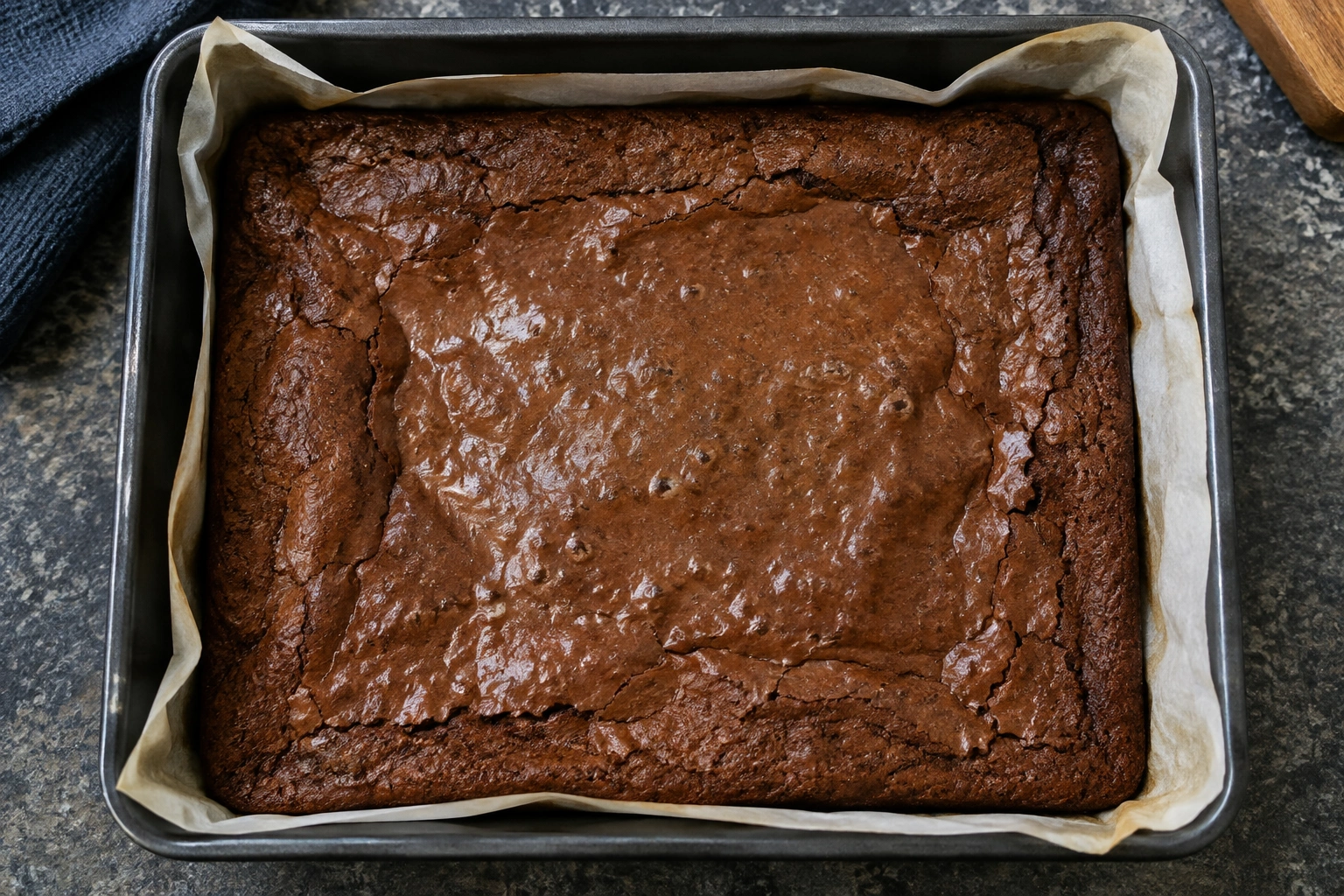
This is the most common dark-pan problem. If the edges are getting too dark while the center still needs time, do not immediately assume the whole batch is ruined.
Try one of these fixes:
- Reduce the oven temperature next time by 25°F
- Line the pan with parchment paper
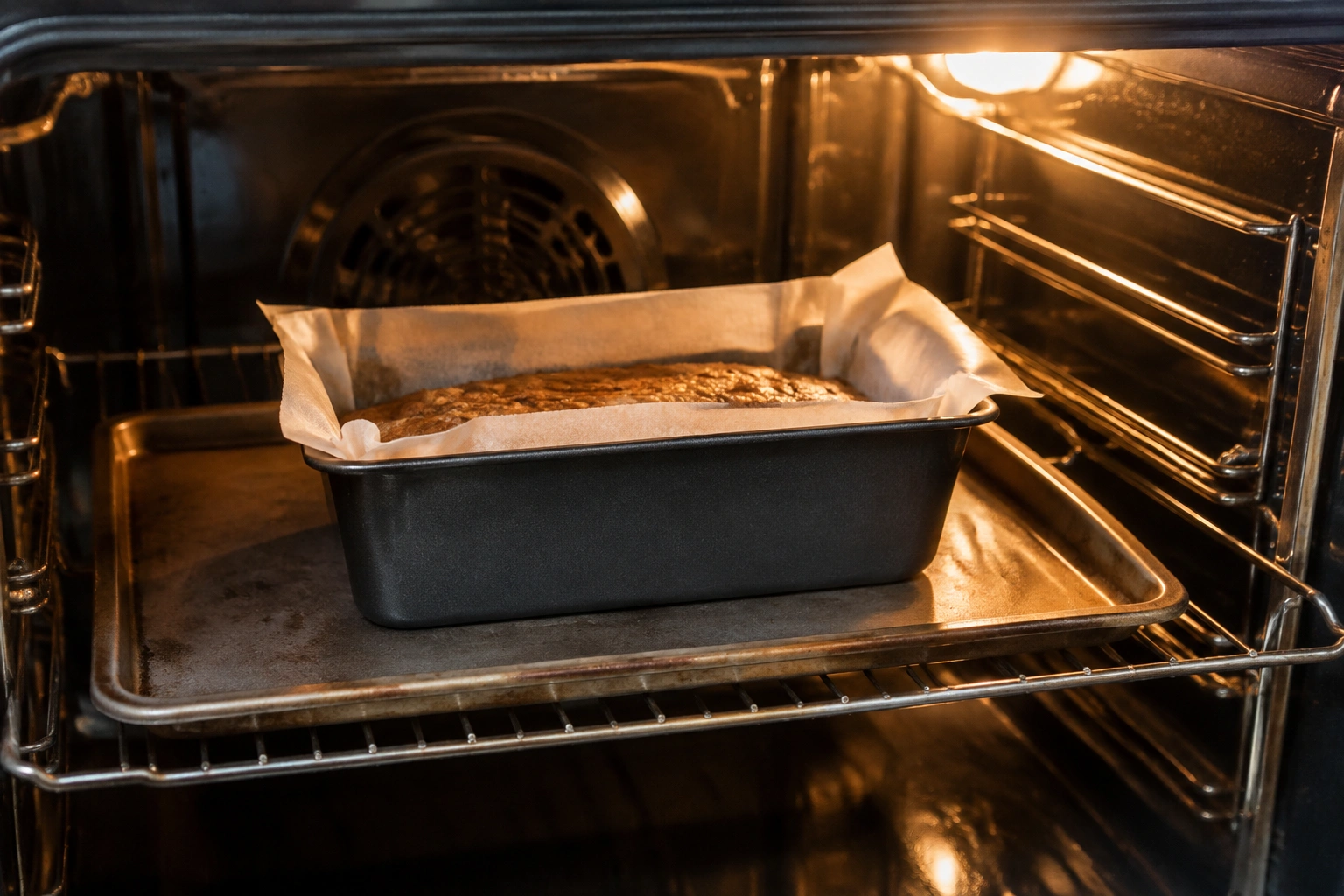
- Set the pan on a baking sheet to soften direct bottom heat
- Rotate the pan if your oven has hot spots
Those adjustments can slow the browning enough for the center to finish properly.
Adjustments by Recipe Type
Different baked goods tolerate dark pans differently. The right adjustment depends on whether the recipe needs a long center-set time or just a quick color change.
Cakes
Cakes are the most sensitive to overbrowning in dark pans. The outside can set and color before the center is fully baked, especially in deeper pans.
For cakes, the usual approach is the clearest one: lower the oven temperature by 25°F and check earlier. That keeps the crumb from drying out before the middle is done. If the top is browning too fast, a loose sheet of foil can help toward the end of baking, but use it only after the cake has had time to rise and set.
A good example is a vanilla layer cake recipe written for a light aluminum pan. In a dark nonstick pan, the cake may look ready on the outside before it is fully baked in the center. The lower temperature gives the batter more time to rise evenly.
Cookies
Cookies usually bake faster, so the adjustment is often smaller. The bottoms can darken quickly in a dark baking sheet, even when the tops still look pale.
For cookies, the most useful move is to check a little early and watch the bottoms. If your recipe already bakes at a fairly high temperature, a 25°F reduction may be worth testing, especially for thin or delicate cookies. If the recipe is designed for a crisp finish, you may only need to shorten the bake slightly.
For example, chocolate chip cookies on a dark sheet can go from golden to too dark on the bottoms very quickly. Pulling them when the centers still look slightly soft often gives the best final texture.
Brownies and bars
Brownies and bar cookies sit in the middle: they need enough time for the center to set, but they are also prone to overbrowned edges.
For these, use a small temperature reduction if the edges darken too fast, and start checking the center early. Brownies are one of the easiest bakes to overdo in a dark pan because the top can look finished while the middle is still soft. Bars with fruit or a crumb topping can have the same issue.
If the edges are already brown before the center is done, parchment paper or a pan shield can help more than simply cutting time. That keeps the edges from turning too dark while the middle finishes.
Breads and loaf cakes
Loaf breads and loaf cakes often need a longer bake, so they are especially vulnerable to early crust color in a dark pan. The crust may look finished while the interior still needs more time.
A modest temperature reduction usually helps here. If the loaf is browning too quickly on top, tent it lightly with foil after it has expanded and the surface has set. That is better than pulling the loaf too soon and ending up with a gummy center.
Dark Nonstick Pans vs. Standard Dark Metal Pans
Dark nonstick bakeware should be treated with the same caution as other dark pans. Milk Street’s guidance on dark nonstick bakeware also recommends lowering the temperature by 25 degrees and checking earlier.
The nonstick coating does not erase the effect of the dark color. The practical difference is mostly in cleanup and release, not in the need for adjustment. If the pan is dark, assume it may brown faster than the recipe expects.
That said, the same adjustment does not always apply in exactly the same way to every dark nonstick pan. A very dark anodized or black-coated pan may brown more aggressively than a lighter dark-coated pan, so it is worth watching the first batch closely.
When to Use Parchment, a Baking Sheet, Rotation, or a Pan Shield
Sometimes the best fix is not a bigger recipe change. It is a small piece of baking control.
Parchment paper
Parchment can help reduce direct contact between the batter and the dark metal, especially on the bottom and sides. It is especially useful for brownies, bars, and cake layers. It also makes removal easier, which matters when the edges are delicate.
A baking sheet underneath
Setting a dark pan on a second baking sheet can soften the heat hitting the bottom of the pan. This is useful when the bottom is darkening faster than the top or center.
Rotation
If your oven has hot spots, rotating the pan once during baking can even out browning. This is not a substitute for proper temperature adjustment, but it can help when one side of the pan finishes ahead of the other.
A pan shield or foil tent
If the top is browning too quickly, a loose foil tent or a pan shield can buy the center more time. Use it only after the baked good has had a chance to rise and set, or you may slow browning too much.
How Pan Size and Depth Affect the Adjustment
Not all dark pans behave the same way. A shallow, wide pan and a deep loaf pan do not need the same correction.
A deeper pan usually holds more batter, which means the center needs more time to finish. If that deep pan is also dark, the outer edges may brown before the middle is ready. That is why a recipe written for a light pan may need a little more care when transferred to a dark one.
Pan size matters too. If you use a pan that is smaller than the recipe intended, the batter will be thicker and may need more time, even before you account for the dark surface. If the pan is larger, the batter layer will be thinner and may bake faster.
The safest approach is to treat pan color as one adjustment and pan size as a separate one. A dark pan can change browning, while size changes thickness and bake time. Both matter.
Common Mistakes to Avoid with Dark Pans
The most common problem is overcorrecting.
Cutting the time too much
If you shorten the bake too aggressively, the center can stay underdone even though the edges look fine. A dark pan usually calls for a modest adjustment, not a drastic one.
Lowering the temperature too much
A 25°F reduction is a useful standard starting point for cakes and similar bakes. Dropping the temperature far beyond that can stretch the bake too long and change texture in ways you did not want.
Trusting the timer alone
With dark pans, the timer is less reliable than the appearance and doneness cues. If the edges are dark early, the recipe may need a different finish even if the timer says there is still time left.
Ignoring the coating and finish
A dark nonstick pan may still need the same care as a plain dark metal pan. The coating changes release, not the basic heat behavior of the dark surface.
Quick Troubleshooting for Dark Pans
If your bakes keep turning too dark in a dark pan, use this simple checklist:
- Edges brown too fast: lower the oven temperature next time.
- Center is underdone but the top looks finished: keep baking and cover loosely with foil if needed.
- Bottom is too dark: try parchment paper or a second baking sheet underneath.
- One side bakes faster: rotate the pan once during baking.
- Recipe was written for a different pan material or thickness: expect the timing to shift a little and check earlier.
FAQs
Do dark metal pans always bake faster?
They usually brown faster and can make the outside finish sooner than a lighter pan. That does not always mean the whole bake is dramatically faster, but it does mean you should check earlier and watch the edges closely.
Should I always lower the oven temperature by 25°F?
It is a strong starting point for cakes and many similar baked goods. For cookies or thin items, you may only need earlier checking. For recipes with deep pans or sensitive browning, the 25°F reduction is often the safer choice.
If I use parchment, do I still need to adjust the time?
Usually, yes. Parchment can help with release and may soften direct browning, but it does not completely cancel the effect of a dark pan.
What if the recipe was written for glass?
Glass behaves differently from dark metal, so the same timing may not carry over cleanly. If you are switching from glass to a dark pan, watch the bake closely and use the dark-pan adjustments rather than assuming the same timing will work.
Is a dark nonstick pan treated the same as a regular dark pan?
Yes, for baking purposes it should be treated with the same caution. The nonstick coating helps with release, but the dark color still encourages faster browning.
How do I know when brownies are done in a dark pan?
Look for set edges and a center that is no longer wet or sloshy. A tester should show moist crumbs, not raw batter, if the recipe is aiming for a fudgy texture.
What if only the edges are getting too dark?
That is a sign to reduce the temperature next time, or to use parchment, a baking sheet underneath, or a foil tent if the top is browning too fast. The goal is to let the center finish without overcooking the perimeter.
Can I use the same rule for cakes, cookies, brownies, and bread?
Use the same starting idea, but not the same exact response. Cakes and loaf breads usually benefit most from a temperature reduction. Cookies often need only earlier checking. Brownies and bars often need the most attention to edge browning and center set.
Final practical rule
If a recipe was written for a light pan and you are using a dark metal pan, start with a 25°F lower oven temperature for cakes and other browning-sensitive bakes, or simply check earlier for thin, fast-baking items. If the edges are getting too dark before the center is done, use both adjustments together. From there, let the color of the edges and the doneness of the center tell you whether the pan needs a little more time, a little less heat, or a simple shield to finish well.