
How to Convert a Round Cake Pan to a Square Pan Without Guesswork
If your recipe calls for a round cake pan but you only have a square pan, you can usually make the swap successfully—as long as you match the pan’s capacity closely enough and watch the batter depth. The shape change itself is not the problem. The real issue is whether the new pan can hold the same amount of batter at a similar height.
A square pan with a similar area to the round pan will usually behave similarly in the oven. A pan that is much larger will make the cake thinner and often faster to bake. A pan that is smaller or shallower may overflow or bake unevenly. That is why the safest conversion is based on pan area and depth, not just the label on the pan.

Can You Swap a Round Cake Pan for a Square Pan?
Yes, often you can.
A round cake pan and a square cake pan can be close enough in volume to work as a direct swap, but only if the sizes are comparable. For example, King Arthur Baking notes that an 8-inch square pan and a 9-inch round pan have the same volume and can be used interchangeably.
The practical takeaway: if your square pan is close in capacity to the round pan, you can usually keep the batter amount the same. If it is noticeably larger or smaller, adjust the batter or expect a different cake height and bake time.
How to Convert Round Pan Size to Square Pan Size
The easiest way to think about the conversion is area.
- Round pan area is based on the circle formula.
- Square pan area is simply side × side.
A simple worked example: a 9-inch round pan has an area of about 64 square inches, while an 8-inch square pan has an area of 64 square inches exactly. That is why those two pans are often treated as a practical match in home baking.
If you want a quick formula, use this:
Equivalent square side ≈ round diameter × 0.89
For example, a 9-inch round pan × 0.89 = about 8 inches, which points you to an 8-inch square pan. This is only a shortcut, but it is a useful one when you do not want to calculate exact area every time.
Simple rule of thumb
If the square pan’s footprint is close to the round pan’s footprint, the batter amount can usually stay the same.
If the square pan is larger, the cake will be thinner.
If the square pan is smaller, the cake will be thicker and may need less batter.
Common Round-to-Square Pan Equivalencies
These are the most useful everyday comparisons.
| Round pan | Closest square pan | What to expect |
|---|---|---|
| 8-inch round | 8-inch square | Very close in volume; usually a workable swap |
| 9-inch round | 8-inch square | Approximate capacity match; often interchangeable |
| 8-inch round | 9-inch square | Larger footprint; cake will be thinner and may bake faster |
| 9-inch round | 9-inch square | Same nominal size, but not the same footprint; expect a different batter spread and possibly a different bake time |
Here is the practical reading of those numbers: the 8-inch square and 9-inch round are close enough that many recipes work well in either. The 9-inch square, however, gives more surface area than a 9-inch round, so the batter spreads out more and the cake bakes thinner.
When a “close” match is close enough
A close match works best when:
- the recipe is a standard layer cake or snack cake,
- the batter amount is moderate,
- the pan depth is similar,
- and you are comfortable checking doneness a little earlier or later than the original recipe says.
When to scale instead of swap
Scale the batter if:
- your square pan is much smaller than the round pan,
- the recipe fills the original pan nearly to the top,
- or the cake depends on a very specific height.
Why Pan Depth and Capacity Matter Too
Footprint is only part of the story. A pan’s depth affects how much batter it can safely hold.
King Arthur Baking recommends filling a cake pan about half to two-thirds full and erring on the side of caution if the pan looks too full. That advice matters even more when changing pan shape, because a pan that looks similar from above may still have a different usable volume.
A deeper pan gives you more room for batter rise. A shallow pan may be the same width and length as the original pan but still be too risky if it does not have enough height.
A useful example
Suppose your recipe was written for a 9-inch round pan, and you want to bake it in a square pan. If your square pan is 8 inches and at least as deep as the round pan, the swap is usually straightforward. If your square pan is 9 inches but shallow, the batter may spread out safely but brown faster and finish with a thinner crumb.
What capacity changes in practice
- More capacity than needed: thinner cake, shorter bake time
- Less capacity than needed: overflow risk, domed top, underbaked center
- Same footprint but deeper pan: similar batter amount, possibly longer bake time
How Much Batter to Use in the Square Pan
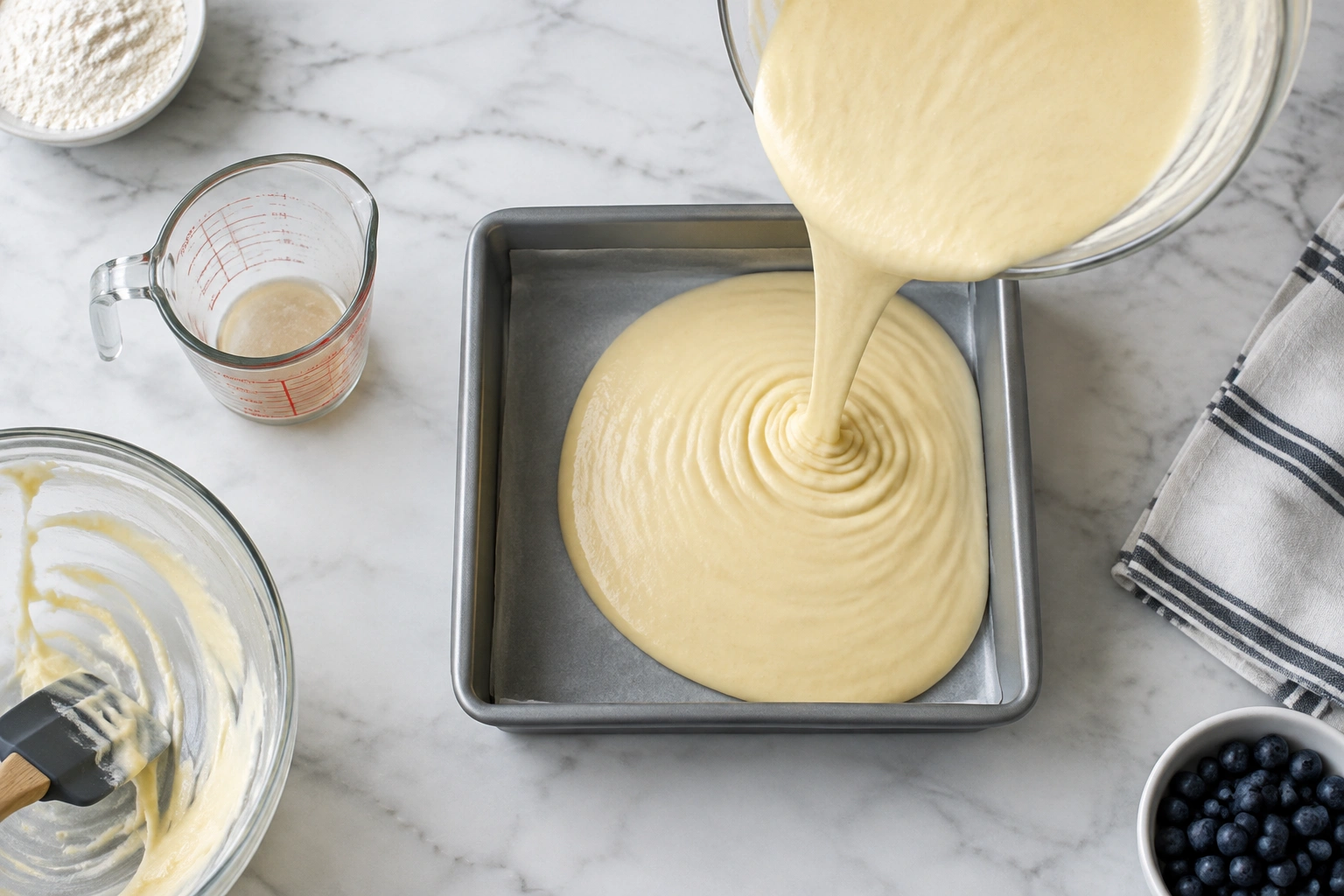
The safest fill level is usually half to two-thirds full.
That range gives the batter room to rise without spilling over. If your square pan is a little larger than the round pan, using the full recipe amount may still be fine because the batter will spread out more. If the square pan is smaller, you may need to hold back some batter or bake a little extra batter separately.
Practical fill-level guide
- Square pan is equivalent or very close: use the full recipe amount
- Square pan is slightly larger: use the full amount, but expect a thinner cake
- Square pan is slightly smaller: remove some batter before baking
- Pan looks nearly full before baking: do not force it; scoop some out
Example: 9-inch round to 8-inch square
Because these pans are considered equivalent by King Arthur Baking, you can usually keep the batter amount the same. The cake should bake at a similar height and volume, though the edges may brown a bit differently because of the square corners.
Example: 9-inch round to 9-inch square
This swap is common, but the square pan generally gives more surface area than a 9-inch round, so the batter spreads out more. If your recipe was meant to produce a tall round layer, the square version may feel slightly thinner unless the batter amount is adjusted upward using a proper recipe scaling method.
Example: reducing batter for a smaller square pan
If the square pan is clearly smaller, start by setting aside about one-quarter of the batter and checking the fill level. For example, if the original pan would be filled to about two-thirds full, stop once the square pan reaches that same visual mark and bake any extra batter in a small ramekin or muffin cup.
How Bake Time Changes When You Switch Pan Shapes
Bake time usually changes when the pan shape changes, even if the volume is close.
A wider pan spreads the batter thinner, which often means the cake bakes faster. A deeper or smaller pan can take longer because the center takes more time to set.
You should not assume the original recipe time will be exact in the new pan.
What usually happens
- Larger square pan: shorter bake time
- Smaller square pan: longer bake time
- Equivalent square pan: similar time, but still worth checking early
How to adjust without overbaking
Check the cake a few minutes before the recipe’s stated finish time. If the pan is a little larger than the original, check even earlier. If the pan is deeper or slightly smaller, expect the center to need more time.
A darker metal pan can also change how quickly the edges set and brown. If that applies to your bakeware, our guide on how to adjust baking time for a dark metal pan explains why the edges may finish sooner than the middle.
How to Tell When the Cake Is Done
When you change pan shape, doneness cues matter more than the clock.
Use a combination of signs:
- The center looks set, not wet or jiggly.
- The edges begin to pull slightly from the pan.
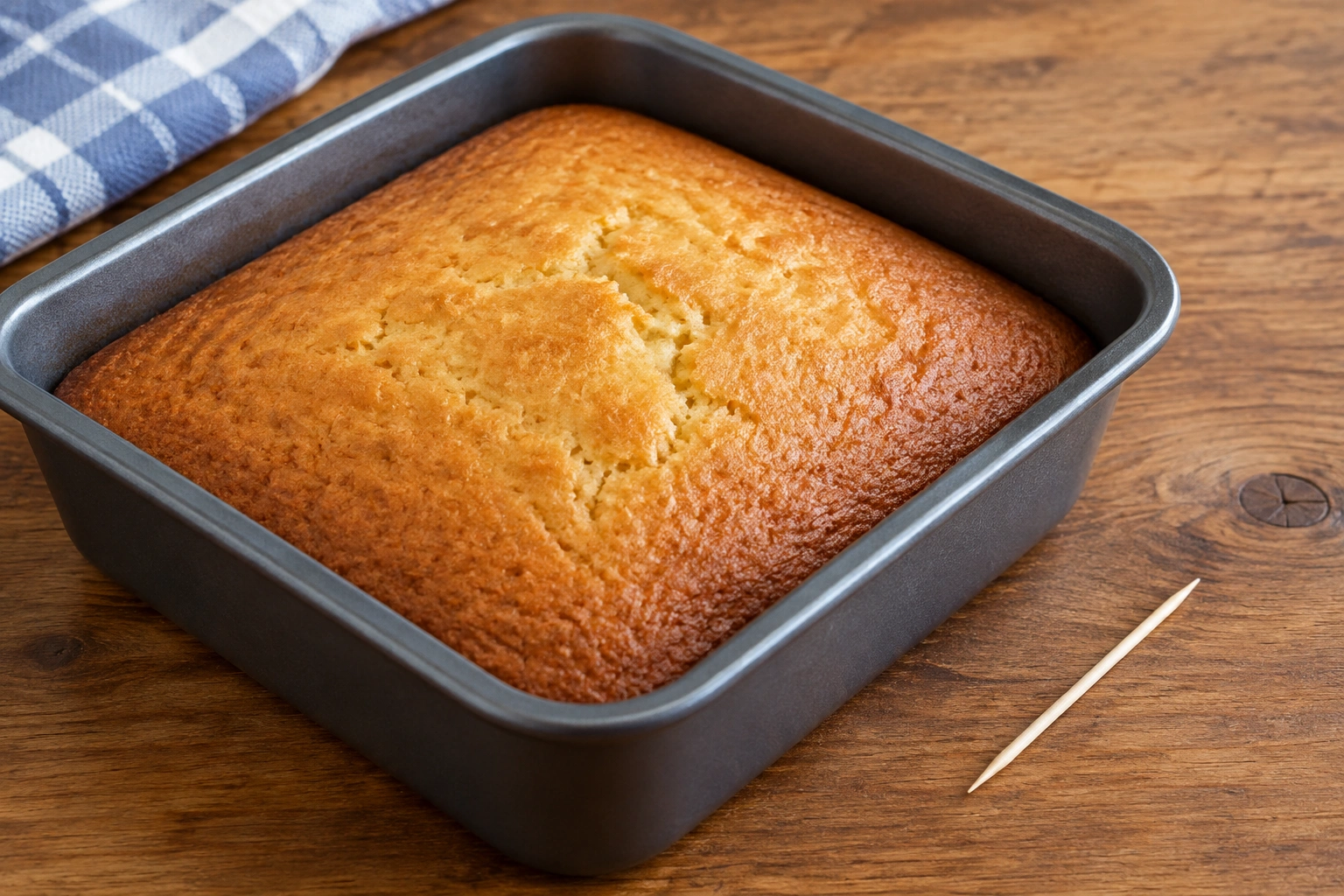
- A toothpick inserted near the center comes out with a few moist crumbs or clean, depending on the cake style.
- The top springs back lightly when touched.
If the top is browning too quickly but the middle is not done, cover loosely with foil and keep baking until the center sets.
When a Direct Swap Is Close Enough and When It Isn’t
A direct swap works best when the pan sizes are close in capacity and depth.
Close enough for a direct swap
Use the original batter amount when:
- the pans are known equivalents, such as 8-inch square and 9-inch round,
- the depth is similar,
- and the recipe is not extremely sensitive to height.
Not close enough for a direct swap
Adjust the recipe when:
- the square pan is much larger,
- the square pan is much smaller,
- the recipe fills the original pan near the top,
- or the cake’s final height is important for layering.
A simple decision rule
If the pan swap changes the batter depth only a little, keep the recipe the same and watch the bake time.
If the swap changes the batter depth a lot, resize the batter instead of hoping it will work out in the oven.
Quick Conversion Examples and Decision Guide
Here is the fastest way to decide.
If you have a recipe for an 8-inch round pan
- Use an 8-inch square pan: usually a good swap
- Use a 9-inch square pan: expect a thinner cake and shorter bake time
- Use a smaller square pan: reduce batter or divide it
If you have a recipe for a 9-inch round pan
- Use an 8-inch square pan: often interchangeable
- Use a 9-inch square pan: workable, but the cake may bake differently in height and timing
- Use a shallow square pan: only if the batter amount fits comfortably below the two-thirds mark
If you are unsure
Pour the batter into the square pan and check the fill level before baking. If it looks close to two-thirds full or more, stop and re-evaluate. That one visual check prevents most overflow problems.
A Practical Baker’s Checklist Before You Bake
Before putting the cake in the oven, confirm these four things:
- The square pan has enough depth.
- The batter will not exceed about two-thirds full.
- The cake can tolerate a slightly different height.
- You are ready to check doneness earlier or later than the original recipe time.
That short checklist solves most round-to-square conversions without turning the process into a math problem.
When to Consult a Pastry Chef
If the cake is for a special occasion, a layered build, or a recipe that must rise to a specific height, a pastry chef or experienced baker can help you scale the formula more precisely. That is especially useful when the pan change is more than a small adjustment, or when the recipe was developed for a very specific pan depth and shape.
For everyday home baking, though, most round-to-square swaps come down to three things: compare the area, respect the depth, and watch the bake rather than the clock.
FAQs
Can I use a square pan instead of a round pan for cake?
Usually yes, if the square pan is close in capacity to the round pan and deep enough for the batter. The closer the sizes are, the more likely the swap will work without changing the recipe.
What square pan is equivalent to a 9-inch round pan?
King Arthur Baking says an 8-inch square pan and a 9-inch round pan have the same volume and can be used interchangeably. That is one of the most useful swaps to remember.
Do I need to change the batter amount?
Not always. If the pans are close in capacity, keep the batter amount the same. If the square pan is much larger or smaller, adjust the batter so the pan is filled only about half to two-thirds full.
Will the bake time be different?
Often, yes. A larger square pan usually bakes faster because the batter is thinner. A smaller or deeper pan usually takes longer. Check doneness earlier than usual if the new pan is wider.
Does pan depth matter?
Yes. Depth affects how much batter the pan can safely hold and how long the center takes to bake. A pan with the right footprint but insufficient depth can still overflow.
What if my square pan is slightly larger than the round pan?
That is usually safer than using a pan that is too small. The cake will be thinner and may bake a little faster, but overflow is less likely.
What if my square pan is slightly smaller?
Use less batter or be prepared to bake any extra batter separately. If the pan looks too full, do not force all the batter in.
Final Takeaway
To convert a round cake pan to a square pan, match the pan’s area and depth as closely as you can, then adjust batter and bake time only as needed. In many home-baking situations, an 8-inch square and 9-inch round pan are close enough to swap, but a much larger or smaller square pan needs a more careful adjustment. When in doubt, fill the pan conservatively and judge doneness by the cake itself, not just the recipe timer.

