How to Convert Fan Oven Temperatures for Baking Without Guesswork
If a recipe was written for a conventional oven, the simplest fan oven rule is this: lower the temperature by about 20°C. In Fahrenheit, that usually means reducing the recipe temperature by about 25°F.
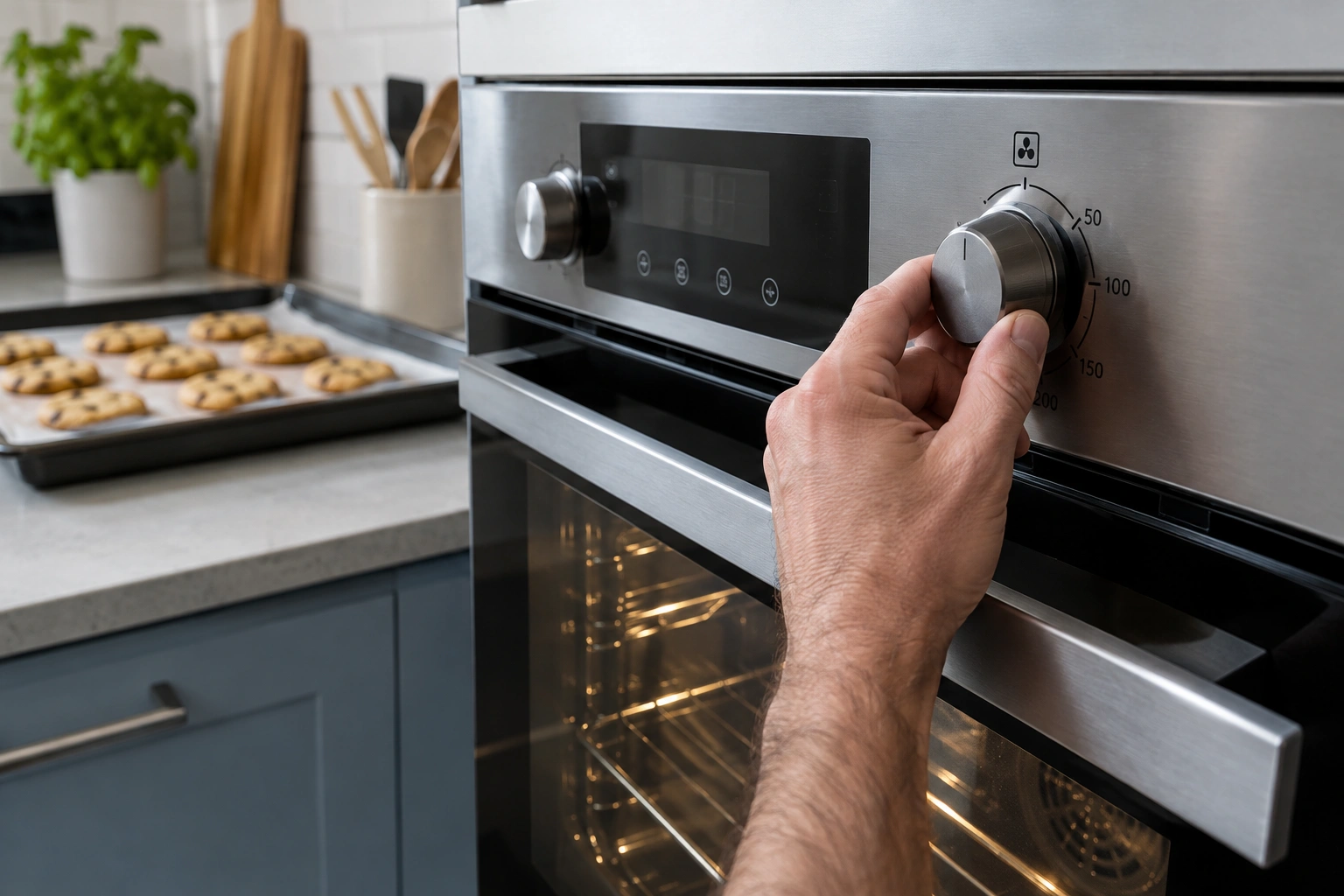
So if a cake recipe says 180°C conventional, set your fan oven to 160°C. If it says 350°F conventional, aim for 325°F fan.
That one adjustment solves most everyday baking conversions. It is not perfect for every recipe, but it is the right place to begin for cakes, cookies, tray bakes, and many other home bakes.
Fan oven vs conventional oven: what changes and why it matters
A conventional oven heats with stationary top and bottom elements. A fan oven moves hot air around the cavity, which helps the heat reach the food more evenly. In practice, that often means the oven bakes a little more efficiently, and the surface of your bake can color faster.
That is why recipes can behave differently even when the ingredient list is identical. A sponge may rise well in a conventional oven but darken too quickly in fan mode. Cookies may brown sooner around the edges. A tray bake may cook more evenly across the pan, but the top can take on color before the center is fully set.
The key point is simple: fan mode changes how heat reaches the food, so the temperature written for a conventional oven usually needs to come down.
The simple conversion rule for fan oven baking
For most baking, use this rule:
- Conventional oven to fan oven: subtract about 20°C
- Conventional oven to fan oven in Fahrenheit: subtract about 25°F
This is a common practical adjustment for home baking. It makes the rule easy to remember and usually close enough for everyday recipes.
A few important caveats:
- Some ovens run hotter or cooler than the dial suggests.
- Some recipes already account for fan heat.
- Very delicate bakes may need a smaller adjustment or no fan at all.
- Your oven’s manual may give its own recommended conversion.
If a recipe specifically says “fan” or “convection,” follow that instruction rather than applying the rule again.
Quick conversion table for common baking temperatures
Here is a practical chart you can use right away.
| Conventional oven | Fan oven | Gas mark |
|---|---|---|
| 150°C | 130°C | 2 |
| 160°C | 140°C | 3 |
| 170°C | 150°C | 4 |
| 180°C | 160°C | 4 |
| 190°C | 170°C | 5 |
| 200°C | 180°C | 6 |
| 220°C | 200°C | 7 |
| 230°C | 210°C | 8 |
For Fahrenheit, the same idea applies:
| Conventional oven | Fan oven |
|---|---|
| 325°F | 300°F |
| 350°F | 325°F |
| 375°F | 350°F |
| 400°F | 375°F |
| 425°F | 400°F |
| 450°F | 425°F |
These are rounded working values, not lab measurements. They are meant to help you convert a recipe quickly without doing mental math every time.
Worked examples you can copy straight into the kitchen
Here are the most common conversions home bakers ask about:
- 180°C conventional → 160°C fan
- 200°C conventional → 180°C fan
- 350°F conventional → 325°F fan
- 400°F conventional → 375°F fan
If you are converting from a recipe written in Fahrenheit and want the Celsius equivalent too, a useful reference is the standard formula: multiply Celsius by 1.8 and add 32 to get Fahrenheit. For example, 160°C = 320°F. In fan baking, though, it is usually easier to think in the direction of the original recipe: conventional down to fan.
What to do about baking time in a fan oven
Temperature is the first thing to adjust. Time may change too, but not in a fixed, universal way.
Fan ovens often bake a little faster because the moving air transfers heat efficiently. That does not mean you should automatically slash the baking time by a set amount. A sponge cake, a cookie tray, and a loaf cake all respond differently.
A better approach is this:
- Lower the temperature first.
- Start checking the bake 5–10 minutes before the recipe time is due, or around 75–80% of the stated baking time for longer bakes.
- Use visual and texture cues, not the clock alone.
For example, if a recipe says to bake for 30 minutes in a conventional oven, begin checking around 20–25 minutes in fan mode. Look for the signs of doneness that fit the bake: set edges, springy center, even color, and a tester that comes out as expected for that recipe.
This approach matters because fan heat can brown the outside before the inside is fully baked. If you rely only on time, you may pull the bake too late and end up with a dry edge or an overcolored top.
When to use fan mode and when to avoid it
Fan mode is useful when you want even browning and steady heat across the oven. It often works well for:
- cookies
- tray bakes
- sheet cakes
- pastries that benefit from even color
- multiple trays, if your oven handles them well
But fan mode is not always the best choice. Delicate bakes can suffer if the air movement is too strong or the heat is too direct. That includes:
- very light sponge cakes
- meringues
- custards and other egg-based bakes
- soufflés
- some cheesecakes
- recipes where the surface needs to stay pale
For these, the fan can dry the surface too quickly or push the top into color before the center is ready. If a recipe depends on a gentle, still heat, conventional mode may give you better control.
A practical rule: if the bake is meant to rise softly and stay tender, be cautious with fan. If the bake needs even browning and a drier finish, fan is often helpful.
Gas mark conversions for fan ovens
Older UK recipes often use gas mark instead of Celsius or Fahrenheit. The same conversion principle still applies: fan oven settings are usually lower than conventional gas mark temperatures.
Here is a compact working guide for common settings:
| Gas mark | Conventional oven | Fan oven |
|---|---|---|
| 2 | 150°C | 130°C |
| 3 | 160°C | 140°C |
| 4 | 180°C | 160°C |
| 5 | 190°C | 170°C |
| 6 | 200°C | 180°C |
| 7 | 220°C | 200°C |
| 8 | 230°C | 210°C |
If you are reading a recipe that lists only gas mark, the safest move is to convert it to Celsius first, then apply the fan adjustment. That keeps the process consistent and avoids guessing.
How to check doneness in a fan oven
Because fan ovens can brown more quickly, doneness checks matter more than ever.
Use the cue that matches the bake:
- Cakes: lightly springy center, edges just starting to pull from the pan, tester comes out as the recipe describes
- Cookies: set edges and a center that no longer looks raw, even if it still seems soft
- Tray bakes: top evenly colored, center no longer wobbly or wet
- Loaf cakes: deep golden crust and a skewer that comes out clean or with the expected crumbs
If the top is darkening too fast while the center still needs time, tent loosely with foil and continue baking at the adjusted temperature. That is often better than lowering the heat too much and risking an underbaked middle.
An oven thermometer can also help if results keep drifting. It is useful when one side of the bake colors faster than the other.
Common mistakes when converting to a fan oven
The most common error is the simplest one: using the same temperature in fan and conventional mode. That often leads to overbrowning, drier edges, or a bake that looks finished before the center is ready.
Other frequent mistakes include:
- lowering the temperature too much and underbaking the middle
- assuming every recipe needs the same time reduction
- using fan mode for a delicate bake that really wants gentler heat
- ignoring the actual behavior of your oven
- trusting the timer even when the bake looks done early
A useful habit is to note what happened after each bake. If your cakes are consistently dark at the edges, your oven may be running hot or the fan setting may need a slightly bigger adjustment. If the bake is pale but underdone, the temperature may have been reduced too far.
Why oven calibration and hot spots can affect your results
No oven dial is perfect. Two ovens set to the same temperature can behave differently, and even one oven can heat unevenly from shelf to shelf.
That is why the “about 20°C lower” rule is a starting point, not a guarantee. If your oven runs hot, you may need a slightly larger reduction. If it runs cool, a standard fan conversion may already be enough.
This is where an oven thermometer becomes useful. It gives you a reality check against the dial and helps you see whether the oven is actually matching the temperature you set. If you bake often, that small tool can save a lot of frustration.
If you want a deeper guide to testing your oven accurately, see our post on how to calibrate a home oven for baking.
A practical decision rule for everyday baking
When a recipe is written for a conventional oven, use this order of decisions:
- Lower the temperature by about 20°C or 25°F.
- Check the recipe type. Delicate bakes may need conventional mode instead.
- Start checking doneness a little early.
- Use an oven thermometer if your results are inconsistent.
- Adjust based on your own oven, not just the recipe.
That keeps the method simple without pretending every oven behaves the same.
For more on oven settings and baking conversions, you may also find our guide to how to calibrate a home oven for baking helpful when your dial and your results do not seem to agree.
When to Consult a Pastry Chef
If you are baking something especially sensitive — for example, a high-ratio cake, a meringue-based dessert, or a recipe that keeps failing in the same spot — a pastry chef can help you troubleshoot the formula, pan choice, shelf position, and oven setting together. Sometimes the temperature conversion is only part of the issue.
FAQs
Is a fan oven the same as a convection oven?
In everyday baking, the terms are often used similarly. Both refer to an oven that moves hot air around the cavity. That said, appliance brands sometimes use the labels differently, so check your manual if the oven behaves unexpectedly.
Do I always lower the temperature by 20°C in a fan oven?
That is the standard starting point for many baking recipes, but not an absolute rule. Some ovens need a slightly different adjustment, and some recipes are already written for fan mode.
What is 180°C in a fan oven?
A recipe written for 180°C conventional usually converts to about 160°C fan.
What is 350°F in a fan oven?
A recipe written for 350°F conventional usually converts to about 325°F fan.
Should I reduce baking time as well as temperature?
Sometimes, but not by a fixed amount. Lower the temperature first, then start checking the bake 5–10 minutes early or around 75–80% of the stated time, and rely on doneness cues.
Why does my cake brown too fast in a fan oven?
The moving air can help the surface color faster. If the top is dark before the center is done, lower the temperature, move the pan lower in the oven if appropriate, or cover loosely with foil near the end of baking.
Can I use fan mode for all baking?
No. Fan mode is useful for many tray bakes and cookies, but delicate cakes, custards, and meringues often do better with gentler conventional heat.
How do I convert gas mark recipes for fan ovens?
Convert the gas mark to its usual conventional temperature, then reduce by about 20°C for fan mode. For example, gas mark 6 is roughly 200°C conventional and about 180°C fan.
Final takeaway
If you remember only one thing, make it this: fan ovens usually need a lower baking temperature than conventional ovens, typically by about 20°C or 25°F. That small change is enough to improve most recipe conversions and reduce overbrowning.
From there, let the bake itself guide you. Temperature gets you close; doneness checks finish the job.