
How to Freeze Pizza Dough for Better Flavor, Texture, and Flexibility

If you’ve ever made a batch of pizza dough and wondered whether you can save the rest for later, the short answer is yes — you can freeze pizza dough and still get a very usable crust afterward. In fact, pizza dough is one of the better yeast doughs to freeze, as long as you handle it with a little care.
Freezing changes dough in a few important ways. Yeast activity slows dramatically, and some yeast cells may die during storage. That sounds like bad news, but it’s not the end of the story. As King Arthur Baking notes, frozen and thawed pizza dough can actually become easier to shape because dead yeast releases glutathione, a natural dough relaxer. The trade-off is that you should expect a slightly different rise and a bit less strength than with fresh dough, especially if it stays frozen for a long time. King Arthur Baking
The good news? With the right wrapping, timing, and thawing method, frozen dough can still bake into a crust with good structure, decent oven spring, and plenty of flavor.
Can You Freeze Pizza Dough? What Changes After Freezing
Yes — pizza dough can be frozen successfully, whether it’s homemade or store-bought. The key question is not “can it be frozen?” but “how much quality do you want to preserve?” Store-bought dough can vary more than homemade dough depending on ingredients, hydration, and preservatives, so follow the package instructions if they differ from general freezer guidance.
Here’s what freezing does:
- Slows fermentation so the dough doesn’t keep expanding in the freezer
- Weakens some yeast cells over time, which can reduce rise later
- Can relax the gluten a bit, making the dough easier to stretch
- Raises the risk of freezer burn if the dough is poorly wrapped
That last point matters more than many home bakers realize. Freezer burn doesn’t usually make dough unsafe, but it dries the surface and can create tough, leathery patches that fight back when you stretch the dough. If you’ve ever had a crust tear in one spot while stretching, freezer damage is one possible culprit.
A dough that has been wrapped tightly and thawed slowly will generally behave better than one that was loosely packed in the freezer.
Best Time to Freeze Pizza Dough: Before Rising, After Rising, or After Shaping?
This is the decision that affects the final result most.
The simplest rule
- Freeze before the first rise if you want the easiest make-ahead method.
- Freeze after the first rise if you want to preserve more fermentation progress and save time later.
- Freeze after shaping into dough balls if you want the most convenient portion control.
Ooni recommends preparing the dough up to the first rise, then dividing it into equal portions and balling them before freezing. That’s a very practical approach for home bakers because it gives you ready-to-use portions instead of one oversized mass that thaws unevenly. Ooni also suggests lightly oiling the sides of airtight containers to help prevent sticking. Ooni’s freezing guide
Quick comparison: which method fits your schedule?
| Freezing point | Best for | Trade-off |
|---|---|---|
| Before first rise | Simple prep, beginner-friendly | You’ll need to complete more fermentation later |
| After first rise | Better time savings and flavor development | Slightly more handling and timing control needed |
| After shaping into balls | Easy portioning, fast weeknight use | You need to plan the final shape size in advance |
| Pre-shaped crusts | Maximum convenience | Less flexibility if you change your mind about size or thickness |
Quick decision guide
- Use the dough within a day or two? Freeze it after the first rise or as dough balls.
- Want the easiest future pizza night? Freeze it as pre-shaped dough balls.
- Want maximum convenience and already know the final size? Freeze pre-shaped crusts.
- Still developing the recipe? Freeze after the first rise so you preserve more of the dough’s fermentation progress.
What You Need Before You Freeze It
You do not need special equipment, but you do need the right basics.
Prep checklist
- Pizza dough, mixed and fermented to the chosen stage
- Olive oil or another neutral oil for a light coating
- Plastic wrap or another tight food-safe wrap
- Freezer bags or airtight containers
- Labels or masking tape and a marker
- A tray or plate if you want to freeze portions flat first
Why each item matters
- Oil reduces sticking and surface drying.
- Airtight packaging prevents freezer burn.
- Labels save you from the “What is this dough and how old is it?” mystery later.
- A tray or plate helps keep dough portions from flattening into odd shapes while they firm up.
If you’re freezing several dough balls, I like the “double layer” method: wrap each ball tightly, then place it in a freezer bag or container. That extra layer is worth it because dough picks up odors and loses moisture faster than many people expect.
How to Freeze Pizza Dough Step by Step
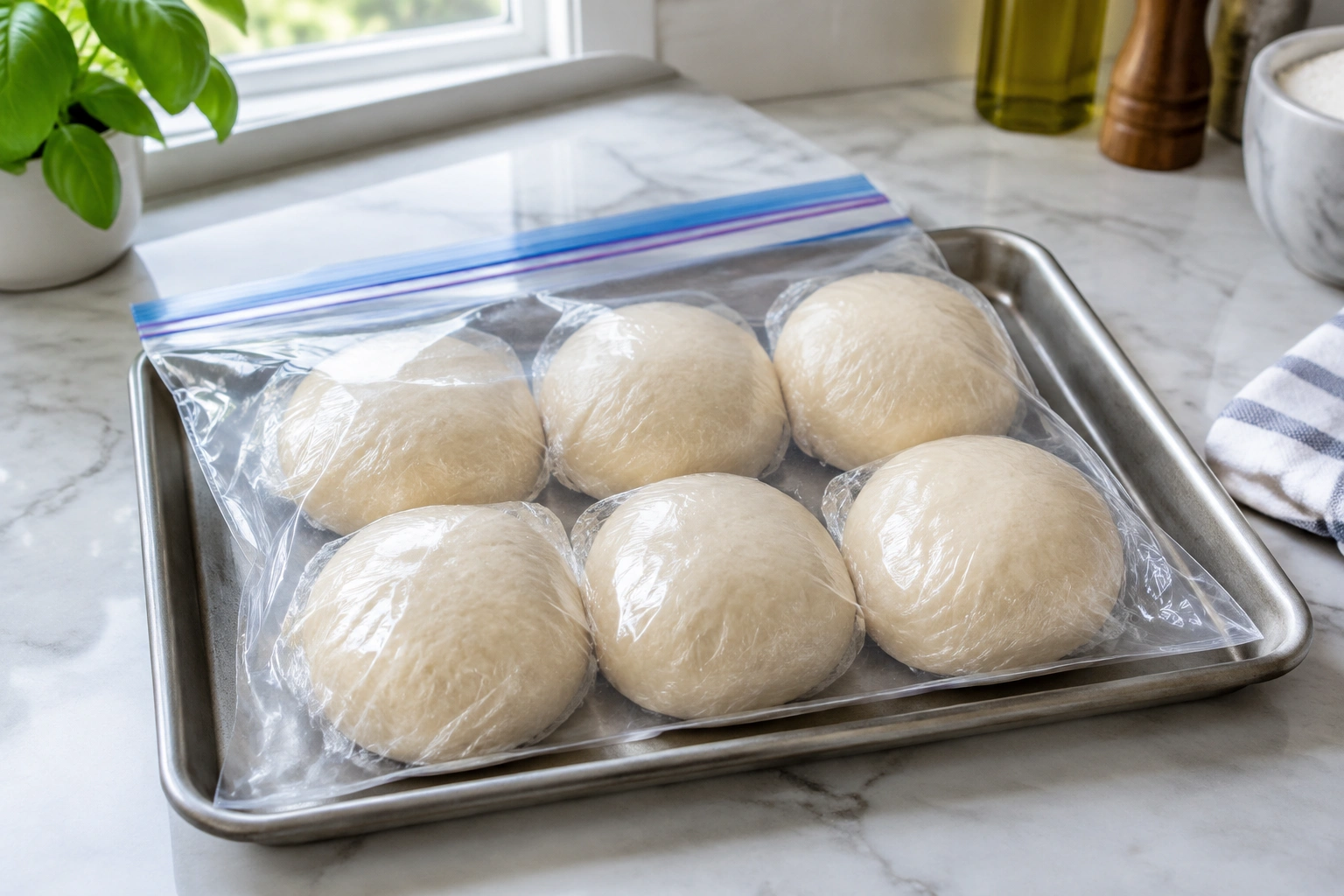
Here’s the kitchen-tested method I’d use for most home setups.
1. Portion the dough first
Divide the dough into the size you’ll actually use later. For example, if you usually make individual pizzas, portion it into single-pizza balls instead of freezing one giant batch.
That decision saves time on thaw day and helps the dough thaw evenly.
2. Shape each portion into a tight ball
A smooth, taut surface helps the dough hold together in the freezer. If the dough is ragged or torn, it dries out faster and can develop weak spots.
3. Lightly oil the surface or container
A thin film of oil is enough. You’re not frying the dough; you’re just reducing sticking. Ooni specifically recommends lightly oiling the sides of airtight containers to keep the dough from adhering to the container walls.
4. Wrap tightly
Wrap each dough ball snugly in plastic wrap, pressing out as much air as possible. If you prefer containers, choose ones that seal well and leave minimal empty space.
5. Bag or box it for extra protection
Place the wrapped dough into a freezer bag or airtight container. If using a bag, press out the air before sealing. Less air means less dehydration.
6. Label clearly
Write the date, dough type, and portion size. A label like “Pizza dough, 2 balls, 8/14” is more useful than you think when your freezer starts to fill up.
7. Freeze promptly
Move the dough to the freezer as soon as it’s wrapped. Don’t leave it sitting out on the counter while you finish cleaning up, or it may continue fermenting and become harder to predict later.
How Long Pizza Dough Lasts in the Freezer
There are two answers here: best quality and still usable.
King Arthur Baking suggests freezing pizza dough no longer than a month for best results. Ooni says pizza dough can be stored in the freezer for up to 3 months. Those are both useful guidelines, but they point to an important reality: dough quality gradually declines the longer it stays frozen. Homemade dough and store-bought dough may age differently in the freezer depending on formulation, so the exact timeline can vary. King Arthur Baking | Ooni
How to think about the time window
- Around 1 month: usually the safest bet for strong texture and better rise
- Up to 3 months: often still usable if wrapped well, though quality may drop
- Beyond that: more risk of freezer burn, weaker yeast, and less reliable stretch
If you’re a home baker who wants dependable results, treat one month as the sweet spot for best quality. If you’re batch-prepping for convenience, three months may still be usable, but expect some quality loss.
Signs the dough may be past its best
- Noticeable dryness on the surface
- Grayish or crusty freezer-burned patches
- Weak smell or an off odor
- Dough that tears too easily when stretched
- Very sluggish rise after thawing
If the dough smells spoiled, shows mold, or has a truly unpleasant sour odor beyond normal fermentation, discard it.
How to Thaw Frozen Pizza Dough Safely
The safest, most reliable method is to thaw pizza dough in the refrigerator. That gives the dough time to warm gradually and reduces the risk of overproofing.
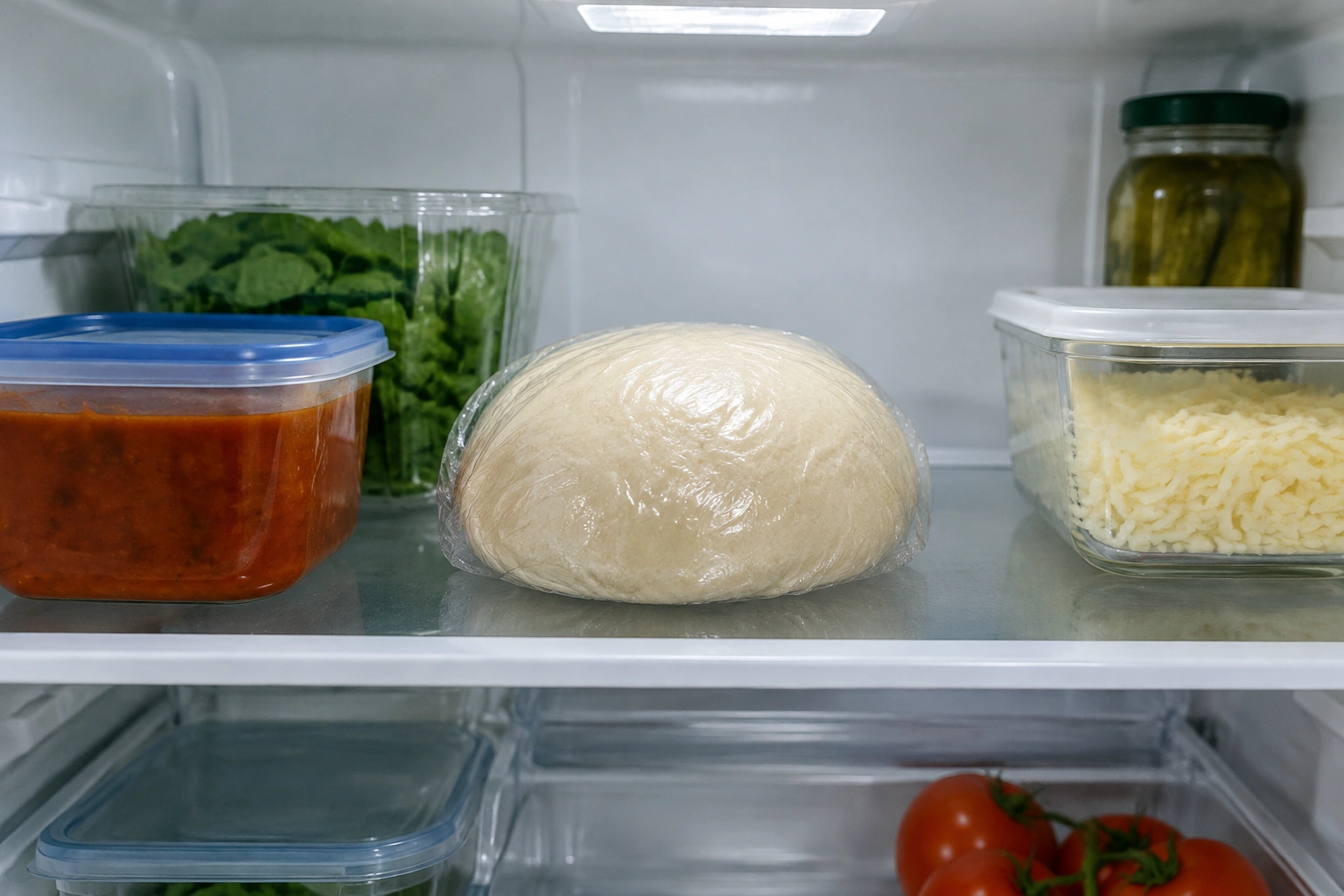
Refrigerator thawing
This is the method I recommend most often.
- Transfer the frozen dough from the freezer to the refrigerator
- Leave it wrapped while it thaws
- Give it enough time to soften fully before shaping
For a standard dough ball, move it from the freezer to the fridge the night before you plan to bake. In general kitchen experience, a typical single-pizza dough ball often needs 8 to 12 hours in the refrigerator, while larger balls may need 12 to 24 hours. Very small portions may thaw sooner.
Room-temperature thawing
Room-temperature thawing is faster, but it’s easier to overshoot. If your kitchen is warm, the outside of the dough may become soft while the center is still cold. That can leave you with a sticky surface and a cool, under-relaxed middle.
Use room-temperature thawing only if you can watch the dough closely. It’s better for a same-day bake when you need speed, but it demands more attention.
Simple rule for choosing a thawing method
- Use the refrigerator if you have at least overnight.
- Use the counter only if you need the dough the same day and can monitor it closely.
- If the dough is a large ball or several portions stuck together, use the fridge so the center thaws evenly.
Quick comparison: fridge vs counter
| Thaw method | Best for | Risk |
|---|---|---|
| Refrigerator | Control, even thawing, better scheduling | Slower |
| Room temperature | Faster turnaround | Easier to overproof or dry out |
How to Tell When Thawed Dough Is Ready to Shape
A thawed dough ball should feel soft, relaxed, and slightly puffy — not icy, stiff, or wet.
Good readiness cues
- The dough feels cool but no longer frozen in the center
- It stretches without snapping back immediately
- The surface looks smooth and hydrated
- It has enough elasticity to form a pizza without tearing
Step-by-step readiness check
- Thaw the dough in the refrigerator first.
- Take it out and let it rest at room temperature for about 30 to 60 minutes before shaping.
- Press a fingertip gently into the dough. If the indentation springs back slowly, the dough is usually ready.
- If it still feels tight or resists stretching, let it rest another 15 to 20 minutes.
- If it becomes too slack or sticky, move it back to the fridge briefly to firm up before shaping.
If the dough is still tight and springy, let it rest longer. If it’s overly soft and slack, it may need a short chill in the fridge before shaping.
One important note
Frozen dough is often easier to stretch than fresh dough because the freezing process can relax it. That’s helpful when you’re trying to open a crust by hand, but it also means you may need to handle it a bit more gently than you would with a brand-new dough ball.
Troubleshooting Frozen Pizza Dough Problems
Even when you freeze dough correctly, a few things can still go sideways. Here’s how to read the dough and respond.
Sticky dough
Possible cause: thawed too long at room temperature or surface condensation
What to do: dust lightly with flour and chill briefly if needed. Don’t bury it in flour, or the crust can turn dry and dense.
Dry or leathery surface
Possible cause: poor wrapping or freezer burn
What to do: trim off badly damaged outer patches if they’re small, then proceed if the dough still smells normal. If the damage is extensive, the crust will likely bake up tougher than you want.
Weak rise after thawing
Possible cause: yeast loss during freezing or dough stored too long
What to do: allow a longer final proof, but keep expectations realistic. If the dough still seems sluggish after a reasonable rest, it may be time to use it for a thinner, less airy crust style.
Shrinking when stretched
Possible cause: dough is still too cold or not fully relaxed
What to do: give it more bench rest. Cold gluten snaps back; relaxed gluten stretches more willingly.
Overproofed thawed dough
Possible cause: left out too long after thawing
What to do: shape it sooner next time, and use the refrigerator for more control. Overproofed dough can still bake, but it may lose structure and oven spring.
Common Mistakes to Avoid
These are the errors that most often ruin frozen pizza dough.
Freezing without airtight protection
This is the fastest route to freezer burn. Even a decent dough can dry out badly if it’s left exposed.
Freezing one giant lump
A large mass thaws unevenly. The outside warms first, while the center stays cold. That usually means inconsistent texture and awkward shaping.
Waiting too long before freezing
If the dough is already overproofed before it goes into the freezer, freezing won’t “reset” it. It will just preserve a dough that was already past its best point.
Leaving thawed dough out too long
This is where many bakers lose control. Once the dough is thawed, it can move quickly from relaxed to overproofed, especially in a warm kitchen.
Refreezing after full thaw
Refreezing isn’t the ideal plan. It can damage texture further and make the dough less predictable. If you thawed more dough than you need, bake it or portion it more carefully next time.
Practical Examples for Real Kitchens
Weeknight pizza for a family
Make a batch on Sunday, portion it into four balls, and freeze three in individual bags. Move one to the refrigerator the night before pizza night. By dinner time, it should be thawed, relaxed, and ready to shape.
Culinary student testing fermentation
Freeze one dough after the first rise and another after a longer fermentation window. Thaw both under the same conditions and compare extensibility, rise, and crust color. That’s a useful way to see how fermentation stage affects the final bake.
Batch baking for a busy schedule
If you know you’ll only use dough once a week, freeze it in meal-sized portions instead of one large batch. You’ll get more predictable thawing and less waste.
Pre-shaped crust for maximum convenience
If your goal is speed, you can freeze a shaped crust, but expect less flexibility later. It’s best when you already know the exact size and thickness you want.
When to Consult a Master Baker
If your dough repeatedly comes out dense, sticky, or flat after freezing, the issue may be the formula rather than the freezer method. Dough with very high hydration, very low yeast, or unusual enrichment can behave differently after freezing and may need recipe adjustments.
That’s also true if you’re working on professional production timelines or trying to standardize results for classwork or menu development. In those cases, a master baker can help you adjust fermentation, portion size, and proofing strategy so the dough behaves consistently from batch to batch.
FAQ
Can you freeze store-bought pizza dough?
Yes. Store-bought dough can usually be frozen the same way as homemade dough, but check the package first in case the manufacturer gives specific handling instructions. If it’s already close to its expiration date, freeze it sooner rather than later.
Can you freeze pizza dough after it has already risen?
Yes, and that’s often a smart option. Freezing after the first rise can preserve some fermentation progress and save time later. Just be sure the dough isn’t already overproofed before it goes into the freezer.
Can you refreeze pizza dough after thawing?
It’s not a good idea if the dough has fully thawed. Refreezing can worsen texture and reduce rise. If you need smaller portions, divide the dough before freezing instead.
Is frozen dough easier to shape than fresh dough?
Often, yes. King Arthur Baking notes that frozen and thawed pizza dough can be easier to shape because of the natural dough-relaxing effect that comes from yeast changes during freezing. That said, easier to shape does not mean better in every respect; you still need to handle it gently.
Should I freeze pizza dough in balls or as one large batch?
Dough balls are usually the better choice for most home bakers. They thaw more evenly and let you use only what you need. A single large batch makes sense only if you always bake the full amount at once.
What if my thawed dough feels weak?
Let it rest briefly and test it again. If it still tears too easily or refuses to hold structure, the dough may have lost too much strength in the freezer. In that case, use it sooner rather than trying to force a long proof.
How do I know if frozen dough is no longer good?
Discard it if you see mold, smell spoilage, or notice severe freezer burn, discoloration, or an off odor that goes beyond normal fermentation. If it just looks a little dry but still smells normal, it may still be usable, though the crust may be less tender.
Can I freeze pre-shaped pizza crusts?
Yes, but that method is best when convenience matters more than flexibility. Pre-shaped crusts are handy for quick pizza nights, though dough balls usually hold texture and shaping options better.
Final thought
Freezing pizza dough is less about preservation alone and more about control. If you portion it well, wrap it tightly, thaw it patiently, and give it enough time to relax, you can turn a weekend dough session into several future pizza nights without sacrificing much quality.