
How to Make Bread Flour at Home: A Practical Guide for Better Yeast Baking

If you’ve ever opened the pantry, found no bread flour, and wondered whether all-purpose flour could step in, the answer is yes—usually with a little help. The trick is understanding what bread flour does in a dough and how to mimic that behavior well enough for everyday bread, pizza, and rolls.
Bread flour is valued because it’s made from hard, high-protein wheat, which gives dough more strength and chew after baking. In practical terms, that extra protein helps build more gluten, and gluten is what traps gas from yeast and gives bread its structure. All-purpose flour can still make good bread, but it typically has less protein, so the dough may be a little softer, less elastic, or less lofty depending on the recipe.
A common homemade substitute is simple: all-purpose flour plus vital wheat gluten. The blend won’t be identical to a commercial bread flour, but it can get close enough for many yeast doughs when you mix and handle it thoughtfully.
Bread Flour vs. All-Purpose Flour: What Actually Changes?
The difference is not just a label on the bag. Flour protein affects how a dough behaves from mixing through baking.
Bread flour is typically higher in protein than all-purpose flour, though exact protein ranges vary by brand and country. That usually means stronger gluten development. That stronger network helps dough hold onto fermentation gases better, which can improve rise and create a chewier crumb. All-purpose flour usually sits lower on the protein scale, so it tends to produce a slightly more tender, less chewy result.
Here’s the key decision point: if a recipe depends on strong structure—think sandwich loaves, pizza dough, bagels, or sturdy rolls—bread flour gives you more margin for error. If the recipe is more forgiving, all-purpose flour may work fine on its own.
A useful way to think about it:
- Bread flour: stronger dough, more chew, better gas retention
- All-purpose flour: softer dough, easier to find, slightly less structure
- Homemade bread flour substitute: a middle ground that boosts structure without requiring a special trip to the store
For a deeper look at flour measurement basics, you may also find our guide on how to measure flour without a measuring cup helpful.
Before You Start: Ingredients, Tools, and the Best Way to Measure
You only need two ingredients for the standard version:
- All-purpose flour
- Vital wheat gluten
And a few tools make the job much easier:
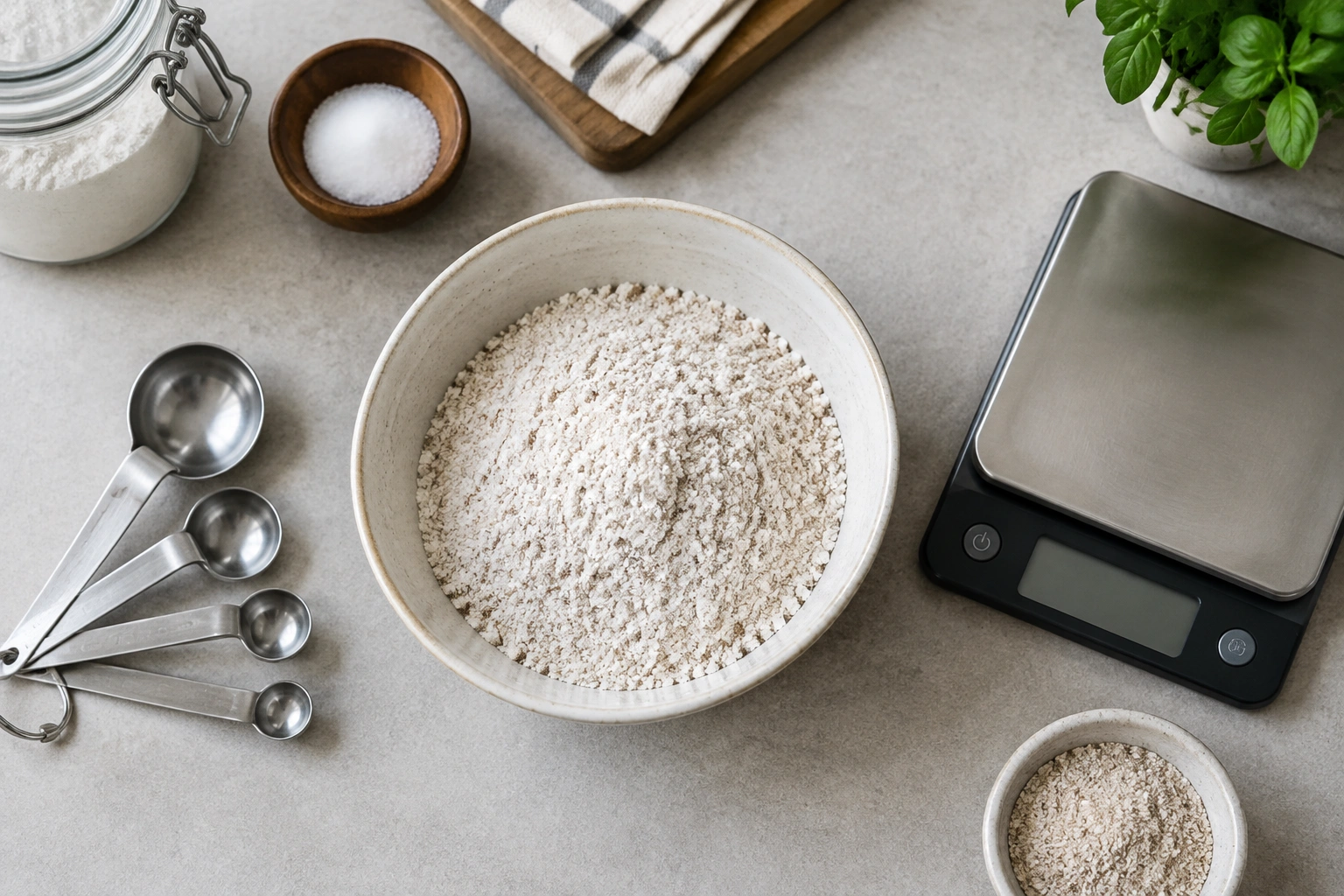
- A kitchen scale for the most accurate results
- Measuring cups if you don’t have a scale
- A bowl for mixing
- A whisk or fork for blending
- An airtight container if you want to store the mix
If you bake regularly, a scale is worth having. Flour can pack differently from scoop to scoop, so weight gives you more repeatable results. That matters when you’re trying to match a recipe’s hydration and dough strength.
A quick note on vital wheat gluten
Vital wheat gluten is the ingredient that raises the protein level of your homemade blend. It is not a universal pantry item, but it’s easy to store and useful if you bake bread often. Since it contains wheat, it is not suitable for anyone with celiac disease or a wheat allergy.
Bread Flour Substitute Formula: Small Batch and Bulk Batch
The most practical approach is to replace a small portion of the flour with vital wheat gluten, rather than adding gluten on top of the flour. That keeps the ratio balanced.
Small batch: enough for one recipe
For 1 cup of all-purpose flour, use 120 g all-purpose flour and 4 g vital wheat gluten. Whisk well.
This is a common home-baking method because it’s easy to remember and close enough for many yeast recipes.
Bulk batch: make a larger container ahead of time
If you bake bread often, mix a larger quantity using the same ratio:
- 480 g all-purpose flour
- 16 g vital wheat gluten
Whisk thoroughly, then store in an airtight container.
Weight-based version
If you prefer grams, use the same idea: for every 100 g all-purpose flour, add about 3 to 4 g vital wheat gluten and reduce the flour by the same amount so the total flour weight stays the same. In other words, a practical formula is 96 to 97 g all-purpose flour plus 3 to 4 g vital wheat gluten per 100 g final blend.
Because flour brands vary, there is no single perfect number that fits every bag and every recipe. This gram-based range is a useful starting point for home baking, but you can adjust slightly based on the dough.
Exact Ratios for Cups and Weight
Use this table as your quick reference.
| Base flour | Vital wheat gluten added | Best use | What to expect |
|---|---|---|---|
| 1 cup all-purpose flour | 1 1/2 tsp | One loaf, pizza dough, rolls | Slightly stronger dough, better chew |
| 4 cups all-purpose flour | 2 tbsp | Batch prep | Good for several bakes |
| 1 cup cake flour | Not recommended | None for bread baking | Too weak for most yeast doughs |
| 1 cup whole wheat flour | Not a direct bread-flour substitute | Some bread recipes with adjustments | Heavier texture, less lift, denser crumb |
If you’re measuring by volume, be consistent. If you’re measuring by weight, be even more consistent. That’s the better choice when you want the same dough from week to week.
How to Mix the Blend Evenly Without Clumps
This part matters more than many bakers realize. If the gluten isn’t evenly distributed, one scoop of flour may be stronger than another, and your dough will behave inconsistently.
Use this method:
- Measure the all-purpose flour into a bowl.
- Remove the small amount of flour you plan to replace.
- Add the vital wheat gluten.
- Whisk for 20 to 30 seconds, or sift the mixture once if you want extra even distribution.
- Use immediately, or store it in a sealed container.
A whisk works well for small batches. For larger batches, shake the container after mixing, then whisk again before storing if needed. The goal is a uniform blend, not just a quick stir.
How to Use Homemade Bread Flour in Bread, Pizza Dough, and Rolls
This substitute is most useful in yeast doughs, where structure matters and a slight shift in flour performance is manageable.
Yeast bread
For sandwich loaves and crusty pan breads, use the blend exactly where the recipe calls for bread flour. Keep the rest of the formula the same at first. If the dough feels a little firmer than usual, that’s normal.
A stronger flour can help the loaf hold shape better, especially in enriched doughs that include milk, butter, or eggs.
Pizza dough
Pizza dough often benefits from a stronger flour because it needs stretch and chew. Your homemade blend can work well here, especially if you want a bit more elasticity than all-purpose flour alone gives you.
If the dough tightens quickly while kneading, let it rest for 10 to 15 minutes before continuing. That pause gives the flour time to hydrate and relax.
Rolls
Dinner rolls and sandwich rolls are forgiving, so they’re a good place to test the blend. You may notice slightly more structure and a less delicate crumb, which is often a plus for rolls that need to hold fillings or butter.
[IMAGE_1_PLACEMENT]
[IMAGE_1_PURPOSE]
[IMAGE_1_CAPTION]
[IMAGE_1_ALT_TEXT]
[IMAGE_1_PROMPT]
[IMAGE_1_SIZE]
[IMAGE_1_FILENAME]
[IMAGE_1_SURROUNDING_TEXT]
Adjustments to Make After Substitution
This is where many bakers get tripped up. Even a good substitute changes dough behavior a little.
If the dough feels too dry
Add liquid in small amounts, about 1 teaspoon at a time for a small batch. Stronger flour can absorb a bit more water, but you don’t want to flood the dough. Wait after each addition and knead briefly before deciding on more.
If the dough feels too tight or elastic
That usually means the gluten network is developing strongly. Give the dough a short rest, then continue kneading. A rest often solves the problem better than forcing more mixing.
If the dough feels weak or slack
That can happen if the gluten wasn’t mixed evenly or if the recipe was already formulated for a stronger flour. Next time, whisk the blend more thoroughly and consider whether the recipe is especially dependent on bread flour.
Kneading time
Don’t assume you need a dramatically longer knead, but do pay attention to dough feel. Stronger flour can take a little more work to fully develop, especially in stand mixers. Watch the dough, not the clock.
When the Substitute Works Well — and When It Doesn’t
A homemade bread flour blend works best when the recipe is flexible and built around yeast dough.
It usually performs well in:
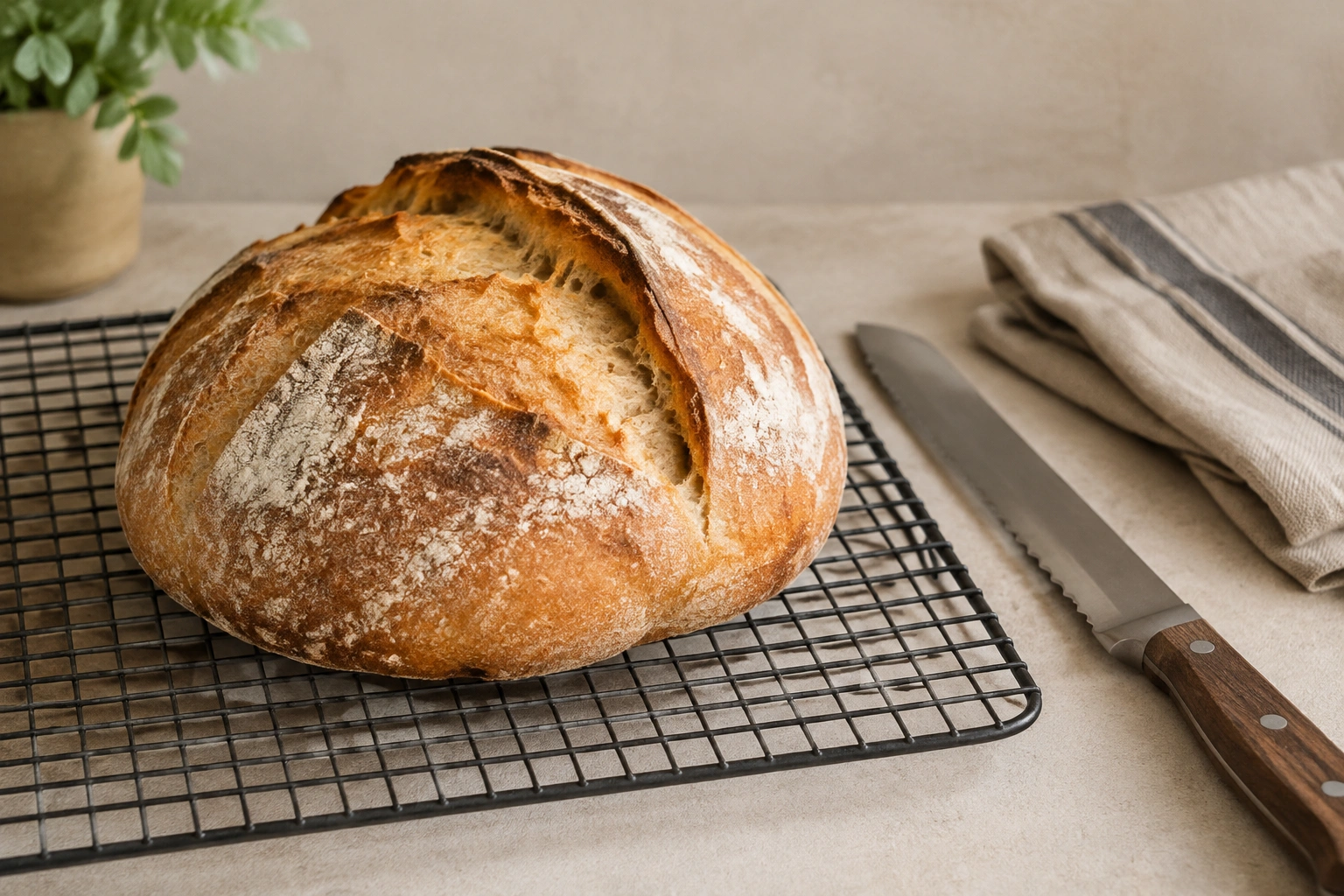
- Sandwich bread
- Pizza dough
- Dinner rolls
- Soft buns
- Basic enriched loaves
It may be less ideal in recipes where flour performance is central to the final result, such as extremely delicate breads, formulas with very specific hydration targets, or doughs that rely on exact commercial flour behavior.
That’s why recipes are developed with a certain flour in mind. The flour protein level and liquid amount are matched to create the intended dough texture and rise. If you change the flour, you sometimes need to make small corrections.
For a practical example of flour-sensitive yeast dough technique, our baguette guide shows how much flour choice can influence shaping and crumb.
What to Do If You Don’t Have Vital Wheat Gluten
If you only have all-purpose flour, you can still bake bread. You just need to know what you’re giving up.
Best fallback: use all-purpose flour as-is
This is the simplest option. For many home recipes, all-purpose flour alone will still produce a perfectly usable loaf, especially if the recipe is forgiving.
Another fallback: choose a recipe designed for all-purpose flour
That gives you the best chance of success without needing to force bread-flour behavior from a weaker flour.
A practical adjustment some bakers use
If you’re baking with all-purpose flour instead of bread flour, some bakers slightly reduce the liquid and expect a softer crumb. That won’t make the flour behave like bread flour, but it can help the dough feel more manageable.
What not to expect
Without vital wheat gluten, your flour won’t truly become bread flour. You may get a softer, less chewy loaf with a little less rise. That isn’t failure—it’s just a different result.
If you bake often and want repeatable results, buying bread flour is the better choice. If you only need one loaf and already have all-purpose flour, baking with what you have is often the smarter move.
Common Mistakes to Avoid
A few errors show up again and again:
Using cake flour or pastry flour as the base
These flours are too low in protein for most bread doughs. They’re built for tenderness, not structure.
Adding too much vital wheat gluten
More is not better here. Too much can make dough overly elastic or even tough.
Mixing unevenly
If the gluten isn’t distributed well, the dough won’t behave predictably.
Expecting exact equivalence
A homemade blend can be very useful, but it won’t perfectly match every commercial bread flour brand.
Ignoring the dough’s feel
The dough tells you more than the recipe name does. If it feels dry, tight, or slack, adjust thoughtfully instead of blindly following the clock.
Troubleshooting Dough Problems
Dough is too dry
Add water a little at a time. Stronger flour often needs a touch more hydration.
Dough is too stiff
Let it rest before adding more water. Sometimes the flour simply needs a few minutes to absorb moisture.
Dough is too elastic
Pause and let the dough relax. Overworking strong flour can make shaping frustrating.
Dough is too weak
Check whether the blend was mixed evenly. If it was, the recipe may simply need a true bread flour for best structure.
If you’re working with preferments, a flour choice can matter even more. Our poolish guide explains how flour strength affects fermentation and final dough handling.
How to Store Homemade Bread Flour Blend
Store the blended flour in an airtight container in a cool, dry place. Label it clearly so you remember what’s inside and when you mixed it.
A few practical tips:
- Make only what you’ll use in a reasonable time
- Shake or stir the container before scooping if it has sat for a while
- Keep it away from moisture and strong odors
- Use a clean, dry scoop every time
If you bake frequently, a bulk batch saves time. If you bake occasionally, a small batch is usually better so the blend stays fresh and you don’t forget what ratio you used.
Quick Decision Guide: Make It or Buy Bread Flour?
Choose the homemade substitute if:
- You need bread flour now and don’t have it
- You’re baking yeast bread, pizza dough, or rolls
- You have all-purpose flour and vital wheat gluten
- You’re comfortable making small adjustments to dough feel
Buy bread flour if:
- The recipe is highly flour-sensitive
- You want the most consistent results possible
- You bake bread often enough to justify stocking it
- You don’t want to troubleshoot hydration or texture changes
As a baker, I’d frame it this way: if the recipe is important and the result needs to be reliable, use the flour the formula was built for. If you’re making a weeknight loaf or a pizza dough that can tolerate a little flexibility, a well-mixed homemade blend is a smart, practical backup.
Final Thoughts
Learning how to make bread flour at home is really about learning how flour strength works. Once you understand that bread flour is simply a stronger, higher-protein flour, the substitute becomes much less mysterious. All-purpose flour plus vital wheat gluten gives you a workable stand-in for many yeast recipes, especially when you measure carefully and watch the dough instead of chasing a perfect label.
For home bakers and culinary students alike, that’s the real skill: knowing when to adapt, when to adjust, and when to reach for the exact flour the recipe wants.