
How to Reheat a Croissant in an Air Fryer for the Best Crisp Texture
Leftover croissants are at their best when the outside turns crisp again and the center warms without drying out. An air fryer can do that quickly, but the method works only if you keep the heat moderate and check early.
Quick Answer: Air Fryer Temperature and Time
For most croissants, a practical starting point is 300°F.
Use these approximate starting times:
- Small, room-temperature croissant: 2 to 3 minutes
- Standard, room-temperature croissant: 3 to 4 minutes
- Large croissant: 4 to 5 minutes
- Refrigerated croissant: 4 to 6 minutes
- Frozen croissant: 6 to 8 minutes, then check and add more time if needed
Use this simple rule:
- Room temperature: heat briefly until the outside is crisp and the center feels warm.
- Refrigerated: start at the same temperature, but plan on a little more time.
- Frozen: use a slightly longer, gentler reheat so the middle warms before the outside over-browns.
If your air fryer runs hot, start on the lower end of the range and check early.
What You Need to Know Before Reheating
Croissants are delicate because their texture depends on layers of butter and dough. That means the result changes a lot based on three things:
-
Size
A small bakery croissant heats faster than a large, thick one. Mini croissants may only need a very short refresh, while oversized croissants usually need a bit more time for the center. -
Starting temperature
A croissant from the counter, one from the refrigerator, and one from the freezer all behave differently. Cold pastry needs more time before the center is comfortable to eat. -
Air fryer model
Air fryers vary in how aggressively they move hot air. Some brown quickly, while others are gentler. That is why visual checking matters more than relying on one exact clock setting.
If you are reheating a croissant that already feels soft, the goal is not to “cook” it again. The goal is to restore the crust and warm the interior without pushing moisture out of the layers.
Step-by-Step: How to Reheat a Croissant in an Air Fryer
Here is a simple, repeatable method that works well for most leftover croissants.
Room temperature croissant
- Set the air fryer to 300°F.
- Place the croissant in a single layer with space around it.
- Heat for 2 to 4 minutes, depending on size.
- Check the crust and center. If needed, add 30 to 60 seconds more.
- Serve right away.
Refrigerated croissant
- Set the air fryer to 300°F.
- Put the croissant in the basket in a single layer.
- Heat for 4 to 6 minutes.
- Check whether the center is warm and the outside is crisp.
- If it needs more time, add 30 to 60 seconds at a time.
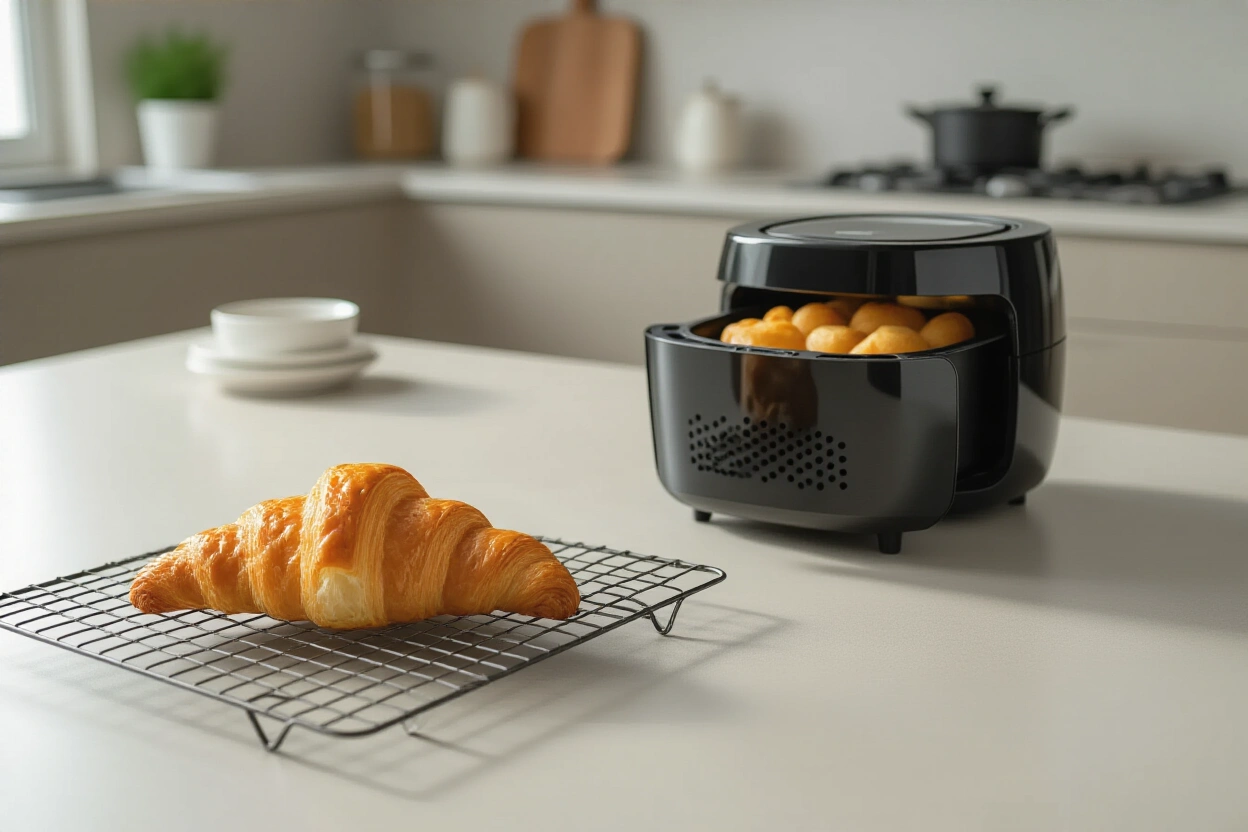
Frozen croissant
- Set the air fryer to 290°F to 300°F.
- Place the frozen croissant in a single layer.
- Heat for 6 to 8 minutes to start.
- Check the center; if it is still cool, continue in 1-minute increments.
- If the outside is browning too fast, lower the temperature slightly for the next round.
Best Temperature and Time by Croissant Type
The table below gives practical starting points. Treat these as general guidance, not a fixed rule. Air fryer models, croissant size, and how cold the pastry starts all change the result.
| Croissant type | Suggested starting temp | Typical time range | Notes |
|---|---|---|---|
| Small, room-temperature croissant | 300°F | 2 to 3 minutes | Check early; small pastries brown fast. |
| Standard, room-temperature croissant | 300°F | 3 to 4 minutes | Good starting point for most leftovers. |
| Large or bakery-style croissant | 300°F | 4 to 5 minutes | Watch the outside so it does not over-brown. |
| Refrigerated croissant | 300°F | 4 to 6 minutes | The center needs more time to warm through. |
| Frozen croissant | 290°F to 300°F | 6 to 8 minutes, then more if needed | Best handled in stages so the outside does not dry out. |
Room temperature croissants
These are the easiest to refresh. The pastry only needs enough time to regain crispness and warmth. If the croissant is already fairly fresh, a very short air fry can be enough.
Refrigerated croissants
Cold croissants usually need a little more time than room-temperature ones. The butter layers are firmer, so the center takes longer to soften. If you rush this step with high heat, the outside can darken before the inside feels warm.
Frozen croissants
Frozen croissants need the most patience. They are best treated as a separate category, not as if they were just stale leftovers. A gentler approach helps the middle thaw and warm without making the crust tough.
If the croissant is frozen solid, give it a longer first round, then check. If the outside looks ready before the center warms, reduce the temperature slightly for the next round rather than turning the heat up.
How to Keep the Croissant Crisp Without Drying It Out
This is the real challenge. Croissants have a crisp shell and a tender interior, and air fryers can push them too far in either direction.
A few practical habits help:
- Use moderate heat instead of high heat. Higher heat can brown the outside too quickly.
- Check early, then finish in short bursts if needed. That helps protect the layers from drying out.
- Heat in short stages for frozen pastry. That protects the outside while the center warms.
- If the croissant is soft, avoid adding extra moisture unless it is truly dry. A light brush of melted butter can improve flavor and help the surface feel richer, but it is best used sparingly.
- If the croissant is stale, a short reheat can improve the crust, but it will not fully restore a freshly baked texture. Stale pastry usually needs warmth more than added moisture.
- If the croissant is slightly soggy, let it sit in the air fryer basket for a minute after heating. That can help the surface dry out a little before serving.
Avoid overdoing any misting or brushing. Too much moisture can soften the flaky layers instead of reviving them.
For a croissant that feels soft rather than stale, the goal is different. You want more surface crispness, not a long bake that dries the crumb.
Should You Use Foil, Parchment, or Nothing?
For the crispest result, nothing is usually the best choice. Direct airflow helps the pastry re-crisp.
That said, there are trade-offs:
- No liner: best for crispness and browning
- Parchment: can make cleanup easier, but it may slightly reduce airflow if it covers too much of the basket
- Foil: can help limit browning in some cases, but it also reduces direct crisping
If the croissant is already browning unevenly or looks very delicate, a small piece of foil or parchment can be useful as a partial shield, but only if your air fryer manufacturer allows it and it does not block airflow. Use it to protect the most exposed spots, not to wrap the pastry fully.
A useful rule: if the croissant is already very delicate and you only want to warm it gently, a liner may be acceptable. If you want the flakiest outside possible, skip it.
Can You Reheat More Than One Croissant at a Time?
Yes, as long as the croissants fit in a single layer with space around them. That spacing matters more than the exact number.
Two smaller croissants may reheat well together. Two large bakery croissants may crowd the basket and trap steam, which softens the crust instead of crisping it.
If you are reheating several at once:
- keep them in one layer
- avoid stacking
- leave room for hot air to move around each pastry
- expect to check for doneness more often
Batch reheating is convenient for breakfast or coffee service, but the texture is usually better when the basket is not full. If you care most about the flakiest result, reheat in smaller batches.

How to Tell When the Croissant Is Done
Do not rely on the timer alone. A croissant is ready when:
- the outside feels crisp again
- the pastry is warm through the center
- the surface is lightly golden, not dark brown
- the layers still feel tender, not hard
If the croissant looks done but the center is still cool, give it a little more time at the same or slightly lower temperature. If the outside is browning too fast, reduce the heat next time and use a slightly longer reheating window.
A croissant that is done should feel refreshed, not baked all over again.
Common Mistakes to Avoid
A few errors cause most disappointing results.
Using too much heat
High heat can scorch the outside before the center warms. That is the fastest way to end up with a croissant that looks done but eats dry.
Leaving it in too long
Even a good croissant can become tough if it stays in the basket too long. Air fryers are efficient, so the difference between “warmed” and “overdone” can be small.
Crowding the basket
When pastries touch, airflow drops. The result is usually softer crust and uneven reheating.
Treating frozen croissants like thawed ones
Frozen pastry needs more time and a gentler approach. If you use the same timing as a room-temperature croissant, the outside may brown too quickly.
Walking away
Croissants reheat fast. Check early, especially the first time you use a new air fryer model.
Fixes for common texture problems
- If the croissant is stale: reheat briefly at 300°F to refresh the crust, then serve immediately. Do not overcook it in an attempt to “bring it back.”
- If the croissant is soft: use a single layer and a short finish time so the surface can re-crisp.
- If the croissant is slightly soggy: give it a little extra time in the basket after heating so excess surface moisture can escape.
- If the croissant is over-browned: lower the temperature next time and shorten the first round.
Air Fryer vs Oven for Reheating Croissants
The air fryer is a convenient option when you want the exterior to crisp again without waiting for a full oven preheat.
An oven can still be useful when you are reheating a larger batch or want a more gradual, even warm-up. It gives you more breathing room, but it usually takes longer.
In practical terms:
- Choose the air fryer when crispness matters and you want a quick reheat.
- Choose the oven when you are reheating several pastries and do not mind the extra time.
If your croissant is only slightly stale, the air fryer usually gives the more satisfying quick fix.
Serving Ideas and Final Touches
Serve the croissant as soon as it comes out of the basket. That is when the layers are most noticeable and the crust has the best snap.
Simple finishing ideas:
- add a small amount of butter while the pastry is warm
- split it and fill it with jam
- serve alongside coffee or tea
- pair it with soft scrambled eggs if you want a fuller breakfast
If the croissant is plain, a light spread of butter or a little fruit preserves can make the refreshed texture feel more complete. Keep the topping modest so it does not overwhelm the crisp exterior.
For more pastry storage advice, see how to store freshly baked croissants without losing their flake and, for broader reheating guidance, how to reheat homemade bread without drying it out.
FAQs
Can I reheat a croissant straight from the fridge?
Yes. A refrigerated croissant can go directly into the air fryer. It usually needs a bit more time than one at room temperature.
Do I need to preheat the air fryer?
Not always, but preheating can improve consistency. If your air fryer tends to brown unevenly, preheating is worth the extra step.
Should I use foil or parchment paper?
Usually neither, if crispness is the priority. If you do use a liner, keep it minimal and follow your air fryer’s safety guidance.
Why did my croissant get dry?
It was likely heated too long or at too high a temperature. Next time, use a moderate setting and check earlier.
Can I reheat multiple croissants at once?
Yes, if they fit in a single layer with space around them. Crowding can soften the crust.
What if my croissant is frozen?
Treat it as frozen, not as a regular leftover. It needs more time and a gentler approach so the outside does not over-brown before the center warms.
How do I know when it is done?
Look for a crisp exterior and a warm center. If it feels hot but dry, it stayed in too long.
What should I do if the croissant is already stale or soft?
A short reheat at 300°F can improve the crust, but stale croissants will not fully return to bakery-fresh. Soft croissants usually need a little extra time to re-crisp the outside.
When to Consult a Pastry Chef
If a croissant is expensive, especially large, highly laminated, or filled with delicate ingredients, and you want the best possible texture, a pastry chef can help you fine-tune reheating for that specific style. That is especially useful when you are working with specialty bakery pastries that behave differently from standard croissants.

