
How to Store Tupperware and Lids Without the Cabinet Chaos

If your food storage cabinet has become a jumble of mismatched lids, leaning containers, and one mystery base that never seems to fit anything, you are not alone. The simplest fix is to give all your containers one dedicated home, then separate the lids from the bases in a way that matches how your household actually cooks. That one change usually makes the whole system easier to use and easier to maintain.
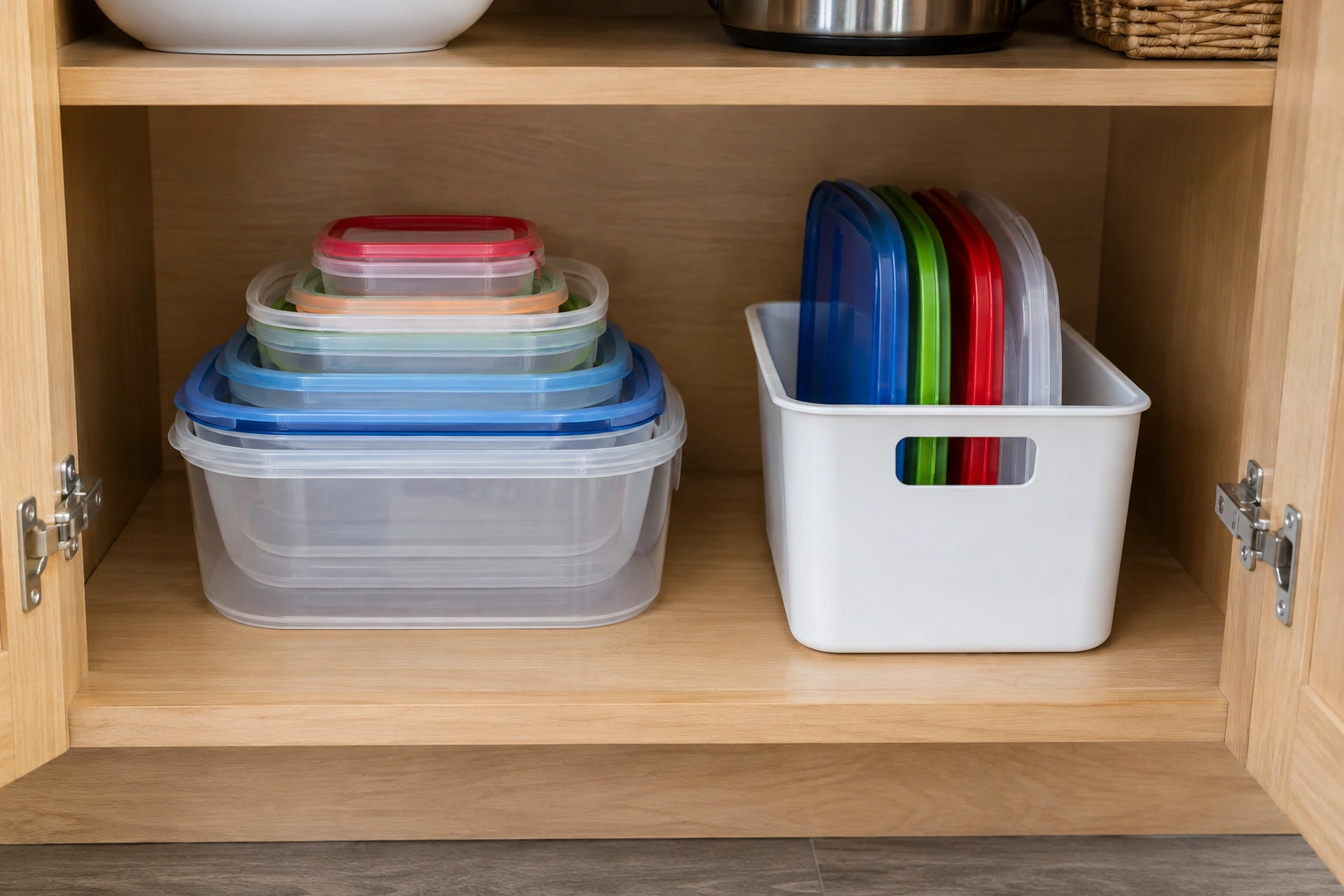
The most practical default setup is this: keep everyday containers nested by size, store lids upright in one shallow bin or file-style divider, and keep overflow pieces in a separate backup box or pantry shelf. Put the bases in one section of the cabinet or drawer, the lids in a second section right beside them, and any unmatched or extra pieces in a clearly marked overflow spot. That keeps the cabinet from turning into a buried pile, and it makes it easier to grab what you need when leftovers are still warm and the kitchen is busy.
Quick Answer: The Easiest Way to Store Tupperware and Lids
If you want the fastest workable system, use one cabinet or drawer for all food storage pieces, then split that space into two zones:
- one zone for container bases, nested by size
- one zone for lids, sorted so you can see them quickly
That layout works because it reduces the two most common sources of clutter: random stacking and mixed lid piles. A dedicated storage spot also makes it easier for everyone in the house to return items to the same place.
For many homes, the best version is not fancy. It is a shallow bin for lids, a simple divider for container sizes, and a rule that only matching pieces stay in the system. Put overflow lids and orphan bases in a separate box, basket, or labeled shelf so they do not keep crowding the main cabinet. That alone can turn a frustrating cabinet into a usable one.
Decide Whether to Store Lids Together or Separately
There are three common ways to handle lids, and each has a trade-off.
Store lids attached to the containers
This is the most convenient option in the moment. You open the cabinet, pull one stack, and the lid is already with the base.
The downside is space. Containers with lids on take up more room, and the stack can become awkward if the lids are different sizes. This method works best when you have a small number of matched sets and plenty of cabinet height.
Store lids separately from the bases
This is the approach that usually works best for most kitchens because it keeps the cabinet calmer and makes it easier to sort by size. Store the bases nested in one zone and keep the lids upright, angled, or filed in a narrow organizer in a second zone nearby. That setup lets you reach for just the lid you need without disturbing the rest.
This method is especially useful if you use the same containers often for meal prep or leftovers. The trade-off is that you do have one extra step when you put food away: you have to pair the lid and base.
Store lids and containers in paired groups
This is a middle ground. You keep matching lids and bases close together, but not necessarily attached. For example, each size can have its own stack or bin section.
That setup can work well for families because it is easy to understand. It is usually the better choice when you have a medium-sized kitchen and want a system that feels intuitive without giving up all of the space savings of separate storage. It is not always the most space-saving option, but it tends to be easier to maintain than a highly customized system.
Decision rule: if your main problem is clutter, separate the lids. If your main problem is speed, keep the most-used sets paired. If your main problem is a small cabinet, separate the lids and nest the bases. If your kitchen is medium-sized and you want a simpler family-friendly system, paired groups are often the easiest compromise.
Declutter Mismatched, Damaged, and Duplicate Pieces First
Before you organize anything, pull every container and lid into one place. This is the step that prevents you from building a tidy system around a pile of unusable pieces.
Sort into four groups:
- Keep — matching sets, useful sizes, and containers you actually use
- Donate — clean extras that are still usable but not needed in your kitchen
- Recycle or discard — cracked, warped, or damaged pieces
- Unsure — items you cannot match right away
If a lid has no clear match after you sort, set it aside in the unsure pile and give it a short trial period only if you have a likely match nearby. A practical rule: keep an orphan lid if you own a container that seems close and you plan to test it within the next week or two; otherwise, let it go or move it to overflow. If a container has no matching lid and you already own enough similar pieces, it is usually just taking up space. The goal is not to keep every piece you have ever owned. The goal is to keep the pieces that make meal prep easier.
This is also the moment to reduce duplicates. A cabinet with six nearly identical small containers is harder to use than one with a few clearly defined sizes. Fewer, more intentional pieces are easier to return to the right spot.
Sort Containers and Lids by Size, Shape, and Use
Once you have trimmed the pile, group the remaining pieces in a way that reflects how you cook.
Group by size first
Stacking containers by size is a practical way to reduce cabinet clutter and make matching easier. Similar pieces nest more cleanly and do not create unstable piles.
A simple size order might look like this:
- small snack containers
- medium lunch containers
- large leftovers containers
- specialty or bulky pieces
Group by shape if the lids are similar
Square, rectangular, and round containers behave differently in storage. If you mix shapes too freely, the stack can become hard to manage. Keeping similar shapes together usually makes nesting smoother.
Keep daily-use items closest
The containers you use most often should be the easiest to reach. That may mean the lunch containers live at eye level while the holiday or backup pieces go on a higher shelf.
A good real-life test: if you reach for a container several times a week, it should not be buried behind a deep stack of rarely used pieces.
Choose the Best Storage Location: Cabinet, Drawer, or Pantry
The best location is the one that fits your kitchen layout and your habits, not the one that looks best in a photo.
| Storage location | Best for | Trade-off |
|---|---|---|
| Cabinet | Larger containers, stacked nesting, flexible setups | Items in back can be harder to see |
| Drawer | Lids, small containers, quick access | Can get crowded if the drawer is shallow |
| Pantry shelf | Overflow storage or less-used pieces | Less convenient for everyday meal prep |
Cabinet storage
Cabinets work well when you need height for stacking bases. A dedicated cabinet also keeps the system together, which is one of the simplest ways to reduce clutter.
Drawer storage
Drawers are often better for lids because they make it easier to see what you have at a glance. If the drawer is shallow, it can be especially helpful for upright lid storage or sectioned bins.
Pantry storage
A pantry shelf can work if your kitchen cabinets are already full. It is a practical overflow option for extra containers, specialty pieces, or seasonal items. The trade-off is distance: if you have to walk across the kitchen every time you need a lid, you are less likely to maintain the system.
Use Bins, Dividers, or Shelf Organizers to Create Simple Zones
You do not need expensive organizers to make this work. You need barriers that stop the pile from spreading.
Bins
Open bins are useful because they corral loose pieces. They are especially helpful for lids, since lids tend to slide and fan out when stacked directly on a shelf. A shallow bin works well for lids, while a slightly deeper bin can hold overflow bases or less-used pieces.
Drawer dividers
Drawer dividers create fixed sections, which is useful if multiple people use the kitchen. They make it clearer where one size group ends and another begins.
Shelf organizers
Shelf organizers can help if you are using a cabinet and want to separate a top layer from a bottom layer. They are most useful when the cabinet has enough vertical space to justify a second level.
Budget-friendly household items
If you do not want to buy anything, use what you already have. A small cardboard box can hold overflow lids, a magazine holder can stand lids upright in a drawer, and a dish rack can work as a vertical file for flat lids or container bases. Those are simple, no-buy options that can keep the system working until you decide whether you need a more permanent organizer.
The key is not the product itself. The key is whether it stops items from sliding into one another.
How to Nest Containers Without Creating a Deep Stack
Nesting saves space, but deep nesting can make the bottom sizes annoying to reach. The trick is to nest only within a size family and keep the most-used pieces near the top.
Here is a workable method:
- group only similar shapes together
- nest from largest to smallest within that group
- keep the everyday sizes on top or in front
- move specialty sizes to the back or a higher shelf
This avoids the classic problem where you have to remove five containers just to reach the one you use daily. A shallow, organized stack is more useful than a tall, unstable one.
If your cabinet is deep, consider splitting one large stack into two smaller stacks. That can make access easier and reduce the chance that forgotten containers collect at the back.
Best Ways to Store Lids Vertically vs. Horizontally
Lids are usually the hardest part to manage because they slide, lean, and multiply.
Vertical storage
Vertical storage is often the easiest to browse. Keep lids standing upright or slightly angled in a narrow bin, file holder, or divider so you can flip through them quickly without dumping the whole pile.
Vertical storage works well when:
- you have a drawer or narrow cabinet section
- you want quick visual access
- the lids are mostly flat and similar in shape
Horizontal storage
Horizontal stacking can work if you have limited height or a very shallow bin. It is simpler to set up, but it can become messy if the pile gets too deep.
Which is better?
If your lids are constantly getting mixed up, vertical storage usually gives better visibility. If your space is very shallow or your lids are bulky, horizontal stacking may be more realistic.
A practical rule: choose vertical storage when you want faster access; choose horizontal storage when the container height is too limited for upright filing.
Simple Storage Setups for Small Kitchens and Busy Households
Small kitchens need systems that are easy to understand at a glance.
For a very small kitchen
Use one drawer or one cabinet shelf for all food storage pieces. Put lids in a vertical file-style system using a narrow bin, magazine holder, or dish rack, and keep the bases in one shallow bin or one short nested stack beside them. Keep only the sizes you use every week in the main space, and move everything else to overflow storage.
For a family kitchen
Use a larger bin for everyday leftovers containers and a second area for less-used or specialty pieces. When multiple people put dishes away, the setup should be obvious enough that they do not need instructions every time.
For meal preppers
Meal prep usually means repeated use of similar containers. That is where matched sets help most. Keep the same type of container, or at least containers that nest easily, so the cabinet stays less unruly and lid matching stays simple.
If you prep lunches several times a week, keep those containers in the easiest-to-reach spot. Do not bury them behind holiday serving pieces or oversized storage tubs.
How to Label or Visually Cue the System
If kids, partners, or roommates help put dishes away, make the zones obvious.
Simple ways to do that include:
- a small label on the lid bin and the base bin
- a piece of tape on the shelf edge
- using one bin shape for lids and a different one for bases
- keeping overflow in a clearly separate box or basket
You do not need elaborate labels. The point is to make the right home obvious enough that people can put things away without guessing.
How to Keep the System Working Over Time
A good storage system is one that survives a busy week.
Use these maintenance habits:
- return each lid to its own category immediately
- do a quick match check when unloading the dishwasher
- remove broken or warped pieces as soon as you notice them
- keep overflow containers out of the main zone
- reset the cabinet when it starts to feel crowded, not after it becomes unusable
If several people use the kitchen, the system needs to be obvious. That usually means fewer categories, not more. A simple setup is easier for kids, partners, or roommates to maintain because it does not require them to remember a complicated sorting rule.
Common Mistakes That Make Tupperware Clutter Worse
A few habits create more mess than they solve:
Keeping every piece forever
Unmatched lids and duplicate containers take up valuable space. If they do not fit your current system, they are just making the cabinet harder to use.
Building a stack that is too deep
Deep stacks look tidy for a day, then become annoying. The items at the bottom get forgotten, and the stack starts sliding apart.
Mixing every lid together
A single loose pile of lids is hard to browse and easy to knock over. Sorting by size or container family is much more manageable.
Making the system too complicated
If the setup requires labels, three bins, and a memory test, it will not survive a busy Tuesday night. Simpler usually wins.
Storing everything in the wrong place
If the containers live far from where you pack meals or pack lunches, the system loses convenience. Practical placement matters as much as neatness.
A Simple Rule of Thumb You Can Use Today
If you want one decision framework to guide the whole project, use this:
- Need speed? Keep the most-used containers together and the lids easy to see.
- Need space? Separate lids from bases and nest the containers.
- Need simplicity for the whole household? Use one dedicated spot with clear zones.
- Need less clutter? Remove unmatched and damaged pieces first.
That combination is usually enough to create a storage system that feels calm instead of chaotic.
For related freezer and container storage guidance, see Can Tupperware Go in the Freezer? and Can You Freeze Glass Containers With Plastic Lids Safely?. If you want a cabinet-specific walkthrough, this guide on organizing Tupperware in a cabinet may help.
FAQ
Should Tupperware lids be stored with the containers or separately?
Separately is usually the easiest system for most kitchens because it saves space and makes lids easier to see. If you have only a few matched sets and plenty of cabinet room, keeping lids attached can also work.
What should I do with mismatched lids and containers?
Sort them into keep, donate, discard, and unsure. If a lid does not have an obvious match, give it a short trial period only if you have a likely container to test it with soon. Otherwise, move it to overflow or let it go.
What is the best storage setup for a small kitchen?
A vertical lid system plus one shallow bin for bases is usually the most practical. Keep only the everyday sizes in the main cabinet and move the rest to overflow storage.
How do I keep the system organized if my family uses it too?
Use simple labels or visual cues, and keep the layout very basic. The fewer categories you have, the easier it is for everyone to put things back in the right place.
What can I use if I do not want to buy organizers?
Use a cardboard box for overflow, a magazine holder for upright lids, or a dish rack as a simple divider. A no-buy setup can work well as long as it keeps pieces from sliding around.