
How to Tell If Your Oven Temperature Is Accurate: A Baker’s Practical Guide
If your cakes brown too quickly, cookies spread more than they should, or bread takes longer to bake than the recipe suggests, your oven may not be heating the way the dial or display says it is. That does not automatically mean the appliance is broken. In many kitchens, the issue is a steady temperature offset, a thermometer problem, or normal heat fluctuation that becomes obvious only when you bake.
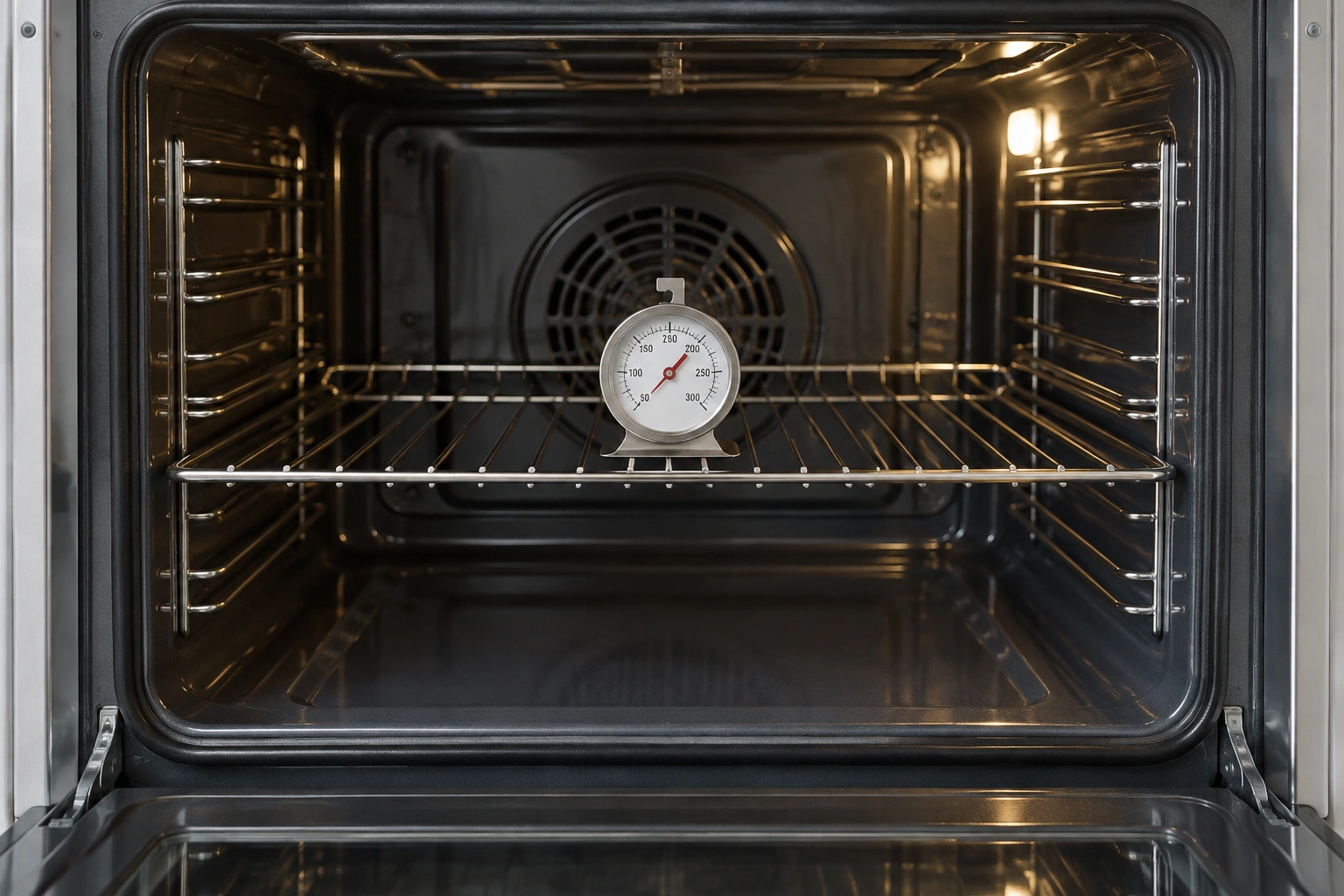
The good news is that you can check oven accuracy at home with a simple test and a reliable oven thermometer. Once you know whether your oven runs hot, cool, or unevenly, you can decide whether to calibrate it, work around the difference, or call for service.
Signs Your Oven Temperature May Be Off
Baking problems often show up before you ever test the oven.
A few common clues include:
- Overbrowning before the center is done. Cakes may darken on top while the middle still looks underbaked.
- Slow baking or pale results. Cookies may stay light longer than expected, and loaves may need extra time.
- Uneven color from front to back. One side of a tray may finish earlier than the other.
- Recipes that seem to “fail” only in this oven. If the same formula works elsewhere, temperature accuracy is worth checking.
- Repeated adjustments that still do not fix the outcome. If you keep moving racks or extending time without improvement, the heat may be inconsistent.
A single bad bake does not prove the oven is inaccurate. A tray of cookies can spread for several reasons, including dough temperature, pan type, or rack position. But when the same pattern repeats across different recipes, the oven deserves a closer look.
Image placeholder 1
What You Need to Check Oven Accuracy at Home
The most useful tool is an oven thermometer placed inside the oven cavity. It gives you an actual temperature reading instead of relying only on the built-in display.
That distinction matters. On some models, the display shows the set temperature; on others, it shows the oven’s sensed temperature. An oven thermometer shows the heat where your food is baking, which is the more useful number for testing accuracy.
Oven thermometer vs. built-in display
Here is the practical difference:
| Check method | What it tells you | Strength | Limitation |
|---|---|---|---|
| Built-in oven display | Set temperature or sensed temperature | Convenient and easy to read | May not match actual cavity temperature |
| Oven thermometer | Actual temperature inside the oven | Better for checking accuracy | Must be placed correctly and read carefully |
If you bake often, a basic oven thermometer is usually worth having. Choose one designed for oven use, not a cheap general-purpose thermometer that may not tolerate the heat or may respond too slowly.
How to Test Your Oven Temperature Step by Step
A reliable test depends on consistency. One reading can be misleading, so the goal is to measure the oven after it has fully settled.
1) Place the thermometer correctly
Set the oven thermometer on the center rack, roughly in the middle of the oven cavity. Keep it away from the walls, the back, the door, and direct contact with heating elements if possible.
That placement matters because edges of the oven can run hotter than the center. If the thermometer sits too close to a wall, it may record a number that does not reflect where your pan actually bakes.
2) Preheat fully, then wait for stabilization
Let the oven preheat until it signals that it has reached temperature, then give it extra time to settle before you take the first reading. A practical rule is to wait an additional 10 to 15 minutes after the preheat signal. Many ovens continue to cycle after the first signal, so the first beep or light does not always mean the cavity has settled.
If you open the door during this period, give the oven another few minutes to recover before reading the thermometer.
3) Check the reading without disturbing the oven more than necessary
Open the door briefly, read the thermometer, and close it again. Every door opening lets heat escape, so repeated checks can distort the result.
If your thermometer has a clear dial, read it quickly. If it is digital, make sure the probe or display is made for oven temperatures and is positioned safely.
4) Take several readings
Take 3 to 5 readings over one bake cycle, spaced a few minutes apart. That gives you a better picture of whether the oven is holding fairly steady or swinging widely.
For example:
- If the oven says 350°F and the thermometer stays near 325°F through several checks, the oven may be running cool in a consistent way.
- If the oven bounces between 325°F and 375°F, the issue may be fluctuation rather than a simple calibration offset.
5) Test more than once
One test can be affected by how long the oven was preheated, how often the door opened, or where the thermometer sat. Repeating the test on another day helps confirm whether the result is consistent.
How to Read the Results
The key question is not whether the oven is perfect. It is whether the difference is steady enough that you can bake around it.
A steady offset
A steady offset means the oven is consistently hotter or cooler than the set temperature. That is often easier to manage than a fluctuating oven because you can compensate by adjusting the setting.
Example: if a recipe calls for 350°F and your oven thermometer repeatedly shows about 25°F lower, you may choose to set the oven higher for similar results.
Temperature swings
Some ovens do not hold one exact number. They cycle on and off, so the temperature rises and falls around the target. A little movement is normal in many home ovens. In practical terms, a modest swing of about 10 to 20°F around the set point is often something you can work with, especially if the oven returns to the target range fairly quickly.
What matters is whether the swings are modest or extreme. If the temperature keeps changing a lot, or the oven never seems to settle near the set point, that points to a bigger issue than a simple calibration tweak.
When the oven is “accurate enough”
For baking, the useful standard is practical rather than perfect. If the oven is close enough that your cakes rise properly, cookies brown evenly, and bread finishes on schedule, it may be accurate enough for home use even if it is not exact.
If the difference is large enough to change texture, color, or bake time every time you use it, then it is worth correcting.
Why Oven Readings Can Be Wrong or Inconsistent
Not every inaccurate reading means the oven itself is faulty.
Thermometer error
A poor-quality oven thermometer can be slow to respond or poorly calibrated. If the reading seems strange, compare it with another thermometer before assuming the oven is the problem.
Poor placement
A thermometer near the door may read cooler because heat escapes there. One too close to a wall may read hotter because of radiant heat. Placement can easily create a false impression of inaccuracy.
Door opening
Opening the door drops the temperature quickly. If you check the reading repeatedly, you may end up measuring the effect of the door opening rather than the oven’s true behavior. After opening the door, wait a few minutes for the oven to recover before trusting the next reading.
Convection vs. conventional heat
A convection oven uses a fan to move air, which can improve evenness and reduce hot spots. But it may bake differently from a conventional oven even when both are set to the same number. That is not always a calibration problem; sometimes it is simply the effect of airflow.
This is one reason it helps to understand your oven type before making big adjustments. If you use a fan oven, you may also want to review how fan settings affect baking temperatures. Our guide on how to convert fan oven temperatures for baking explains that difference in practical terms.
How to Calibrate or Adjust an Oven That Runs Hot or Cold
If your oven shows a consistent offset, the next step depends on the appliance.
If your oven allows user calibration
Some ovens let you adjust the temperature setting through the controls. The exact method varies by brand and model, so the owner’s manual is the safest place to start.
A careful approach is to make a small adjustment, then retest with the thermometer. That prevents overcorrecting in the wrong direction.
If your oven does not allow easy adjustment
Not every oven offers user calibration. In that case, you can often work around the difference by adjusting the set temperature for future bakes.
For example:
– If the oven runs cool, you may set it a little higher than the recipe calls for.
– If it runs hot, you may lower the set temperature slightly and watch for doneness earlier.
This is less precise than true calibration, but it can improve results when the offset is stable.
Manual adjustment vs. repair
A steady, moderate offset is often manageable. Large swings, inconsistent heating, or controls that seem unreliable are a different matter. Those problems may not respond to calibration alone.
When Temperature Problems Mean the Oven Needs Repair
Some symptoms point beyond ordinary calibration.
Consider professional service if you notice:
- The oven never reaches the set temperature
- The temperature rises and falls wildly
- The display behaves unpredictably
- The oven shuts off unexpectedly
- Baking results vary dramatically from one batch to the next even with the same setup
Gas ovens, electric ovens, and convection models can all develop control or sensor problems. If the appliance seems unsafe, smells unusual, or behaves erratically, stop using it and have it checked by a qualified technician.
How Inaccurate Oven Temperature Affects Baking Results
Small temperature differences can have very visible effects in baking.
If the oven runs too hot
A hotter-than-expected oven can:
– Brown cookies too fast before the centers set
– Darken cake edges before the middle finishes
– Dry out quick breads
– Set pastry surfaces before enough lift develops
If the oven runs too cool
A cooler oven can:
– Slow rising and lengthen bake times
– Leave cookies pale and soft when they should be set
– Cause cakes to sink because the structure has not fully set
– Make bread seem underbaked even when the crust looks fine
If the oven is uneven
Uneven heat often shows up as one side of a tray finishing before the other. Rotating pans can help, but if the problem is severe, the oven may have a hot spot or circulation issue that needs more than a simple workaround.
For cookie-specific troubleshooting, our guide on how to compare oven temperatures for better cookie results can help you connect temperature checks to real baking outcomes.
Quick Comparison: Test, Adjust, or Call for Help
| Situation | Likely meaning | Best next step |
|---|---|---|
| Oven is consistently a little hot or cool | Steady offset | Calibrate if possible, or adjust baking temperature |
| Oven temperature changes a lot during baking | Fluctuation or control issue | Retest, then consider service |
| Oven display and thermometer disagree | Display may not match cavity temperature | Trust the oven thermometer for baking checks |
| Bakes are uneven only on one rack or one side | Hot spot or rack-position issue | Adjust rack placement and retest |
| Oven will not hold temperature at all | Possible appliance fault | Call for repair |
When to Call for Service
If you bake frequently and still cannot get consistent results after checking the oven, the issue may be more than a simple calibration mismatch. A technician can help you determine whether the thermostat, sensor, or control system needs repair.
That kind of outside help is especially useful when the oven is “close enough” on paper but still producing disappointing cakes, cookies, or bread in practice.
FAQs About Oven Temperature Accuracy
How long should I preheat before checking the temperature?
Wait for the oven to signal that it has preheated, then give it an additional 10 to 15 minutes to settle before taking a reading. The first signal alone may not mean the cavity has fully stabilized.
Should I trust the oven display or an oven thermometer?
For checking actual temperature, the oven thermometer is usually the better reference. The display may reflect the set point or sensor reading, not the temperature where your food sits.
Does opening the oven door affect the reading?
Yes. Each time you open the door, heat escapes and the reading can drop. Brief checks are fine, but repeated opening can make the test less reliable.
How much temperature variation is normal?
Some cycling is normal. A practical swing of about 10 to 20°F around the set temperature is often manageable for home baking if the oven returns to range fairly quickly. Larger or erratic swings are more likely to need attention.
What if my oven thermometer and display disagree?
Use the thermometer as the more practical check for baking. If the difference is steady, you may be able to adjust the set temperature or calibrate the oven if the model allows it.
How do I test an analog oven versus a digital one?
For both types, place an oven thermometer on the center rack and let the oven stabilize before reading it. On analog ovens, the dial may have no easy calibration menu, so you may need to adjust by setting the dial slightly higher or lower if the offset is consistent. On digital ovens, check the owner’s manual for a calibration option; if none is available, use the thermometer reading as your guide and compensate manually.
Why do my cookies and cakes bake unevenly even when the temperature looks right?
Uneven baking can come from rack position, hot spots, pan color, convection airflow, or door opening—not just the temperature setting. That is why a temperature test is only one part of diagnosing the problem.
A careful oven check takes a little time, but it gives you something very useful: a clear picture of how your oven actually behaves. Once you know that, you can bake with fewer surprises and make decisions based on evidence instead of guesswork.

