How to Test Air Fryer Temperature Accuracy at Home
If your air fryer seems to brown too fast, cook unevenly, or miss recipe timing by a wide margin, the display may not be telling the whole story. Air fryers are small, powerful convection appliances, and that combination can make temperature behavior feel less predictable than a standard oven. The good news is that you can check it at home with a simple, repeatable test.
The goal is not to find a perfect number at one instant. It is to learn whether your air fryer is consistently close to the setting, whether it runs hot or cool, and how much it swings during normal cycling. Once you know that, you can make smarter adjustments and follow recipes with more confidence.
Why air fryer temperature accuracy matters
Temperature accuracy affects more than doneness. In an air fryer, a small offset can change how quickly the outside browns, how evenly the center cooks, and whether the food finishes at the same time the recipe expects.
That matters most with foods that rely on timing and surface color: roasted vegetables, breaded items, pastries, and reheated leftovers. If the machine runs hotter than the display, you may see dark edges before the inside is ready. If it runs cool, food can dry out while still looking pale.
For bakers, this is especially familiar. A recipe written for one appliance assumes a certain heat pattern. If your air fryer behaves differently, the recipe is not necessarily wrong — the appliance may simply need a small offset.
If you already know how to check oven accuracy, the logic here will feel familiar. I cover that process in more detail in this practical guide to oven temperature testing, and the same habit of measuring before adjusting is just as useful here.
What you need to test an air fryer temperature
You do not need specialized equipment, but the tool you choose affects how meaningful the result is.
If you only want one practical option, buy an oven thermometer first. It is the simplest and most reliable starting point for most home cooks because it measures the air inside the cooking chamber rather than the appliance surface. If you do not already own one, that is the tool to get before trying to judge accuracy.
Oven thermometer
An oven thermometer is the simplest option for checking the air temperature inside the basket or cooking chamber. It is inexpensive, easy to read, and designed for hot-air environments.
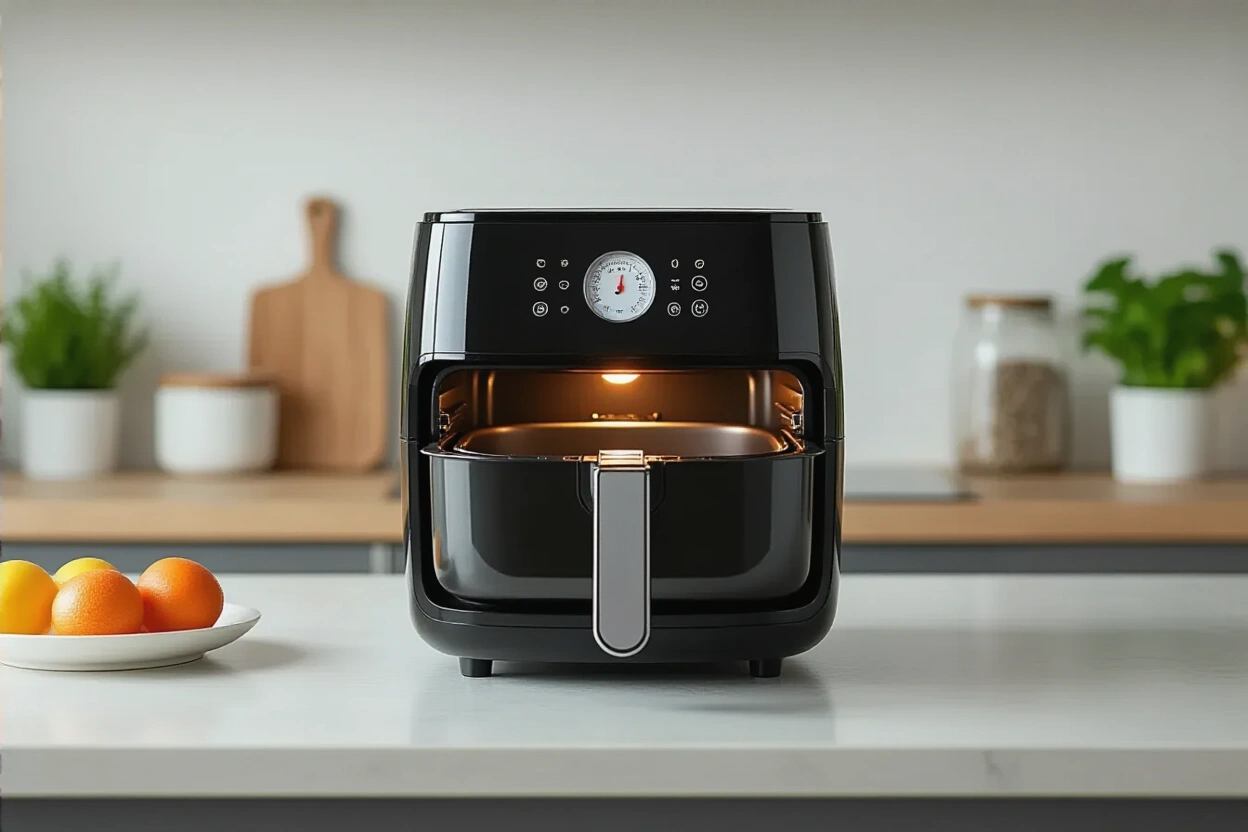
For most home cooks, this is the best starting point because it measures the surrounding air rather than the surface of the appliance. That makes it more useful for comparing against the set temperature.
Probe thermometer
A probe thermometer can also work, especially if you already own one. It gives a direct reading at the probe tip, which can be helpful if you can place it safely in the airstream.
The trade-off is placement. In a basket-style air fryer, a probe can interfere with airflow or touch the basket wall, which can distort the reading. It is useful, but only if you can position it without blocking circulation.
Infrared thermometer
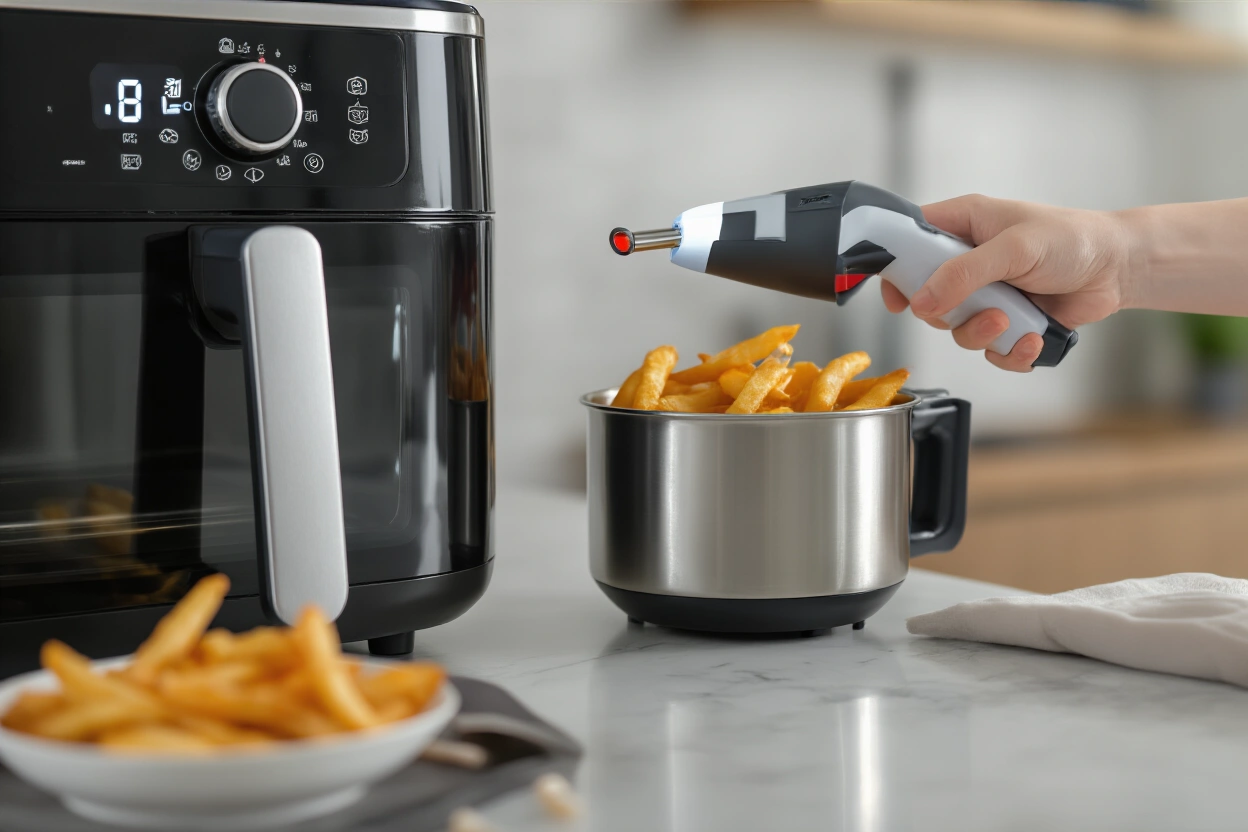
An infrared thermometer is fast and convenient, but it measures surface temperature, not air temperature. That is the key limitation.
Inside an air fryer, reflective metal surfaces can produce misleading readings. You might point the tool at a shiny basket wall and get a number that looks precise but does not reflect the actual cooking environment. Infrared tools are better for checking hot spots on surfaces than for confirming the temperature of the air itself.
Here is the short version: if your goal is to compare set temperature with actual cooking temperature, an oven thermometer is usually the most practical choice.
| Tool | What it measures | Best use | Main limitation |
|---|---|---|---|
| Oven thermometer | Air temperature | Checking actual cooking conditions | Needs enough space for airflow |
| Probe thermometer | Temperature at probe tip | More direct measurement if placed carefully | Can block airflow or touch surfaces |
| Infrared thermometer | Surface temperature | Spot-checking surfaces | Does not reliably measure air temperature |
How to test your air fryer temperature at home
The simplest test is a controlled preheat-and-check method. You are comparing the set temperature with the temperature the appliance actually reaches and maintains.
1. Place the thermometer in the cooking area
Put an oven thermometer in the basket or on the rack, depending on your model. Keep it away from the heating element, fan, and basket walls. If it sits against metal, the reading may be influenced by the surface temperature instead of the air.
For a basket-style air fryer, the most useful spot is usually centered in the basket and raised slightly if possible so air can move around it. For a tray- or rack-style model, place it on the cooking rack in the middle of the usable cooking space, again away from the walls and direct heat source. The idea is to measure the air where food would actually cook.
2. Preheat the air fryer
Turn the unit on and let it preheat at the temperature you want to test. A practical wait time is about 5 to 10 minutes, or whatever your model recommends for preheating if the manual gives a longer figure.
If your air fryer has a preheat function, use it. If it does not, run it at the test temperature and give it time to cycle a few times before checking the reading.
3. Take a small series of readings
Once the preheat time is up, take 3 readings over the next few minutes rather than trusting the first number you see. For example, check once right after preheat, then again about 1 to 2 minutes later, then once more after another 1 to 2 minutes.
This gives you a more realistic picture of the actual temperature and its normal cycling range. If the readings stay in roughly the same band, you can use that range to judge accuracy. If one reading is much higher or lower than the others, do not let that single number drive the conclusion.
4. Repeat the test
Run the test more than once, ideally on a different day. If the results are similar, you have a reliable picture of how the appliance behaves. If the numbers vary widely from run to run, that inconsistency is useful information too.
A one-time reading can be a fluke. Repeated readings tell you whether the air fryer is predictable.
Where to place the thermometer for a meaningful reading
Placement matters as much as the thermometer itself.
For a basket-style air fryer, place the thermometer in the center of the basket if possible. Keep it elevated or supported so it is exposed to circulating air. If it sits directly on the basket floor, the metal can affect the reading.
For a tray- or rack-style air fryer, place the thermometer on the rack in the middle of the cooking area, not pushed against the back wall or directly under the heating element. If the model has multiple rack positions, test the one you actually use for cooking.
Avoid these spots:
- Right next to the heating element
- Tight against the basket wall
- Directly in front of the fan outlet
- Under a piece of foil or food that blocks airflow
That is why “where” you test is part of the result. A reading near the top of the basket may not match the reading near the bottom, and that difference can explain why food browns unevenly.
Should you test an empty basket or with food in it?
Both approaches are useful, but they answer different questions.
Empty basket test
An empty basket test isolates the appliance. It shows how the machine behaves without the heat absorption of food. This is the best way to judge whether the display is close to the actual air temperature.
If you want to know whether the unit is running hot, cool, or roughly on target, start here.
Food-in-basket test
A food load changes the result. Cold or dense food absorbs heat, which can pull the temperature down temporarily. That does not necessarily mean the air fryer is inaccurate — it may simply be responding to a real cooking load.
This test is helpful when your question is, “Why does the recipe behave differently than expected?” If the appliance looks accurate empty but drops noticeably once food is added, the issue may be load size, spacing, or preheat time rather than calibration.
In practice, I recommend testing empty first, then doing one real cooking run with a typical food load. That gives you both the appliance baseline and the real-world result.
How long to preheat and when to take readings
Do not rush this part. Air fryers heat quickly, but “hot” is not the same as “stable.”
A practical routine is to preheat for about 5 to 10 minutes, then take 3 readings over the next few minutes. That is usually enough to see the normal cycling pattern without overcomplicating the test.
You are looking for the set temperature and the actual temperature to settle into a repeatable range. A single reading can catch the unit at a high point or low point in the cycle, so use the small series of readings as your comparison point rather than one snapshot.
For example, a unit set to 375°F might bounce around that target as it cycles. If the three readings stay in a narrow band and the food cooks consistently, that is usually more useful than an exact match to the display.
How to tell normal temperature cycling from a problem
Air fryers do not hold one fixed number. They cycle to maintain heat, so the actual temperature rises and falls around the set point.
That means some movement is expected. The key question is whether the swings stay in a fairly narrow, repeatable range or whether they are large enough to affect cooking.
Normal behavior usually looks like this
- The temperature rises after preheating
- It drops slightly as the heating element cycles off
- It returns toward the set point in a repeating pattern
- The pattern is similar from one test to the next
Concerning behavior usually looks like this
- Large swings that keep changing from run to run
- A temperature that never seems to stabilize
- A major gap between the set temperature and the measured result every time
- Food that burns in one spot and stays underdone in another, even after you adjust placement
A helpful way to think about it: if the unit is consistently close to the set point and cooks predictably, it is probably fine even if it does not sit on one exact number. If it behaves wildly differently each time, that is more suspicious.
How far off is still acceptable?
There is no universal number I can give you as a hard rule without the manufacturer’s own specification. In real kitchens, the decision usually comes down to consistency and usefulness.
A practical rule of thumb is this: if your readings stay in a fairly tight range around the set temperature and the food cooks the way you expect, that is usually normal cycling, not a problem. If the measured temperature is regularly far enough above or below the set point that you have to keep rescuing the food, that is more concerning.
Ask these three questions:
- Is the air fryer close enough to the set temperature that recipes still behave predictably?
- Is it off by about the same amount each time?
- Can you compensate with a small adjustment?
If the answer to all three is yes, the appliance is probably usable as-is with a note in your recipe notebook.
If the temperature varies a lot from one test to the next, or if the gap is large enough that food keeps overbrowning or undercooking, that is a stronger sign of trouble.
A consistent offset is easier to manage than an inconsistent one. A unit that runs cool by a repeatable amount can often be handled with a small time or temperature change. A unit that swings unpredictably is much harder to trust.
How to compensate if your air fryer runs hot or cool
Once you know the pattern, write it down. A simple note like “runs about 15°F hot” or “needs a little extra time for thicker foods” is enough to make future cooking easier.
If it runs hot
Lower the set temperature a bit and watch the color more closely. For example, if a recipe calls for 375°F and your air fryer runs hot, try setting it to 360°F or 350°F and retest the result.
You may also need to move food farther from the heating element if your model allows it, or rotate the basket midway through cooking if one side colors faster.
If it runs cool
Raise the temperature modestly or extend the cook time. For example, if a recipe calls for 375°F and your air fryer runs cool, try 385°F or add a few extra minutes, then check whether the food finishes more evenly.
A cool unit often benefits from a slightly longer preheat too, especially for foods that need a strong initial burst of heat.
If it has a hot spot
Rotate the food during cooking. A basket that reads warmer near the top than the bottom, for example, may need a shake or flip halfway through. That adjustment often improves results more than changing the temperature itself.
A good compensation rule is to make one small change, then retest. Lower or raise the set temperature by a modest amount, or adjust time in a few-minute increment, and see whether the result improves before making another change.
When inaccurate results may mean the appliance is failing
A small offset is one thing. Persistent instability is another.
You may want to question the appliance if:
- It never seems to stabilize after a reasonable preheat
- The readings are very different from one test to the next
- The display says one thing while the food behaves as if the temperature is much higher or lower
- The unit cooks unevenly even after you adjust placement and timing
At that point, the issue may be more than recipe technique. It could be a sensor problem, a fan issue, or simply an appliance that no longer performs reliably. If the machine is under warranty, checking the manufacturer’s guidance is the sensible next step.
Common mistakes when testing air fryer temperature
A few testing errors can make a good appliance look bad.
Taking only one reading
One reading can catch the unit mid-cycle. Use a series of readings instead.
Placing the thermometer too close to metal
The basket wall and heating element can distort the result. Center the thermometer in the airflow when possible.
Using an infrared thermometer as if it measured air
It does not. It measures surface temperature, which is a different thing entirely.
Testing before preheat is complete
If the unit has not stabilized, the reading is not very useful.
Ignoring the effect of food
A basket full of cold food is not the same as an empty basket. Test both if you want a complete picture.
Changing too many variables at once
If you adjust temperature, time, basket position, and food amount all at once, you will not know which change fixed the problem. Make one adjustment at a time and note the result.
A simple way to interpret your results
Here is the practical standard I use when teaching technique:
- Consistent and close enough: keep using the air fryer and note any small offset
- Consistently hot or cool: compensate with a small adjustment and retest later
- Highly inconsistent: investigate further or consider repair or replacement
That framework keeps the test useful without turning it into a lab experiment. Your goal is dependable cooking, not perfect numbers on a display.
Frequently asked questions
Can I test air fryer temperature with food only?
You can, but food adds variables. If you want to know whether the appliance itself is accurate, test it empty first. Use a food test as a second check for real cooking conditions.
Is an oven thermometer better than a probe thermometer?
For most basket-style air fryers, yes. An oven thermometer is usually simpler and less likely to interfere with airflow. A probe thermometer can work well, but only if you can place it safely.
Why does my air fryer temperature seem to jump around?
That is often normal cycling. Air fryers turn the heating element on and off to maintain heat, so some movement around the set point is expected.
Should I trust an infrared thermometer?
Use it carefully. It can be helpful for surface checks, but it is not the best tool for measuring the air temperature inside an air fryer, especially if the interior is reflective.
What if my air fryer cooks fine even though the thermometer is off?
Then the appliance may still be usable. Recipe performance matters. If the offset is predictable and the food turns out well with a small adjustment, that is often enough for home cooking.
Final thoughts
Testing air fryer temperature accuracy is less about chasing a perfect number and more about understanding how your appliance behaves. Once you know its pattern, you can choose better temperatures, better timing, and better placement for the food you cook most often.
A simple thermometer, a careful preheat, and a few repeat readings are usually enough to tell you whether the unit is trustworthy, needs a small adjustment, or deserves a closer look.