
How to Roll Dough Evenly for Better Cookies, Pie Crust, and Pizza

Even rolling is one of those small baking skills that pays off every time you bake. If dough is thicker in the middle than at the edges, cookies bake unevenly, pie crust can shrink or tear, and pizza may puff in one spot while staying underdone in another. The goal is simple: a sheet of dough with the same thickness across the whole surface and a shape that matches what you need.
That sounds straightforward, but in a busy kitchen it helps to have a method that works without specialty equipment. The good news is that you can get consistent results with a standard rolling pin, a clean work surface, and a few habits that keep the dough calm and controllable.
What Even Rolling Means and Why It Matters
Even rolling means the dough is the same thickness from edge to edge, with no thin patches, thick ridges, or hidden low spots. For cutout cookies, that means every piece bakes at roughly the same rate. For pie dough, it means the crust fits the pan without fragile spots that can split when moved. For pizza, it helps the crust cook more uniformly so the center and rim finish at the same time.
Uneven dough causes predictable problems. Thin areas brown too fast. Thick areas stay soft or doughy. If the dough is stretched more on one side than the other, it can also pull back when you try to transfer it.
A useful target is not “perfectly flat” in a lab sense. It is “consistent enough that the recipe behaves the way you expect.” That mindset keeps you from overworking the dough while chasing perfection.
Choose the Right Surface and Prep the Dough
The surface you roll on matters because it affects friction, control, and cleanup. A lightly floured counter gives you direct control and works well when you need to move and turn the dough often. Parchment paper reduces sticking and can make cleanup easier, especially for soft doughs or when you want to lift the dough onto a baking sheet without distortion.
Here is the practical trade-off:
- Floured counter: better grip and more control, but you need to manage sticking carefully.
- Parchment paper: less sticking and less mess, but the dough can slide if the sheet moves.
If the dough is soft, warm, or very elastic, chilling it first usually makes it easier to handle. Cold dough resists sticking and tearing better. If it is too cold, though, it may crack at the edges. In that case, let it sit briefly so it becomes flexible enough to roll without breaking.
A simple way to prepare the dough is to flatten it into a rough disk or rectangle before you reach for the rolling pin. That gives you a head start on even thickness and makes the first few passes more predictable.
How to Roll Dough Evenly Step by Step
If you want a reliable method, use a sequence instead of random passes.
1) Press the dough lightly before rolling
A small amount of pressing helps the dough settle and makes the first roll easier. Some bakers create shallow indents across the surface before rolling so the pin has a more even starting point. You are not trying to flatten it completely; you are just giving the dough a head start.
2) Roll from the center outward
Place the rolling pin in the center of the dough and roll toward the far edge, then back through the center toward you. This helps push the dough outward evenly instead of stretching one edge more than the other. If you only roll from the edges, the middle often stays thicker.
Use steady pressure rather than leaning hard on one side. If one hand is doing most of the work, the dough tends to drift into a lopsided oval.
3) Check after every few passes and rotate the dough
After every few passes, pause and check the dough from above and from the side. Looking from the side makes it easier to spot a thicker edge or a low spot that is hard to see from overhead. Rotate the dough a quarter turn every few passes as well. This is one of the simplest ways to avoid a thick middle and skinny ends.
If one side is becoming thinner than the other, stop rolling that area for a moment and give the thicker side a few extra light passes. Keep the pressure gentle so you are correcting the shape instead of stretching the dough further.
If the dough starts sticking, lift it gently, dust the surface very lightly, and continue. Do not keep forcing the pin through a sticky patch; that usually makes the thin spots thinner.
4) Stop before the dough gets too thin
Over-rolling is a common reason dough becomes uneven. Once the dough is close to the size and thickness you need, switch to shorter, lighter passes. That gives you more control over the final shape and reduces the risk of creating paper-thin sections.
How to Keep Dough from Sticking, Tearing, or Shrinking
Sticking
Cause: The surface needs a little more flour, or the dough needs a brief rest.
Fix: Use flour sparingly and lift the dough often. If it still grips the surface, pause and let it rest briefly before continuing. Too much flour can dry out the dough and change the texture of the finished bake.
Tearing
Cause: The dough is too dry, too cold, or being rolled with too much force.
Fix: Patch the tear with a small piece of dough and press it together lightly, then roll over it gently. A heavy pass with the pin usually makes the tear worse.
Shrinking
Cause: The dough has been stretched and the gluten is tightening back up.
Fix: Let the dough rest for a few minutes so it can relax. If it keeps springing back, chill it briefly and try again. For pie dough, a little patience matters more than speed. For cookie dough, a quick chill can help maintain sharp edges and even thickness. For pizza dough, a relaxed dough is easier to stretch without snapping back.
How to Check Thickness Without Special Equipment
You do not need a fancy gauge to tell whether dough is even. A few simple checks work well.
Look across the surface at eye level
Bend down so your eyes are close to the counter and look across the dough. High spots and low spots are easier to see from the side than from directly above.
Feel for ridges with your fingertips
Run your fingertips lightly over the surface. Uneven areas often show up as thicker bands near the edges or a raised center. This is especially helpful with softer doughs that look even but are not.
Use a simple household guide if needed
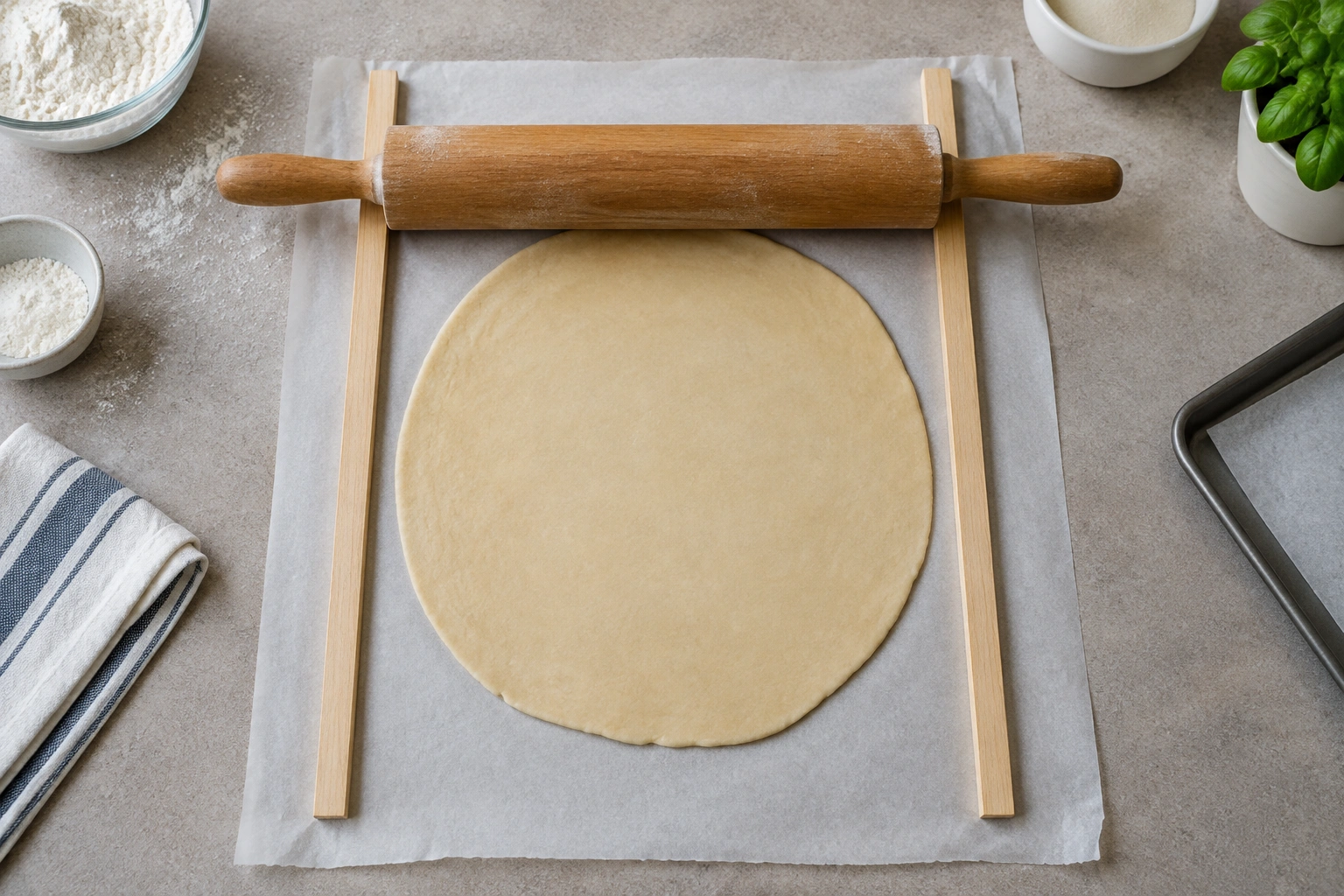
If you want more consistency, use two rulers, dowels, or similar straight guides placed along the sides of the dough so the rolling pin rests on them. MasterClass describes this approach as lining up two rulers or dowels with the dough edges and positioning the pin so it rests on them, which gives you a built-in thickness stop. That can be especially helpful for beginners or for dough that needs a very consistent final thickness. MasterClass guide to rolling dough evenly
Use a quick test cut
For cookie dough, cut one test piece and compare it to the rest of the sheet. If the first cut looks noticeably thicker or thinner than expected, adjust before cutting the full batch.
Recommended Thickness for Cookies, Pie Crust, and Pizza Dough
The right thickness depends on what you are making. Use the recipe first if it gives a number. If it does not, these practical targets are a useful starting point.
| Dough type | Practical thickness target | Why it helps |
|---|---|---|
| Roll-and-cut cookies | About 1/4 inch for many home recipes | Helps cookies bake at a similar rate and hold their shape |
| Pie crust | About 1/8 to 1/4 inch, unless the recipe says otherwise | Thin enough to fit the pan without stretching, while still holding together |
| Pizza dough | Even thickness with a slightly thicker edge if desired | Promotes more uniform baking and a balanced crust |
For cookie dough, consistency matters more than chasing an exact measurement. A 1/4-inch sheet is a common home-baking target because it is thick enough to handle but still bakes evenly.
For pie crust, the important decision is not only thickness but also whether the dough is stretched during transfer. A dough that is rolled evenly but stretched into the pan can still shrink back. Lift and settle it into place instead of pulling it. If your recipe gives a different thickness, follow the recipe first.
For pizza dough, a little variation at the rim can be useful if you want more structure around the edge. What matters most is that the center is not dramatically thinner than the rest.
Rolling Pin Choices and When Thickness Guides Help
King Arthur Baking notes that the best rolling pin is the one you are most comfortable using, and that with good technique almost any pin can get the job done. That is useful advice because the pin itself matters less than how consistently you use it. King Arthur Baking on choosing a rolling pin
A standard handled pin is familiar and versatile. A straight pin can give you a very direct feel for the dough. An adjustable-ring pin or guide rings can help beginners keep thickness more consistent because the pin physically stops at a set height.
Here is the trade-off:
- Standard rolling pin: low-cost, flexible, and easy to find.
- Thickness guides or rings: better for repeatable thickness, but they add another tool to clean and store.
If you bake the same type of dough often, guides can save time and reduce guesswork. If you bake occasionally and want fewer tools, a standard pin plus a simple ruler check is enough.
Common Mistakes That Make Dough Uneven
The most common mistake is pressing harder on one side of the pin than the other. That creates a dough sheet that is thicker on one end and thinner on the other. If you notice this happening, slow down and pay attention to where your hands are applying pressure.
Another mistake is skipping rotation. Dough that never gets turned usually develops a shape that is longer in one direction and uneven in the center.
Using too much flour can also cause trouble. The dough may slide instead of gripping the surface, which makes it harder to control. Using too little flour causes sticking, which can tear the dough and leave rough patches.
Finally, many bakers keep rolling after the dough is already close enough. That is when thin spots appear. Once the dough is near the target size, switch to lighter passes and check thickness more often.
A Simple Decision Framework for Better Results
If you are deciding how to roll a batch of dough, use this quick filter:
- Need the most control? Roll on a lightly floured counter.
- Need less mess? Use parchment paper.
- Need repeatable thickness? Try guide rings or simple dowels.
- Dough keeps shrinking? Rest or chill it before continuing.
- Dough keeps sticking? Add a light dusting of flour and lift it often.
That approach keeps the process manageable, especially when you are baking around a family schedule or prepping several items at once.
When to Ask a Food Safety Expert
If dough has been left out longer than your recipe or household routine allows, or if you are unsure whether an ingredient or filling should be handled differently, check a trusted food safety source before baking. For general home food handling guidance, the USDA’s food safety resources are a reliable place to start.
FAQ
Should I roll dough from the center or the edges?
From the center outward. That gives you better control over thickness and helps prevent the middle from staying too thick.
Do I need special tools to roll dough evenly?
No. A standard rolling pin works well if you use even pressure and rotate the dough. Guides can help, but they are optional.
Why does my dough keep shrinking back?
It is usually too elastic or too warm. Let it rest briefly, and chill it if needed before trying again.
Is parchment paper better than a floured counter?
Neither is always better. Parchment is cleaner and reduces sticking; a floured counter often gives you more direct control.
How do I know when to stop rolling?
Stop when the dough is the thickness and size the recipe needs and the surface looks even by sight and touch. If you are still making large corrections, the dough probably needs a short rest before more rolling.
Can I use the same rolling method for cookies, pie crust, and pizza dough?
The basic method is the same, but the goal changes. Cookies need uniform thickness, pie crust needs evenness without stretching, and pizza dough needs a balanced shape with enough structure to handle topping and baking.