
Is an Air Fryer Good for Office Lunch? A Practical Guide for Workday Meals
If you want a hot lunch at work, an air fryer can be a very good tool — but only in the right office setup. It shines when you care about crisp texture, are reheating a small portion, and have enough space, time, and permission to use it safely. If your break room is cramped, noisy, or already has a microwave that works well, the air fryer may be more trouble than it’s worth.
The simplest way to think about it: an air fryer is best for office lunch when the goal is better texture, not maximum convenience. For many people, that makes it a smart option for leftovers like fries, breaded chicken, roasted vegetables, or potato wedges. For others, especially in shared workspaces, the microwave still wins on speed and ease.
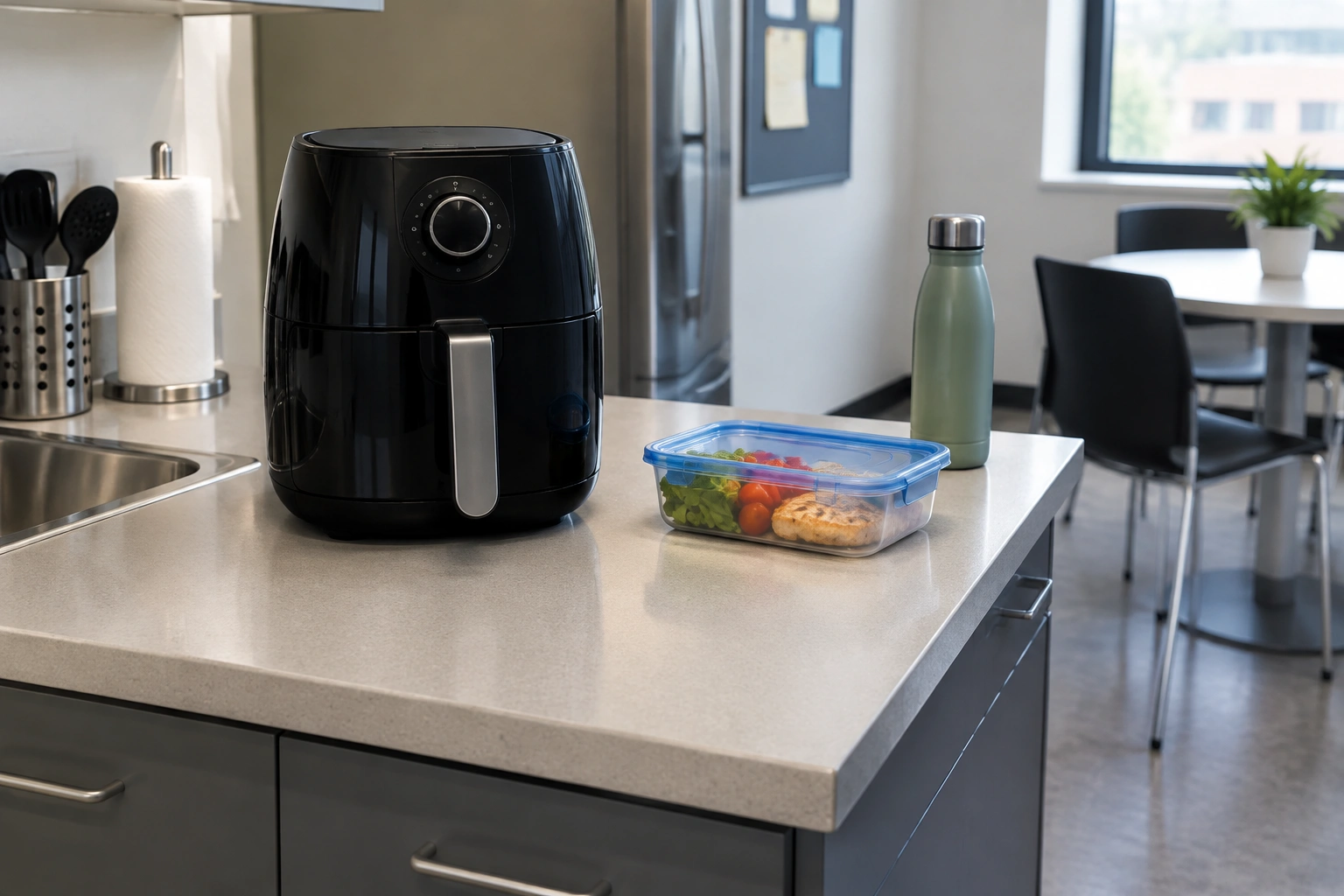
Quick Answer: Is an Air Fryer Good for Office Lunch?
Yes — sometimes very good, but not universally practical.
An air fryer works well for office lunch if:
- you have a real place to use it
- your office allows personal appliances
- you’re reheating food that benefits from crisping
- you can spare a few extra minutes at lunch
- your coworkers won’t mind the noise or smell
It is less useful if you need to eat in a hurry, have limited counter space, or work in a break room where every extra appliance becomes a nuisance. In those cases, a microwave, toaster oven, or even a cold lunch may be the cleaner choice.
The main trade-off is simple: better texture vs. more setup.
When an Air Fryer Makes Sense at Work
An air fryer is most useful in office settings where lunch is more of a short break than a race.
Here are the situations where it tends to work well:
You reheat small portions
Air fryers are built for individual servings. That makes them a good match for one lunch box, not a team meal. A single portion of chicken tenders, roasted potatoes, or veggie patties usually fits the basket better than a full casserole dish.
Your food should stay crisp
This is where the air fryer earns its place. A microwave can heat food quickly, but it often softens breading and makes fried or roasted foods limp. An air fryer does the opposite: it can revive texture better, especially with leftovers that were already crisp to begin with.
A good example is leftover takeout-style lunch food:
- fries
- tater tots
- breaded chicken
- potato wedges
- roasted broccoli or cauliflower
- spring rolls or similar crispy snacks
Your break room has enough space and airflow
A shared office kitchen with a clear counter, easy outlet access, and decent ventilation is much more workable than a tiny pantry nook. If the appliance can sit safely away from paper goods, bags, and clutter, the setup is far less stressful.
You don’t mind a few extra minutes
Air fryers usually need a little preheating and a short cook time. That’s not a problem if you have a flexible lunch break. It is a problem if you only have five minutes between meetings.
You want to prep at home and reheat at work
This is a strong use case. You can cook most of the meal at home, pack it safely, and use the air fryer only to reheat and crisp it at lunch. That gives you better results than relying on the office microwave alone.
When an Air Fryer Is a Poor Fit for Office Lunch
There are plenty of workplaces where an air fryer is technically possible but not realistically worth it.
The office has strict appliance rules
Some workplaces limit personal appliances because of fire safety concerns, building rules, or shared-space policies. If that applies, don’t assume a small appliance is automatically acceptable. Ask before you bring one in.
The break room is cramped
A compact air fryer still needs room for heat, airflow, and safe handling. If people are already crowding around the microwave, adding another hot appliance can make the space awkward fast.
You need speed above all else
If lunch is a 10-minute break, the microwave usually wins. It’s faster, simpler, and easier to clean up after. An air fryer may improve texture, but it usually cannot match the microwave for sheer convenience.
Strong smells would be a problem
Some foods are fine in a shared space; others are not. Reheating fish, heavily seasoned foods, or especially greasy items may not be appreciated in a small office kitchen. Even if the food tastes good, the smell can linger.
You don’t want extra cleanup
An air fryer basket, tray, or crisper plate needs washing. In a shared office kitchen, that becomes one more thing to manage. If your office already struggles with sink space or dish etiquette, the air fryer adds friction.
Air Fryer vs Microwave for Office Lunch
This is the comparison most people actually need.
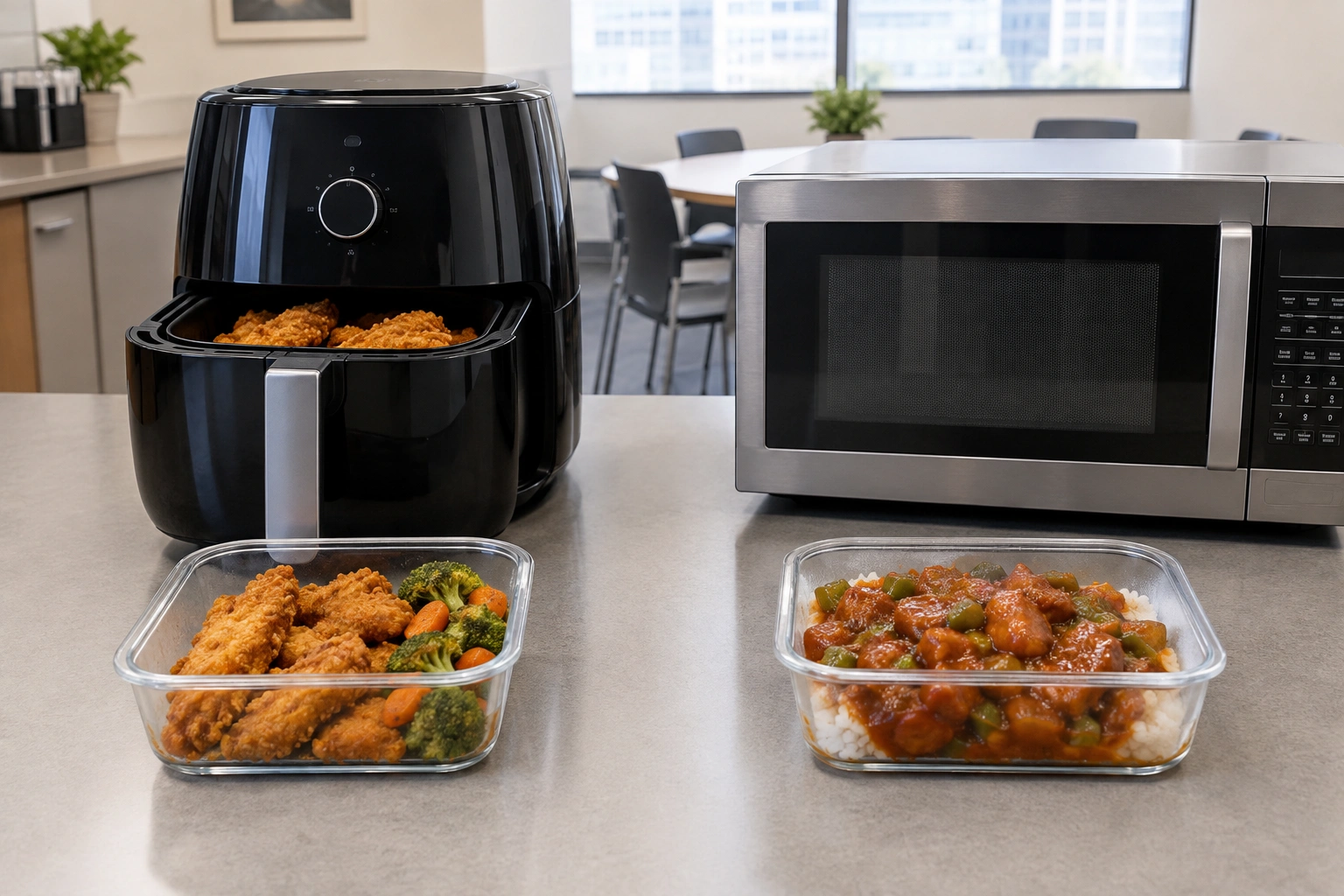
| Factor | Air Fryer | Microwave |
|---|---|---|
| Speed | Slower, usually needs preheating | Faster |
| Texture | Better for crisping | Softens food |
| Smell | Can be noticeable | Usually less lingering during use |
| Cleanup | Basket or tray needs washing | Usually minimal |
| Space needed | More counter space | Very little |
| Office friendliness | Mixed, depending on policy and etiquette | Usually the easiest option |
| Best for | Crispy leftovers, breaded foods, roasted foods | Soups, rice, pasta, saucy meals |
If your lunch is rice, chili, soup, or pasta, the microwave is usually the better tool. If your lunch is breaded chicken, fries, or roasted vegetables, the air fryer usually gives a better result.
If speed, reliability, and minimal cleanup are your top priorities, the microwave is the better default for office workers. It is also the easiest choice when you are not sure what the break room can handle.
A practical rule: choose the microwave for mixed, saucy, or soft foods; choose the air fryer for foods that should stay crisp.
Air Fryer vs Toaster Oven vs Cold Lunch
The air fryer is not the only non-microwave option.
Air fryer vs toaster oven
A toaster oven is often better if you need a little more flexibility with flat foods, sandwiches, or open-faced items. It may also feel more familiar in an office setting because it looks closer to a small oven.
For office lunch, the toaster oven can be the more practical shared-appliance option when you want a larger tray surface, while the air fryer usually wins on faster crisping for small portions and takes up less room. The toaster oven also tends to be easier for items like pizza slices or a sandwich on a tray.
Air fryer vs cold lunch
Cold lunch is the simplest option of all. No appliance, no waiting, no cleanup. It makes sense if your office setup is restrictive or your schedule is tight.
But cold lunch is a trade-off, not a failure. A well-packed cold meal can be just as satisfying if you build it around foods that taste good chilled:
- grain bowls
- pasta salad
- wrap sandwiches
- hummus and veggie boxes
- chicken salad
- pasta with vinaigrette-based dressing
If you want hot food and texture matters, the air fryer wins. If convenience matters most, cold lunch is hard to beat.
Best Lunch Foods to Reheat in an Air Fryer
The best office lunches for an air fryer are foods that already have some structure and can benefit from a dry, hot blast of air.
Foods that usually reheat well
- breaded chicken cutlets or tenders
- fries, tater tots, and potato wedges
- roasted vegetables
- tofu cubes that were cooked to be crisp
- veggie patties
- spring rolls or similar hand-held snacks
- leftover pizza, if your basket or tray fits it
- breakfast-for-lunch items like hash browns or breakfast sandwiches, when packed carefully
Air fryers are especially useful for already-fried or frozen foods such as chicken nuggets, fries, and tater tots.
A few good office lunch examples
-
Breaded chicken + potato wedges + green beans
This is a strong air fryer lunch because all three items benefit from crisping. -
Veggie burger + sweet potato fries
Reheats well if the patty is sturdy and the fries are not piled too thickly. -
Leftover roasted cauliflower and chickpeas
Good if you want a lighter lunch with better texture than a microwave can provide. -
Chicken tenders with a small container of dipping sauce
Reheat the chicken first, then add sauce after cooking so the coating stays crisp.
Foods That Do Not Reheat Well in an Air Fryer
Some office lunches simply do better in a microwave or a cold container.
Foods that usually disappoint
- soups and broths
- chili and stews
- saucy pasta dishes
- rice bowls with a lot of sauce
- delicate fish
- leafy salads
- foods with thin coatings that dry out quickly
- anything already very dry before reheating
These foods can overcook on the outside before they heat evenly inside. They may also lose moisture fast, which is the opposite of what you want during a workday lunch.
A sandwich is a borderline case. A toasted sandwich can be great, but a soft sandwich with wet fillings often gets awkward in an air fryer. If the filling is very moist, the bread may toast before the middle warms properly.
How to Reheat Lunch in an Air Fryer Without Drying It Out
The biggest mistake people make is treating the air fryer like a tiny oven and leaving lunch in too long.
Here’s the approach that usually works better:
1. Preheat if your model needs it
A short preheat helps food start crisping right away. If you skip it, the food may sit too long while the basket heats up.
2. Use a moderate temperature
For reheating, lower or moderate heat is usually safer than blasting lunch at the highest setting. High heat can dry out breaded food before the inside is warmed through.
3. Keep portions small and spread out
Crowding the basket blocks airflow. If lunch is stacked in a pile, some pieces will get soggy while others overcook. One layer is better whenever possible.
4. Check early
Lunch food often reheats faster than people expect. Check it before you assume it needs more time. A minute or two too long can change the texture a lot.
5. Add moisture carefully
If a food tends to dry out, a light brush of oil or a small amount of sauce added after reheating can help. Don’t soak the basket or the food. The goal is to protect texture, not steam the meal.
6. Reheat sauce separately
If you pack dipping sauce, gravy, or a dressing, keep it in a separate container and add it after the food is hot. That keeps breading and roasted surfaces crisp.
Office Rules, Noise, Smell, and Shared-Space Etiquette
This is the part many people overlook.
An air fryer is not just a cooking tool; in an office, it becomes a shared-space issue.
Check the rules first
If your workplace has a facilities policy, use that before bringing in any appliance. Some offices allow personal cooking devices only in designated areas. Others prohibit them entirely.
Think about noise
Air fryers are not silent. The fan hum is usually manageable, but in a quiet break room it can still be noticeable. If people take calls nearby, that matters.
Think about smell
Even good-smelling food can be disruptive if the room is small or poorly ventilated. In a shared office, choose foods that are likely to be well tolerated. Avoid anything especially pungent unless you know your coworkers are fine with it.
Clean up immediately
Wipe the basket, tray, and surrounding area after use. Don’t leave crumbs, grease, or food residue behind. In a shared kitchen, that matters as much as the cooking itself.
Size, Portability, and Power Needs: What to Look For
If you are considering bringing an air fryer to work, size matters more than most people expect.
Match the capacity to the office use case
For a single lunch portion, a compact 2-quart to 3-quart air fryer is usually enough. If you want room for a larger lunch, a sandwich, or a small shared setup, a 4-quart model is often the more practical middle ground. Bigger than that usually makes less sense unless the appliance stays in a larger office kitchen and gets regular use.
Compact models are usually the better office choice
A compact air fryer is easier to store and carry, and it is less likely to dominate the break room counter. It also fits the kind of lunch portions most office workers actually make.
Full-size models are harder to justify
A larger air fryer may be fine at home, but in an office it can feel excessive unless the space is generous and the appliance will be used often.
Check outlet access and power load
Use a proper outlet and avoid overloading the circuit with other high-draw appliances. That’s especially important in older office buildings or shared kitchen spaces where the electrical setup may already be busy. If the break room already has a coffee maker, microwave, and other appliances on the same circuit, check with facilities before plugging in another heavy-use device.
Portability matters more than it seems
If you plan to bring the appliance from home, weight and handle design matter. A machine that is easy to carry is more likely to be used consistently.
Meal-Prep Strategies That Work Best with an Air Fryer
Air fryer office lunches work best when you prep with reheating in mind.
Pack components separately
Keep crisp items away from wet ingredients. For example:
- chicken in one container
- sauce in a small cup
- greens or salad in another container
- potatoes or vegetables in a separate section
This prevents the lunch from turning soggy before you even reheat it.
Choose foods that hold shape
Meal prep is easier when the main item stays intact. Breaded chicken, roasted vegetables, and sturdy patties hold up better than fragile or heavily sauced foods.
Pre-cook at home, reheat at work
This is usually the best balance for office life. You get the convenience of meal prep without depending on the office kitchen for full cooking.
Don’t overpack the container
If you cram everything into one box, the air fryer can’t help much later. A lunch that is loosely packed at home reheats more evenly at work.
Food Safety Basics for Reheating Office Lunch
For leftovers, food safety matters as much as texture. The USDA’s air fryer food safety guidance covers safe handling basics for air fryer use.
A few practical rules for office lunches:
- keep leftovers refrigerated until you are ready to reheat them
- reheat only once, and don’t let cooked food sit out for long before or after heating
- if you do not have a thermometer, reheat until the food is steaming hot throughout and the center is no longer cool
- stir or separate thick leftovers if needed so they heat more evenly
- when in doubt, follow the food’s packaging directions or official food-safety guidance
Simple Decision Guide: Should You Use an Air Fryer at Work or at Home?
Use this quick rule:
Bring or use an air fryer at work if:
- your office explicitly allows it
- the break room has room and ventilation
- you regularly reheat crisp foods
- you have time to wait a few extra minutes
- you’re only making one lunch at a time
Stick with the microwave if:
- speed matters more than texture
- your lunch is saucy, soft, or liquid-based
- the office already has a good microwave
- you want the easiest cleanup
Use the air fryer at home instead if:
- your office setup is cramped
- coworkers are sensitive to smell or noise
- you want to crisp lunch before commuting
- you’d rather pack a hot, already-finished meal
That last option is often overlooked. For many commuters, the best routine is to use the air fryer at home in the morning, then pack lunch in a way that stays good until noon. You get the texture benefit without turning the office into a cooking station.
Workplace Policy and Facilities Check
If your workplace has appliance restrictions, electrical limits, or shared-kitchen rules, check with facilities or your manager before bringing in an air fryer. Ask whether personal countertop appliances are allowed, whether there are designated outlets or spaces, and whether the break room circuit can handle another high-draw device. If the policy is unclear, get approval first instead of assuming it is fine.
Bottom Line
So, is an air fryer good for office lunch? Yes — if your office setup supports it and your lunch food is the kind that benefits from crisp reheating. It is especially useful for small portions, breaded foods, roasted vegetables, and meal-prepped lunches that need texture more than speed.
If your workday is tight, your break room is crowded, or your lunch is mostly soups and sauces, the microwave is probably the better fit. In other words, the air fryer is a strong office lunch tool for the right person, but it is not the universal answer.
For related reading, you may also find these helpful:
– Is an Air Fryer Good for Busy Parents? A Practical Guide for Family Meals
– Is an Air Fryer Good for Baking? What Works, What Doesn’t, and How to Adjust
– Is an Air Fryer Good for Low-Calorie Meals? A Practical Guide for Healthier Everyday Cooking
FAQ
Can I bring an air fryer into an office?
Sometimes, but only if your workplace allows personal appliances and the break room setup can handle it. Check facilities or office policy first.
What size air fryer is best for office lunch?
A 2-quart to 3-quart model is usually enough for one person. A 4-quart air fryer is a better choice if you want a little more flexibility or occasional shared use.
Is an air fryer better than a microwave for office lunch?
Not usually for speed. The microwave is better for fast, low-effort reheating. The air fryer is better when you want crisper texture.
What foods are best for an office air fryer?
Breaded chicken, fries, tater tots, roasted vegetables, and other foods that should stay crisp tend to work best.
Do I need a thermometer to reheat leftovers safely?
A thermometer is helpful, but if you do not have one, reheat leftovers until they are steaming hot throughout and no longer cool in the center.

