
NutriChef 5.8 Quart Air Fryer Review (2026)

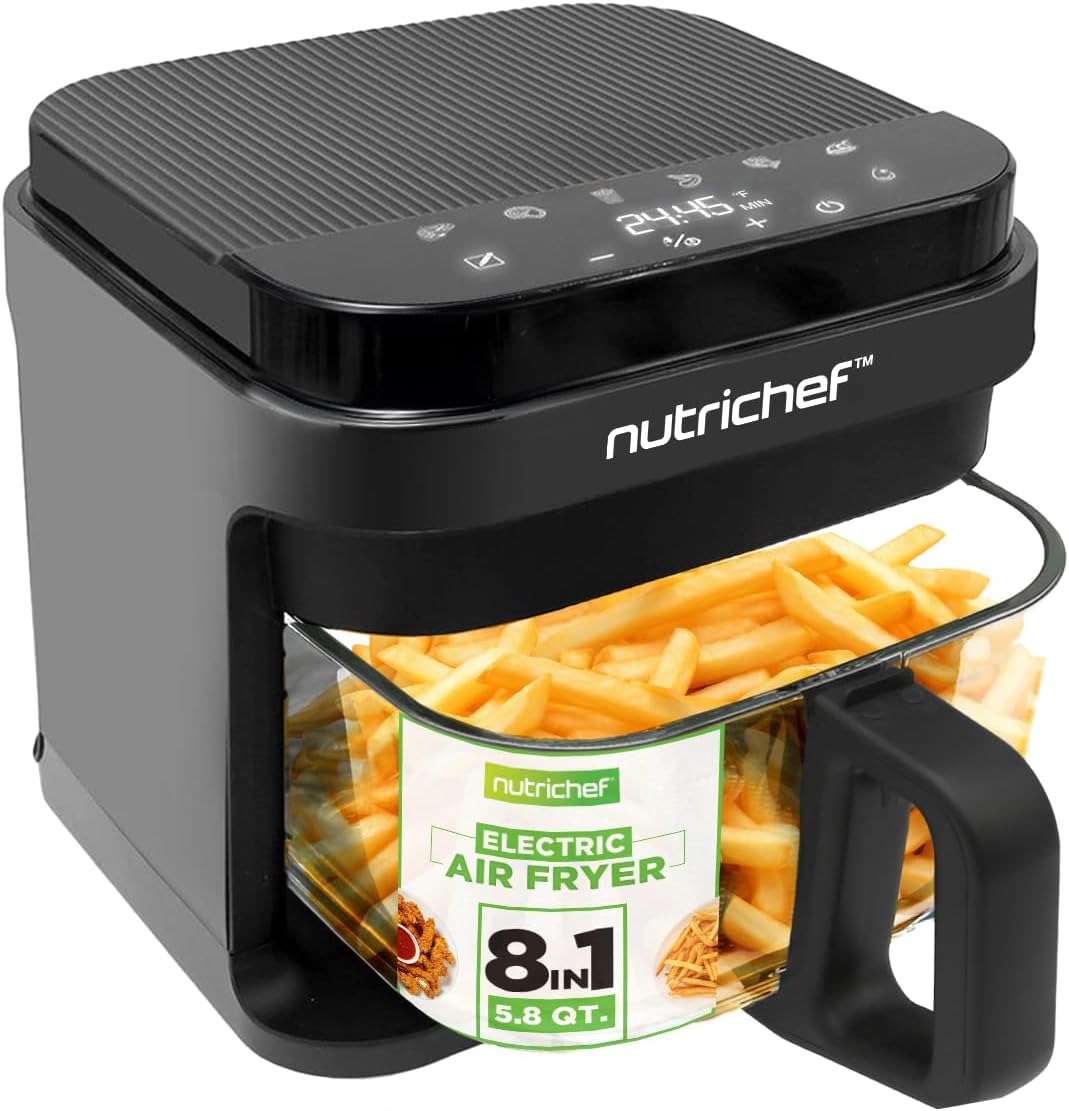
The NutriChef NCAF539TB is a 5.8-quart (5.5L) single-basket air fryer built around one unusual feature: a transparent glass cooking bowl. That makes it easy to watch fries, wings, vegetables, or reheated food without repeatedly opening the basket. The trade-off is performance. Independent RTINGS testing found the 1200W system slower and less even than stronger rivals, so this model makes the most sense for buyers who prioritize visibility, easy cleanup, and a compact footprint over class-leading crisping speed.
Quick Overview and Specifications
| Specification | NutriChef NCAF539TB |
|---|---|
| Capacity | 5.8 qt / 5.5L; RTINGS measured the same 5.8-qt volume |
| Power | 1200W rated; RTINGS measured about 1185W maximum draw |
| Temperature range | 105°F–390°F |
| Timer | Up to 60 minutes |
| Controls | Digital touchscreen with eight food/cooking presets |
| Basket | Transparent glass chamber with nonstick mesh tray |
| Dimensions | About 14.0″D × 11.6″W × 11.1″H |
| Safety | Automatic shut-off and overheat protection |
| Warranty | 1 year |
First Impressions
The first thing that separates this NutriChef from ordinary drawer air fryers is the glass chamber. You can see food color and surface browning from the side rather than relying on a small window or opening the basket. The body is also fairly compact for its advertised capacity; RTINGS measured roughly 11.3 inches wide and 13.8 inches deep, while Consumer Reports lists it at about 12 × 14 inches.
The touchscreen is straightforward, but the “8-in-1” wording deserves context. NutriChef lists food presets for fries, chicken, fish, shrimp, steak and similar tasks, while RTINGS classifies only Defrost and Manual/Air Fry as distinct cooking-method modes. New owners may want to begin with a small calibration batch; our guide to the first thing to cook in a new air fryer explains why frozen fries quickly reveal browning and airflow behavior.
Performance & Feel
This is where the NCAF539TB becomes more mixed. RTINGS measured only 52% of test fries as properly crispy, with 42% undercooked and 6% overcooked. The machine also needed 23:12 to reach its moisture-loss benchmark, so it is not one of the faster basket fryers. That matches retailer feedback describing it as easy to use but slower than higher-powered models.
Capacity is more convincing than speed. RTINGS measured 59.4 square inches of basket surface and judged it suitable for roughly two to three people when food is kept in a single layer. Crowding reduces consistency, so the best results come from leaving visible space around fries, wings, vegetables, or breaded foods. If you are deciding where air frying is actually worthwhile, our guide to whether food tastes better from an air fryer explains why browning and surface dryness matter so much.
Glass Basket Visibility & Cleanup
The glass bowl is the strongest reason to choose this model. You can monitor cheese browning, wing color, vegetables, or reheated leftovers without dumping heat by opening the basket. That is especially helpful here because temperature recovery is slow: RTINGS measured about 5 minutes 57 seconds to recover after food was added, with a 62°F variation at a 400°F setting.
Cleanup is another advantage. NutriChef lists a removable basket and dishwasher-safe mesh tray, and multiple retailer reviews specifically praise the easier-to-clean glass design. The glass needs sensible handling, though. NutriChef warns against sudden temperature changes, impacts, abrasive cleaners, and continued use if the chamber becomes cracked or chipped.
Durability
Long-term evidence is less reassuring than the feature sheet. NutriChef backs the unit with a one-year warranty, but Target’s smaller review pool includes reports of an E1 error after several months, control-area separation after about a year, and declining heat performance. Those reports do not prove a universal defect, and the sample is much smaller than Amazon’s rating pool, but they are enough to make long-term durability a question rather than a proven strength.
Value for Money
At the roughly $70–$85 prices seen during research, value depends on what you are buying for. If the glass chamber is the priority, the NutriChef is reasonably accessible and offers useful capacity, simple controls and easy monitoring. If cooking performance is the priority, 1200W, a 390°F ceiling, slow preheat and inconsistent crisping make the same price harder to justify against 1700W-plus rivals.
Comparison to Similar Competing Products
COSORI TurboBlaze 6-Qt: This is the performance-focused alternative. It uses 1725W, reaches 450°F, offers nine functions and multiple fan-speed profiles. It has no glass chamber, but it is faster, more versatile and better suited to crisping. See our COSORI TurboBlaze 6-Qt review.
Ninja Air Fryer Pro AF141: The Ninja has a slightly smaller 5-quart rating but a 1750W heater and a larger usable cooking surface. It lacks the NutriChef’s glass bowl, yet independent testing favors it for faster, more consistent air frying. Our Ninja AF141 review covers that compact alternative.
Ninja Crispi Pro AS101: This is the more direct glass-cooking competitor. RTINGS found it cooks faster and more evenly and offers broader temperature/mode flexibility, although it typically costs more. The NutriChef counters with a simple all-in-one footprint and slightly larger basket surface area.
Pros & Cons
Pros
- Transparent glass cooking chamber
- Compact footprint for 5.8 qt
- Easy food monitoring without opening
- Dishwasher-safe mesh tray
- Simple digital controls and presets
Cons
- Uneven crisping in independent testing
- Slow preheat and heat recovery
- Only 390°F maximum temperature
- Lower 1200W power than many rivals
- Some retailer complaints about longevity
Who Should Buy This?
Buy the NCAF539TB if you cook mainly for one to three people, want to see food as it browns, dislike opaque nonstick drawers, and value easy cleanup more than maximum speed. It is especially sensible for reheating, vegetables, smaller frozen-food batches, and users who want a compact glass-basket design. Skip it if you regularly cook large batches, want a 450°F finishing mode, or expect the fastest and most even fries for the money.
Extended FAQ
Is the NutriChef NCAF539TB really 5.8 quarts?
Yes. NutriChef markets it as 5.5L/5.8 qt, and RTINGS measured 5.8 qt of chamber capacity.
Does it have a glass basket?
Yes. The transparent cooking chamber is glass, which is the model’s most distinctive feature and lets you watch food without opening the basket.
How hot does it get?
The adjustable range is 105°F to 390°F. That is enough for ordinary air frying, but below the 450°F ceiling offered by some competing models.
Is the NutriChef 5.8-quart air fryer dishwasher safe?
The mesh tray is listed as dishwasher-safe. The glass chamber should be handled according to NutriChef’s care instructions and protected from thermal shock and abrasive cleaning.
How many people can it cook for?
RTINGS found the basket practical for roughly two to three people when food is arranged in a single layer. Larger households will often need multiple batches.
Is it better than the COSORI TurboBlaze?
The NutriChef is better suited to shoppers specifically wanting a transparent glass chamber. For speed, high heat, cooking modes and crisping performance, the TurboBlaze has the stronger specification and test profile.
Final Verdict
The NutriChef 5.8 Quart NCAF539TB succeeds at being different: its glass bowl is genuinely useful, cleanup is straightforward, and the compact body still gives two or three people workable capacity. But independent testing exposes the cost of its lower-powered design. Slow preheating, weak temperature recovery and uneven crisping keep it behind stronger competitors. Choose it for the glass-basket experience and visibility; choose a COSORI or Ninja alternative if cooking speed and crisping consistency matter more.
As an Amazon Associate, we earn from qualifying purchases…