
What Size Container Fits 5 Pounds of Flour? A Practical Storage Guide

If you want the short answer: a 6-quart container is the safest all-around choice for 5 pounds of flour. It gives you enough room for the flour itself plus a little headroom for scooping and leveling without making a mess. A 1-gallon container may work for some flour types, but it can be tight depending on how densely the flour packs and whether you want to keep a scoop inside.
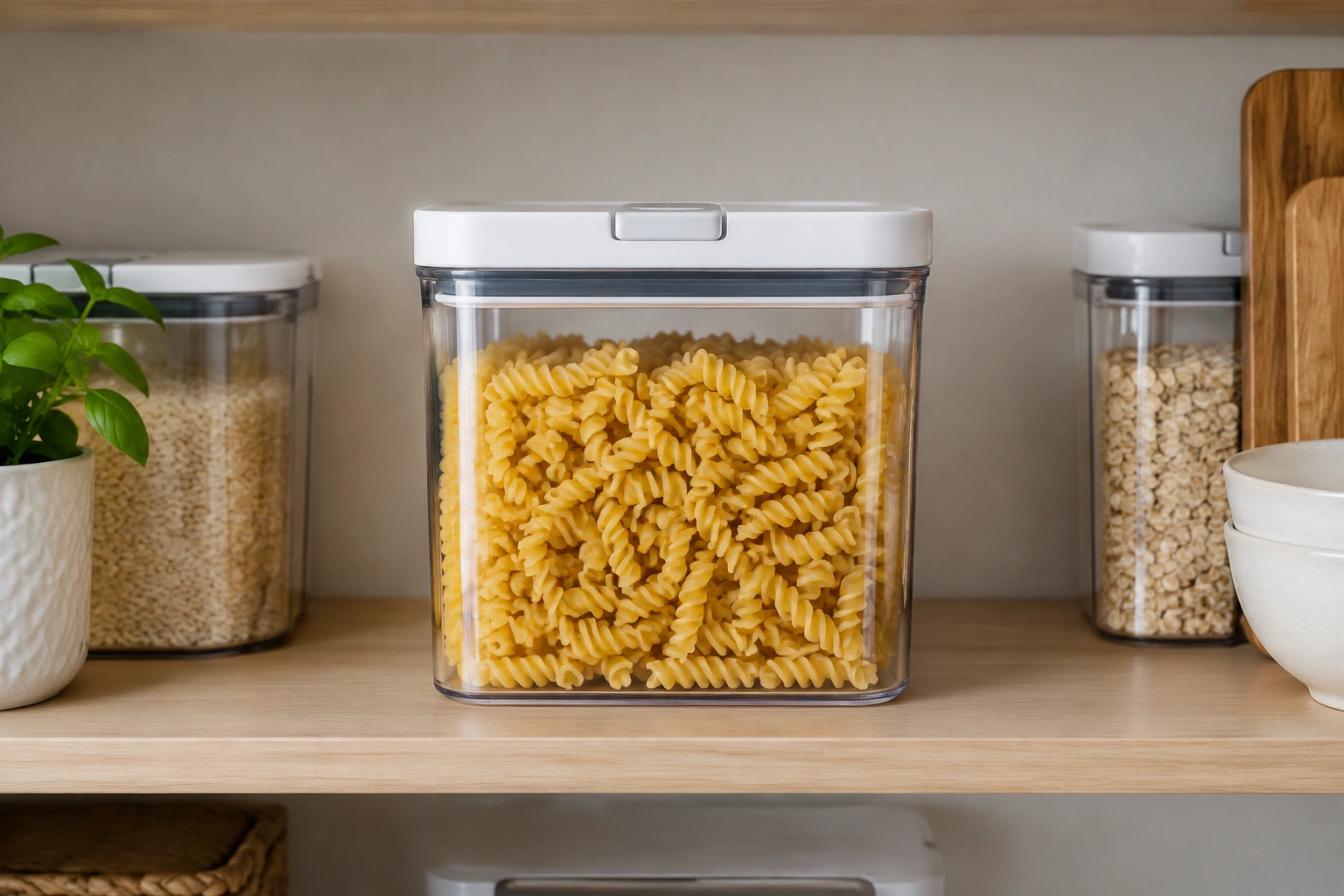
For a quick conversion, 5 pounds of flour is roughly 18 to 20 cups, about 6 quarts, about 5.7 liters, or about 1.5 gallons. The exact cup count varies by flour type and how the flour is scooped or packed, so treat that as an estimate rather than a fixed number.
For most busy kitchens, that means this simple buying rule works well:
- Best single-container pick: about 6 quarts
- Tight but sometimes workable: 1 gallon
- If you want extra room for easy scooping: go larger than 6 quarts
For the default shopper, the practical recommendation is simple: buy one 6-quart airtight, wide-mouth container for one 5-pound bag of flour. Choose 8 quarts if you want extra room for a scoop, easier handling, or a bag liner. If you plan to keep the original bag inside the bin, choose a larger container than 6 quarts because the bag reduces usable space.
All-purpose flour, bread flour, and whole wheat flour can vary slightly in packing density, so the safe choice is to size up rather than buy a container that fits exactly.
That recommendation is a practical rule of thumb, but actual usable capacity can vary by container shape, flour type, and whether you transfer the flour loosely or keep it in the bag. If you want a reference point, The Practical Kitchen’s flour container guide is useful, and King Arthur Baking also notes that a 6-quart container is a good size for 5 pounds of flour.
What You Need to Know Before Choosing a Container
Before you buy, think about three things:
- What kind of flour you store most often
- Whether you transfer flour loosely or pack it down
- Whether the container must also hold a scoop or measuring cup
Those details matter because flour is not a rigid product. It settles. It aerates. It packs differently depending on how it was bagged, how it was poured, and how much it was handled before you transferred it.
All-purpose flour is usually the easiest to size for. Bread flour and whole wheat flour can take up slightly different amounts of space because their particle structure and packing behavior differ. The practical takeaway is simple: buy for a little extra room, not for a perfect edge-to-edge fit.
If you want the container to do double duty as storage and daily-use access, choose one with a wider opening. A narrow container can technically hold the flour but still be annoying every time you try to scoop it.
How Much Space 5 Pounds of Flour Takes Up
A 5-pound bag of flour does not translate to one exact volume in every kitchen. Density varies by flour type and by how the flour is handled. That said, the following comparison is useful for shopping.
Approximate volume guide for 5 pounds of flour
| Flour amount | Approximate capacity | What that means in practice |
|---|---|---|
| 5 pounds flour | about 6 quarts | Comfortable single-container storage for most home kitchens |
| 5 pounds flour | about 5.7 liters | Similar to a 6-quart container |
| 5 pounds flour | about 1.5 gallons | Roughly the loose-volume estimate for many flours, but not a guarantee that a 1-gallon bin will fit comfortably |
A few practical notes:
- A quart is a little under a liter.
- A 1-gallon container equals 4 quarts.
- That means a gallon bin is often too small if you want easy scooping room, even if the flour itself might squeeze in depending on the type and how densely it packs.
A helpful real-world comparison: a 64-ounce half-gallon jar is often described as holding about 3.5 to 4 pounds of flour, but that is only a rough comparison because flour weight-to-volume conversions vary by flour type and packing method. It is better as a sizing clue than as a precise rule. If half a gallon is not enough, a full gallon may still feel tight unless the container is unusually efficient in shape.
Best Container Size for 5 Pounds of Flour
If you want the most practical answer, buy a container with at least 6 quarts of capacity.
That gives you enough room for:
- the flour itself
- a little air space at the top
- easier leveling with a cup or scoop
- less spill risk when you open and close the lid
Is a 1-gallon container enough?
Sometimes, but I would not call it the safest buy.
A 1-gallon container gives you 4 quarts of volume. Since 5 pounds of flour is often close to 6 quarts in practical pantry terms, a gallon container can be short on space. Even if the flour fits after settling, you may not like how full it feels when you try to scoop from it. That matters in a real kitchen, because a container that is technically “big enough” can still be frustrating if flour piles up near the rim.
My practical recommendation
- Choose 6 quarts if you want one container for one 5-pound bag.
- Choose 8 quarts if you want extra room for a scoop, a bag liner, or easier handling.
- Choose a gallon only if you know the flour type and container shape leave you enough margin.
This is the kind of situation where a little extra space is useful. A container filled to the brim is harder to use, more likely to spill, and less pleasant to keep tidy in a pantry.
One Large Container or Two Smaller Containers?
This is the decision point many home cooks actually face. Both approaches work, but they solve different problems.
One large container works best when:
- you want the simplest setup
- you buy flour in 5-pound bags and use it regularly
- you have a shelf that can handle one medium-large bin
- you prefer fewer containers to wash and label
The advantage is convenience. You open one lid, scoop one ingredient, and move on.
The trade-off is size. A single container is heavier to lift and may be awkward if your pantry shelf is narrow or high.
Two smaller containers work best when:
- your pantry space is tight
- you want easier lifting and pouring
- you like to keep a backup portion separate
- you use flour in different areas of the kitchen
A practical split is one 3-quart container plus one 2-quart or 3-quart container, depending on how much room you want for scooping. Another simple option is two 4-quart containers if you want more flexibility and easier handling. This can be especially useful for families who bake often but do not want one bulky bin taking over the shelf.
The trade-off is more lids, more labels, and more chances to forget which container is open first.
Simple decision rule
- If you want easy, low-maintenance storage, choose one 6-quart container
- If you want flexibility and easier handling, split it into two smaller airtight containers, such as two 3-quart bins or one 4-quart plus one 2-quart bin
- If you want extra room for a scoop or liner, step up to 8 quarts
Best Container Shape and Material for Pantry Storage
For flour, shape matters almost as much as capacity.
Shape: square or rectangular usually wins
A square or rectangular container generally uses pantry space more efficiently than a round one. It sits closer to the wall, stacks better, and wastes less shelf space around the edges.
Round containers can be comfortable to scoop from, but they often leave awkward gaps on the shelf. If your pantry is narrow or crowded, that wasted space adds up fast.
Material: food-safe, airtight, and easy to clean
For dry pantry storage, choose a wide-mouth, food-grade plastic or BPA-free bin with a gasket-style lid. That combination is usually the easiest pantry choice because it is lightweight, easy to scoop from, and simple to wipe clean.
Look for:
- a tight-sealing lid
- a wide enough opening to scoop easily
- a material that wipes clean without holding odors
- a shape that fits your shelf depth
If you like to keep flour in the original bag for convenience, you can place the whole bag inside a larger container. That can make cleanup easier if the bag tears. Just remember that the bag takes up some of the useful space, so you will need a slightly larger bin than you would for loose flour.
For general container selection, this guide on choosing kitchen storage containers for everyday use can help you compare lid types, materials, and pantry-friendly features.
Step-by-Step: Store 5 Pounds of Flour the Right Way
Here is the simplest method for transferring flour without making a mess.
-
Pick the container before you open the flour bag.
Make sure the opening is wide enough for scooping and that the capacity is at least around 6 quarts if you want comfortable room. -
Wash and dry the container completely.
Any moisture left inside can cause problems for dry goods. -
Transfer the flour slowly.
Pour in a steady stream. If the opening is narrow, use a funnel or pour in smaller batches. -
Leave a little headroom.
Do not fill the container to the top. A practical fill line is about 80 to 85 percent full if you want easier scooping and fewer spills. -
Label the container.
Write the flour type and the date you transferred it. That helps with pantry rotation and avoids confusion if you store more than one kind. -
Seal it tightly.
A secure lid is worth prioritizing if you want cleaner pantry storage. -
Store it in a cool, dry cabinet.
Keep it away from heat and moisture sources.
If you use flour regularly, keep the container where you can reach it without moving other items first. That small adjustment makes meal prep feel much easier.
Common Mistakes to Avoid
Buying the exact size with no margin
A container that matches the volume too closely may be annoying to use. You need room for scooping, leveling, and closing the lid cleanly.
Assuming every flour takes the same space
All-purpose flour, bread flour, and whole wheat flour can behave a little differently. If you switch between types, size for the one you use most often.
Choosing a shape that looks nice but stores poorly
A round container may be pleasant to handle, but a square one often fits a pantry better.
Forgetting about the scoop
If you want to leave a measuring cup inside, the container needs more room than the flour alone requires.
Using a non-airtight bin
Flour should be kept sealed in a clean, food-safe container. For storage basics, the FDA’s food storage guidance is a useful place to review general dry-goods handling and container cleanliness principles: FDA food storage basics.
Troubleshooting: If Your Flour Doesn’t Seem to Fit
If the flour seems too full for the container, here are the likely fixes.
The container is just a little too small
Move up one size. For most households, that means stepping from a 1-gallon or 3.8-quart bin to a 6-quart container.
The flour is packed tighter than expected
Flour can settle during shipping or after you tap the bag. Fluff it lightly before transferring if you need a more accurate sense of volume.
You want to store the original bag inside
That adds bulk. Choose a larger container if you want the convenience of leaving the flour in the bag.
You need room for a scoop
Pick a wider bin, not just a taller one. Height alone does not solve an awkward opening.
You are splitting storage between pantry and backup
Use two containers: one for daily use and one for reserve. That can be easier than forcing everything into a single tight bin.
Practical Examples of Container Choices
Here are a few realistic setups.
Example 1: The simple pantry setup
You buy one 5-pound bag of all-purpose flour and store it in a 6-quart square airtight container. This is the easiest all-around option for most home kitchens.
Example 2: The tight pantry shelf
You do not have much depth on the shelf, so you choose a rectangular container with about 6 quarts of capacity rather than a round bin. It fits closer to the wall and wastes less space.
Example 3: The flexible family setup
You split the flour into two smaller airtight containers so one stays in the pantry and the other sits in a backup cabinet. This works well if several people cook and you want the storage easier to lift and handle.
Example 4: The “I want room for the scoop” setup
You choose a container larger than 6 quarts so the flour is not packed near the rim. That makes everyday baking less messy.
When to Ask a Food Safety Expert
If you are unsure whether a container is food-safe, or you are dealing with pantry pest issues, unusual moisture, or flour that has been stored improperly, it is worth checking with a food safety professional or your local extension office. A clean, dry, sealed container is the baseline, but specific problems are worth getting checked rather than guessed at.
Final Takeaway
For most home cooks, the answer to what size container for 5 pounds of flour is straightforward: buy about a 6-quart airtight container. It gives you enough room for the flour plus practical headroom, and it is usually easier to live with than a tight 1-gallon bin. If you want extra room for a scoop or a bag liner, step up to 8 quarts. If your pantry is cramped, a smart square or rectangular container will usually serve you better than a round one. And if you prefer the original bag inside the bin, choose a larger container than 6 quarts so you do not lose usable space.