
What Temperature to Bake Bread for the Best Crust and Crumb

If you want the short answer, here it is: most bread bakes somewhere between 350°F and 475°F (177°C to 245°C), but the best temperature depends on the style of bread, the pan or vessel you’re using, and how dark or crisp you want the crust.
As a working rule:
– Lean artisan loaves and sourdough boules often bake hotter, around 425°F to 475°F
– Sandwich bread usually does well around 350°F to 375°F
– Enriched breads and rolls often land around 325°F to 375°F
– Rye and gluten-free yeast breads may need special attention to finish temperature more than oven temperature
That’s the part many bakers miss: the oven setting is only half the story. Bread is truly done when the inside is baked through, not just when the crust looks brown.
Bread Baking Temperature Chart by Bread Type
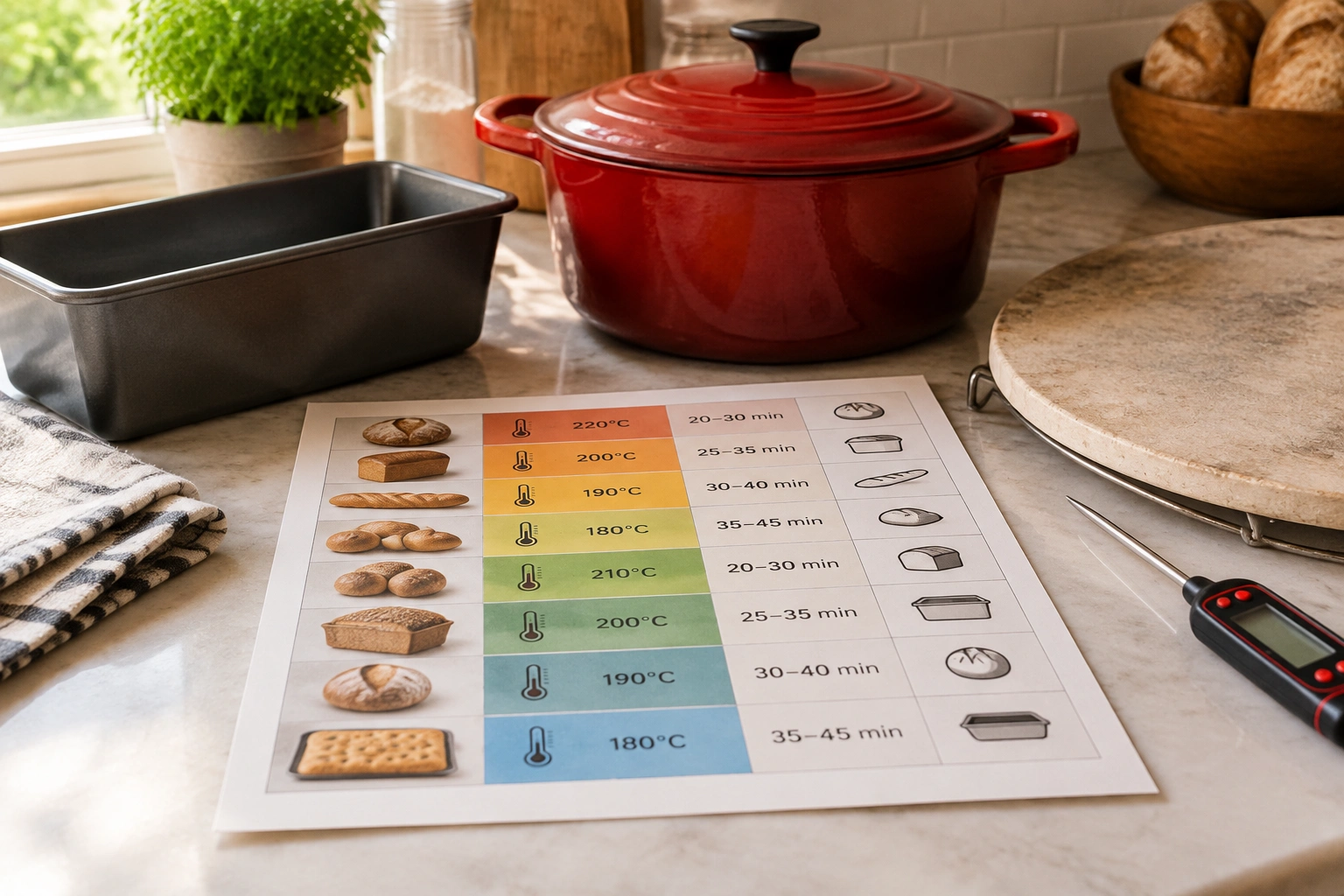
Use this as a practical starting point, not a rigid rule. Recipes, pan size, dough hydration, and oven behavior can shift the ideal setting a little.
| Bread type | Typical oven temperature | Common bake setup | Target internal temperature |
|---|---|---|---|
| Lean artisan loaf | 425°F to 475°F | Dutch oven, stone, or steel | About 205°F to 210°F |
| Sourdough boule | 450°F to 475°F | Preheated Dutch oven | About 205°F to 210°F |
| Baguette or crusty hearth bread | 450°F to 475°F | Stone or steel with steam | About 205°F to 210°F |
| Sandwich bread | 350°F to 375°F | Loaf pan | About 180°F to 190°F |
| Enriched bread | 325°F to 375°F | Loaf pan or sheet pan | About 180°F to 190°F |
| Dinner rolls | 350°F to 375°F | Sheet pan | About 180°F to 190°F |
| Rye bread | 375°F to 425°F | Pan or hearth bake | About 205°F to 210°F |
| Gluten-free yeast bread | 350°F to 400°F | Loaf pan | About 205°F |
A few important notes on that chart:
- Lean breads contain little or no fat or sugar, so they can tolerate higher heat and benefit from strong oven spring.
- Enriched doughs brown faster because fat, sugar, and dairy encourage color. A gentler oven helps the center finish before the crust gets too dark.
- Rye and gluten-free breads often need a more careful doneness check. The internal temperature matters a lot because their structure behaves differently from wheat bread.
For a deeper look at dough ingredients and how they affect baking behavior, see our guide on what bread dough is made of.
What You Need Before You Bake
Before you choose a temperature, make sure your setup can support it.
Essential tools
- An oven thermometer: Many home ovens don’t match the dial exactly, so it’s worth checking the actual temperature.
- An instant-read thermometer: This is the most reliable way to tell whether bread is baked through.
- A loaf pan, baking stone, baking steel, or Dutch oven: The bake vessel changes how heat reaches the dough.
- Oven mitts and a stable place to set hot cookware: Especially important with Dutch ovens and stones.
A useful habit is to preheat long enough that the oven walls and bake surface are fully heated, not just the air inside. Bread reacts to stored heat, especially in the first minutes of baking.
Commercial bread ovens can reach 260°C (500°F) or higher, which most home ovens cannot match. They also often use a stone floor that holds and spreads heat differently than a typical kitchen oven. That’s one reason home bakers often need to be more deliberate about preheating and temperature checks.
How to Choose the Right Baking Temperature
Instead of asking, “What is the one best temperature for bread?” ask these three questions:
1. What kind of bread am I baking?
- Lean artisan dough: choose a hotter oven for strong rise and a crisp crust.
- Sandwich or enriched dough: choose a moderate oven so the loaf cooks through before the crust overbrowns.
- Rye or gluten-free yeast bread: follow the recipe closely, then verify doneness with a thermometer.
2. What result do I want?
- Deep brown, crackly crust: go hotter.
- Soft, even sandwich crust: go cooler.
- A balance of color and tenderness: moderate heat usually wins.
3. What vessel am I using?
- Dutch oven: often supports a hotter start because it traps steam and shields the loaf early on.
- Loaf pan: usually works better at moderate heat.
- Baking stone or steel: can handle high heat well, but the bottom crust may brown faster.
The trade-off is simple: higher heat gives better oven spring and stronger crust development, but it also increases the risk of a dark exterior before the center is finished. Moderate heat is gentler, but the loaf may look less dramatic.
Step-by-Step: Bake Bread at the Right Temperature
1. Preheat fully
Set the oven to the recipe’s target temperature and give it enough time to stabilize. If you are using a stone, steel, or Dutch oven, let those heat thoroughly too.
2. Place the loaf correctly
- Loaf pan bread usually bakes in the center of the oven.
- Stone or steel loaves need enough clearance around them for heat to circulate.
- Dutch ovens should be preheated carefully and handled with serious caution.
3. Load the bread and keep the heat steady
Once the loaf goes in, avoid opening the door repeatedly. Heat loss can reduce oven spring and delay browning.
4. Use steam when the recipe calls for it
Steam matters most for hearth breads and artisan loaves. It helps the crust stay flexible during the first part of baking, which supports oven spring and a thinner, shinier crust.
A common approach is to start with steam or a covered vessel and then remove the steam source later in the bake. For example:
– Artisan sourdough or boules: start hot, often in a preheated Dutch oven at 450°F to 475°F, then uncover for the final portion if the recipe calls for it.
– Baguettes or hearth loaves on a stone: start at a hot temperature with steam, then continue baking after the steam is released or removed.
– Sandwich loaves and enriched pan breads: usually do not need steam; they benefit more from steady, moderate heat.
5. Adjust if the recipe calls for it
Some breads begin at a higher temperature and then finish lower. That hot start helps the loaf expand quickly, while the lower finish protects the crust from overbrowning.
A simple rule of thumb: start hot for oven spring, then lower the temperature once the loaf has risen and the crust has set enough to hold its shape. That is especially useful for artisan loaves. Sandwich loaves are more often baked at one steady moderate temperature, though some recipes may still begin hotter and then drop slightly to finish the center without overbrowning the top.
6. Check doneness near the end
Use the recipe’s time as a guide, not a verdict. Insert an instant-read thermometer into the thickest part of the loaf.
For many lean breads, you’re looking for about 205°F to 210°F inside. For enriched breads, 180°F to 190°F is a common target.
How Oven Type Changes the Temperature You Use
Conventional oven
A conventional oven is the easiest place to follow a standard bread recipe. It still has quirks, though. Some run hot, some run cool, and some brown unevenly.
If your oven is unreliable, an oven thermometer is worth using regularly. A small difference of 15°F to 25°F can change crust color and bake time enough to matter.
Convection oven
A convection fan moves air around the oven, which usually speeds browning and can shorten bake time. A practical rule is to reduce the recipe temperature by about 25°F when using convection, unless the recipe specifically says otherwise. If a bread recipe was written for conventional heat, that adjustment is a sensible starting point.
That said, convection is not automatically better for every loaf. Some breads do fine with the fan on, while others develop a crust that sets too quickly. If the loaf is browning too fast, you may need to reduce the temperature a bit more or switch back to conventional heat if your oven allows it.
Dutch oven
A Dutch oven traps steam around the loaf, which helps the surface stay flexible during the early bake. That often improves oven spring and crust texture.
Because the vessel is already preheated, it can create intense bottom and side heat. That’s great for artisan bread, but it also means you need to handle the pot carefully and watch for overbrowning on the base.
Baking stone or baking steel
A stone or steel gives strong bottom heat and can improve crust development. It’s especially useful for hearth breads and baguettes.
The trade-off is that the underside can brown faster than the top. If your loaves are dark on the bottom but pale on top, the stone may be too low in the oven or the temperature may be too high for that setup.
Loaf pan
Pan bread usually benefits from moderate heat. The pan supports the dough’s shape and slows direct exposure to oven heat, which helps the center bake evenly.
That’s one reason sandwich bread often bakes lower than free-form artisan loaves.
How Temperature Affects Crust, Oven Spring, and Crumb
Temperature changes more than color.
Hotter baking
A hotter oven:
– boosts oven spring
– encourages a thicker, darker crust
– helps create a more open crumb in lean doughs
– can dry the crust sooner
This is why sourdough boules and crusty hearth breads are often baked hot. The early blast of heat helps the loaf expand before the crust sets.
Cooler baking
A cooler oven:
– gives the center more time to cook
– reduces the chance of a burnt crust
– works better for enriched doughs and pan breads
– can produce a softer crust
If you’ve ever pulled out a loaf that looked perfect outside but was gummy inside, the oven may have been too hot for the dough style or the pan.
Loaf size matters too
A larger loaf usually needs more bake time and sometimes a slightly lower temperature so the center can finish before the crust gets too dark. A smaller loaf or rolls may bake faster and can sometimes handle a bit more heat. If you scale a recipe up or down, don’t rely on the original bake time alone.
How to Tell When Bread Is Fully Baked
Bake time is useful, but it is not enough on its own.
Use internal temperature first
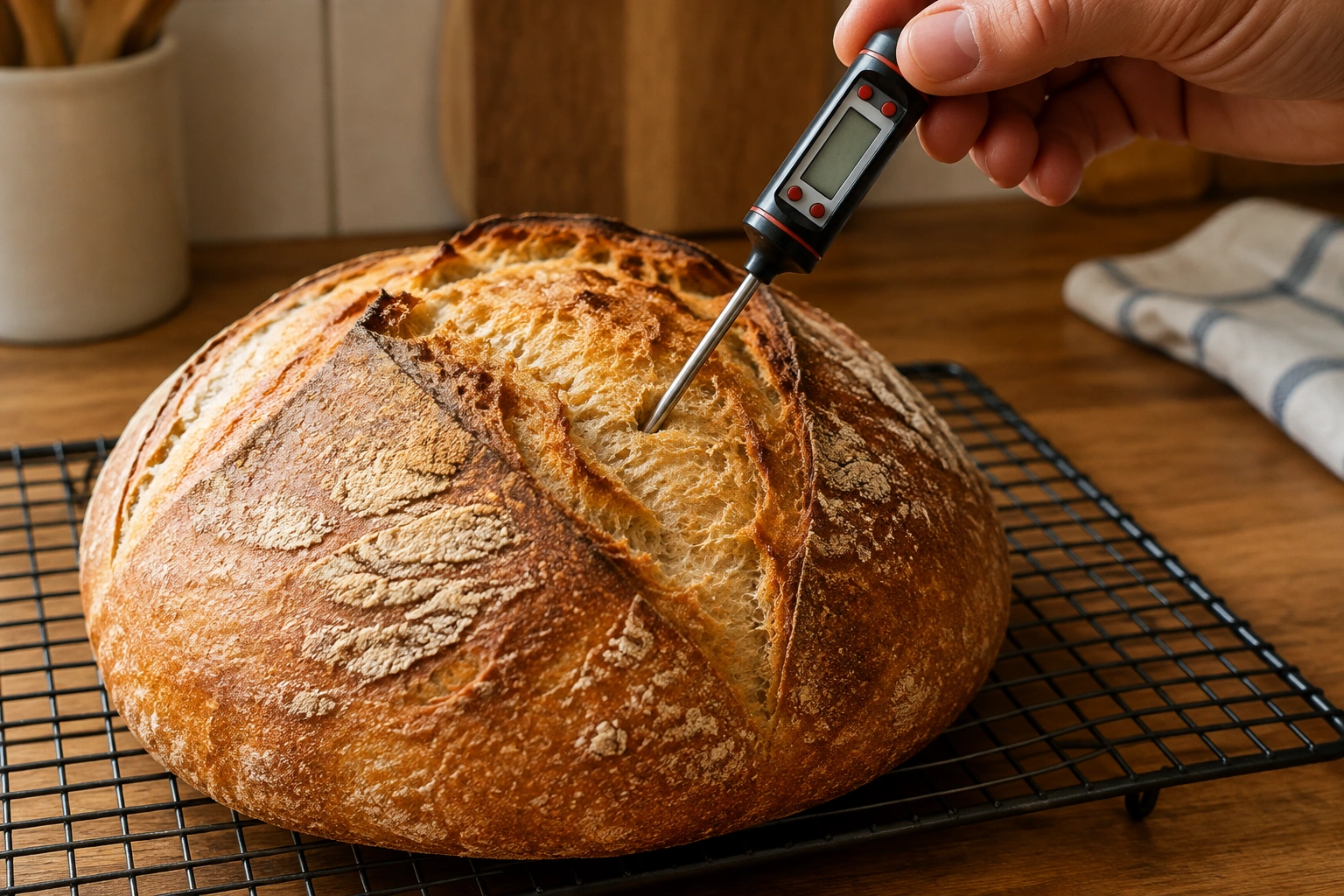
An instant-read thermometer is the most dependable tool. Different breads finish at different temperatures:
– Lean breads: about 205°F to 210°F
– Enriched breads: about 180°F to 190°F
– Rye bread: often 205°F to 210°F
– Gluten-free yeast bread: about 205°F
A helpful reference is King Arthur Baking’s thermometer guide, which can be useful supporting guidance when you want to compare bread styles and doneness cues. For specialized breads like rye or gluten-free yeast loaves, follow the recipe first and use temperature as a confirmation rather than a universal rule.
Look for supporting visual cues
- A loaf should look set and well-colored.
- The crust should feel firm, not soft and wet.
- Pan bread often pulls slightly from the sides of the pan.
Listen and feel
For crusty loaves, the crust should sound hollow when tapped, but that test is less reliable than temperature. A loaf can sound hollow and still be underdone in the center.
Common Mistakes When Baking Bread at the Wrong Temperature
Using one temperature for every loaf
A single setting does not suit every bread. Lean artisan bread and enriched sandwich bread behave very differently.
Trusting crust color alone
A dark crust does not guarantee a baked interior. This is one of the easiest ways to end up with gummy bread.
Skipping the full preheat
If the oven or bake vessel is not fully heated, the loaf may spread before it gets enough lift.
Forgetting about convection
If a fan is running, the loaf may brown faster than expected. That can be useful, but only if you account for it.
Ignoring oven quirks
Home ovens can run hot, cool, or unevenly. If your bread keeps baking too fast or too slowly, the recipe may be fine and the oven may be the real issue.
Troubleshooting: If Your Bread Browns Too Fast or Bakes Too Slowly
If the crust browns too quickly
Try one of these fixes:
– lower the oven temperature by 15°F to 25°F
– move the loaf one rack lower if the top is scorching
– tent loosely with foil once the crust reaches the color you want
– reduce or disable convection if your oven allows it
If the center stays underbaked
- bake a little longer at a moderate temperature
- check that the loaf is not too large for the pan or recipe
- confirm the oven temperature with a thermometer
- make sure the loaf is reaching the correct internal temperature, not just the correct color
If the bottom burns
- move the baking stone or steel higher
- lower the oven rack
- reduce the oven temperature slightly
- insulate the loaf with a pan if the vessel is conducting too much heat
If your oven runs cool
A cool oven can flatten oven spring and extend bake time. Verify the actual temperature before making bigger recipe changes.
Practical Examples of Temperature Settings for Real Breads
Sourdough boule in a Dutch oven
A common approach is a hot bake, often around 450°F to 475°F, especially for the first part of the bake. That gives strong oven spring and a crisp crust. Check the center for about 205°F to 210°F before removing it.
Sandwich loaf in a loaf pan
A loaf pan bread usually does better around 350°F to 375°F. That temperature range helps the center bake evenly while keeping the crust soft enough for slicing.
Enriched rolls
Dinner rolls, brioche-style buns, and other enriched doughs often bake best in a moderate oven, usually 325°F to 375°F. The goal is even baking without overdarkening the surface.
Rye or gluten-free loaf
These breads need careful doneness checks. Follow the recipe’s oven temperature, then verify the center reaches the proper internal temperature. For rye and gluten-free yeast breads, that is often around 205°F.
When to Consult a Master Baker
If you are consistently getting the same problem across multiple recipes — for example, pale loaves, gummy centers, or crusts that burn before the crumb is set — it may be time to get a second set of eyes on your process. A master baker can help you evaluate oven performance, dough formulation, and bake setup together, instead of treating temperature as the only variable.
Final Takeaway
If you remember only one thing, make it this: bread temperature is recipe-specific, but doneness is measurable. Use a hotter oven for lean artisan loaves, a gentler oven for sandwich and enriched breads, and an instant-read thermometer to confirm the loaf is actually baked through. That combination will take a lot of guesswork out of bread baking.
FAQ
Should bread start at a high temperature and then be lowered?
Often, yes — especially for artisan loaves, sourdough boules, and hearth breads. A hot start helps the loaf expand before the crust sets, and then the temperature can be lowered if the recipe calls for it. Sandwich loaves usually bake at a steady moderate temperature, though some recipes may still begin a little hotter and then finish cooler.
Do convection ovens need a different bread temperature?
Usually they do. A practical rule is to reduce the recipe temperature by about 25°F for convection, unless the recipe gives different instructions. Because convection can brown bread faster, it may also shorten bake time.
Does loaf size change baking temperature?
Yes. Larger loaves usually need a longer bake and may do better at a slightly lower temperature so the center can finish without overbrowning the crust. Smaller loaves or rolls bake faster and may tolerate a bit more heat.
How do I know if my bread is done?
The most reliable method is an instant-read thermometer. Many lean breads are done around 205°F to 210°F, while enriched breads are often done around 180°F to 190°F.
Do I always need steam for bread?
No. Steam is most useful for hearth breads and artisan loaves. It helps the crust stay flexible early in the bake. Pan breads, sandwich loaves, and enriched breads usually do not need steam.
Is high-altitude baking different?
Sometimes, but it is best treated as a specialized adjustment, not a universal rule. Some bakers may need to fine-tune bake time or doneness checks at high altitude, but the right change depends on the recipe, loaf style, and oven behavior.