
Why Your Air Fryer Shuts Off Early and How to Fix It
If your air fryer keeps stopping before the timer ends, the cause is usually one of a few practical issues: overheating, blocked airflow, a basket or drawer that is not fully seated, a power problem, or an internal fault in the control panel.
The good news is that many early shutoff problems can be checked at home without taking anything apart. The key is to narrow down whether your air fryer is protecting itself from heat, losing power, or failing to read the cooking cycle correctly.

Why an air fryer may shut off early
An air fryer is designed to turn off at the end of a cycle, but it should not keep quitting in the middle of cooking. Normal automatic shutoff happens when the timer ends; abnormal shutoff happens before the cycle is finished. When that happens, the appliance is usually reacting to a condition it does not like.
The most common possibilities are:
- Thermal shutoff or overheat protection: the unit gets too hot and shuts itself down
- Poor airflow: vents are blocked, the unit is crowded against a wall, or the basket is overloaded
- Basket or drawer alignment issues: the appliance thinks the drawer is not fully closed
- Power interruption: a loose plug, weak outlet, or overloaded circuit cuts power briefly
- Control panel or timer fault: the electronics stop the cycle even though nothing obvious is wrong
A useful way to think about it is this: if the fryer shuts off after running hard for a while, heat is a likely suspect. If it shuts off right away or when you touch the basket, seating or power is more likely.
Here’s a quick comparison to help you sort it out.
| Symptom | Likely cause | First thing to check |
|---|---|---|
| Shuts off after running hot for a while | Overheating / thermal shutoff | Let it cool, then improve airflow |
| Shuts off when placed near a wall or cabinet | Blocked vents / poor ventilation | Move it to open space |
| Shuts off when the basket is bumped | Basket or drawer not seated | Reinsert the basket firmly |
| Shuts off only on one outlet | Outlet or circuit issue | Try a different outlet on another circuit |
| Shuts off randomly with no pattern | Control panel or internal fault | Stop troubleshooting and contact support |
If your air fryer is new to you, it may help to first understand how it normally cooks. I explain that in more detail in How Does an Air Fryer Cook Food? and What Exactly Does an Air Fryer Do?.
Check for overheating and thermal shutoff first
Air fryers rely on strong airflow and a heating element working in a tight space. That makes them efficient, but it also means they can get hot quickly if airflow is restricted or the unit is pushed too hard.
A thermal safety shutoff is not always a sign of failure. It is the appliance protecting itself from damage. If the fryer gets too hot, the power may cut out until it cools down. That is why the first safe step is to turn it off, unplug it, and let it cool completely before trying again.
Signs that point toward overheating include:
- The outside of the unit feels unusually hot
- You notice a hot plastic or burning smell
- It shuts off after a longer cooking session, not immediately
- It works again after cooling, but only temporarily
A practical example: if your air fryer stops halfway through chicken wings and the cabinet around it feels warm, the fryer may simply need better airflow and a break between batches. If it shuts off again on the next run, the issue is probably recurring overheating rather than a one-time glitch.
Proper ventilation is important for many air fryer models, and blocked vents can contribute to overheating or unexpected shutoff. The exact cleaning and spacing guidance may vary by manufacturer manual, so it is worth checking your model’s instructions before restarting. You can also review this guidance here: air fryer ventilation and shutdown troubleshooting.
Make sure airflow is not blocked
Poor airflow is one of the easiest problems to miss because the fryer may still seem to be working normally until it overheats or struggles to maintain temperature.
Check these points:
- Leave space around the fryer, especially at the back and sides
- Don’t push it against a wall or under a low cabinet
- Keep vents free of grease, crumbs, and dust
- Avoid overfilling the basket so hot air can circulate
- Shake or turn food if the basket is packed tightly
An air fryer depends on moving hot air around the food. If that air cannot circulate, the heating element and fan have to work harder, which can trigger a shutdown.
This is especially common with foods that are piled too high. A basket full of frozen fries or breaded snacks may look efficient, but if the food is stacked tightly, the fryer has less room to move air. The unit may then run hotter than intended or cook unevenly, which can lead to early shutoff.
Cleaning the vents and exterior openings
If you see dust or greasy buildup near the air intake or exhaust areas, clean them gently after unplugging the appliance and letting it cool. A soft brush works well for loose debris. Compressed air can help with stubborn dust, but use it carefully and only on exterior openings.
Do not open the appliance or probe deep inside the housing. That is no longer simple cleaning; it becomes a repair job.
Confirm the basket or drawer is fully seated
A surprising number of air fryer shutdowns come from a basket or drawer that is not fully clicked into place. Many basket-style air fryers have a safety switch that prevents operation unless the drawer is properly seated.
If the basket is even slightly out of alignment, the unit may:
- Stop heating
- Shut off the display
- Pause the timer
- Turn back on only after the basket is pushed in again
This often happens after shaking food, cleaning the basket, or sliding the drawer in quickly. The fix is simple: remove the basket, inspect the rails or track, and reinsert it firmly until it locks into place.
A good test is to close it slowly and listen for the click. If the fryer only works when you press on the drawer, the seating mechanism may be worn or the track may be dirty.
If the basket or latch is damaged, repeated forcing usually makes the problem worse. At that point, the issue is not a user mistake anymore; it is a mechanical fault.
Rule out power outlet, cord, and plug problems
If the fryer shuts off without warning, especially early in the cooking cycle, the next thing to check is power delivery.
Before doing anything else, unplug the fryer and inspect the cord and plug for visible damage. Look for:
- Fraying
- Cracks
- Burn marks
- A plug that feels loose in the outlet
Then try a different outlet that is not sharing power with another heavy appliance. Some kitchen outlets are already carrying a lot of load, and high-wattage appliances can trip a breaker if they are on the same circuit.
A practical example: if your air fryer shuts off every time you use it in one part of the kitchen, but works normally in another outlet, the fryer may be fine and the outlet may be the issue. In that case, the problem is electrical supply, not cooking performance.
A troubleshooting guide from Aosom notes that air fryers can trip a kitchen breaker if multiple high-wattage appliances are on the same circuit, and moving the fryer to a separate outlet may help. You can see that guidance here: air fryer breaker and outlet troubleshooting.
If the cord is damaged, stop using the appliance. A damaged cord is not something to keep testing.
Look for control panel, timer, or electronic faults
If airflow, seating, and power all check out, the problem may be inside the control system.
Signs of a control panel or electronic fault include:
- The display flickers or resets
- Buttons respond inconsistently
- The timer jumps, freezes, or ends early
- The fryer shuts off in the same way every time, even after cleaning and cooling
This is where the pattern matters. A unit that fails once after heavy use may just have overheated. A unit that repeatedly shuts off at the same minute, on different outlets, with a clean basket and clear vents, is pointing more toward an internal defect.
At that stage, I would not keep experimenting with it. Internal electronic issues are not something to solve with more cooking tests, and opening the control panel is not a safe DIY step for most home cooks.
Clean the air fryer to prevent repeat shutdowns
Grease and crumbs do more than make cleanup annoying. They can interfere with airflow, create hot spots, and add stress to the fan and heating area.
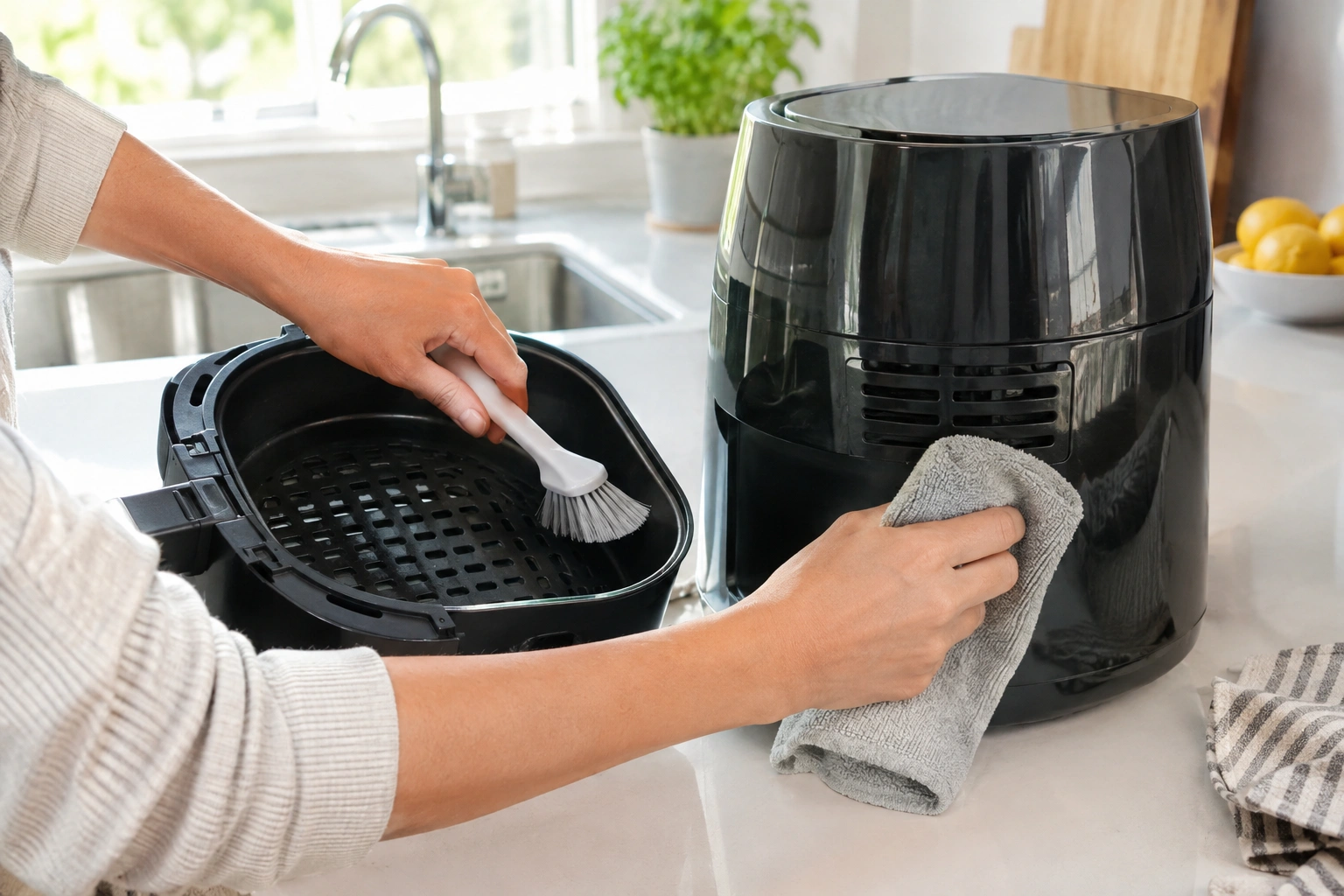
Pay attention to these parts:
- Basket
- Drawer
- Crumb tray, if your model has one
- Interior walls
- Air vents
- Heating area visible from the inside, if accessible by the manual
The goal is not just appearance. A greasy fryer can run hotter than it should because residue may change how air moves through the unit.
Here is a simple maintenance routine that helps prevent repeat shutdowns:
- Let the fryer cool fully.
- Unplug it.
- Wash removable parts according to the manual.
- Wipe interior surfaces with a soft, damp cloth.
- Clear crumbs from vents and edges.
- Dry everything completely before using it again.
If you cook a lot of breaded food, wings, or anything that sheds crumbs and grease, cleaning more often can help. A fryer that looks “mostly clean” may still have enough buildup to affect performance.
When it is safe to troubleshoot at home versus when to stop
A little troubleshooting is reasonable. But some signs mean you should stop using the air fryer right away.
Stop and unplug it if you notice:
- Burning smell that does not go away after cooling
- Smoke from the unit
- Sparking
- Melted plastic
- A damaged cord or plug
- Repeated shutdowns with no clear cause
Those are not normal nuisance problems. They suggest a safety issue or a failing internal part.
If the appliance only shut off once and then worked again after cooling, that is one thing. If it keeps doing it, or if it smells overheated every time, do not keep pushing it through another cycle just to see what happens.
When to contact the manufacturer or replace the air fryer
Once you have checked cooling, airflow, basket seating, outlet power, and cleaning, the remaining question is whether the fryer is worth repairing.
Contact the manufacturer if:
- The unit is still under warranty
- The shutdown happens repeatedly after basic troubleshooting
- The display or controls are clearly malfunctioning
- You suspect a defect in the basket switch, control panel, or internal power system
If the fryer is older and out of warranty, replacement may make more sense than repair, especially if the issue is electronic or the cord is damaged. For a lower-cost appliance, repair may not be practical depending on the model, parts availability, and local repair costs.
A useful rule: if the fryer still shuts off early after you have ruled out overheating, blocked airflow, seating problems, and outlet issues, the appliance itself is probably the problem. At that point, continuing to use it is more frustrating than helpful.
A simple step-by-step way to diagnose the problem
If you want the shortest possible troubleshooting path, use this order:
- Unplug the fryer and let it cool completely.
- Clean the vents, basket, and interior.
- Move it to open space with clear airflow.
- Reinsert the basket or drawer firmly.
- Test a different outlet on another circuit.
- Run a short cooking cycle and watch for repeat shutdown.
- If it still fails, contact support or stop using it.
That order works because it separates the most common, fixable causes from the more serious ones. It also keeps you from guessing too early.
When to Consult a Professional
If your air fryer has a damaged cord, repeated electrical shutdowns, a burning smell, smoke, sparking, or a control panel that behaves unpredictably, stop using it and contact the manufacturer or a qualified repair service. If the unit is under warranty, that is usually the best next step. If it is older and the same problem keeps returning after basic troubleshooting, replacement is often the more practical choice.
For a home cook, the main thing is not to treat every shutdown as a mystery. Most early shutoff problems come down to heat, airflow, seating, or power. Once you check those in a sensible order, the cause usually becomes much clearer.

