
Why Natural Cocoa and Dutch-Process Cocoa Bake Differently
If you’ve ever followed a chocolate recipe and wondered why one cocoa powder gives a cake good lift while another makes it taste darker and smoother, the answer is chemistry, not brand preference. Natural cocoa powder is acidic; Dutch-process cocoa has been alkalized, which makes it less acidic. That one difference changes how each cocoa interacts with baking soda, baking powder, flavor, color, and even crumb structure.
In practical baking terms, natural cocoa often works like part of the leavening system in recipes that use baking soda. Dutch-process cocoa behaves more like a neutral chocolate ingredient: it brings flavor and color, but it usually does not contribute the same acid-driven reaction. That is why two recipes with similar ingredient lists can rise, taste, and look noticeably different depending on which cocoa powder they use.
Quick answer: why the two cocoa powders behave differently
The short version is this:
- Natural cocoa powder still contains more of cocoa’s natural acidity.
- Dutch-process cocoa powder has been treated with an alkalizing agent, which reduces acidity.
That matters because baking soda needs acid to create carbon dioxide gas, and that gas helps baked goods rise. If a recipe depends on natural cocoa for part of that acid, swapping in Dutch cocoa can weaken the reaction unless the recipe has another acidic ingredient to make up the difference.
The flavor changes too. Natural cocoa tends to taste sharper and more chocolatey-tangy. Dutch-process cocoa usually tastes smoother, rounder, and often darker in appearance. Neither is “better” in every recipe. They simply behave differently.
What natural cocoa powder is
Natural cocoa powder is the more acidic form of cocoa powder you’ll see in many classic home baking recipes. It is made from cocoa solids after the cocoa butter is removed, and it keeps more of the cocoa’s original acidity.
That acidity affects baking in two useful ways:
-
It helps baking soda work.
When baking soda meets acid, it releases carbon dioxide. Those gas bubbles expand in the oven and help cakes, muffins, and cookies rise. -
It contributes flavor and structure.
The acidic environment can make chocolate flavor taste brighter and slightly sharper. In some recipes, that brightness is exactly what the recipe is built around.
A chocolate cake made with natural cocoa, baking soda, and buttermilk is a common example of this kind of formula. The buttermilk and cocoa both supply acidity, and the baking soda uses that acid to create lift. If you remove the acid source without adjusting the leavening, the cake can turn out flatter or denser than expected.
What Dutch-process cocoa powder is
Dutch-process cocoa is cocoa powder that has been treated with an alkalizing agent to reduce its acidity. Bakers often notice three immediate differences:
- It looks darker
- It tastes smoother
- It behaves differently in leavened recipes
Because it is less acidic, Dutch-process cocoa does not help baking soda react in the same way natural cocoa does. That does not make it less useful. It simply means it fits better in recipes that rely on baking powder, or in recipes that already have enough acid from other ingredients.
Dutch-process cocoa is often chosen when a baker wants a deep, mellow chocolate flavor without the sharper tang that natural cocoa can bring. In brownies, for example, that can create a more rounded chocolate profile. In cake, it can make the color richer and the flavor less acidic.
How acidity changes leavening in baking
This is the part that explains most of the confusion.
Baking soda needs acid
Baking soda is sodium bicarbonate. On its own, it does not create the same rise you get in a finished batter. It needs an acid to react with. Once it meets acid, it produces carbon dioxide gas. That gas is what helps lift the batter.
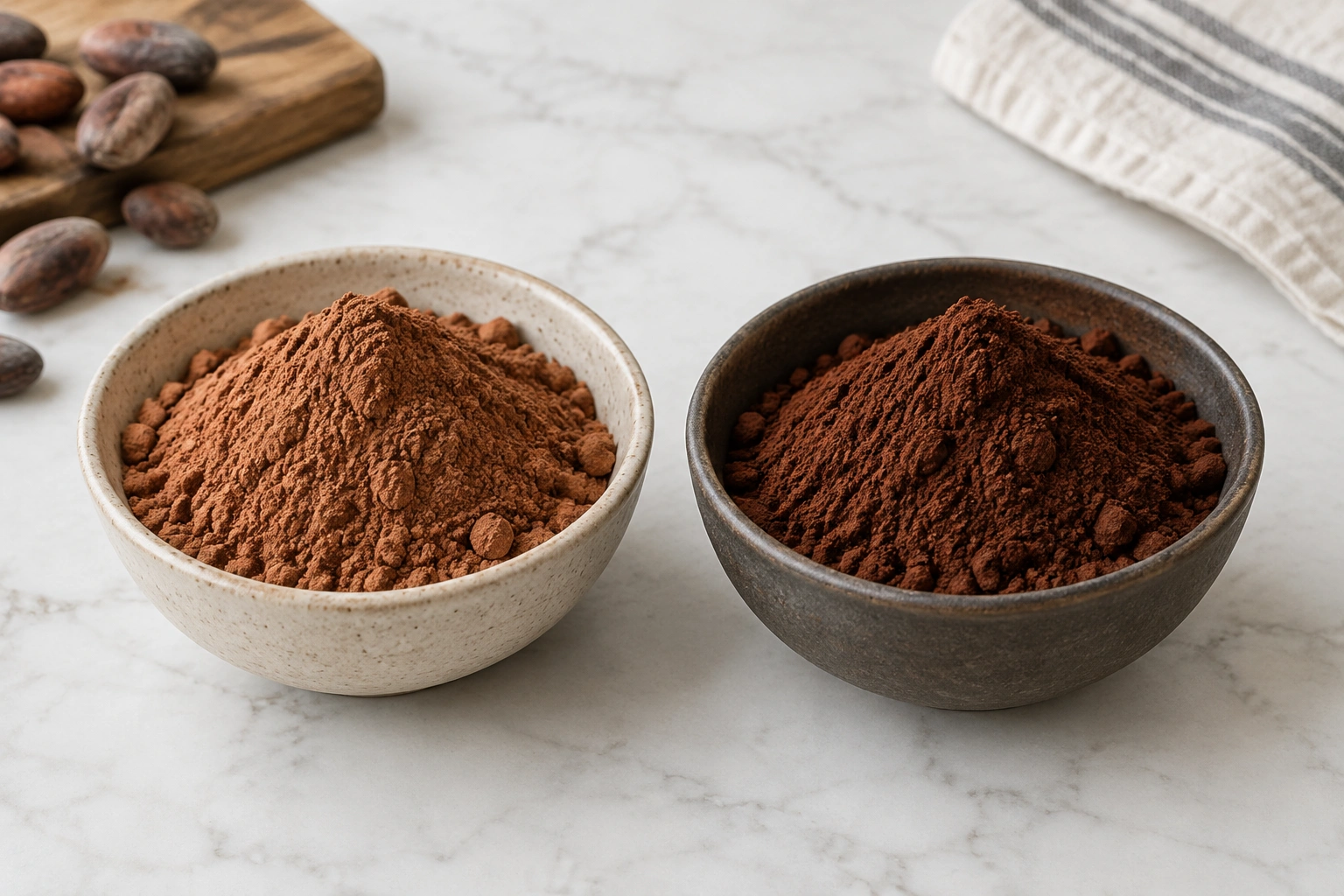
Natural cocoa can provide part of that acid. So can buttermilk, yogurt, sour cream, vinegar, molasses, and some brown sugar-heavy recipes. When a recipe includes baking soda plus one or more acidic ingredients, it is often designed around that reaction.
Baking powder already contains acid
Baking powder is different. It already includes both a base and an acid, so it does not depend on cocoa acidity to function. That is why Dutch-process cocoa works more easily in many baking powder-based recipes.
A simple way to think about it:
- Natural cocoa + baking soda often works well together
- Dutch-process cocoa + baking powder often works well together
- Dutch-process cocoa + baking soda can be risky if there is not enough other acid in the recipe
That does not mean the recipe will always fail. It means the chemistry may no longer match what the formula was built to do.
Why the same recipe rises, tastes, and looks different with each cocoa
Even when the ingredient list looks similar, the cocoa choice can change the finished bake in several ways.
Rise and crumb
If a recipe depends on natural cocoa to help activate baking soda, swapping in Dutch-process cocoa can reduce lift. The result may be a tighter crumb, less rise, or a slightly heavier texture.
Spread
In cookies, cocoa type can change how the dough spreads. A recipe balanced for natural cocoa may spread differently if the cocoa is less acidic. Sometimes the cookie stays thicker; sometimes it sets up with a different edge-to-center balance.
Color
Dutch-process cocoa usually produces a darker, deeper brown. Natural cocoa often bakes to a lighter brown with a warmer tone. Color alone does not tell you whether the bake is better, but it does signal that the formula behaves differently.
Flavor
Natural cocoa can taste brighter and slightly sharper. Dutch-process cocoa usually tastes smoother and less acidic. If you love a bold, almost tangy chocolate note, natural cocoa may be the better fit. If you want a softer, deeper chocolate flavor, Dutch-process cocoa often wins.
A side-by-side cake comparison often shows the difference clearly: the natural cocoa version may rise a bit more and taste brighter, while the Dutch-process version may look darker and taste smoother.
Natural cocoa vs. Dutch-process cocoa: quick comparison
| Feature | Natural Cocoa Powder | Dutch-Process Cocoa Powder |
|---|---|---|
| Acidity | More acidic | Less acidic after alkalization |
| Best leavening match | Baking soda, especially with acidic ingredients | Baking powder, or recipes with other acid sources |
| Flavor | Brighter, sharper, more tangy | Smoother, milder, deeper |
| Color | Lighter brown | Darker brown |
| Recipe risk when swapped | Can make a formula more acidic than expected | Can weaken a baking soda-based formula if acid is lacking |
| Common use | Classic cakes, some cookies, soda-based formulas | Brownies, darker cakes, recipes built around baking powder |
How to tell which cocoa powder a recipe expects
When a recipe does not clearly say “natural” or “Dutch-process,” the rest of the ingredient list usually gives clues.
Clues that point to natural cocoa
Look for:
– Baking soda as the main leavener
– Buttermilk, yogurt, sour cream, vinegar, or molasses
– Recipes that seem built around a brighter chocolate flavor
A chocolate cake with buttermilk and baking soda is a strong sign the recipe expects natural cocoa.
Clues that point to Dutch-process cocoa
Look for:
– Baking powder as the main leavener
– Little or no acidic ingredient in the batter
– Recipes that want a darker color and smoother chocolate flavor
Many brownie formulas fall into this category, especially when the goal is a fudgier texture and deep color, though brownie recipes vary and some are written for natural cocoa.
When the recipe gives no clue
If the recipe uses both baking soda and baking powder, the cocoa choice may be more flexible, but not always. Mixed leaveners often mean the formula is balancing acidity from several ingredients, so cocoa type still matters for flavor, color, and sometimes texture. In those recipes, do not assume the cocoa swap can be corrected with a simple leavening swap; the full formula matters.
Can you substitute one cocoa powder for the other?
Sometimes, yes. Sometimes, no. The safest answer is that a direct swap is most reliable when the recipe does not depend on cocoa acidity for leavening.
Quick substitution rule set
Use this decision tree:
- Does the recipe rely mainly on baking soda?
- Yes: Swapping cocoa is risky unless there are other acidic ingredients already in the formula.
-
No: Move to the next question.
-
Does the recipe use baking powder, or a mix of baking powder and baking soda?
- Yes: A swap is often safer, but still expect changes in flavor, color, and possibly texture.
-
No: If it is soda-only and the cocoa is part of the acid balance, leave the cocoa type unchanged if you want the original result.
-
Is there another clear acid source in the batter, such as buttermilk, yogurt, sour cream, vinegar, or molasses?
- Yes: The swap is more likely to work.
-
No: The swap is riskier.
-
Is the recipe a cake, cupcake, or other structure-sensitive bake?
- Yes: Leave the leavening unchanged unless you know the full formula is designed for the swap.
- No: Cookies and some brownies are often more forgiving, but not always.
When a swap is usually safer
A substitution is more likely to work when:
– The recipe uses baking powder, not just baking soda
– The batter includes another acid source that can support baking soda
– You care more about getting a workable result than matching the original flavor exactly
When a swap is riskier
Be cautious when:
– The recipe uses baking soda and natural cocoa together
– The recipe has no other acidic ingredients
– The formula is a cake or cookie where rise and spread matter a lot
If you swap Dutch-process cocoa into a natural-cocoa recipe without adjusting anything else, the bake may lose some lift. If you swap natural cocoa into a Dutch-process recipe, the batter may become more acidic than intended, which can affect flavor and texture.
How to adjust leavening when you swap cocoa types
This is where many bakers overcorrect. The goal is not to “fix” the recipe with a big leavening change. The goal is to keep the acid-base balance close to what the recipe expects, and that balance depends on the entire formula, not cocoa alone.
If you use Dutch-process cocoa in a recipe written for natural cocoa
The recipe may need enough acid from somewhere else to support the baking soda. If it does not have that acid, the batter may not rise the same way.
A cautious approach is to:
– Check whether the recipe already includes buttermilk, yogurt, sour cream, vinegar, or another acidic ingredient
– If not, assume the original formula may have depended on natural cocoa’s acidity
– Avoid adding extra baking soda unless you understand the full formula, because too much can create a soapy or metallic taste
If you use natural cocoa in a recipe written for Dutch-process cocoa
The batter may become more acidic than intended. That can shift flavor and sometimes texture. In a recipe that uses baking powder, the effect is usually less dramatic than a soda-only formula, but it can still matter.
The safest practical move is to keep the rest of the recipe unchanged unless you know the formula is sensitive. If the result tastes too sharp or the texture seems off, the issue is often the cocoa swap itself, not a missing extra spoonful of leavening.
Practical takeaway
There is no simple one-to-one baking soda or baking powder conversion based on cocoa type alone. If you change the cocoa, first ask whether the recipe’s acid sources and leaveners were designed as a system. If you are not sure, leave the leavening unchanged and treat the cocoa swap as a flavor-and-structure change, not a math problem.
Which cocoa powder works best for cakes, brownies, and cookies
Cakes
Cakes are the most sensitive to cocoa choice because they depend on balanced rise and crumb. If the recipe uses baking soda and an acidic ingredient, natural cocoa often fits naturally into the formula. If the recipe uses baking powder and aims for a dark, smooth chocolate profile, Dutch-process cocoa is often a better match.
Brownies
Brownies are more forgiving, but cocoa type still matters. Dutch-process cocoa often gives brownies a darker color and a smoother chocolate taste. Natural cocoa can make brownies taste a little brighter and sometimes slightly more cake-like, depending on the rest of the recipe.
Cookies
Cookies show cocoa differences in spread and texture. A natural-cocoa cookie with baking soda may spread differently from the same dough made with Dutch-process cocoa. If the recipe is designed around a specific spread pattern, changing cocoa can alter the final shape more than you expect.
For cookie bakers, this matters especially when you want repeatable results. If you are already dialing in pan size, oven rack position, and bake time, changing cocoa type adds another variable.
Common baking mistakes when using the wrong cocoa powder
The most common problems are not dramatic disasters. They are usually subtle changes that make the bake feel “off.”
Flat or weak rise
This often happens when a recipe depends on natural cocoa to help activate baking soda, but Dutch-process cocoa is used instead.
Dense or tight crumb
If the acid-base balance shifts, the batter may not trap gas the same way. The structure can feel heavier than expected.
Overly tangy or acidic flavor
This can happen when natural cocoa is swapped into a recipe that was built for Dutch-process cocoa and the formula already has enough leavening without extra acid.
Soapy or metallic taste
This is usually a sign of too much baking soda or a formula that was adjusted too aggressively. More leavening is not always better.
Color that does not match the recipe
A darker or lighter cocoa can change the visual result even when the texture is acceptable. That matters in layer cakes, sandwich cookies, and any bake where appearance is part of the goal.
Simple rule-of-thumb recap
When you are standing in the kitchen and need a fast decision, use this:
- If the recipe uses baking soda and acidic ingredients, natural cocoa is often the safer match.
- If the recipe leans on baking powder and aims for a darker, smoother chocolate flavor, Dutch-process cocoa is often the better fit.
- If you swap cocoa types, expect changes in rise, color, and flavor—not just chocolate intensity.
- If the recipe is a cake, treat cocoa type as part of the structure, not just the taste.
- If the recipe does not specify cocoa type, read the leavening and acidic ingredients before you guess.
Once you learn to read those clues, cocoa powder stops being confusing and starts becoming one more tool you can use with confidence.
FAQ
Can I use Dutch-process cocoa instead of natural cocoa?
Sometimes, but it is safest when the recipe does not rely on baking soda for lift. If the formula includes baking soda and acidic ingredients, the swap is more likely to change rise and texture.
Can I use natural cocoa instead of Dutch-process cocoa?
Yes, in some recipes, but expect a brighter flavor and possibly a different texture. The change is more noticeable in recipes built around baking powder and a darker chocolate profile.
Why does natural cocoa need baking soda?
Because natural cocoa is acidic. Baking soda needs acid to produce carbon dioxide gas, which helps the batter rise.
Why does Dutch-process cocoa look darker?
The alkalizing process changes the cocoa’s color and flavor. That is why Dutch-process cocoa often gives baked goods a deeper brown tone.
How do I know which cocoa a recipe wants?
Check the leavening and the acidic ingredients. Baking soda plus buttermilk, yogurt, vinegar, or sour cream often points to natural cocoa. Baking powder and a less acidic batter often point to Dutch-process cocoa. If a recipe uses both baking soda and baking powder, treat that as a sign that the formula is balanced as a system, so cocoa swaps should be approached cautiously.
For more on how ingredient balance affects baking consistency, see our guide on how to measure flour without a kitchen scale. If you’re baking large cookie batches, our post on how to bake cookies on two racks evenly can help you keep results consistent from pan to pan.

