
Why Overmixing Makes Muffins Tough and How to Keep Them Tender
If your muffins come out dense, chewy, or a little rubbery, the mixing step is often the first place to look. Muffin batter is meant to be handled gently. When it is stirred too long or too hard, the texture can shift from soft and tender to tight and tough.
The good news is that this is one of the easiest muffin problems to prevent once you understand what is happening in the bowl. You do not need a perfect-looking batter. In fact, a slightly lumpy batter is often exactly what you want.
Why Overmixing Makes Muffins Tough
Flour contains proteins that can form gluten when they are mixed with liquid and worked. Gluten is useful in bread because it gives dough strength and structure. Muffins are different. They are a quick bread, and their texture should be soft, not elastic.
When muffin batter is overmixed, more gluten tends to develop. That extra structure can make the crumb feel chewy or tough instead of tender. The batter can also start to feel tighter and more resistant as it is worked too much for this kind of bake.
Mixing also affects how air and liquid are distributed. A batter that has been stirred aggressively can trap pockets unevenly or become overly smooth and tight. That can lead to muffins with a heavier crumb, peaked tops, or uneven tunnels inside.
In plain terms: the more you work muffin batter, the more it starts acting like bread dough. Muffins usually do better when the batter is just combined and left alone.
What the Muffin Method Is and Why It Works
The muffin method is the standard approach for mixing muffins, quick breads, and similar batters. It usually means combining the dry ingredients in one bowl, the wet ingredients in another, and then mixing them together only until the flour is moistened.
That method works because it limits how much the flour is handled after liquid is added. Less handling usually means less gluten development, which helps keep the final crumb tender.
A practical example: if you stir blueberry muffin batter until every last streak disappears and the batter looks smooth, you may be going farther than the recipe needs. If you stop when the dry ingredients are mostly hydrated and a few small lumps remain, the muffins often bake up lighter.
The goal is not a polished batter. The goal is a batter that is evenly combined without being overworked.
What Properly Mixed Muffin Batter Should Look and Feel Like
Proper muffin batter is usually thicker than cake batter and less smooth than pancake batter. It should look cohesive, but not silky.
A few small lumps are normal. In many cases, they are a sign that you stopped at the right moment. You may also see a few narrow streaks of flour disappear as you fold, and that is fine if the batter is otherwise combined. What you do not want are dry flour pockets or patches of unmixed flour hiding at the bottom or sides of the bowl.
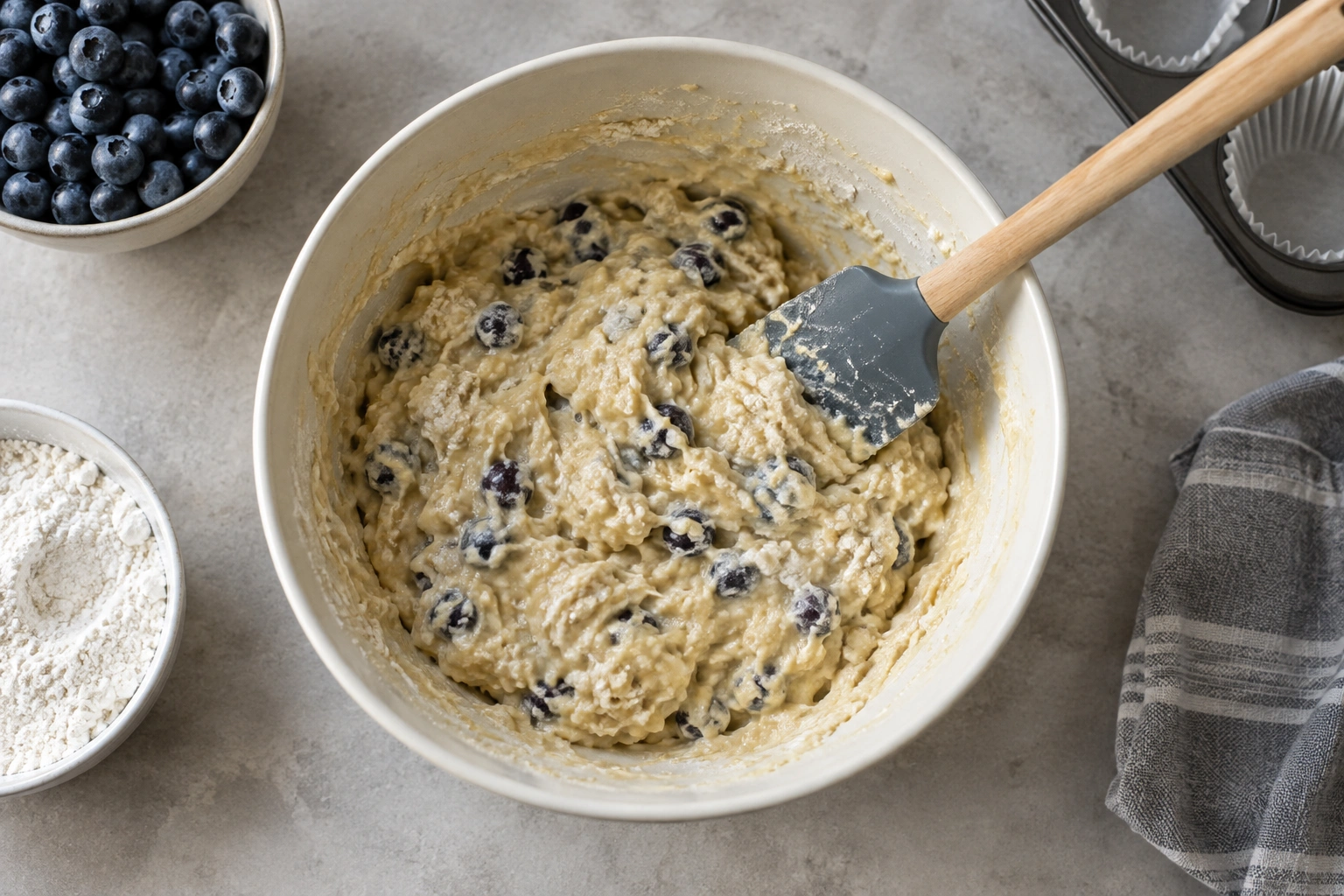
Here are the cues I tell students to watch for:
- The flour is mostly moistened.
- The batter holds together without dry pockets at the bottom of the bowl.
- It looks rough, not glossy.
- It is thick enough to scoop, but not stretchy like dough.
If you are unsure, tilt the bowl and check the bottom and sides with a spatula. Dry flour hiding at the edge is a more important problem than a few lumps in the middle.
Signs Your Muffin Batter Has Been Overmixed
Overmixed muffin batter often gives itself away before it goes into the oven. The signs are subtle at first, but they become clearer as the batter is worked.
Look for these warning signs:
The batter turns smooth and glossy
Muffin batter does not need to look polished. When it starts looking unusually sleek, it may have been stirred too much.
It becomes stretchy or elastic
If you lift the spatula and the batter seems to pull into strands, that is a sign the flour has been worked more than a muffin batter usually needs.
You see tunnels in the baked muffins
Large air pockets or tunnel-like holes inside muffins often point to overmixing or aggressive stirring after the wet and dry ingredients were combined.
The crumb feels chewy instead of soft
A muffin should break tenderly. If it has a tight, bready chew, overmixing may have played a role.
The tops become peaked or uneven
This can happen for several reasons, but a batter that has been mixed too much can bake with a less delicate rise.
How to Mix Muffin Batter Correctly Without Overworking It
The safest way to mix muffin batter is with a spoon or spatula by hand. A mixer can be too efficient for this kind of batter unless the recipe specifically calls for one.
Use this approach:
- Combine the dry ingredients in one bowl.
- Whisk or stir the wet ingredients in another bowl just until blended.
- Add the dry ingredients to the wet ingredients.
- Stir gently with a spatula or wooden spoon.
- Stop as soon as the flour is mostly moistened.
That last step matters most. If you keep stirring because the batter still looks a little rough, you can move from “combined” to “overmixed” quickly.
A useful stopping rule: stop after the dry ingredients disappear and only a few small lumps remain.
This is one area where restraint pays off. A batter that looks slightly unfinished often bakes better than one that looks perfectly smooth.
How to Fold In Berries, Chocolate Chips, Nuts, and Other Add-Ins
Add-ins are one of the easiest places to overwork muffin batter. Once the base batter is mixed, folding in berries, chocolate chips, nuts, or dried fruit should be quick and gentle.
Use a few broad folds with a spatula rather than repeated stirring. The goal is even distribution, not full blending. Once the add-ins are in, keep folding only until they are dispersed; extra stirring after that can push the batter into overmixed territory.
A few practical tips help:
- Toss berries or chocolate chips lightly in a spoonful of flour if the recipe suggests it.
- Add mix-ins at the very end, after the batter is already combined.
- Fold only until the add-ins are spread through the batter.
- Stop if the batter starts to loosen up and look glossy.
Flour-coating add-ins is optional and recipe-dependent, not a universal rule. Some batters benefit from it, while others do not need it at all.
Frozen berries need extra care because they can break apart if handled roughly. If you stir them too much, you may also tint the batter and make it look wetter than it really is. That can tempt you to keep mixing, which only makes the texture worse.
Muffin Batter vs. Cake Batter: Why the Texture Should Be Different
It is easy to expect muffin batter to look like cake batter, but they are not meant to behave the same way.
Cake batters are often mixed for a smoother, more refined texture. Muffin batter is usually mixed more minimally because muffins are supposed to be a little coarser and more rustic. That difference is part of what gives muffins their soft but hearty crumb.
Here is the trade-off:
- Smoother batter can look neat and uniform, but it often means more mixing.
- Lumpier batter may look less finished, but it usually protects tenderness.
If you are making muffins and trying to smooth out every lump, you may be aiming for the wrong texture. A muffin is not a small cake in disguise. It should be lighter than bread, but not as delicate and smooth as layer cake.
Other Reasons Muffins Turn Out Dense or Tough
Overmixing is a common cause of toughness, but it is not the only one. If your muffins are still dense after you improve your mixing technique, check these other issues.
Too much flour
Scooping flour directly from the bag can pack in more than the recipe expects. Extra flour can make muffins heavy and dry. Measuring accurately matters because too much flour can create a texture that feels tough even if the batter was not overworked.
Overbaking
A muffin that stays in the oven too long can lose moisture and feel firm or dry. That dryness can be mistaken for toughness from mixing, although overbaking usually causes dryness more than true toughness. If the crumb seems dry as well as dense, baking time may be part of the problem.
Batter left sitting too long
Once baking powder or baking soda is mixed into the batter, it begins doing its job. If the batter sits for a long time before baking, the rise may suffer. That can leave the muffins flat or heavy even if the mixing was gentle.
Ingredients that are too cold or unevenly combined
Very cold butter pieces, clumps of flour, or poorly blended wet ingredients can affect texture too. The batter should be mixed just enough to remove dry pockets, but not so much that it becomes tight.
Can You Save Overmixed Muffin Batter?
Sometimes, but only to a point.
If the batter has just gone a little too far, the best move is to stop mixing immediately and bake it right away. Do not try to “fix” it by stirring in more flour or more liquid unless the recipe specifically directs you to do so. That usually makes texture problems worse.
If the batter has become very smooth, stretchy, and elastic, it is unlikely to bake up as tender as intended. You can still bake it, but the result may be denser than you wanted. Once gluten has developed too far, the texture cannot be fully reversed; the real fix is prevention next time.
In that situation, the practical goal shifts from perfection to prevention next time. Use a gentler hand, stop earlier, and trust the lumps.
A Quick Comparison: Properly Mixed vs. Overmixed Muffin Batter
| What you notice | Properly mixed batter | Overmixed batter |
|---|---|---|
| Appearance | Rough, slightly lumpy | Smooth, glossy, tight |
| Feel | Thick but not elastic | Stretchy or elastic |
| Mixing level | Just combined | Stirred well past combined |
| Baked texture | Tender and light | Chewy, dense, or tough |
| Common clue | A few lumps remain | Batter looks “too perfect” |
That comparison is useful because it shows why a smooth batter is not always a better batter for muffins.
Simple Habits That Help Prevent Tough Muffins
A few small habits make a big difference:
- Use a spatula or wooden spoon instead of a mixer when the recipe follows the muffin method.
- Mix wet and dry ingredients separately first, then combine briefly.
- Stop when the flour is moistened, even if the batter still looks rustic.
- Fold in berries, nuts, or chocolate chips at the end with minimal stirring.
- Measure flour carefully so you do not accidentally create a dry, heavy batter.
Those steps are simple, but they solve the problem at the source. Tender muffins usually come from gentle mixing, not extra effort.
FAQ
Can you fix overmixed muffin batter?
Not fully. If the batter is only slightly overmixed, bake it right away and avoid adding extra flour or liquid unless the recipe says to. If gluten has already developed too much, the texture cannot be completely undone.
How many stirs is enough for muffin batter?
There is no exact number that works for every recipe, but a good stopping point is when the dry ingredients disappear and only a few small lumps remain. Stop before the batter turns smooth.
Are lumps in muffin batter bad?
No. A few small lumps are normal and often desirable. What you want to avoid are dry flour pockets or visible patches of unmixed flour.
Why did my muffins turn out tough even though I did not overmix?
Other common causes include too much flour, overbaking, or batter that sat too long before baking. Ingredient temperature and uneven mixing can also affect texture.
For more muffin troubleshooting, you may also find it helpful to read about how to store muffins without getting soggy and how to freeze muffins for meal prep without losing texture.
Final Thoughts
If you remember only one thing, make it this: muffin batter should be mixed gently, not chased into smoothness. The slight roughness you see in the bowl is often what helps the finished muffins stay tender.
Once you understand why overmixing makes muffins tough, the fix becomes much easier. Stop earlier, fold in add-ins carefully, and trust the muffin method. That small change can make the difference between a heavy, chewy muffin and one that bakes up soft and light.

