
BOSWELL 7.5 QT Glass Air Fryer Review: Worth It?
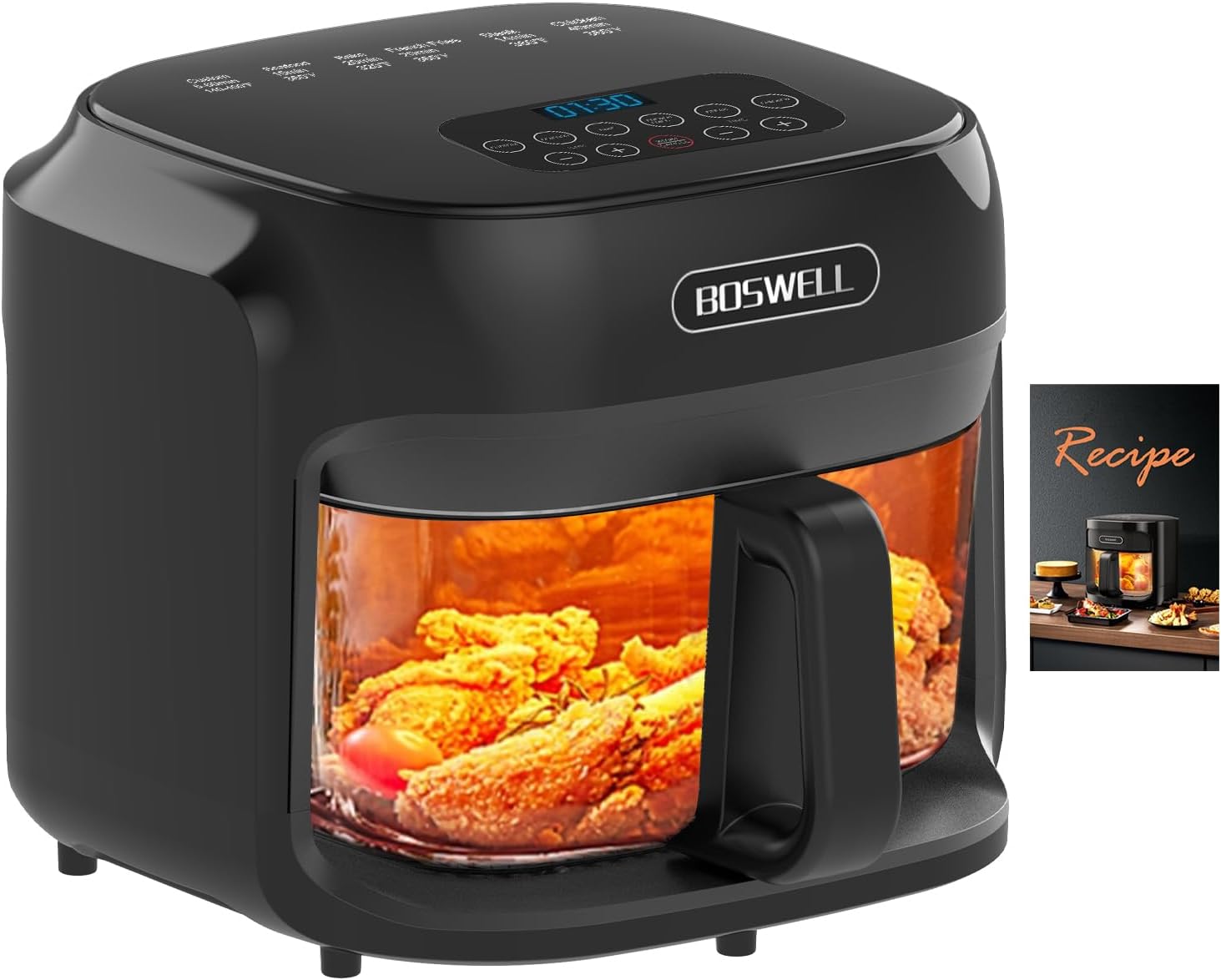
The BOSWELL 7.5 QT Large Glass Air Fryer is a family-size countertop air fryer built around a transparent glass cooking vessel, digital touch controls, and circulating hot air. Its main purpose is to air fry, roast, bake, and reheat larger batches while letting you watch browning without repeatedly opening the cooker.
This BOSWELL 7.5 QT Large Glass Air Fryer review focuses on the black GM-AF04-B configuration: capacity, heat range, controls, glass handling, and cleanup. If you are new to the category, this guide to the main use of an air fryer explains its core cooking method.
Quick Verdict
Reviewed Product
BOSWELL 7.5 QT Large Glass Air Fryer
A roomy glass-vessel air fryer for buyers who value cooking visibility and family-size capacity.
Rating: ★★★★☆4.0/5
Best For: Households wanting a large transparent cooking vessel and straightforward preset-plus-manual control.
Key Specs
7.5 qt • 1200W • up to 400°F • 120V
Key Advantage
The transparent glass vessel makes cooking progress easy to monitor.
Main Trade-off
A 400°F ceiling and 1200W heater are modest for this capacity.
Bottom Line
The BOSWELL is a strong fit when large glass capacity and visibility matter more than maximum heat or premium control depth. Buyers prioritizing faster high-heat cooking should compare higher-powered basket models.
At a Glance
- 7.5-quart glass cooking vessel aimed at larger household batches.
- 1200W, 120V electrical rating with a maximum setting of 400°F.
- Touch controls with named presets plus manual/custom adjustment.
- Transparent vessel allows visual monitoring without opening the cooker.
- Dishwasher-safe glass component is listed for easier routine cleanup.
- Overall appliance weight is about 6.85 kg, so portability is limited.
Verified Specifications & Buyer Implications
| Attribute | Verified Detail | Why It Matters |
|---|---|---|
| Capacity | 7.5 quarts | This is larger than many 4–6 quart single-basket models, giving households more room for family portions while still requiring enough open space for effective airflow. |
| Power | 1200W, 120V | The electrical load is moderate, but wattage alone does not prove cooking speed. In a 7.5-quart chamber, buyers should not assume the same heating aggression as 1700W competitors. |
| Maximum temperature | 400°F | This covers common air-frying, roasting, reheating, and baking tasks, but recipes designed around 425–450°F need adjustment or a different appliance. |
| Controls | Touch controls | Digital controls support preset-driven operation and manual changes, which is more flexible than a fixed-program cooker but still simpler than app-connected models. |
| Dimensions | 9.84 × 9.84 × 10.2 in | The footprint is compact relative to the stated capacity, yet operating clearance around the hot appliance still matters and should follow the current manual. |
| Weight | About 6.85 kg | This is not an appliance most owners will want to move after every meal. A stable, permanent counter position is more realistic for frequent use. |
Design & Build Quality
The defining design choice is the glass cooking vessel. It gives a direct view of food color and browning, which can reduce unnecessary opening during a cook cycle and makes the appliance easier to understand for visual cooks.
The listed black GM-AF04-B model uses touch controls and a compact square footprint. Glass improves visibility, but it also demands careful handling; the documented total weight reinforces that this is better treated as a countertop appliance than a portable one.
Setup & Ease of Use
- Place the appliance on a stable, heat-resistant surface with the clearance required by its manual.
- Wash removable food-contact parts before first use according to the manufacturer’s instructions.
- Select a preset when it matches the food, or use manual time and temperature controls.
- Use visual progress through the glass as a cue, but judge doneness with appropriate food-safety methods.
- Allow hot glass and surrounding parts to cool before cleaning or storage.
How This Review Was Researched
This review evaluates the BOSWELL using verified exact-model specifications, current retailer and product-database information, the supplied product imagery, and comparison context from relevant alternatives. No personal hands-on testing is claimed.
Category-Specific Performance
Cooking Visibility
Visibility is the BOSWELL’s clearest evidence-backed advantage. A transparent vessel lets you watch surface browning and food movement without repeatedly interrupting the cooking chamber.
That is especially useful for fries, wings, vegetables, and reheated foods where color changes quickly near the end. Visibility does not, however, prove temperature accuracy or crisping evenness.
Airflow and Batch Size
The listing identifies 360-degree or cyclonic hot-air circulation and a 7.5-quart chamber. In practical terms, the large vessel gives more batch room, but effective browning still depends on leaving enough open space for moving air.
Filling a chamber to its volume limit is not the same as maximizing crisping performance. For foods that need dry, browned surfaces, a looser layer and mid-cook repositioning may be more useful than simply using every available quart.
Heat Range and Power
The BOSWELL reaches a listed maximum of 400°F and uses 1200W. That range is sufficient for many common air-fryer jobs, but it does not offer the 450°F finishing headroom found on some newer basket models.
The 1200W rating is also lower than several similarly sized conventional air fryers. Without controlled testing, that should be treated as a specification difference rather than proof that the BOSWELL cooks slowly.
Preset Flexibility
Current listing information names five food presets—seafood, fries, steak, chicken, and bake—alongside manual/custom control. That appears to explain the “6-in-1” positioning more accurately than describing six separate food presets.
Expert Insight
The BOSWELL’s case is strongest when you value visible cooking and vessel size together. Capacity is useful, but airflow and food spacing still determine whether that space translates into crisp results.
Key Features Explained
7.5-Quart Glass Vessel
The large transparent vessel is the feature that most clearly separates this model from compact glass fryers. It gives buyers more volume while preserving a direct view of food during cooking.
Up to 400°F Manual Control
Manual control matters when a preset does not suit a recipe. A 400°F ceiling covers most everyday air frying, though buyers who frequently use 425–450°F recipes should factor that limit into the decision.
Dishwasher-Safe Glass Component
The glass component is listed as dishwasher safe, which can reduce cleanup effort after greasy foods. Owners should still follow the current care instructions for any rack, tray, lid, or powered component rather than assuming every part can go in the dishwasher.
Real-World Usability & Maintenance
Choose a preset or set time and temperature manually, then use the clear vessel to watch progress. The glass also makes residue easy to see before cleaning.
The main ownership consideration is handling. At roughly 6.85 kg for the appliance, frequent cabinet-to-counter movement is less convenient, and hot glass should be handled only as the manufacturer directs.
Pros & Cons
Pros
- Large 7.5-quart capacity
- Transparent glass cooking vessel
- Preset plus manual controls
- Dishwasher-safe glass component
Cons
- 400°F maximum temperature
- 1200W is modest for the capacity
- Heavy for frequent moving
Common Issues & Fixes
A Recipe Calls for More Than 400°F
Cause: The verified maximum setting is 400°F.
Fix: Use a lower temperature with adjusted timing, or choose a 450°F-capable alternative when high heat is essential.
The Appliance Feels Awkward to Move
Cause: The listed appliance weight is about 6.85 kg.
Fix: Give it a permanent counter position and avoid moving the unit while the vessel or surrounding parts are hot.
“6-in-1” Preset Wording Is Confusing
Cause: Current product information names five food presets plus manual/custom control.
Fix: Treat the appliance as five named food presets with an additional manual cooking mode.
What to Know Before You Buy
Confirm that 7.5 quarts matches the way you cook. Large volume is useful, but crisping still benefits from enough open space for airflow.
Second, decide whether a 400°F ceiling is enough for your recipes. If you often convert oven directions, the 20/20 air fryer rule is a practical starting framework, but food thickness, quantity, and appliance design still require early checking.
Who Should Consider It / Who Should Look Elsewhere
Who Should Consider It
- Families wanting a roomy glass cooking vessel
- Visual cooks who monitor browning closely
- Buyers prioritizing simple cleanup
Who Should Look Elsewhere
- Cooks needing 425–450°F settings
- Small households wanting a lighter appliance
- Buyers prioritizing maximum heater power
Alternatives to Consider
A smaller glass model makes sense when counter space and batch size matter more than maximum capacity, while a conventional 8-quart basket model suits buyers who want stronger heater power. Our Kismile 5QT Glass Air Fryer review and Chefman TurboFry Touch 8 Qt review provide deeper context.
Reviewed Product
BOSWELL 7.5 QT Large Glass Air Fryer
Best For: Large glass-vessel cooking
Key Specs: 7.5 qt • 1200W • 400°F max
Advantage: Large transparent vessel
Trade-off: Modest heater output for size
Alternative A
Kismile 5QT Glass Air Fryer
Best For: Smaller households wanting glass
Key Specs: 5 qt • 1500W • up to 400°F
Advantage: Smaller footprint and 8 presets
Trade-off: Less cooking capacity
Alternative B
Chefman TurboFry Touch 8 Qt
Best For: Higher-powered family air frying
Key Specs: 8 qt • 1700W • 200–400°F
Advantage: More heater power and shake reminder
Trade-off: Nonstick basket instead of glass vessel
Is It Worth It?
The BOSWELL is worth considering when 7.5-quart capacity, transparent glass, touch controls, and easier glass cleanup match your priorities. Those features address practical daily use without a dual-basket design.
The trade-off is that capacity is paired with a 1200W heater and 400°F maximum. A smaller glass fryer may suit lighter households better, while a 1700W conventional basket model is more compelling when heating power matters more than glass construction.
Final Verdict
The BOSWELL 7.5 QT Large Glass Air Fryer is best suited to families and batch cooks who want to see food while it cooks and prefer a large glass vessel. Its strongest feature is visibility at a generous capacity; its most important limitation is a relatively modest 1200W/400°F performance envelope on paper.
Choose it when glass construction, visual monitoring, and capacity are decision-critical. Consider an alternative if you need a lighter appliance, more preset depth, or higher-powered conventional basket cooking.
Frequently Asked Questions
Is the BOSWELL 7.5 QT air fryer really a glass air fryer?
Yes. Current exact-model specifications identify glass as the main material and glass as the inner cooking material, with a transparent cooking vessel.
What is the maximum temperature?
The listed maximum is 400°F. That is enough for many air-frying and roasting tasks, but not recipes that specifically depend on 425–450°F heat.
How many cooking presets does it have?
Current product information names five food presets plus manual/custom control. That is the clearest way to interpret the product’s “6-in-1” wording without overstating the number of named food programs.
Is the glass part dishwasher safe?
Yes, the glass component is listed as dishwasher safe. Follow the current manual for every other removable or powered component rather than assuming the whole appliance is dishwasher safe.
Is 7.5 quarts suitable for a family?
It is a family-oriented capacity on paper. Actual batch size depends on food shape and the space needed for airflow, so crisp foods may perform better when the vessel is not packed tightly.
Does this review include hands-on testing?
No. This assessment is based on verified product specifications, current product information, supplied imagery, and comparison context rather than claimed personal testing.
Affiliate disclosure: bakingpastryschools.com earns a small commission when you purchase through links on this page — at no extra cost to you. Our editorial process is independent: affiliate relationships never influence which products we recommend or how we rank them.

