
Bread Dough Too Sticky? How to Diagnose It and Fix It Without Ruining the Loaf

If your bread dough feels like it’s clinging to your hands, the bowl, and the counter all at once, take a breath. Sticky dough is frustrating, but it does not automatically mean you’ve ruined anything.

In bread work, the real question is not “Why is it sticky?” but “What kind of sticky is it?” A dough can be too wet, underdeveloped, overfermented, or simply normal for the style you’re making. Once you identify which one you’re dealing with, the fix becomes much clearer.
As a baker, I like to think of sticky dough as a message. Sometimes it’s telling you to keep mixing. Sometimes it wants a short rest. Sometimes it’s asking for a small correction. And sometimes it’s telling you the recipe itself is meant to be soft and high-hydration, which means your job is to handle it differently, not fight it.
Why Bread Dough Gets So Sticky
Several different things can make dough feel stickier than expected:
Too much water for the flour you used
Hydration matters more than many beginners realize. If the water level is high for the flour strength or the style of bread, the dough will feel loose and clingy. That does not always mean the recipe is wrong, but it may mean the dough is designed for a softer, more open crumb.
If you want a deeper breakdown of hydration and how to read it, this guide on bread dough hydration is a useful companion piece.
Flour type changes absorption
Bread flour usually handles water better than all-purpose flour because it has more protein and tends to build stronger structure. Whole wheat flour often behaves differently again because the bran and germ absorb water and can make the dough feel rougher, heavier, or stickier as it hydrates.
That means two doughs with the same formula can feel very different if one uses bread flour and the other uses all-purpose or whole wheat flour.
Gluten may not be developed yet
A dough can feel sticky simply because the gluten network is still weak. Early in mixing, flour and water haven’t fully bonded, so the dough spreads, smears, and grabs onto everything. With more mixing or a rest, the same dough can become smoother and more elastic.
Fermentation and proofing can change the texture
If dough has fermented too long, the gluten can weaken and the dough may become slack and sticky again. It may look puffy but feel fragile, almost like it has lost its backbone. That is different from a dough that is sticky because it has not been mixed enough.
Temperature and humidity matter
Warm dough tends to feel softer and stickier. A humid kitchen can also make dough feel wetter, especially during shaping. That’s why the same formula may behave beautifully in one kitchen and feel unruly in another.
Sticky vs. Tacky: What’s Normal?
A lot of bakers use “sticky” and “tacky” as if they mean the same thing, but they don’t really.
| Dough feel | What it usually means | Best next move |
|---|---|---|
| Slightly tacky, soft, cohesive | Often normal, especially in enriched or high-hydration doughs | Keep going; use light handling |
| Sticky but still elastic | May need more mixing or a short rest | Check gluten development first |
| Very wet, slack, and hard to shape | Could be too much water or weak gluten | Rest, then reassess before adding flour |
| Sticky again after rising | May be overproofed or overfermented | Shape gently and avoid overworking it |
| Dry on the outside but sticky inside | Often caused by too much bench flour or uneven mixing | Use less dusting flour and mix more evenly |
A useful rule: if the dough is sticky but still cohesive, elastic, and improving as you work it, that’s usually not a crisis. If it behaves like batter, won’t hold together, or smears into a puddle instead of gathering into a mass, that’s a different problem.
What You Need Before You Try to Fix It
A sticky dough is easier to manage when you have the right tools within reach:
- A kitchen scale for accuracy
- A bench scraper
- A clean work surface
- A bowl or container for resting the dough
- A little oil for your hands or bowl, if the recipe allows it
- A spray bottle of water or a small bowl of water for handling sticky dough
How to Fix Sticky Bread Dough Step by Step
1) Stop and look at the dough before changing anything
If the dough is sticky, resist the urge to dump in flour immediately. First ask: is it undermixed, just resting, or already strong enough?
If the dough is still shaggy and uneven, it may need more mixing. If it is smooth but sticky, it may simply need time. If it was fine earlier and has turned slack later, fermentation may be the issue.
2) Use a simple decision tree
Before you add flour, decide what stage the dough is in:
- Shaggy, rough, and tearing easily? Keep kneading or mixing.
- Smooth but still sticky and extensible? Rest it for 15 to 30 minutes, then reassess.
- Sticky, elastic, and holding shape better after rest? Continue with folds or gentle kneading.
- Wet, slack, and spreading like batter even after rest? Add flour in tiny amounts only if needed.
- Puffy but fragile after a long rise? Treat it as an overfermented or overproofed dough and handle it gently.
This is the quickest way to decide whether the answer is more kneading, more resting, or a small flour adjustment.
3) Give it a short rest
A short rest can make a noticeable difference. During that time, flour continues absorbing water, and the dough often becomes easier to handle without any ingredient changes.
This is especially useful if you just finished mixing and the dough feels too soft to judge. A rest is often the cleanest first move because it improves texture without risking a dry loaf.
4) Test gluten development
Try a small stretch of dough between your fingers. If it tears immediately and feels weak, it likely needs more gluten development. If it stretches thin before tearing, it may already be close to ready.
You can also use the windowpane test. If the dough stretches into a thin membrane without tearing right away, gluten is developing well. If it rips quickly, keep mixing or use stretch-and-folds.
5) Use mixing or folding based on dough style
For lean sandwich bread or similar doughs, continued kneading may be the right move. For wetter doughs, stretch-and-folds are often better because they build strength without forcing the dough to absorb too much bench flour.
A practical trade-off:
– Kneading gives speed and direct control, but can warm the dough and make it feel slacker if you overdo it.
– Stretch-and-folds take longer, but they work well for soft doughs and help preserve structure.
6) Add flour only in very small amounts if needed
If the dough is clearly too wet and still unmanageable after resting and mixing, add flour gradually. Use only a teaspoon or a tablespoon at a time, then mix and reassess before adding more.
The mistake I see most often is adding too much flour too early. That can turn a potentially excellent loaf into something dense and dry.
When to Add Flour and When to Stop
Use this rule of thumb:
- Add a teaspoon or tablespoon of flour at a time if the dough is so sticky that it cannot be kneaded or shaped at all, even after a rest.
- Stop adding flour if the dough is sticky but elastic, improving with time, or clearly meant to be soft.
- Do not keep dusting endlessly just because the surface feels wet. Surface flour and actual dough balance are not the same thing.
A useful practical approach is to add only enough flour to make the next stage possible. For example, if the dough keeps sticking so badly that you cannot fold it, a small adjustment may help. But if it is already elastic and holding shape, more flour is usually the wrong answer.
That is especially true for enriched doughs like brioche or soft rolls. They often feel sticky by design because fat, sugar, and eggs affect the dough’s structure.
How to Handle Wet Dough Without Ruining It
Sticky dough is much easier to work with when you stop trying to handle it like dry dough.
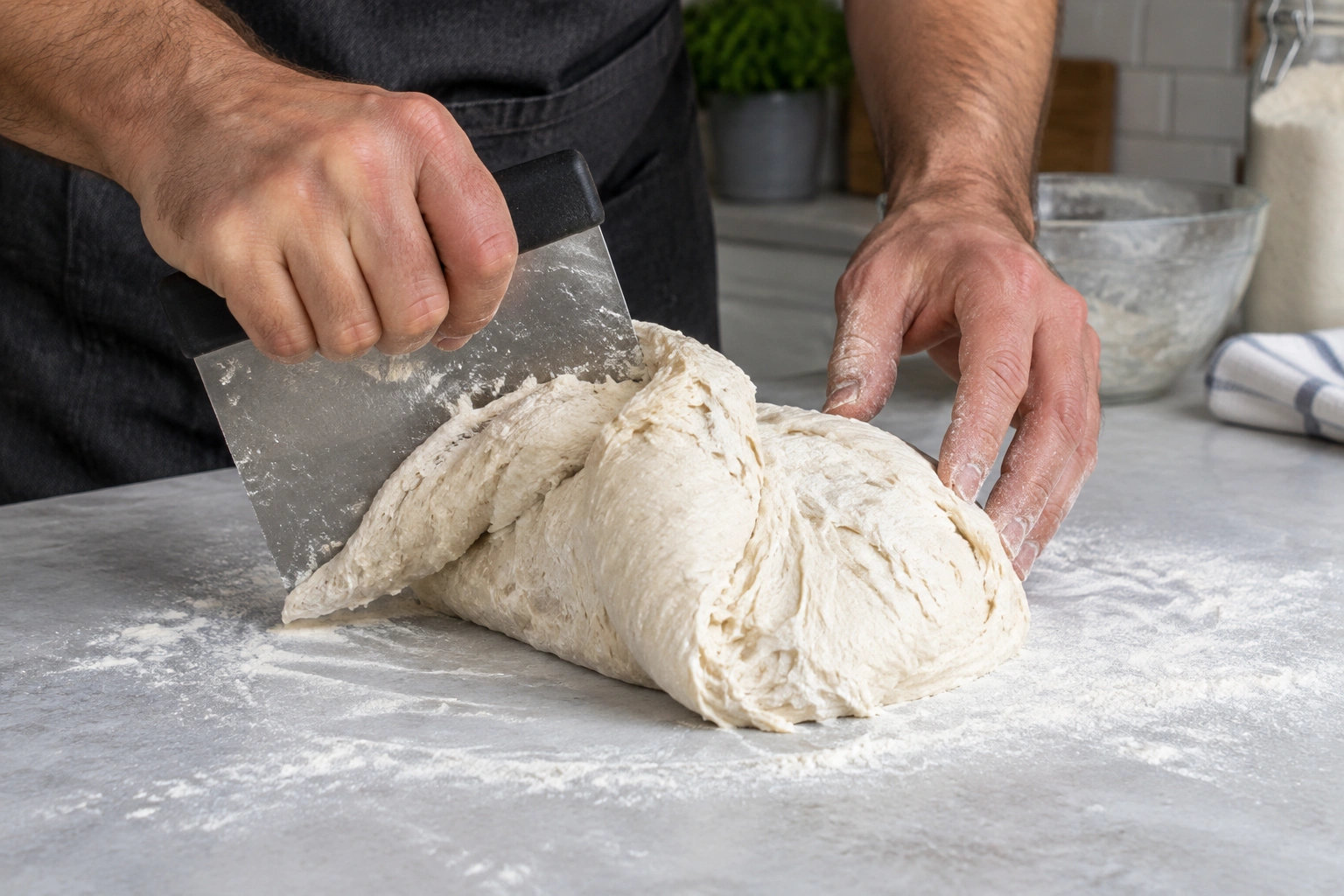
Use wet or lightly oiled hands
A light film of water or oil on your hands can reduce sticking. Use a small amount, though. Too much oil can make the dough slippery and harder to shape cleanly.
Keep the bench scraper in your hand
Think of the scraper as part of your hand. Use it to lift, fold, and release the dough from the counter. That keeps you from tearing the dough by pulling at it.
Shape with confidence, not flour
A common beginner mistake is to keep dusting flour into the dough during shaping. That can dry the outer layer and prevent a good seal. Instead, use quick, efficient movements and let the scraper do the heavy lifting.
Use folds instead of force
If the dough is very soft, a few stretch-and-folds during bulk fermentation can strengthen it more gently than aggressive kneading. This is one of the best methods for high-hydration doughs.
How Flour Type, Hydration, and Environment Affect Stickiness
Bread flour vs. all-purpose flour
Bread flour usually gives you more structure and a dough that becomes easier to handle as gluten develops. All-purpose flour may feel softer and stickier in the same recipe, especially if the formula was designed with stronger flour in mind.
Whole wheat flour
Whole wheat dough often needs more attention because the bran interferes with gluten development and absorbs more water over time. That does not mean it is bad dough. It just behaves differently.
Room temperature and humidity
In a warm kitchen, dough can loosen faster. In a humid environment, the dough may feel wetter and stickier even when the recipe is correct. If your kitchen is consistently warm or humid, you may need to make small adjustments next time rather than forcing the current dough to behave like a different one.
Common Mistakes That Make Dough Stickier
Here are the big ones I watch for:
- Adding flour too early
- Confusing underdeveloped dough with overhydrated dough
- Kneading too little, then assuming the recipe failed
- Using too much bench flour during shaping
- Ignoring the flour type used in the recipe
- Treating a high-hydration dough like a standard sandwich loaf
One especially common error is trying to “fix” sticky dough by repeatedly dumping in flour. That often creates a dry crust on the outside and a dense crumb inside.
How to Know the Dough Is Ready Even If It Still Feels Soft
A finished dough does not have to feel dry to be ready. Look for these signs instead:
- It feels elastic, not weak
- It holds together as one mass
- It smooths out after folding or kneading
- It passes a reasonable windowpane test
- It springs back a little when pressed
Soft dough can still be fully developed. In fact, many excellent breads depend on dough that remains slightly tacky rather than dry and stiff.
Troubleshooting by Stage
During mixing
If the dough is sticky right away, keep mixing until it becomes more cohesive. If it still looks shaggy and weak, let it rest, then continue mixing or folding.
During kneading
If it sticks badly but is becoming smoother, keep going in short intervals. If it tears and smears, it likely needs a rest or more development. If it is already elastic, stop kneading and let gluten continue to relax and organize.
During shaping
Use a scraper, lightly wet hands, and minimal flour. Shaping is often where bakers sabotage a good dough by over-flouring the surface.
During proofing
If the dough becomes slack later, especially after a long rise, overproofing may be the real issue. At that point, more flour will not rebuild the lost structure.
Real-World Examples of Sticky Dough Problems
Sandwich bread that feels too wet
If a basic loaf made with all-purpose flour feels sticky from the start, the recipe may need stronger flour or slightly less water next time. But before changing anything, give the dough a rest and check whether gluten has had time to develop.
Whole wheat dough that seems to get stickier as it sits
That is common. Whole wheat absorbs water differently, so the dough can feel manageable at first and then soften as hydration continues. A rest and a few folds often help more than extra flour.
Ciabatta-style dough
This style is supposed to be very soft. If you expect a firm dough, it will seem wrong from the beginning. The solution is usually better handling, not more flour.
Humid-kitchen dough
If your recipe usually works but suddenly feels off, the environment may be part of the problem. The next batch may need a small water adjustment rather than a major formula change.
How to Adjust the Next Batch
If the dough was genuinely too sticky, make one change at a time next time:
- Reduce the water slightly
- Switch from all-purpose to bread flour
- Add more mixing time or a longer rest
- Use stretch-and-folds instead of relying only on kneading
- Keep notes on room temperature and humidity
That last point is worth doing. A baker who tracks dough behavior learns faster than a baker who guesses from memory.
If you want to understand the numbers behind the formula, revisit your hydration percentages and compare them to the bread style you’re making. That will tell you a lot more than “it felt sticky.”
When to Consult a Master Baker
If the same dough keeps failing even after you adjust water, flour type, and mixing time, it may be worth getting a second set of eyes on your process. A master baker can often spot whether the issue is formula balance, mixing technique, fermentation timing, or shaping method.
That kind of feedback is especially useful when you’re working with enriched doughs, whole grain doughs, or high-hydration formulas that should feel soft but not hopelessly slack.
Sticky dough is not the enemy. Misreading it is. Once you learn the difference between normal tackiness, underdeveloped dough, and a formula that truly needs adjustment, you can work with the dough instead of fighting it.