
How Much Salt to Use in Bread Dough: A Baker’s Guide to Better Flavor and Rise

If you want one dependable answer right away, use about 2% salt based on flour weight for most bread doughs. In practical terms, that means 20 g salt per 1,000 g flour, or 10 g salt per 500 g flour.
That single rule will get you very close for everyday loaves. It gives bread enough flavor, helps the dough hold its shape, and keeps fermentation under control without making the loaf taste salty.
There is a reason bread formulas are usually written in baker’s percentages instead of teaspoons. Salt is one of those ingredients where a small measuring error can change the dough more than you’d expect. A loaf with too little salt can taste flat and ferment too quickly. A loaf with too much can slow yeast activity and bake up tight or overly salty.
Why Salt Matters in Bread Dough
Salt does more than make bread taste better, though flavor is the most obvious benefit. It also affects how the dough behaves from mixing to baking.
Flavor: the simplest reason and often the biggest one
Without enough salt, bread often tastes dull even when the crust is well browned. Salt sharpens the wheat flavor, balances sweetness from starches breaking down during fermentation, and makes the loaf taste more complete.
That is why a bread can look perfect and still feel “missing something.” In many cases, the dough simply needed more salt.
Gluten strength: why dough feels better with salt
Salt tightens and strengthens gluten. That usually means the dough feels a little more elastic and less sticky, and it can hold gas more efficiently during proofing.
If you’ve ever made two similar doughs and noticed that the salted one seemed easier to shape, that is not a coincidence.
For a deeper look at how gluten behaves in dough, see our guide to gluten development in bread.
Fermentation control: why salt keeps yeast in check
Salt slows yeast activity. That is not a bad thing. In bread, controlled fermentation is usually better than rushed fermentation.
When salt is too low, dough can rise faster than expected. That can leave you with weaker structure, less flavor development, and a loaf that overproofs before it is ready. When salt is in the normal range, fermentation tends to move at a steadier pace, giving the dough time to build strength and flavor.
What You Need Before Measuring Salt
Before you calculate anything, make sure you know three things:
- The flour weight
- The type of salt you are using
- Whether your recipe is written by weight or by volume
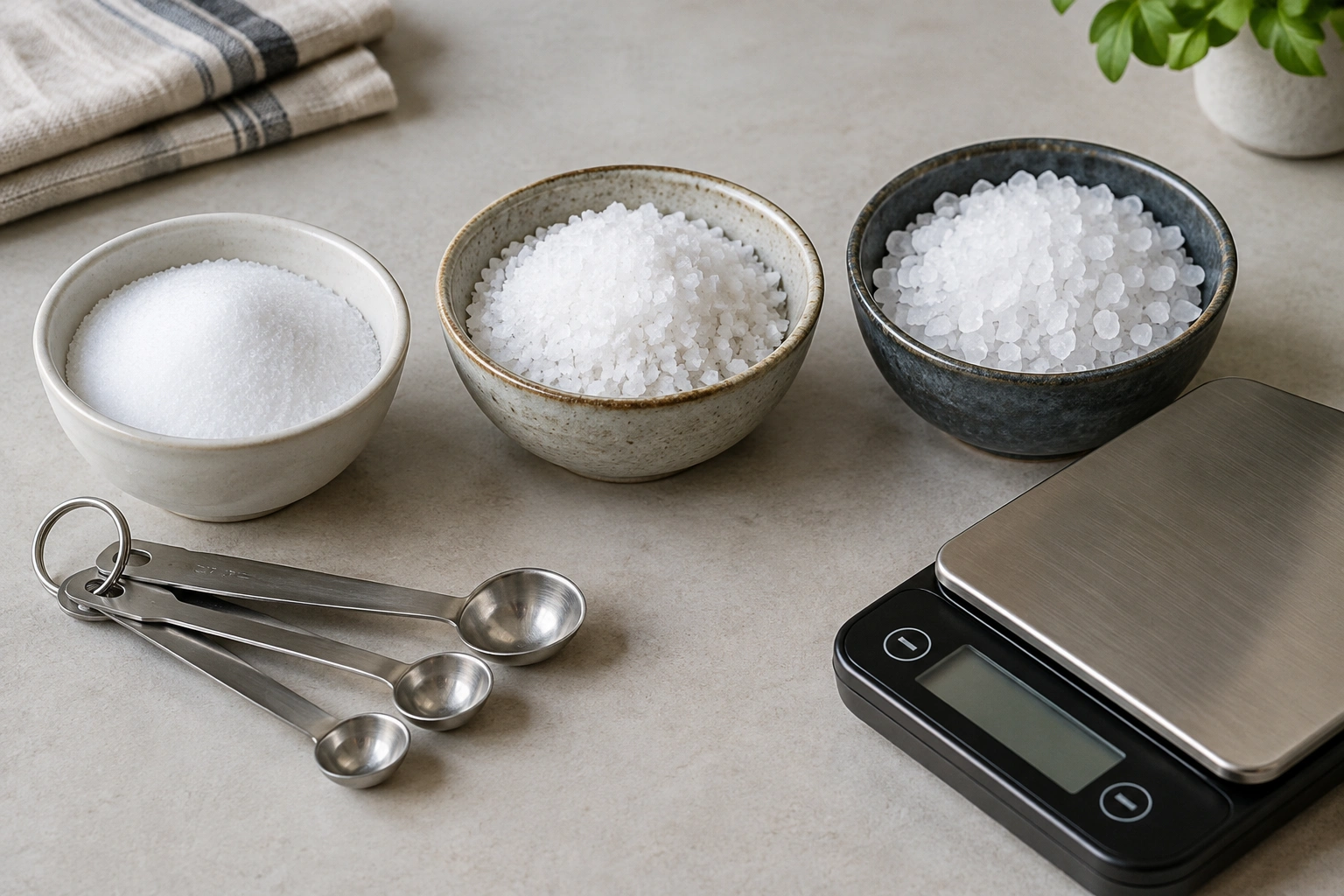
A digital scale is the best tool here. Salt by weight is far more reliable than salt by teaspoons because different salt crystals pack differently. Table salt, fine sea salt, and kosher salt can all measure very differently in a spoon.
If your recipe gives flour in cups, convert it to grams if you can. Cup measurements for flour are already less precise than weight, and adding salt by volume on top of that creates another layer of variation.
For the base ingredients that make up bread dough, this article pairs well with our guide to what bread dough is made of.
How to Calculate Salt by Flour Weight
The formula is simple:
Flour weight × salt percentage = salt weight
If your target is 2% salt and your flour weight is 500 g:
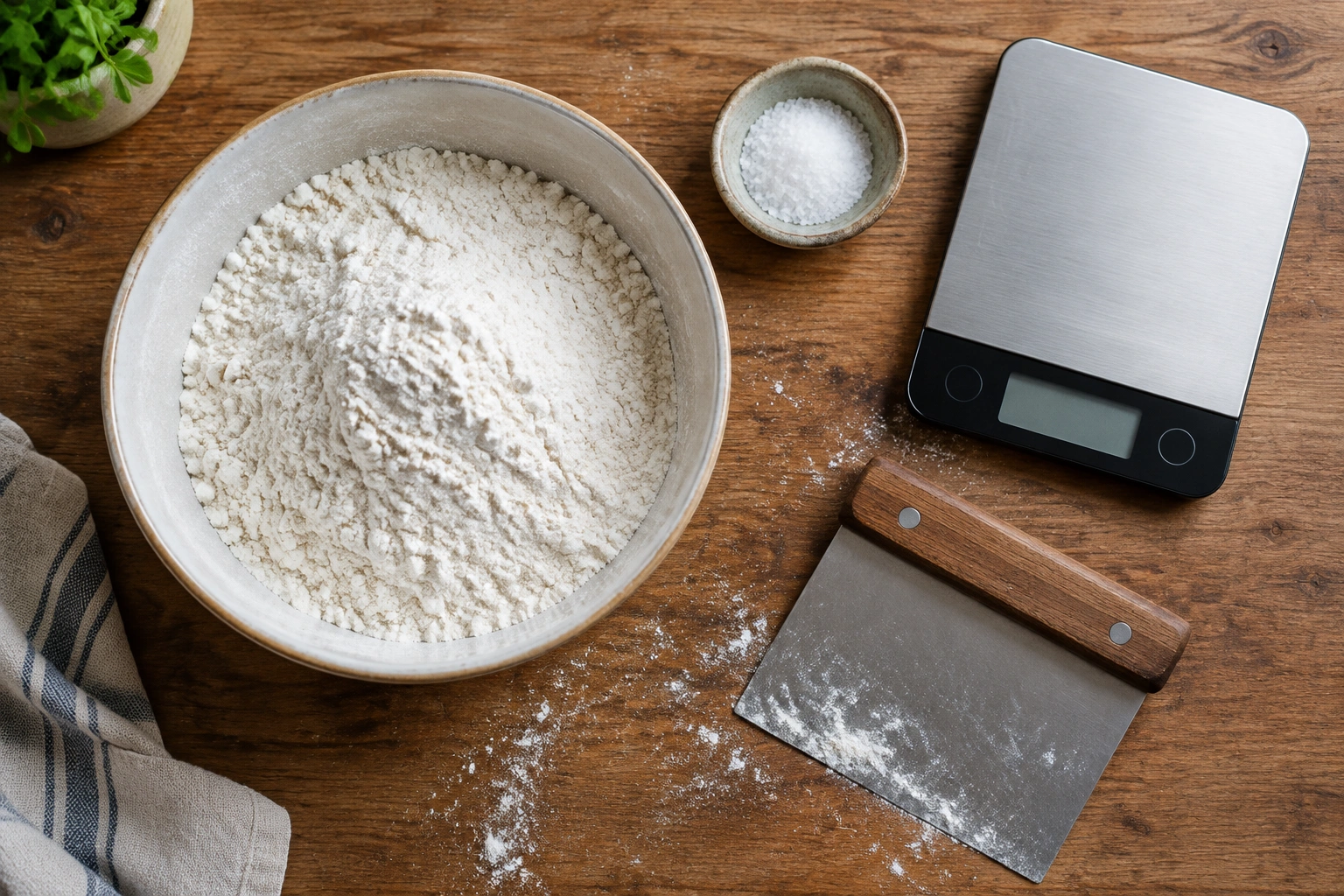
500 × 0.02 = 10 g salt
That is the baker’s percentage method in action. It scales cleanly whether you are making one loaf or ten.
A practical decision rule
- Use 2% for most standard bread doughs
- Use slightly less, around 1.8%, if you want a gentler salt level
- Stay near 2% if you are baking a lean loaf and want balanced flavor
- Drop lower only with intention, because the dough will ferment faster and taste less seasoned
For most home bakers, 2% is the easiest default to remember.
Salt Conversion Chart for Common Bread Recipes
Here is a practical chart you can use right away. The teaspoon values are approximate because salt density varies by grain size and brand.
| Flour weight | 1.8% salt | 2.0% salt | 2.2% salt | Approx. teaspoons of fine table salt at 2% | Approx. teaspoons of kosher salt at 2% | Approx. teaspoons of fine sea salt at 2% |
|---|---|---|---|---|---|---|
| 250 g | 4.5 g | 5 g | 5.5 g | about 7/8 tsp | about 1 tsp | about 7/8 tsp |
| 500 g | 9 g | 10 g | 11 g | about 1 3/4 tsp | about 2 tsp | about 1 3/4 tsp |
| 750 g | 13.5 g | 15 g | 16.5 g | about 2 3/4 tsp | about 3 tsp | about 2 3/4 tsp |
| 1,000 g | 18 g | 20 g | 22 g | about 3 1/2 tsp | about 4 tsp | about 3 1/2 tsp |
Quick conversion note for common salts
A teaspoon is not the same across salt types, so here is a simple practical guide:
| Salt type | 1 teaspoon | 1 gram |
|---|---|---|
| Fine table salt | about 6 g | about 1/6 tsp |
| Kosher salt | about 5 g | about 1/5 tsp |
| Fine sea salt | about 6 g | about 1/6 tsp |
These are approximate, but they are useful for safe substitutions when a recipe gives teaspoons instead of grams.
A quick example for a home loaf
If your dough uses 3 cups flour and your flour weighs roughly 360 g total, then 2% salt is:
360 × 0.02 = 7.2 g salt
That is much more useful than guessing “about a teaspoon,” because teaspoons of different salts do not all weigh the same.
Table Salt vs. Kosher Salt vs. Sea Salt
This is where many bread formulas go wrong. The spoon measure is not the problem; the salt type is.
Table salt
Table salt is fine-grained and compact. That means a teaspoon of table salt usually weighs more than a teaspoon of coarse salt. It is the easiest salt to measure consistently by volume because the grains are small and uniform.
If a recipe says “1 teaspoon salt” and does not specify the type, table salt is often the safest assumption.
Kosher salt
Kosher salt crystals are larger and lighter by volume, so a teaspoon usually weighs less than table salt. But kosher salt is not one universal product. Different brands can vary a lot in crystal size and density.
That is why a teaspoon of one kosher salt may not equal a teaspoon of another. If you bake often, weighing it is the only dependable method.
Sea salt
Sea salt can range from fine to very coarse. Fine sea salt can behave somewhat like table salt, while coarse sea salt may take up more spoon volume with less actual weight.
So the real question is not just “sea salt or table salt?” It is “how fine is the grain, and what does the recipe assume?”
Best practice
If your recipe is written in grams, use grams. If it is written in teaspoons, check the salt type. And if you are converting an old recipe, do not assume all salts are interchangeable by volume.
When to Add Salt to Bread Dough
There are two common mixing approaches, and salt fits into both.
Standard mixing
In a regular mix, salt can go in with the flour at the beginning. That is simple and works well for most doughs.
Autolyse method
If you are using an autolyse, flour and water are mixed first, then salt is added later with the yeast or preferment. This allows the flour to hydrate before salt tightens the dough.
That delay can make the dough easier to mix and improve extensibility, especially in higher-hydration doughs. But the trade-off is that once salt is added, the dough will firm up a bit and fermentation will slow.
Practical timing guide
- Simple home loaf: add salt with the dry ingredients
- Autolyse dough: add salt after the autolyse period
- Very soft doughs: dissolve salt in a little reserved water if that helps even distribution
The main goal is even dispersion. Salt that is patchy in the dough can create uneven fermentation and uneven flavor.
How to Adjust Salt for Different Bread Styles
The standard range works for most breads, but style matters.
Lean breads
Lean doughs, like basic sandwich bread or crusty country loaves, usually do well around the standard 2% mark. These breads rely heavily on flour, water, yeast, and salt, so salt has a big impact on taste and fermentation control.
Enriched breads
Breads with butter, milk, eggs, sugar, or a lot of fat often land a little lower, sometimes around 1.5% to 2%. The richer ingredients already contribute flavor and tenderness, so the salt does not always need to be pushed as high.
The trade-off is that too little salt in an enriched dough can taste sweet or flat very quickly, because the extra fat and sugar can make the loaf seem less “bread-like” if the seasoning is too soft.
High-hydration doughs
Very wet doughs often benefit from careful salt management, not necessarily more salt. The challenge is usually handling and fermentation speed. Salt still belongs in the same normal range, but the dough may feel different because hydration changes how the gluten develops.
If you want to understand how water changes dough behavior, our article on bread dough hydration is a helpful companion.
How to Reduce Salt for Low-Sodium Baking
If you are baking for a lower-sodium diet, the best approach is usually to reduce salt gradually rather than cut it dramatically in one step.
A practical reduction range for many home bakers is from 2% down to about 1.5% to 1.8%. That is enough to lower sodium while keeping the bread closer to a normal structure and flavor profile. Going much below that can start to affect both taste and dough performance more noticeably.
Expect trade-offs:
- less flavor intensity
- faster fermentation
- slightly weaker dough structure
- a shorter window before overproofing
For very low-salt bread, watch proofing closely. Dough can move faster than you are used to, especially in a warm kitchen, so bulk fermentation and final proof may need shorter times than the original recipe.
The Real Bread Campaign recommends a much lower target for salt reduction efforts, but that is a deliberate public-health goal rather than a neutral baking default. For most home bakers, reducing in stages is the safer way to preserve bread quality while lowering sodium.
Common Mistakes When Measuring Salt in Bread
A few small errors cause most salt problems in bread.
Using teaspoons without checking the salt type
This is the most common one. A teaspoon of table salt is not the same as a teaspoon of kosher salt. If the recipe was written by weight, volume can mislead you.
Forgetting that salt is based on flour weight, not total dough weight
Salt percentages are almost always calculated from flour, not from the combined weight of flour, water, and everything else. That distinction matters.
Reducing salt too aggressively
If you slash the salt, the dough may ferment too quickly and taste unfinished. A loaf that is technically “bread” can still feel weak and underseasoned.
Mixing salt unevenly
If salt clumps in one area, some parts of the dough may ferment differently from others. That can show up as uneven crumb or pockets of overly salty flavor.
Troubleshooting Bread That Is Bland, Too Salty, or Rising Too Fast
Salt problems usually show up in the dough before they show up in the oven.
If the bread tastes bland
The next time, increase salt slightly within the normal range. If you were at 1.5%, try 1.8% or 2%. Often that small change is enough to make the loaf taste complete.
If the bread tastes too salty
Check whether you measured by volume and used a dense salt like table salt when the recipe expected something lighter. If the measurement was correct, reduce the percentage a little next time.
If the dough rises too fast
That can happen when salt is too low. Lower-salt dough often needs closer attention during bulk fermentation and final proof. You may need to shorten the rise time or use a cooler environment.
If the crumb is weak or the loaf spreads
Salt may be too low, but hydration and gluten development also matter. A reduction can expose other weaknesses that were previously hidden.
Practical Examples and Rule of Thumb
Here is the simplest rule I teach:
For most bread, use 2% salt by flour weight.
That means:
- 500 g flour = 10 g salt
- 1,000 g flour = 20 g salt
- 250 g flour = 5 g salt
If you want a slightly softer salt profile, stay near 1.8%. If you are making a richer dough, you may stay around the same range or lower it a touch depending on the formula. If you reduce salt for dietary reasons, do it gradually and watch fermentation more closely.
The real skill is not memorizing one number forever. It is learning how salt changes the dough so you can make a small, deliberate adjustment instead of a guess.
For bread bakers, that is the difference between a recipe that merely works and one that you can trust.
FAQs
How much salt should I use per cup of flour?
A cup is not a reliable bread measure because flour weight varies with how it is scooped. If you can, weigh the flour first. Then use about 2% salt by flour weight.
Is 2% salt standard for bread?
Yes, 2% is a very common default in bread formulas. Many bakers use a range around 1.8% to 2.2% depending on style and preference.
Does salt affect yeast?
Yes. Salt slows yeast activity, which helps control fermentation and prevents the dough from rising too quickly.
Can I use kosher salt instead of table salt?
Yes, but do not swap by volume without checking the weight. Kosher salt crystals are usually larger and lighter, so teaspoons do not convert directly.
When should salt go into the dough?
In standard mixing, salt can be added with the dry ingredients. In an autolyse method, it is usually added after the rest period.
What happens if I leave salt out?
The bread may taste bland, the dough may ferment faster, and the structure may be less controlled. It is possible to bake without salt, but the result will not behave like a standard bread dough.