
Why Pizza Dough Won’t Stretch — and How to Fix It Without Ruining the Crust

When pizza dough refuses to stretch, the problem is usually not that you’ve failed as a baker. More often, the dough is telling you something specific: the gluten is too tight, the dough is too cold, it needs more rest, or the balance of hydration and fermentation is off.
The good news is that most stubborn dough can be rescued. You just need to diagnose what kind of resistance you’re feeling before you keep pulling at it. Force is the fastest way to turn a workable dough into one that tears, shrinks back, or bakes up tough.

Why Pizza Dough Won’t Stretch
Pizza dough stretches well when it has two things in balance:
- Elasticity: the dough’s ability to spring back
- Extensibility: the dough’s ability to lengthen without fighting you
If the dough is too elastic and not relaxed enough, it will keep shrinking back. If it’s too dry or too tight, it may tear instead of stretching. If it’s cold, the gluten and fats inside the dough are less pliable, so the dough can feel stubborn even when the formula is fine.
That’s why “just keep stretching” is usually the wrong move. You’re not trying to overpower the dough; you’re trying to get it to relax enough to cooperate.
Quick Diagnosis: What the Dough Is Telling You
Before you decide on a fix, read the dough like a baker would.
| What you see or feel | Likely cause | Best next move |
|---|---|---|
| Snaps back quickly after you stretch it | Gluten is too tight or not relaxed enough | Stop, cover, and rest it |
| Feels stiff straight from the fridge | Dough is cold | Warm it at room temperature before shaping |
| Tears at the edge while you stretch | Surface may be dry or dough may be underhydrated | Reduce bench flour and reassess hydration |
| Feels smooth but fights every pull | Strong gluten development, possibly from mixing or kneading | Give it a longer rest |
| Looks very puffy, fragile, and gassy | May be overproofed | Handle very gently and consider re-balling |
| Feels dense and resistant after mixing | May be underproofed or overworked | Let it ferment longer if time allows |
A simple readiness check can help. Press a finger into the dough ball and watch the indentation. If it springs back very quickly, the dough is not ready to stretch. If it returns slowly and leaves a little impression, the gluten has relaxed enough to shape more easily. That poke test is a practical clue, not a perfect test, but it’s useful when you’re deciding whether to keep going or walk away for a few minutes.
What You’ll Need Before You Try Again
You do not need special equipment to fix most pizza dough problems, but a few tools make the process smoother:
- A clean work surface
- A lightly floured or lightly oiled surface
- A bowl or tray large enough to cover the dough during rests
- A bench scraper, if you use one
- A kitchen scale for future batches
- A timer
That last one matters more than people think. Dough that feels impossible at minute zero may become easy after a short rest. If you don’t time your rest, it’s easy to assume the dough is “bad” when it simply needs a pause.
How to Fix Pizza Dough That Snaps Back
Here’s the fastest recovery path when the dough keeps shrinking as you shape it.
1) Stop forcing it
If the dough resists after a few gentle stretches, pause. Repeated pulling tightens the gluten further and can make the crust tough in a bad way.
2) Cover it
Place the dough under an upside-down bowl, or return it to a covered container. This keeps the surface from drying out while the gluten relaxes.
3) Rest it briefly
A short rest is often enough for dough that was recently worked. If it has been handled aggressively, it may need longer. The key is not the exact minute count; it’s whether the dough has softened and become more extensible.
4) Warm refrigerated dough before judging it
If the dough came straight from the refrigerator, give it time to come closer to room temperature before you decide it is “too tight.” Cold dough often feels firmer than it really is. A dough that seems stubborn at fridge temperature may shape much more easily after warming.
5) Resume shaping in stages
Instead of trying to stretch the full round in one go, stretch a little, rest if needed, then continue. That staged approach is especially helpful when the dough is strong but not yet relaxed.
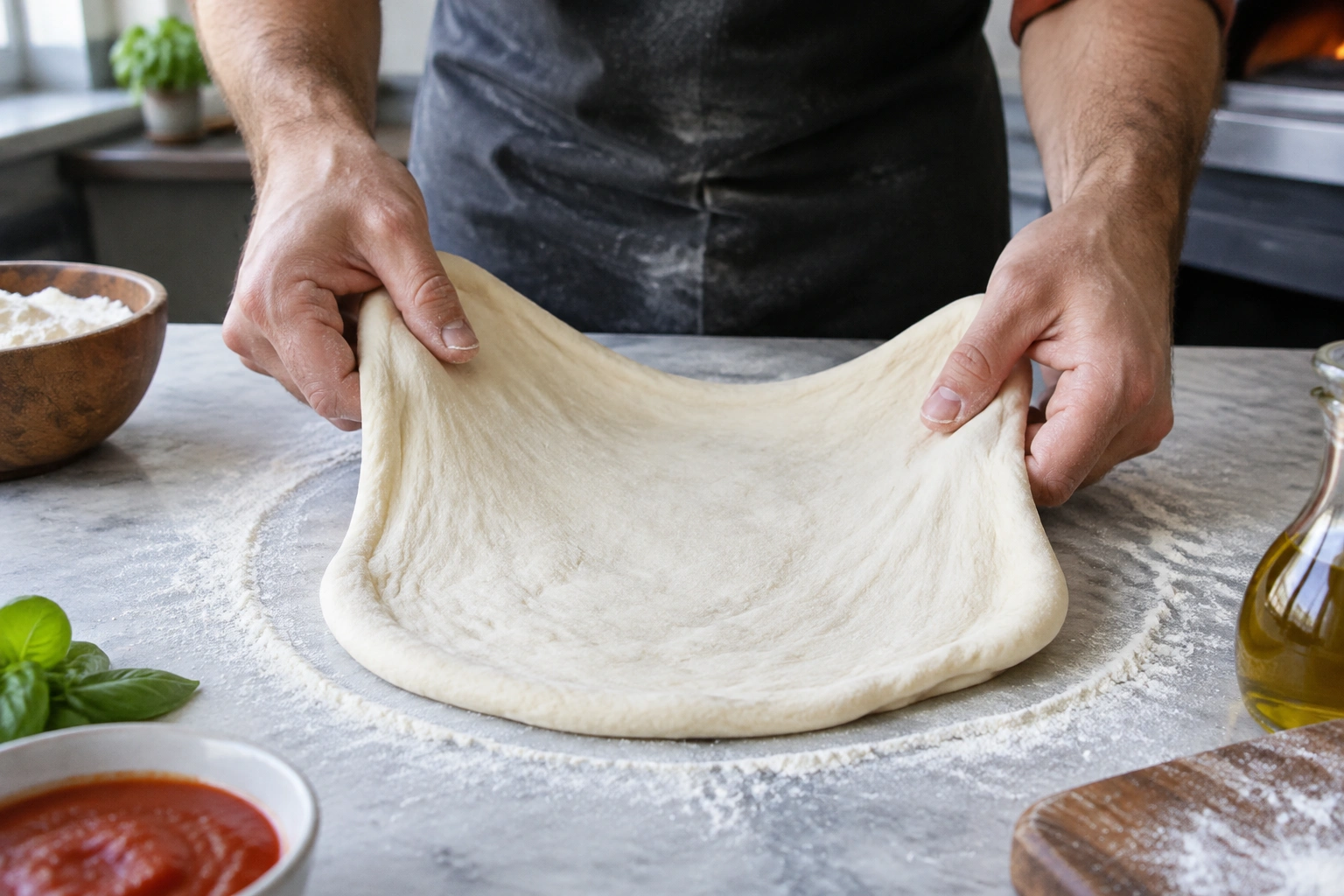
This is also where gravity helps. Gentle hand pulling and letting the dough drape can work better than muscling it from the center outward. The aim is even tension, not brute force.
How Long to Rest the Dough Before Stretching Again
There isn’t one universal rest time, because temperature and dough condition both matter. Still, a few practical ranges help you act quickly:
- Recently mixed dough at room temperature: rest for about 15 to 30 minutes before trying again if it feels tight.
- Dough that has been aggressively kneaded or stretched: give it a longer covered rest, often 30 to 60 minutes, so the gluten can relax.
- Refrigerated dough: let it warm until it is closer to room temperature, which can take 30 to 90 minutes or more depending on dough size, room temperature, and how cold it was stored.
- Dough that still springs back after a short rest: pause again for another 10 to 15 minutes rather than forcing it.
- Dough that feels dry and keeps tearing: rest may help a little, but you should also reduce bench flour and reassess hydration.
A useful decision rule is this: if the dough feels smooth but stubborn, rest is usually the first fix. If it feels cold and stiff, warming comes first. If it feels dry and tears, rest alone may not be enough.
Store-bought dough often benefits from the same logic, but it may need more patience than people expect. Baking Steel notes that store-bought dough often won’t stretch because it wasn’t given enough rest after shaping, or because it was overworked during stretching. Their practical fix is to ball it and rest it before shaping gently with gravity rather than force. You can read their guidance here.
How to Handle Cold, Dry, Underproofed, or Overworked Dough
This section is easiest to use as a decision path:
If the dough is cold
Cold dough is often the easiest problem to fix. It may feel stiff, resistant, and a little rubbery simply because it hasn’t warmed enough. If you try to shape it immediately, it may snap back even though the formula is fine.
Best fix: let it sit covered until it loosens. If it came from the refrigerator, warm it first before you judge the texture.
If the dough feels smooth but keeps snapping back
That usually points to tight gluten, not a ruined dough.
Best fix: stop stretching, cover it, and rest it for 15 to 30 minutes. If it still resists, give it another short rest instead of forcing it.
If the dough tears and feels dry
When the edge tears, the surface may be drying out, or the dough may simply be too flour-heavy on the bench.
Best fix: reduce bench flour and reassess hydration. Handle it more gently, and keep the dough covered between attempts. If the dough is still tearing after that, it may need a small formula adjustment next time.
If the dough seems underproofed
Underproofed dough often feels tight and resistant because it has not fermented enough to become airy and relaxed. It may look smooth, but it can still fight you when stretched.
Best fix: give it more time. Underproofed dough generally needs more fermentation before it becomes easy to shape. If you have time, let it continue proofing before trying again.
If the dough seems overworked
If the dough was kneaded hard or stretched aggressively, the gluten network may be too tense. It can feel “bouncy” in the wrong way, like a rubber band.
Best fix: stop working it and let it relax. More kneading is usually the wrong move here. A longer rest is the better first response.
If the dough seems overproofed
Overproofed dough can behave differently. Instead of springing back, it may feel fragile, very puffy, and prone to tearing. It has often lost some of the structure it needs for clean shaping.
Best fix: handle it very carefully. If it is still holding together, re-ball it gently and give it a short rest before shaping again. If it collapses easily and tears with minimal handling, it may be beyond easy repair.
Elasticity vs Extensibility: The Difference That Matters
These two words explain a lot of pizza dough frustration.
- Elasticity is the dough’s tendency to bounce back.
- Extensibility is the dough’s ability to stretch out.
A dough can have plenty of strength and still be hard to shape if its elasticity is too dominant. That’s why a dough that feels “strong” is not automatically a good dough for pizza. You want enough structure to hold toppings, but enough relaxation to shape into a round without a fight.
If your dough keeps retracting, you usually need more extensibility, not more strength.
Hand-Stretching vs Using a Rolling Pin
For most pizza dough, hand-stretching is the better first choice because it preserves the dough’s internal structure and gives you more control over thickness. It also lets you feel where the dough is tight, thin, or uneven.
A rolling pin is a reasonable fallback if the dough refuses to relax or if you need a fast, even round. The trade-off is that a rolling pin can degas the dough more aggressively and flatten some of the air you built during fermentation.
If you want the best texture and the dough is cooperative, hand-stretching usually wins. If the dough is stubborn and you need a usable base, rolling it out may be the practical choice. If you want to improve that skill, our guide on how to roll dough evenly is a useful companion.
Common Mistakes That Make Dough Harder to Stretch
A few habits make a tight dough even tighter:
Using too much bench flour
Flour helps prevent sticking, but too much can dry the surface and make tearing more likely. If the dough feels dry and rough, the bench may be part of the problem.
Trying to fix everything with more kneading
If the dough is already tight, kneading more can worsen the issue. Rest often helps more than extra mixing.
Stretching straight from the fridge
Cold dough often behaves as if it’s underdeveloped when it’s really just chilled. Give it time to warm before you judge it.
Overhandling during shaping
Every time you force the dough wider, you risk tightening it again. Small adjustments work better than wrestling matches.
Confusing a dry dough with an underproofed one
They can look similar, but the fix is different. Dry dough needs better moisture management. Underproofed dough needs more fermentation time.
When the Dough Is Beyond Easy Repair
Sometimes the kindest answer is to stop trying to save it.
Consider re-balling or starting over if:
- The dough still feels dense and unmalleable after a proper rest and warm-up
- It tears repeatedly even with gentle handling
- It has been over-floured and now feels dry throughout, not just on the surface
- It seems overproofed and fragile, with little strength left and no ability to hold shape
- It has an off smell or visible signs of spoilage
If the dough is only tight, give it another rest. If it is structurally damaged, no amount of stretching technique will fully fix it.
How to Prevent Stretching Problems Next Time
Prevention is much easier than rescue.
Match hydration to your flour and skill level
Higher hydration can make dough easier to stretch, but it also makes the dough stickier and harder to handle. If you’re a newer baker, a slightly lower hydration dough may be easier to manage while you learn shaping.
Don’t rush fermentation
A dough that has had enough time to ferment is usually easier to shape than one that was mixed and used too quickly. Fermentation gives the dough time to relax and develop the structure you want.
Be moderate with kneading
You need enough mixing to develop gluten, but not so much that the dough becomes overly tense. Once the dough is smooth and cohesive, additional kneading may offer less benefit than a rest.
Keep the dough covered
A covered rest protects the surface from drying out. That matters more than people realize, especially if your kitchen is warm or dry.
Bring refrigerated dough up gradually
If you plan to use cold dough, factor in warm-up time before shaping. Dough straight from the fridge is often the reason a pizza session starts with frustration.
If you want to read a shaping-aid approach from a baking source, King Arthur Baking discusses an Easy Roll Dough Improver in their article on stretching pizza dough. It’s worth noting only as an optional technique, not a required fix.
Practical Examples: Real Dough Problems and Fixes
Example 1: Dough from the fridge keeps shrinking
You take a dough ball out of the refrigerator, and it feels firm and springy. You try to stretch it, but it keeps snapping back.
Likely cause: cold dough with tight gluten
Fix: let it warm at room temperature, then rest it covered before trying again
Example 2: Dough was kneaded hard and feels like a rubber band
The dough looks smooth, but every pull fights back.
Likely cause: overworked, highly elastic dough
Fix: stop stretching, cover it, and give it time to relax
Example 3: Dough tears after you dust the bench heavily
The dough starts to stretch, but the edge tears and feels dry.
Likely cause: surface drying from too much flour
Fix: use less bench flour next time and keep the dough covered between attempts
Example 4: Store-bought dough won’t cooperate
The dough is soft enough, but it still resists shaping and shrinks back.
Likely cause: not enough rest after shaping or too much handling
Fix: ball it, let it rest, and stretch it gently rather than forcing it
When to Consult a Master Baker
If you’ve rested the dough, warmed it appropriately, handled it gently, and it still won’t stretch, the issue may be in the formula itself rather than your technique. A master baker can help you evaluate hydration, flour choice, fermentation timing, and mixing method in a more exact way.
That’s especially useful if you’re working through repeated dough problems in a class setting or trying to standardize a recipe for consistent results.
The real goal is not to make the dough obey. It’s to understand what kind of dough you have in front of you and give it the conditions it needs to become extensible. Once you learn that read, pizza shaping gets a lot calmer—and a lot more successful.
FAQ
Why does pizza dough keep shrinking back when I stretch it?
It usually means the gluten is too tight or the dough is too cold. Stop stretching, cover it, and let it rest before trying again.
How long should pizza dough rest before stretching again?
A recently mixed dough may only need 15 to 30 minutes. Refrigerated dough often needs 30 to 90 minutes or more to warm up, and aggressively kneaded dough may need a longer covered rest.
How do I know if pizza dough is underproofed or overproofed?
Underproofed dough tends to feel tight and resistant. Overproofed dough usually feels fragile, very puffy, and prone to tearing or collapsing.
What should I do if pizza dough tears when I stretch it?
First reduce bench flour and reassess hydration. If the dough is dry, rest alone may not solve it. Handle it more gently and keep it covered between attempts.
Can I fix pizza dough that is too cold?
Yes. Let it warm at room temperature before shaping. Cold dough often seems more resistant than it really is.
Is it better to stretch pizza dough by hand or with a rolling pin?
Hand-stretching is usually better for texture and control. A rolling pin is a useful fallback if the dough is too stubborn to shape by hand.
How do I know when the dough is beyond repair?
If it still feels dense and unmalleable after a proper rest and warm-up, tears repeatedly with gentle handling, or shows signs of spoilage, it’s usually better to start over.