
Are Air Fryers Safe for Apartments? A Practical Guide for Renters and Small Spaces
If you live in an apartment, condo, or studio, the short answer is yes: air fryers are generally safe to use indoors when they’re set up correctly. The bigger question is whether your kitchen layout, ventilation, outlet setup, and building rules make it a good fit.
In everyday use, an air fryer usually creates less heat than a full-size oven and less mess than deep frying. But it is still a countertop heating appliance. That means smoke, odor, clearance, and electrical load all matter more in a small space than they would in a larger house.
The safest approach is simple: use the air fryer on a stable counter, keep it away from cabinets and curtains, plug it into a proper outlet, and follow your lease or building rules if they apply. Many air fryers include features such as automatic shut-off and temperature controls, but those features should be treated as helpful safeguards rather than a guarantee of safety in every setup. Source

What Makes Air Fryers Different in Small Spaces
A small apartment changes how appliance heat, smell, and smoke behave.
In a larger kitchen, a little grease smoke may disperse quickly. In a studio or compact galley kitchen, the same amount of smoke can linger longer, reach a smoke alarm faster, and spread into the living area. Odors also hang around more noticeably when the kitchen is open to the rest of the apartment.
That does not make the appliance unsafe by default. It just means the margin for sloppy setup is smaller.
A useful way to think about it: an air fryer is not “smoke-free.” It is usually “lower smoke” than deep frying, but greasy foods, excess oil, and food crumbs can still create visible smoke. If you cook bacon-wrapped food, heavily marinated items, or anything with dripping fat, expect more odor and a higher chance of a smoke alarm event than you would with plain vegetables or dry breaded items.
Main Apartment Safety Risks to Watch For
The real concerns in apartments are usually not the air fryer itself, but how and where it is used.
Fire and Heat Risk
Air fryers get hot. The exterior on many models stays cooler than an oven, but the appliance still needs room for airflow and heat dissipation. If it is pressed against a wall, tucked under low cabinets, or placed beside curtains or paper goods, heat buildup becomes a real concern.
The other risk is user error: overfilling the basket, using too much oil, or running the appliance unattended while food smokes. Those habits are what make any countertop cooker more problematic.
Smoke Alarms
Apartment smoke alarms are often more sensitive than people expect. A little grease smoke, especially in a compact kitchen, can set one off quickly. If your alarm is near the kitchen or in an open-plan living area, you may need to be more careful with oily foods than someone cooking in a larger home.
Odor Spread
Air fryers can leave a noticeable smell, especially with fish, onions, seasoned breading, or fatty meats. In a shared building, odor can travel into hallways or neighboring units if windows are open toward common spaces or if the kitchen ventilation is weak. Close proximity to neighbors means even a normal cooking smell can become a complaint faster than it would in a detached home.
Electrical Strain
A high-wattage appliance on a shared circuit can be a problem in older apartments. If the air fryer shares power with a microwave, kettle, coffee maker, or space heater, the breaker may trip. That is not the same as a fire, but it is a sign the circuit may be overloaded.
Where to Place an Air Fryer Safely
Placement matters more in apartments because the kitchen usually has less room for error.
Keep the air fryer on a stable, heat-resistant countertop. Avoid soft mats, unstable carts, or anything that can shift while the basket is pulled out. The appliance should sit flat and not wobble when the drawer is opened.
Leave clearance on all sides, especially at the back and top. The exact distance depends on the model, so the manual should always come first. If the manufacturer gives a minimum clearance, follow that rather than guessing.
A good apartment setup looks like this:
- On a clear section of counter, not under hanging cabinets
- Away from curtains, dish towels, paper towels, and packaging
- Not pressed against the wall
- Not directly beside the sink where splashes can reach the plug
- With enough room to open the basket fully without bumping anything
If your only available space is a narrow corner under cabinets, that is a warning sign. In that setup, even a safe appliance can become inconvenient or risky because heat and steam have nowhere to go.
Ventilation, Smoke, and Smoke Alarm Considerations
Ventilation is the difference between “normal cooking smell” and “why does the whole apartment smell like dinner?”
If your kitchen has an exhaust fan, use it. If opening a window is practical, crack it before cooking so the apartment has a path for air to move. That does not eliminate smoke, but it helps dilute it.
A few practical habits reduce alarm triggers:
- Preheat only when needed
- Avoid excess oil
- Shake or turn food so grease does not pool in one spot
- Clean the basket and tray regularly
- Don’t cook especially greasy foods at the highest setting unless the recipe calls for it
One easy mistake is assuming the air fryer is “safer” because it is smaller than an oven. In a tiny apartment, smaller can actually mean the smoke is more concentrated near the alarm. That is why oily foods tend to be the biggest troublemaker.
If your smoke alarm is very close to the kitchen, test your setup with a low-smoke food first, such as frozen fries or vegetables, before trying bacon or heavily seasoned wings.
Electrical Safety in Apartments
Most apartment problems with air fryers are not dramatic. They are electrical.
Check the wattage on the appliance label and compare it with the outlet situation in your kitchen. Many air fryers are designed to plug directly into a wall outlet. That is usually the safest choice.
A few rules worth following:
- Use a dedicated wall outlet when possible
- Avoid power strips unless the manufacturer specifically allows it
- Be cautious with extension cords, especially lightweight ones
- Don’t daisy-chain cords or use undersized cords to reach the counter
- Don’t run the air fryer on the same circuit as several other high-draw appliances if you can help it
If your apartment has GFCI outlets near the sink, that is normal and helpful for kitchen safety. What matters most is keeping the plug dry and not stretching cords across wet areas.
If the apartment only has older outlets or limited kitchen circuits, treat repeated breaker trips as a sign the setup may not be suitable. In that case, reduce the load, move the appliance to a proper outlet if one exists, or ask the landlord or an electrician to assess the circuit before using it again.
The biggest mistake I see in small kitchens is treating the air fryer like a low-power gadget. It is still a heating appliance, and the electrical setup should be treated that way.
Lease, Landlord, and Building Rule Checks
Before you assume anything is allowed, check the lease agreement and any building rules.
Most leases do not ban air fryers outright, but some buildings restrict countertop cooking appliances, open heating elements, or anything that creates excessive smoke or odor. Condo associations may also have rules about nuisance odors, ventilation, or fire safety.
It is also worth checking whether apartment fire code or building-specific rules say anything about countertop cooking appliances, balconies, or bedroom/studio setups where kitchen space is limited. General lease language and building safety rules are not always the same thing, so a lease that seems silent may still not tell the whole story.
If you are unsure, look for language about:
- Countertop appliances
- Smoke or odor nuisance
- Kitchen ventilation requirements
- Electrical load limits
- Fire safety or prohibited appliances
To verify whether countertop cooking appliances are allowed, check the written lease, building handbook, condo rules, or fire-safety policy first. If the wording is unclear, ask the landlord or property manager in writing before using the appliance. If possible, ask specifically whether an air fryer is allowed in your unit type and whether balcony or bedroom use is prohibited.
A practical example: if your building has strict nuisance rules and your kitchen vents poorly into a shared hallway, an air fryer used for greasy foods may create avoidable complaints even if it is technically allowed.
How to Reduce Smoke and Odor in a Small Apartment
A few small habits make a big difference in shared or compact housing.
First, keep the air fryer clean. Grease and crumbs left in the basket or around the heating area can burn on the next use and create smoke. If you want a deeper cleaning routine, this guide on whether air fryer baskets are dishwasher safe can help you check what parts need hand washing.
Second, choose foods that fit the appliance’s strengths. Frozen fries, vegetables, chicken pieces, and reheated leftovers usually create less smoke than very fatty or heavily oiled foods.
Third, manage odor at the source. Open a window if possible, run the fan, and empty greasy scraps quickly after cooking. If you leave the basket full of hot drippings on the counter, the smell tends to linger.
Fourth, keep paper products and packaging away from the appliance. In a small kitchen, clutter often becomes the real hazard.
If you notice a burnt-plastic smell instead of normal cooking odor, stop and inspect the appliance. That is different from the smell of food browning and could point to a problem with the unit or a nearby plastic part. If you want a deeper look at that issue, see our guide on whether plastic in air fryers is safe.
Air Fryer vs Oven vs Toaster Oven vs Deep Fryer
Here is the apartment-friendly comparison most renters actually need.
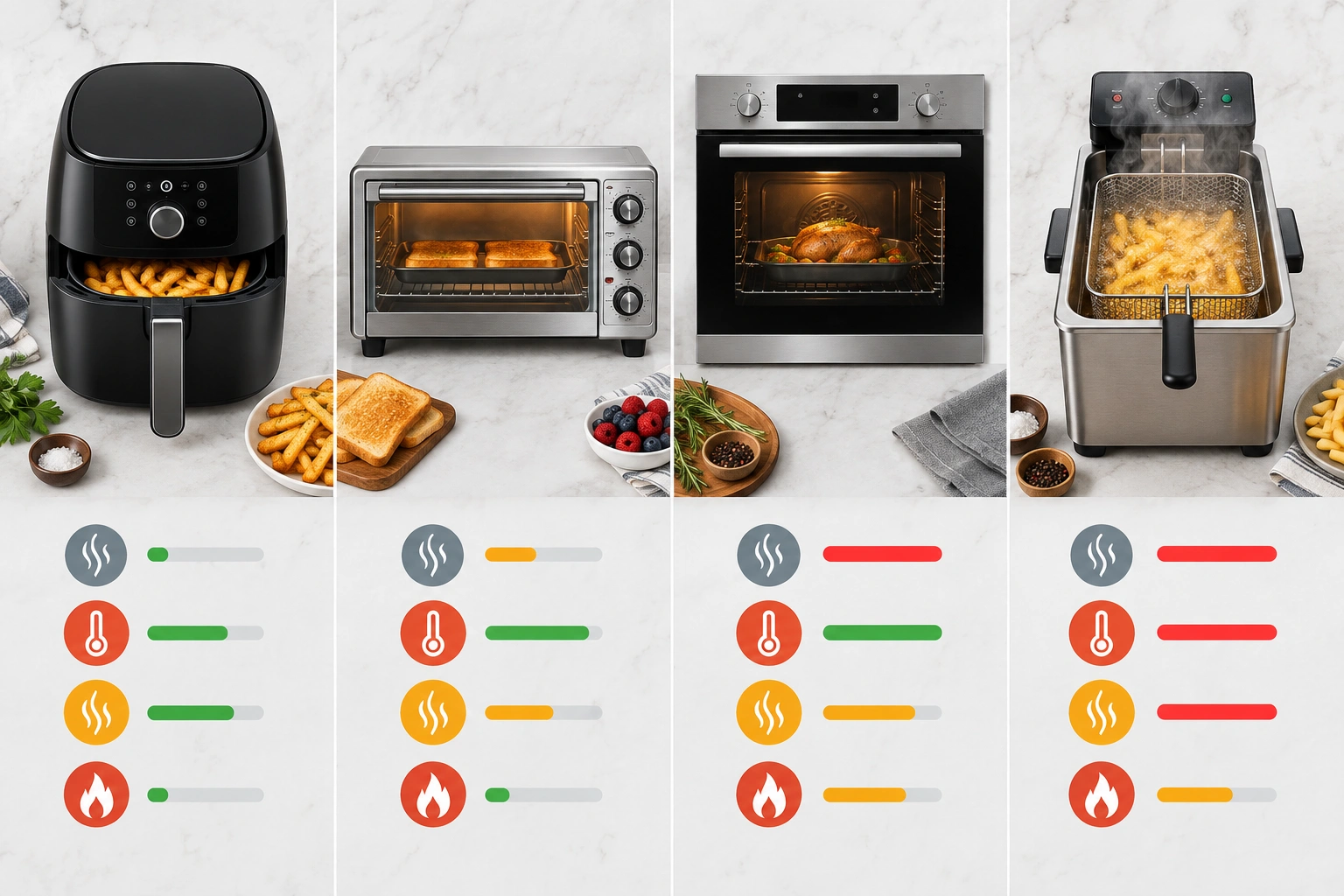
| Appliance | Smoke | Heat in the Apartment | Odor | Fire Risk | Space Needs |
|---|---|---|---|---|---|
| Air fryer | Usually moderate, but can spike with greasy foods | Lower than a full oven in many cases | Noticeable, especially with fatty foods | Lower than deep frying when used properly | Compact countertop space |
| Oven | Can be lower or higher depending on the food, but the room heats up more | Higher | Moderate to strong | Generally low when used normally | No counter space, but needs kitchen heat tolerance |
| Toaster oven | Similar to air fryer for some foods | Moderate | Moderate | Similar concerns for crumbs and grease | Countertop space, often larger footprint |
| Deep fryer | High smoke and strong odor | High near the cooking area | Strong and lingering | Highest of the group because of hot oil | Countertop space plus oil storage |
For most apartment dwellers, the air fryer is more practical than a deep fryer and usually easier to live with odor-wise. Compared with an oven, it often adds less heat to the room, which matters in a small kitchen or during summer. A toaster oven can be a close alternative, but the air fryer often circulates air faster and can cook some foods with less lingering smell.
Apartment-Friendly Safety Checklist Before First Use
Before you plug it in, run through this quick check:
- The counter is flat, stable, and heat-resistant
- There is clear space around the air fryer
- It is not under cabinets, curtains, or towels
- The outlet is in good condition and dry
- You are not using a weak power strip or questionable extension cord
- The kitchen fan works, or a window can be opened
- The lease or building rules do not prohibit countertop cooking appliances
- The basket and tray are clean before use
- You have a plan to stay nearby while it cooks
That last point matters. Even though many air fryers have automatic shut-off functions, I would treat them as a reason to reduce risk, not as a reason to leave the appliance completely unattended in a tight apartment kitchen.
When an Air Fryer May Not Be a Good Fit
There are situations where the answer is basically no, or at least not yet.
If your kitchen is so small that the appliance would sit under cabinets with almost no clearance, that is a poor setup. If your smoke alarm is extremely close to the cooking area and you already know it is sensitive, you may need to rethink what foods you cook in it. If your building has strict appliance rules or nuisance odor policies, you should get written approval before using one.
A simple decision rule for renters: if clearance, ventilation, outlet capacity, or building rules are uncertain, do not use the air fryer until those issues are resolved.
A high-wattage model may also be a bad fit in an older apartment with limited outlets or frequent breaker trips. In that case, a smaller unit may be safer and less frustrating than a larger one.
Balcony or bedroom/studio use is also worth avoiding unless the manufacturer and building rules clearly allow it and the setup still meets clearance and electrical requirements. If it only “works” because you are improvising around missing kitchen space, that is usually a sign to pause and reassess.
When to Consult a Professional
If you suspect your outlet is overloaded, your breaker trips often, or you see signs of heat damage around the plug or cord, contact a licensed electrician. If your lease language is unclear and you are worried about violating building rules, ask the landlord or property manager directly. And if an appliance ever smells like melting plastic or shows visible damage, stop using it until it is inspected or replaced.
Frequently Asked Questions
Can an air fryer set off a smoke alarm in an apartment?
Yes. Grease smoke, overfilled baskets, or cooking very fatty foods can trigger an alarm, especially in a small kitchen.
Is it safe to use an extension cord?
Usually the safest choice is a wall outlet. If you must use an extension cord, it should be appropriately rated and only if the manufacturer allows it. Avoid power strips for high-draw appliances.
Do air fryers make too much smell for apartments?
They can make enough smell to notice, especially with fish, bacon, wings, or heavily seasoned foods. Good ventilation and regular cleaning help a lot.
Can landlords ban air fryers?
Sometimes, yes. The lease or building rules may restrict countertop cooking appliances or anything that creates smoke or odor. Check before using one.
Is an air fryer safer than deep frying in an apartment?
In most cases, yes. It usually avoids hot oil, which means less mess, less odor, and lower fire risk than deep frying.
Should I put the air fryer under the cabinet to save space?
No. That is one of the most common mistakes in small kitchens. Heat needs room to escape, and cabinets can be damaged by long-term exposure.
How do I know if my apartment ventilation is adequate?
If smoke lingers for a long time, the kitchen smells stale after cooking, or your smoke alarm is triggered by normal use, ventilation may be weak. A working fan and a practical way to move air out of the kitchen are good signs; if you are unsure, test with low-smoke foods first and avoid greasy recipes until you know how the space behaves.
Can I use an air fryer on a balcony or in a bedroom studio area?
Only if the manufacturer’s instructions and your building rules clearly allow it, and only if you still have safe clearance, a stable surface, and a proper electrical setup. If any of those are unclear, do not use it there.
For apartment living, the real answer is not “air fryers are always safe” or “air fryers are never safe.” They are safe enough for many renters when the setup is sensible, the electrical load is reasonable, and the building rules allow them. In a cramped kitchen, those details matter more than the appliance brand or the marketing claims.

