
Is Plastic in Air Fryers Safe? What to Check Before You Use It Again
If you’ve noticed plastic parts, a plastic smell, or packaging/material concerns in your air fryer, the short answer is: sometimes yes, sometimes no.
Plastic on the outside of an air fryer — like the handle, control panel, feet, or housing — is often normal and not automatically a problem. The real question is whether any plastic is close to the cooking chamber, heating element, or food-contact area, and whether it shows signs of heat damage. A heat-resistant, food-safe plastic component can be part of a normal design. A warped, melted, smoking, or burnt-smelling plastic part is not.

A good rule: normal plastic parts that stay cool are usually fine; plastic that gets hot enough to soften, deform, or smell burnt needs attention immediately.
If you want a broader safety overview beyond materials, I also cover related concerns in Are Air Fryers Harmful to Health? Risks, Benefits & Safer Use and Is Teflon in Air Fryers Safe? A Practical Guide for Everyday Use.
Quick answer: is plastic in an air fryer safe?
In everyday use, plastic in an air fryer can be safe if it’s designed for that location and temperature range. That usually means non-food-contact plastic on the outside of the appliance, or a heat-resistant plastic part that the manufacturer specifically intended for use near heat.
What is not safe is assuming all plastic is interchangeable. A plastic handle, for example, is one thing. A plastic insert sitting too close to the heating element is another. The same goes for accessories: a silicone accessory rated for high heat is very different from a random plastic tray or liner.
A practical verdict:
- Usually acceptable: exterior plastic, cool-touch handles, control knobs, housing
- Needs verification: plastic accessories, inserts, liners, or removable parts near heat
- Not acceptable: melted, warped, cracked, smoky, or burnt-smelling plastic
One useful comparison is this: metal parts are generally better suited to direct heat exposure, while plastic is acceptable only when it stays outside the hottest zone or is specifically rated for that use.
Which air fryer parts are normally plastic—and which parts should not be
Many air fryers use a mix of materials. That’s normal. The issue is where each material is used.
Common plastic parts that are often normal
These parts are often plastic because they do not sit directly in the hottest part of the appliance:
- Outer casing
- Control panel housing
- Basket handle
- Drawer handle
- Knobs or buttons
- Feet or trim pieces
These components may still warm up, but they should not be exposed to direct heating-element temperatures during normal operation.
Parts that should raise more caution
Be more careful if plastic is used in or near:
- The basket interior
- The drawer where hot air circulates
- The area near the heating element
- Any accessory that sits inside the cooking chamber
- Any part that touches food directly
If a part is supposed to be close to the cooking zone, it should be clearly described by the manufacturer as heat-resistant and suitable for air fryer temperatures.
What normal design looks like
A plastic basket handle that stays cool while the metal basket gets hot is generally normal. A plastic body on the outside of the fryer can also be normal, especially if the appliance has a metal inner chamber.
What is a red flag
Stop and inspect if you see:
- Softened plastic
- Warping
- Discoloration
- Brittleness after heat exposure
- A sticky or glossy changed surface
- Plastic residue on the basket, drawer, or heating area
Those are signs the material may have been exposed to more heat than it was meant to handle.
What kinds of plastic are used in air fryers, and what do the labels really mean?
Not all plastics behave the same way under heat. Some are used because they are lightweight, durable, and inexpensive. Others are chosen because they tolerate heat better.
Heat-resistant plastic versus ordinary plastic
You may see materials such as polypropylene or other heat-resistant plastics in appliance parts. In general, the key question is not simply “Is it plastic?” but “Is this plastic intended for this part of the appliance?”
A plastic handle designed to stay away from the heating element is very different from a plastic accessory sitting in the cooking chamber.
How to verify a specific model’s plastic parts
If you want to know whether one exact air fryer part is safe, check it in this order:
- Manual — look for the parts list, care section, or safety notes that name the component material or temperature limits.
- Product page — check the manufacturer’s listing for wording like “heat-resistant,” “food-safe,” or “BPA-free,” and look for any accessory restrictions.
- The part itself — inspect the basket, liner, insert, or handle for molded markings, symbols, or material codes.
- Manufacturer support — if the manual and product page are vague, ask the company directly whether that specific part is approved for air fryer temperatures and food contact.
If none of those sources clearly identify the material or use case, don’t assume it is safe.
BPA-free is helpful, but not enough
A BPA-free label can be reassuring, but it does not automatically mean the part is safe for high heat. BPA-free mainly addresses one chemical concern; it does not tell you whether the part can handle repeated air fryer temperatures without softening or off-gassing.
So if you see “BPA-free,” treat that as one piece of information, not the final answer.
PTFE, nonstick coatings, and food-contact surfaces
Some air fryer baskets use PTFE nonstick coating. That is not the same thing as plastic trim or a plastic shell. The concern here is usually not the coating alone, but whether it is damaged, scratched, or exposed to temperatures beyond what the manufacturer intended. If you see a temperature claim for a PTFE-coated basket, use the manufacturer’s documentation or a reliable source for that exact model rather than relying on a generic number.
If you want the broader coating discussion, see my guide on Teflon in air fryers.
Silicone is not the same as plastic
Silicone accessories are often more heat-tolerant than ordinary plastic accessories, but they still need to be rated for air fryer use. A silicone insert made for baking or hot cooking is different from a soft plastic mat or cheap liner that was never meant for high heat.
Can plastic melt, warp, or release fumes in an air fryer?
Yes, it can — if it is the wrong material, the wrong location, or exposed to too much heat.
Air fryers move very hot air around a compact chamber. That means small mistakes can matter more than they would in a larger oven. A plastic piece that’s fine on the outside of the unit may be a problem if it bends into the cooking area or touches a hot surface.
The main risks
-
Melting or warping
If plastic softens, it may deform and no longer fit properly. That can affect how the drawer seals, how the basket sits, or how safely the appliance operates. -
Off-gassing or strong fumes
A brief new-appliance odor can happen with some products, but a strong burnt-plastic smell is a warning sign. If the smell is persistent, treat it seriously. -
Residue or contamination
If plastic touches a hot element or surface, it can leave residue on the basket, tray, or interior. That residue should not be ignored.
What matters more than the word “plastic”
The safety question is not just material type. It’s also:
- How close the part is to direct heat
- Whether the part is food-contact or non-food-contact
- Whether the part is rated by the manufacturer
- Whether there is visible damage
A plastic housing on the outside of the machine is one thing. A plastic accessory sitting directly in the cooking chamber is another.
How to tell the difference between a normal new-appliance smell and a safety problem
A little odor during the first use of a new air fryer is not unusual. Manufacturing residues, packaging, or surface coatings can sometimes produce a brief smell when the appliance is heated for the first time.
But there’s a big difference between a mild first-use smell and a burnt plastic odor.
Usually less concerning
- Mild smell only during the first one or two uses
- Smell fades quickly
- No visible damage
- No smoke
- No residue
- No change in the shape or color of the plastic
More concerning
- Smell like melted plastic or hot electronics
- Odor gets stronger during cooking
- Smoke appears
- Plastic looks glossy, warped, bubbled, or discolored
- You find sticky residue or flakes near the hot area
If the smell is strong enough that you hesitate to keep using the fryer, don’t push it. Unplug it and inspect it first.
A practical test
After the unit cools completely, check whether the smell is coming from:
- The outside plastic shell, which may just need another short run in a well-ventilated area if the manual allows it
- The basket, drawer, or interior, which is more concerning if the smell is burnt or persistent
If the odor is coming from the cooking chamber or any visibly changed part, stop using it until you know what happened.
What to check on your specific model before using it again
Manufacturer instructions matter more than general internet advice. If you’re unsure about a plastic component, check the manual first.
Use this checklist
- Find the model number
- Look for a materials section in the manual
- Check whether the part is listed as food-safe or heat-resistant
- Look for temperature guidance
- Inspect the part for warping, cracks, discoloration, or residue
- Confirm whether the accessory is approved for air fryer use
- Check for UL or ETL certification on the appliance label or documentation
Certification labels do not guarantee that every accessory is safe, but they do suggest the appliance was tested to recognized safety standards. That still does not replace checking the exact part you’re worried about.
What to do if the manual is vague
If the manual does not clearly identify the material or temperature rating, contact the manufacturer and ask one direct question:
Is this plastic part intended to be used in the cooking chamber at normal air fryer temperatures?
That one question is more useful than general “Is it safe?” wording.
Are plastic accessories, liners, and inserts safe in an air fryer?
This is where people get into trouble. An accessory may look convenient, but if it’s not designed for high heat, it can become the weak point in the setup.
Safe examples
These are the kinds of accessories that are often acceptable when the manufacturer explicitly approves them:
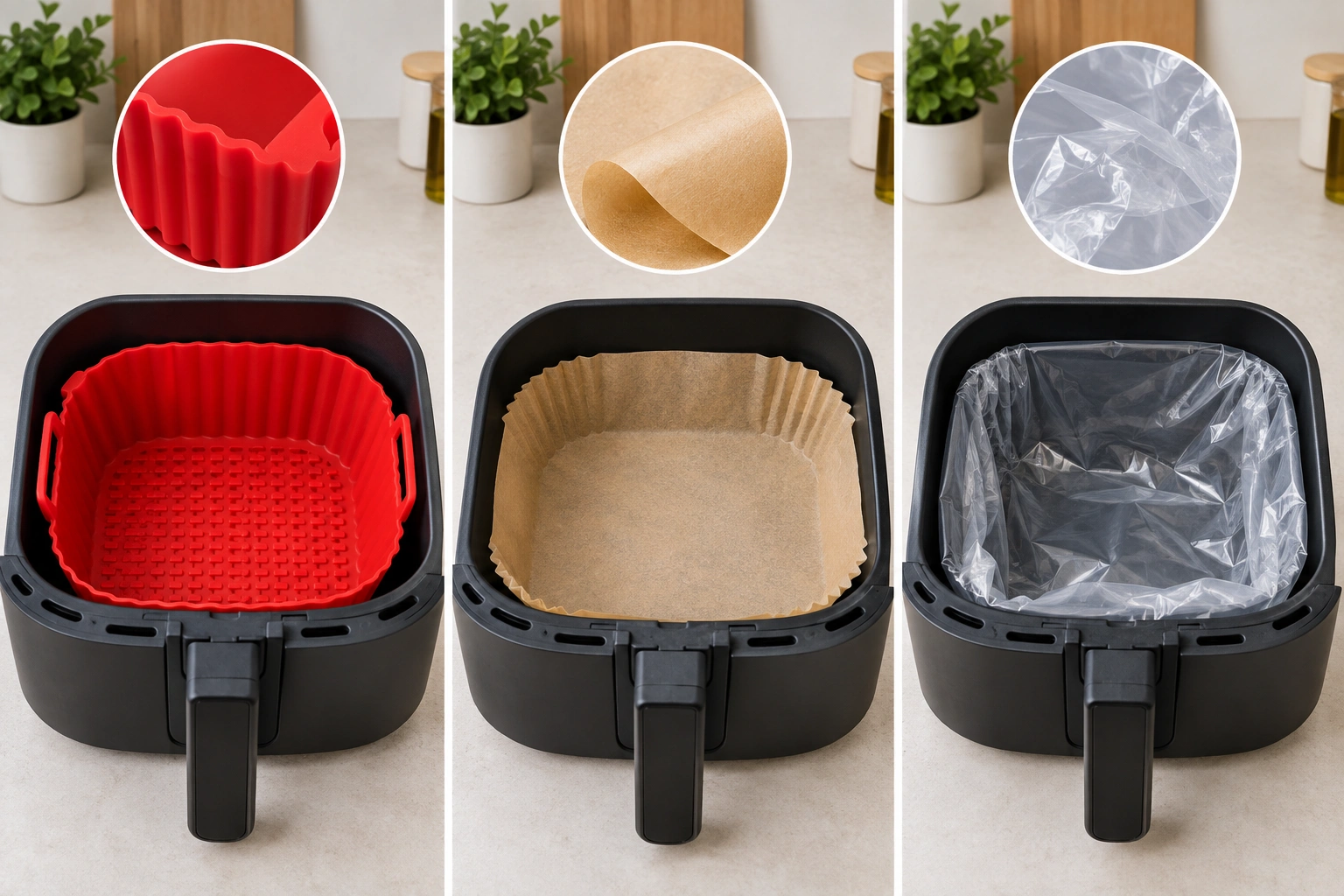
- Silicone baking cups or molds rated for oven or air fryer use
- Silicone baskets or trivets labeled for high heat
- Parchment liners made for air fryers, used so they do not block airflow
- Metal racks or crisper inserts designed for the specific model
Unsafe or questionable examples
Be cautious with these unless the maker clearly says they are safe:
- Generic plastic liners
- Thin plastic trays
- Plastic-coated inserts with no temperature rating
- Plastic-coated racks or baskets not sold for the model
- Soft vinyl-like mats
- Any accessory that bends, sags, or smells when heated
Plastic-coated accessories need extra caution
A plastic-coated insert is not automatically safe just because the base material is metal. If the coating is not clearly rated for air fryer temperatures, skip it. The same goes for a plastic-coated liner or any insert that feels like ordinary plastic with a decorative coating.
Silicone accessories: often better, but still verify
Silicone is usually a better choice than ordinary plastic for heat exposure, but only if the product is clearly rated for air fryer or oven use. A cheap, unlabeled silicone item is not something I’d trust by default.
Parchment liners: different from plastic
Parchment liners are not plastic liners. They’re commonly used in air fryers when cut and placed correctly. They can be a safer heat-management option than mystery plastic inserts, but they still need proper use so they don’t block airflow or touch the heating element.
Best decision rule
- Approved by the manufacturer: usually acceptable
- Clearly heat-rated and food-safe: possibly acceptable
- No rating, no label, or generic “heat resistant” claim only: avoid
If you’re comparing options, this is the simple hierarchy I’d use: metal for direct heat, silicone for rated accessories, parchment for disposable lining, and plastic only when the manufacturer clearly allows it.
What to do right away if plastic touched the heating element, warped, or melted
If you suspect plastic contact with a hot surface, stop using the appliance immediately.
Immediate steps
- Turn it off and unplug it
- Let it cool completely
- Inspect the basket, drawer, heating area, and any accessory
- Look for melted spots, residue, smoke marks, or deformation
- Do not keep cooking until you know the part is safe
- Contact the manufacturer if the damage is unclear or the part is replaceable
What to replace: the accessory or the whole air fryer?
Be decisive here:
- Replace only the accessory if the damage is limited to a removable basket insert, liner, rack, silicone piece, or other accessory, and the appliance itself shows no heat damage.
- Replace the whole air fryer if the heating chamber, wiring area, drawer mechanism, housing, or control area has melted plastic, smoke damage, repeated burnt odor, or visible deformation.
What not to do
- Don’t keep using it “just to see”
- Don’t scrape at unknown residue while the appliance is still warm
- Don’t assume the smell will go away on its own if the plastic is visibly damaged
- Don’t use the unit if the basket no longer fits correctly or the drawer no longer closes as designed
If plastic has melted onto a hot component, the safest move is usually to treat the part as compromised until the manufacturer confirms otherwise.
When to stop using the air fryer or replace it
Sometimes a single accessory is the problem. Sometimes the appliance itself is the problem.
Stop using it if you notice:
- Persistent burnt plastic smell
- Visible warping or melting
- Cracking or brittleness in a structural part
- Smoke during normal operation
- Plastic residue near the heating element
- A basket or drawer that no longer fits properly
Replacement is often the safer choice when:
- The damage affects the appliance structure
- The heating area has been exposed to melted plastic
- The unit repeatedly smells burnt even after inspection
- The manufacturer says the part is not replaceable or not safe to use
If the issue is limited to a removable accessory, you may only need to replace that piece. If the housing, drawer mechanism, or interior heat area is damaged, replacement of the whole appliance may be the more sensible option.
When to Consult a Professional
If you’re unsure whether the plastic damage is cosmetic or structural, or if the appliance shows electrical issues, contact the manufacturer first. If the unit smokes, trips a breaker, or smells strongly of burnt plastic even after it cools, stop using it and have it assessed by a qualified appliance repair professional. If the problem involves wiring, heating-element damage, or repeated overheating, replacement is often safer than repair.
Bottom line
Plastic in an air fryer is not automatically unsafe. Exterior plastic parts and some heat-resistant components are normal. The risk comes from plastic in the wrong place, plastic that is not heat-rated, or plastic that has already been damaged by heat.
If you remember only three things, make them these:
- Normal exterior plastic is usually fine
- Burnt smell, warping, melting, or residue is not fine
- The manual and material labels should decide the final answer, not guesswork
If you’re still unsure, don’t keep cooking with it until the manufacturer confirms the part is intended for air fryer temperatures.

