
Are Air Fryers Safe for Dorm Rooms? What Students Should Check First
If you are asking whether air fryers are safe for dorm rooms, the short answer is: sometimes, but only if your school allows them and your room setup can handle the wattage and heat.
An air fryer can be a practical dorm appliance for quick meals, but dorms are not built like normal kitchens. Rules vary by school, and the safety question is about more than just the appliance itself. You also need to think about electrical load, outlet limits, ventilation, and how much space you actually have around the machine.
For a first-year student, the smartest move is not “Can I fit one in my room?” It is “Does my housing policy allow it, and is there a safer place to use it if it does?”
Quick Answer: Are Air Fryers Safe for Dorm Rooms?
Air fryers can be safe in a dorm room if they are allowed by the residence hall policy, used on a stable heat-safe surface, and connected in a way that does not overload the outlet or circuit.
They are not automatically safe just because they are small. A compact appliance can still draw a lot of power and produce enough heat to cause problems in a crowded room. That is why the real answer depends on three things:
- Dorm policy — some schools ban them in bedrooms entirely.
- Electrical capacity — some rooms cannot comfortably handle another high-wattage appliance.
- Use habits — an air fryer left too close to bedding or run unattended is a bad idea in any shared living space.
If your dorm has a shared kitchenette, that may be a better place to use one than the bedroom itself.
Check Your Dorm Rules Before You Buy
Before shopping, read the residence hall policy or housing handbook. That matters more than product size, price, or brand.
Campus rules often separate appliances into three categories:
- Usually allowed: microwaves, mini fridges, coffee makers
- Sometimes restricted: air fryers, toaster ovens, hot plates, electric skillets
- Usually banned in bedrooms: anything with exposed heating elements or high heat output
Some schools ban not just air fryers but all appliances with exposed heating elements, which is a useful clue when you are trying to predict how strict the policy will be.
If the handbook is unclear, contact the residence life office and ask for a written answer. A quick email can save you from buying a machine you cannot legally use in the building.
A useful question to ask is:
“Are air fryers allowed in dorm rooms, or only in shared kitchenettes?”
That wording helps because some schools allow them in communal cooking areas but not in sleeping areas.
If your school has a fire safety section, read that too. Many housing rules are written to reduce the chance of overloaded circuits, smoke alarms going off, or food appliances being used in cramped rooms with little ventilation.
If the handbook and an RA or housing staff member give different informal answers, follow the written policy and ask for clarification in writing.
Why Dorms Restrict Air Fryers and Other High-Wattage Appliances
Dorms are designed for sleeping and studying, not for running a mini kitchen in every room. That is the main reason these appliances get restricted.
Here is what housing offices are usually trying to prevent:
Fire and heat concerns
Air fryers get hot enough to cook food quickly, which also means the exterior, basket, and surrounding area can become very warm. In a small room, that heat has fewer places to go.
Electrical overload
Dorm rooms often share circuits between multiple devices. If one student plugs in an air fryer while also running a laptop charger, lamp, mini fridge, and fan, the circuit can become overloaded.
Shared-space issues
Even if the appliance itself is fine, the smell, smoke, noise, and cleanup can affect roommates and neighbors. A dorm is a communal environment, so one person’s cooking can become everyone else’s problem.
Policy simplicity
Schools often create broad appliance rules because they are easier to enforce than judging each model one by one. That is why a “small” appliance may still be banned.
Will an Air Fryer Trip the Breaker in a Dorm?
It might. The risk depends on the air fryer’s wattage and what else is already running on that circuit.
If your housing office says the room limit is 1,500 watts and your air fryer is labeled 1,700 watts, that is already over the limit before you count a laptop, lamp, or mini fridge. Even if the school does not publish an exact number, a typical dorm circuit is not something you should assume can handle every appliance at once.
Here is the plain-language version:
- Wattage is how much power the appliance needs.
- Circuit breaker is the safety switch that cuts power if the circuit is overloaded.
- More devices on one outlet or circuit means a greater chance of tripping the breaker.
A breaker trip is not just annoying. In a dorm, it can shut down power to part of the room or create repeated problems with housing staff.
A good rule of thumb is to treat any high-wattage appliance as something to verify with residence life, not something to assume will work. If the housing office gives you a wattage limit, compare it to the air fryer’s label before buying.

If the school does not publish a clear limit, that is another reason to ask before you purchase.
Dorm Fire Safety and Heat Risks to Know
The biggest dorm safety issue is not just the air fryer itself. It is how close the appliance sits to everything else in a small room.
Watch for these common risks:
Flammable clutter
Dorm desks and counters often collect paper, snack bags, notebooks, towels, and clothing. Those items should not be near a hot appliance.
Poor placement
An air fryer should sit on a stable, heat-resistant surface with room around it. A bed, carpeted floor, or cluttered shelf is not a good place.
Unattended cooking
The standard fire-safety advice is straightforward: unplug it after use and avoid leaving it unattended while cooking. That is especially important in a small room where you may be distracted by class work or roommates.
Smoke and odor
Even when food is cooking normally, air fryers can produce smells or a little smoke. In a dorm room, that can set off alarms or make the space uncomfortable for everyone nearby. Adequate ventilation matters.
A practical setup checklist:
– keep the unit away from curtains, paper, and bedding
– place it on a stable, heat-safe surface
– leave space around the vents
– keep the cord clear of walkways and clutter
– use it where smoke and odor are less likely to bother roommates
For food safety while cooking, follow the manufacturer’s manual and official food safety guidance when preparing meat or other temperature-sensitive foods. The USDA’s food safety resources are a helpful reference if you are unsure about safe handling.
How to Use an Air Fryer Safely in a Dorm Room
If your school allows an air fryer, use it with a dorm mindset, not a home-kitchen mindset.
Keep it on a clear, stable surface
A sturdy desk, counter, or kitchenette table is better than a wobbly nightstand or crowded shelf. Leave space around the sides and top.
Avoid extension cords when possible
Do not daisy-chain power strips, and do not assume a cheap extension cord is safe for a heating appliance. If the cord cannot reach comfortably, the setup is probably wrong for that room.
Stay nearby while it runs
You do not need to stare at it the entire time, but you should not leave the room for a shower, a class, or a nap while it is running.
Use the room’s ventilation
If you have a kitchenette fan or a window that can safely be opened, that can help with odor control. Even a small amount of airflow can reduce lingering smells in a tight dorm.
Let it cool before moving it
Air fryers stay hot after the timer ends. Give it time to cool before cleaning or storing it, especially if the room is cramped.
Unplug after use
Once you are done cooking, unplug it.
If your dorm has a shared kitchen, using the air fryer there can reduce heat, odor, and roommate conflict. That is often the most realistic setup for a first-year student.
Dorm-Friendly Air Fryer Features to Look For
If the air fryer is permitted, think small and simple.
Compact footprint
A mini air fryer is usually easier to fit on a dorm desk or kitchenette counter. A full-size model can crowd out study space fast.
Lower wattage
Lower wattage can be easier on a dorm circuit, but it is not a guarantee. A practical range for many compact models is often around 1,000 to 1,500 watts, but the housing office’s limit should come first over any marketing claim.
UL listing or similar certification
A recognized safety certification is worth looking for. It is not a dorm permission slip, but it is a useful sign that the appliance meets basic electrical safety standards.
Easy-to-clean basket
Dorm kitchens are not the place for complicated cleanup. A basket that wipes clean quickly is much more realistic for shared living.
Simple controls
In a dorm, less complexity usually means fewer mistakes. Basic temperature and timer controls are often enough.
Quiet operation
This may not be on the box, but it matters. Loud fans and beeps can be annoying in a small room or late at night.
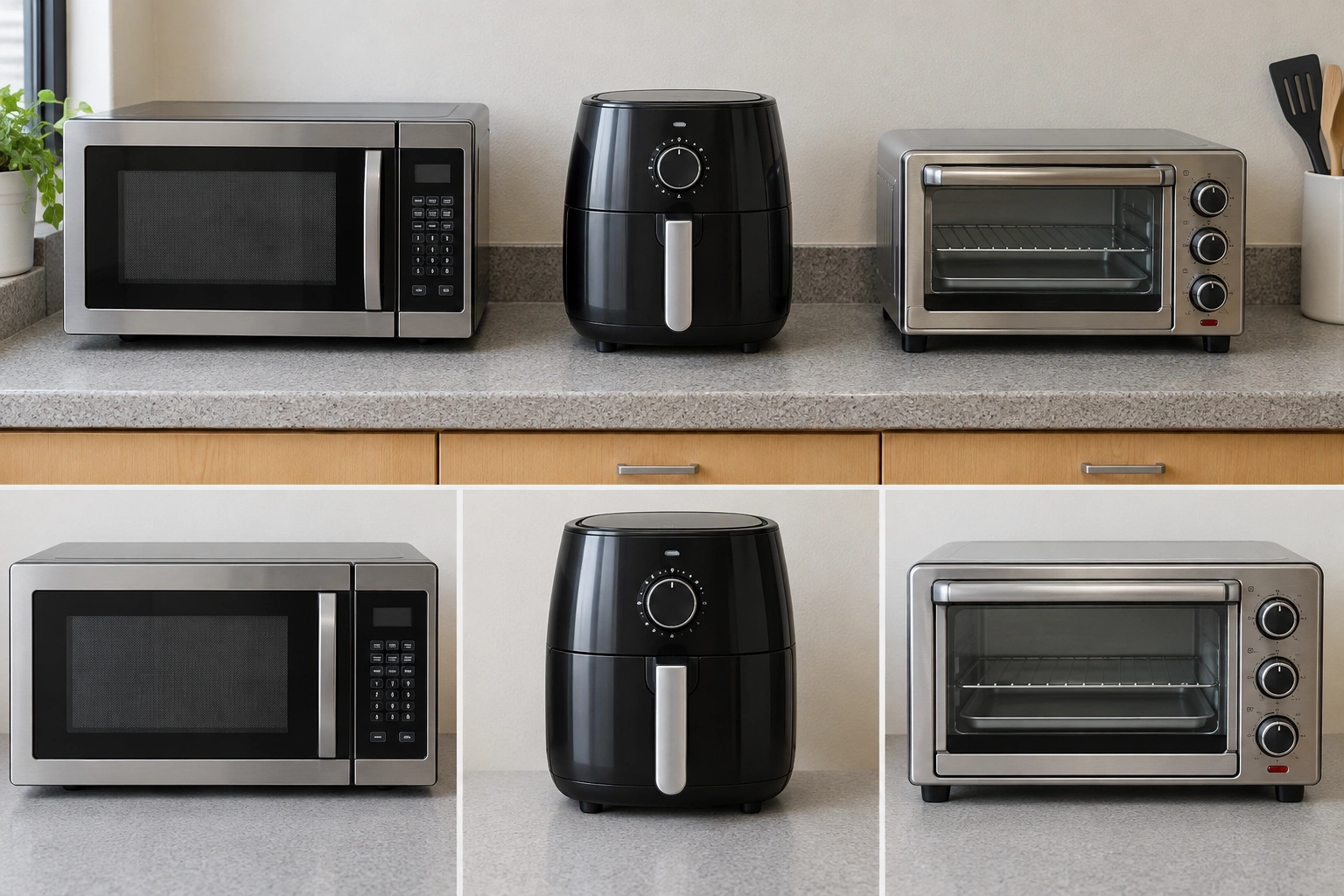
Air Fryer vs Microwave vs Toaster Oven for Dorm Life
If you are deciding between appliances, this comparison helps:
| Appliance | Dorm suitability | Main advantage | Main drawback |
|---|---|---|---|
| Microwave | Usually the easiest to permit | Fast, compact, widely accepted | Limited texture and browning |
| Air fryer | Sometimes allowed, sometimes restricted | Better crisping than a microwave | Higher wattage and more heat |
| Toaster oven | Often less dorm-friendly | More cooking flexibility | Takes more space and can run hot |
If the dorm allows only one appliance, the microwave is usually the best choice because it is the easiest to fit into strict housing rules and the safest for shared spaces.
A toaster oven can do more than a microwave, but it often raises the same concerns as an air fryer, sometimes more. It tends to be bulkier and hotter on the outside.
An air fryer sits in the middle: useful, compact, and convenient, but still a heating appliance that many schools treat cautiously.
If your dorm rules are strict, the microwave usually wins. If your school allows small cooking appliances in a kitchenette, the air fryer can be a better choice for crisped foods and more varied meals.
If Air Fryers Aren’t Allowed: Better Alternatives
If the policy says no, do not try to work around it with a hidden appliance. That can create problems with housing staff and fire safety rules.
Better options include:
- Microwave cooking
- Shared kitchenette use
- Campus dining
- A mini fridge plus microwave combo
- A residence-approved appliance list from housing
If you want something more versatile than a microwave, ask whether the dorm has a shared cooking space. That may let you use an air fryer without keeping it in your bedroom.
For students who live off campus later, our guide on air fryer safety for apartments may also help with outlet, smoke, and clearance questions in a different setting.
What to Do If the Policy Is Unclear
If the handbook does not mention air fryers directly, do not guess.
Email residence life or campus housing and ask for a direct answer. If possible, request written confirmation. That way, if a roommate, resident assistant, or housing office later asks about it, you have documentation.
A simple message works well:
“I’m a first-year student and want to know whether a compact air fryer is allowed in my dorm room, or only in a shared kitchenette. Could you confirm the policy in writing?”
If they reply that it is allowed, ask whether there is a wattage limit or any placement rules. If they say no, ask whether a microwave or shared kitchen is the recommended alternative.
For students choosing between appliances for tight spaces, our guide to air fryers safe for small kitchens can also help you think through size and clearance.
When to Consult a Professional
If your dorm has repeated breaker trips, burning smells from outlets, or damaged wiring, stop using the appliance and contact housing staff right away. That is not a situation to troubleshoot on your own.
If you are a parent helping a student prepare for campus, the best “professional” to consult is usually the residence life office, not a product seller. Housing staff can tell you what is actually permitted in that building.
For questions about a specific appliance’s electrical safety, the manufacturer’s manual is also worth checking. If the manual gives power or ventilation requirements that seem hard to meet in a dorm, choose a different appliance.
Final Takeaway
So, are air fryers safe for dorm rooms? They can be, but only in the right setting and only when the school permits them.
The safest path is simple: check the housing handbook first, confirm wattage and appliance rules, and decide whether your room or a shared kitchenette is the better place to use it. If the policy is vague, get written confirmation before buying anything.
For many first-year students, a microwave is the easiest dorm appliance to live with. For students whose campus allows it, a compact air fryer can be a useful upgrade — as long as it fits the rules, the outlet, and the room.
FAQ
Can you have an air fryer in a dorm room?
Sometimes. It depends on the residence hall policy, the room’s electrical capacity, and whether the school allows heating appliances in bedrooms or only in shared kitchenettes.
What appliances are usually banned in dorms?
Many schools restrict hot plates, toaster ovens, electric skillets, and other appliances with exposed heating elements or high heat output. Always check the housing handbook.
Is a microwave safer than an air fryer in a dorm?
Usually yes, because microwaves are more commonly allowed and are less likely to create heat and odor issues in a small shared room.
What should I do if the RA says one thing and the handbook says another?
Follow the written policy and ask housing for clarification in writing. That gives you the clearest rule to rely on.
How can I tell if an air fryer will overload a dorm circuit?
Compare the appliance’s wattage label with any limit listed by housing. For example, if the limit is 1,500 watts and the air fryer is 1,700 watts, it is not a good fit.
Where should I place an air fryer in a dorm?
Use a stable, heat-safe surface away from curtains, paper, and bedding, and keep it in a spot with enough clearance around the vents.

