
Baking Soda in Hot Tub Benefits Risks and How To Use It

Baking soda can help a hot tub when total alkalinity is low and pH keeps swinging, but it is not a sanitizer. Test first, add slowly, and retest so you do not overshoot.
Baking soda in a hot tub is mainly used to raise total alkalinity, which can help keep pH from swinging up and down too quickly. It is a simple fix, but it only works well when you test first and use it for the right water problem.
- Main use: Baking soda raises total alkalinity and helps stabilize pH.
- Best practice: Test water before adding anything and make small corrections.
- Big risk: Too much baking soda can cause cloudy, scale-prone water.
- Important limit: It does not replace chlorine, bromine, or shock.
- Smart rule: Use it only when low alkalinity is the real problem.
Baking Soda in a Hot Tub: What It Does and Why Owners Use It
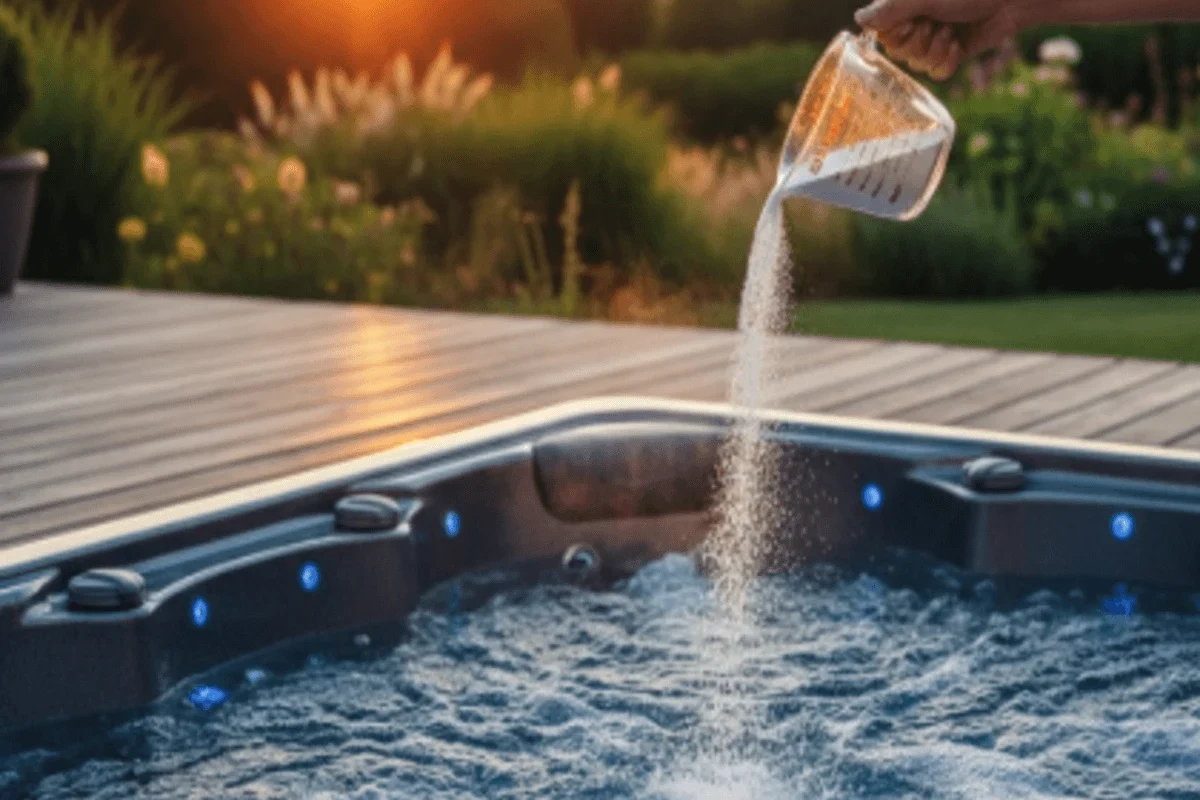
In spa care, baking soda means sodium bicarbonate. It is not a sanitizer, and it will not replace chlorine, bromine, or shock. Its main job is to help balance water so the tub feels more comfortable and the chemistry stays steadier.
Many owners reach for it after a fresh fill, after draining and refilling, or when the water seems hard to keep balanced. If you are also curious about how this ingredient behaves in other cleaning uses, you may find our guide to the baking soda and vinegar reaction helpful, since it explains why sodium bicarbonate acts differently depending on what it meets.
Raising total alkalinity without chasing pH swings
Total alkalinity is the water’s buffer. In simple terms, it helps prevent sudden pH jumps after bather load, aeration, or chemical additions. Baking soda can raise that buffer without forcing you to keep adding small pH fixes every day.
That matters because hot tubs are small, warm, and heavily circulated. Those conditions make water chemistry change faster than in a pool, so a small imbalance can show up quickly as cloudy water, stingy water, or equipment stress.
When baking soda is used as a water-balancing fix, not a sanitizer
Baking soda is a balancing tool, not a disinfectant. It can make the water easier to manage, but it does not kill bacteria or oxidize contaminants. You still need a proper sanitizer program and regular testing.
Do not treat baking soda as a substitute for chlorine, bromine, or shock. If the sanitizer level is off, the water can still be unsafe even when alkalinity looks good.
How Baking Soda Changes Hot Tub Water Chemistry
Hot tub water chemistry is a chain reaction. When one number changes, others often move too, especially pH and alkalinity. That is why a careful, measured approach matters more than simply adding a handful and hoping for the best.
The role of sodium bicarbonate in alkalinity control
Sodium bicarbonate adds bicarbonate ions to the water, which increases total alkalinity. In practical terms, that gives the water more resistance to pH swings. The effect is useful when the water tests low and seems to react too strongly to normal use.
Because spa water volumes vary, the same scoop can be mild in one tub and excessive in another. A compact two-person spa may respond very quickly, while a larger model may need a more measured adjustment. Always verify your spa’s water volume before dosing.
How alkalinity affects pH stability, comfort, and equipment
When alkalinity is too low, pH can bounce around after air bubbles, heat, or sanitizer additions. That can make water feel sharper on skin and may also increase corrosion risk in metal parts or damage to some surfaces over time.
When alkalinity is too high, pH can drift upward and make the water harder to keep balanced. That can contribute to cloudy water, scale on surfaces, and reduced comfort. The goal is not “more is better,” but “stable and within range.”
Why the same dose can behave differently in small and large spas
Hot tubs differ in volume, circulation, fill water, and how much air they pull in through jets. Those differences change how baking soda disperses and how quickly the chemistry settles. Brand of water test kit, testing method, and even temperature can also affect the reading you get.
Warm water speeds up chemical movement and can make pH drift more noticeable in a hot tub than in cooler water.
Benefits of Using Baking Soda in a Hot Tub
Used correctly, baking soda can be a practical maintenance tool. It is inexpensive, widely available, and useful for correcting low alkalinity before that low buffer turns into constant pH correction.
Reducing pH volatility after refills or heavy use
Fresh fill water often starts out unbalanced for spa use. Heavy use can also push the water chemistry around because of sweat, body oils, lotions, and aeration from jets. Raising alkalinity can help calm those swings and make the water easier to manage.
This is similar to how a recipe with the right structure is easier to control than one that keeps collapsing. In baking, the balance of ingredients matters just as much as the ingredients themselves. For more ingredient basics, see our article on whether baking soda and baking powder are the same.
Supporting clearer, less irritating water when balance is corrected
When low alkalinity is corrected, the water often becomes easier to keep clear and comfortable. That does not happen because baking soda “cleans” the water. It happens because balanced water is less likely to swing into harsh or cloudy conditions.
Clear water still depends on filtration, sanitizer, circulation time, and regular cleaning of the spa shell and filter. A balancing fix works best as part of the full maintenance routine.
Budget-friendly maintenance compared with specialty balancers
For many homeowners, baking soda is appealing because it is a familiar household product. It can be a cost-conscious option for raising alkalinity when the situation calls for it. That said, “cheap” only helps if you use the right amount and verify the result with testing.
Risks, Limits, and Common Mistakes to Avoid
The biggest problem with baking soda in a hot tub is not the ingredient itself. It is using it without testing or using it in a water condition where it is the wrong fix.
Overcorrecting alkalinity and creating cloudy, scale-prone water
Too much alkalinity can push the water into a scale-friendly zone, especially in harder water. Cloudiness may follow, and mineral deposits can build on heaters, jets, and shell surfaces. Once that happens, correction can take more time than the original adjustment.
- Can stabilize low-alkalinity water
- May reduce pH swings after refills
- Usually easy to find and use
- Can overshoot the target quickly
- Does not sanitize water
- May worsen cloudiness or scaling if misused
Adding baking soda too fast or without testing first
Dumping in a large amount at once makes it hard to control the result. The water may look fine for a while and then drift farther than expected after circulation. Testing first tells you whether you need baking soda at all, and how much is reasonable.
Even though this is spa care, the safety rule is similar to handling baking ingredients near heat: add small amounts, measure carefully, and avoid guessing.
Expecting baking soda to replace chlorine, bromine, or shock
If the sanitizer is low, the water can still become unsafe. Baking soda does not disinfect, oxidize waste, or remove contaminants on its own. It only supports the water balance that helps your sanitizer work as intended.
Using it in the wrong situation, such as already-high alkalinity
If alkalinity is already high, baking soda usually makes the problem worse. In that case, you would look at different correction methods, often ones aimed at lowering pH or reducing scale risk instead of raising buffer levels. The right fix depends on the test results, not the habit.
How to Use Baking Soda Safely in a Hot Tub
The safest approach is slow, measured, and based on a test kit or reliable strips. Do not rely on appearance alone, because water can look clear while still being out of balance.
Testing current alkalinity and pH before adding anything
Start with a current reading for total alkalinity and pH. If your sanitizer system has manufacturer instructions, follow those first, since some spas and mineral systems have specific care ranges. Keep the test result nearby so you can compare after each adjustment.
- Check total alkalinity and pH
- Confirm the spa water volume
- Review your hot tub manual
- Know your target range before dosing
Measuring typical dose ranges by spa volume
There is no single universal dose because tubs vary widely. The amount depends on water volume, the starting alkalinity, and the brand and concentration of the product. Use the spa owner’s manual or a trusted water-care guide for your specific model when possible.
As a general practice, start with a small amount rather than a full correction. If you are unsure, it is safer to underdose, circulate, retest, and repeat than to overshoot in one step.
Pre-dissolving, circulating, and retesting after each adjustment
Pre-dissolving baking soda in a clean container of water can help it spread more evenly. Add it with the circulation system running so it moves through the tub rather than settling in one place. Then wait for the water to mix fully before testing again.
Use a measured dose instead of pouring directly from the box.
Stir it into water first, then run jets or circulation so it disperses evenly.
Check alkalinity and pH after the water has had time to settle and circulate.
Waiting between additions to avoid overshooting target levels
Do not stack multiple doses back to back. Water chemistry can lag behind the addition, so the first reading may not show the full effect right away. Waiting gives you a more honest picture and reduces the chance of making the water harder to manage.
When Baking Soda Is the Right Fix and When It Is Not
Baking soda is useful in specific situations, but it is not the answer to every hot tub issue. The trick is matching the product to the problem.
Best use cases: fresh fills, low-alkalinity water, and pH instability
It is often most helpful after a refill, when source water tests low in alkalinity, or when the pH keeps drifting because the buffer is too weak. In those cases, baking soda can make the water steadier and easier to maintain.
If you are comparing it with other household uses, remember that spa care is more sensitive than simple cleaning. For example, a product that helps with odor control in the home may not be the right choice for a hot tub. Our guide on baking soda for smoke odors shows how the same ingredient can be useful in one setting and limited in another.
When to choose different products for lowering pH or controlling scale
If pH is high but alkalinity is already in range, you may need a different treatment. If scale is the main issue, you may need a water-softening or scale-control strategy instead of more alkalinity. The test result should drive the product choice.
Examples of real-world hot tub scenarios and the right response
If a spa is freshly filled and tests low on alkalinity, baking soda may be the right first adjustment. If the water is cloudy and alkalinity is already high, adding more baking soda is usually the wrong move. If sanitizer is low, fix sanitizer first, then recheck balance.
That same “use the right ingredient for the job” idea shows up in baking too. If you use the wrong leavener, the texture changes and the result can collapse or taste off. For a simple ingredient comparison, our article on using baking soda instead of baking powder safely explains why substitutions are not always interchangeable.
Maintenance, Safety, and Decision Guide for Hot Tub Owners
Good spa care is mostly routine. Test often, make small corrections, and keep records so you can see patterns instead of reacting to every small change.
How often to test water in 2026-style routine spa care
Testing frequency depends on how often you use the tub, how many people soak, and your sanitizer system. As a practical routine, many owners test more often after heavy use and at least regularly enough to catch drift before it becomes a bigger problem. Follow the spa manufacturer’s instructions and any sanitizer product directions first.
Storage and handling for household baking soda near pool chemicals
Store baking soda in a dry, sealed container away from moisture and away from strong pool or spa chemicals. Keep labels clear so it is not confused with sanitizer, shock, or acid products. Never mix chemicals together in storage or in a container before you know the compatibility.
- Test water before dosing
- Add small amounts gradually
- Circulate and retest after each change
- Follow your spa manual and chemical labels
- Guessing the dose
- Using baking soda as a sanitizer
- Adding more when alkalinity is already high
- Mixing chemicals together by hand
Final recap: whether baking soda belongs in your hot tub care plan
Baking soda can absolutely belong in a hot tub care plan when the water needs more alkalinity and the goal is to steady pH. It is affordable, practical, and easy to find, but it should be used as a measured balancing tool, not a cure-all.
If your test results show low alkalinity and unstable pH, baking soda is often worth considering. If the water is already high in alkalinity, cloudy, or out of sanitizer range, choose a different fix and retest before making another change. Careful testing is the difference between a helpful adjustment and a chemistry problem.
Use baking soda in a hot tub only when tests show low alkalinity or unstable pH, and add it slowly with circulation and retesting. If alkalinity is already high or sanitation is the real issue, choose another correction method instead.
Frequently Asked Questions
You can, but it is better to measure it carefully and add it slowly with circulation running. Pre-dissolving first can help it spread more evenly and reduce the chance of overshooting.
Baking soda raises total alkalinity, which helps stabilize pH. It does not sanitize the water or replace chlorine, bromine, or shock.
Test total alkalinity and pH first. Baking soda is usually used when alkalinity is low and the pH keeps swinging too much.
Yes. Too much can raise alkalinity too high and contribute to cloudy, scale-prone water.
Follow your spa manual and chemical labels, but in general you should never mix chemicals together directly. Keep sanitizer levels in range and make water-balance changes slowly with retesting.
It is commonly used in many spas, but the right amount depends on the tub size, water chemistry, and manufacturer guidance. Always check your owner’s manual and test the water before adding anything.