
The Balanced Chemical Equation for Baking Soda and Vinegar, Explained Simply
If you need the chemical reation formula for baking soda and vinegar reaction equation, the balanced form is:
NaHCO₃ + CH₃COOH → CH₃COONa + H₂O + CO₂
In words, that means:
sodium bicarbonate + acetic acid → sodium acetate + water + carbon dioxide
This is the version most teachers want for schoolwork because it shows the actual substances involved, not just the everyday names. It also explains the fizz: carbon dioxide gas is produced and escapes as bubbles.
For a quick kitchen-science reference, here is a simple comparison table.
| Form | Equation |
|---|---|
| Word equation | sodium bicarbonate + acetic acid → sodium acetate + water + carbon dioxide |
| Formula equation | NaHCO₃ + CH₃COOH → CH₃COONa + H₂O + CO₂ |
| Balanced equation | NaHCO₃ + CH₃COOH → CH₃COONa + H₂O + CO₂ |
The equation is balanced because there is one atom of each element on both sides, with all coefficients implicitly equal to 1.
What Baking Soda and Vinegar Are Chemically
Baking soda is sodium bicarbonate, with the formula NaHCO₃. It is a mild base, which means it can react with acids.
Vinegar is not a single pure chemical. It is a dilute solution of acetic acid in water. In most kitchen contexts, when people say “vinegar,” they mean the acidic liquid you buy for cooking or cleaning, not pure acetic acid.
That distinction matters because school chemistry questions usually want the real chemical names. If you write only “vinegar + baking soda,” you have described the ingredients, but not the chemistry. If you write acetic acid + sodium bicarbonate, you are naming the reactants more accurately.
A useful rule for students:
– Vinegar = the household liquid
– Acetic acid = the acid responsible for vinegar’s sourness
– Baking soda = sodium bicarbonate
Vinegar vs. pure acetic acid
Pure acetic acid is much more concentrated than household vinegar. That means the reaction in a bottle of vinegar is happening in water, not in a neat acid-only liquid. For most classroom explanations, that is enough detail. You do not need advanced chemistry to understand the reaction, but you do need to know vinegar is a solution, not a pure compound.
Word Equation, Formula Equation, and Balanced Equation
Different teachers ask for different forms, and each one serves a purpose.
| Type | Example | Why it helps |
|---|---|---|
| Word equation | sodium bicarbonate + acetic acid → sodium acetate + water + carbon dioxide | Easiest to read and explain |
| Formula equation | NaHCO₃ + CH₃COOH → CH₃COONa + H₂O + CO₂ | More precise for chemistry class |
| Balanced equation | NaHCO₃ + CH₃COOH → CH₃COONa + H₂O + CO₂ | Shows conservation of atoms |
The balanced equation matters because chemical equations must obey conservation of matter. Atoms are not created or destroyed in the reaction; they are rearranged into new substances.
That is why the equation is not written as a random list of ingredients. It shows how the atoms from sodium bicarbonate and acetic acid end up in sodium acetate, water, and carbon dioxide.

How to read the equation
If you read the formula from left to right:
- NaHCO₃ = sodium bicarbonate
- CH₃COOH = acetic acid
- CH₃COONa = sodium acetate
- H₂O = water
- CO₂ = carbon dioxide
This is a good example of a chemical change. The starting substances are not the same as the ending substances, even though the total atoms are still accounted for.
What the Reaction Produces
The reaction produces three main products:
1. Carbon dioxide gas
This is the product you can see most clearly. It forms bubbles and causes the fizzing.
2. Water
Water is also produced, though it is not dramatic or visible in the way the gas is.
3. Sodium acetate
Sodium acetate stays dissolved in the liquid in typical classroom or kitchen conditions. It is the salt formed after the acid and base react.
If you are trying to explain the reaction in one sentence, this is the cleanest version:
Baking soda and vinegar react to form carbon dioxide gas, water, and sodium acetate.
That sentence is simple enough for a student report, but still chemically accurate.
Why the Mixture Fizzes and Bubbles
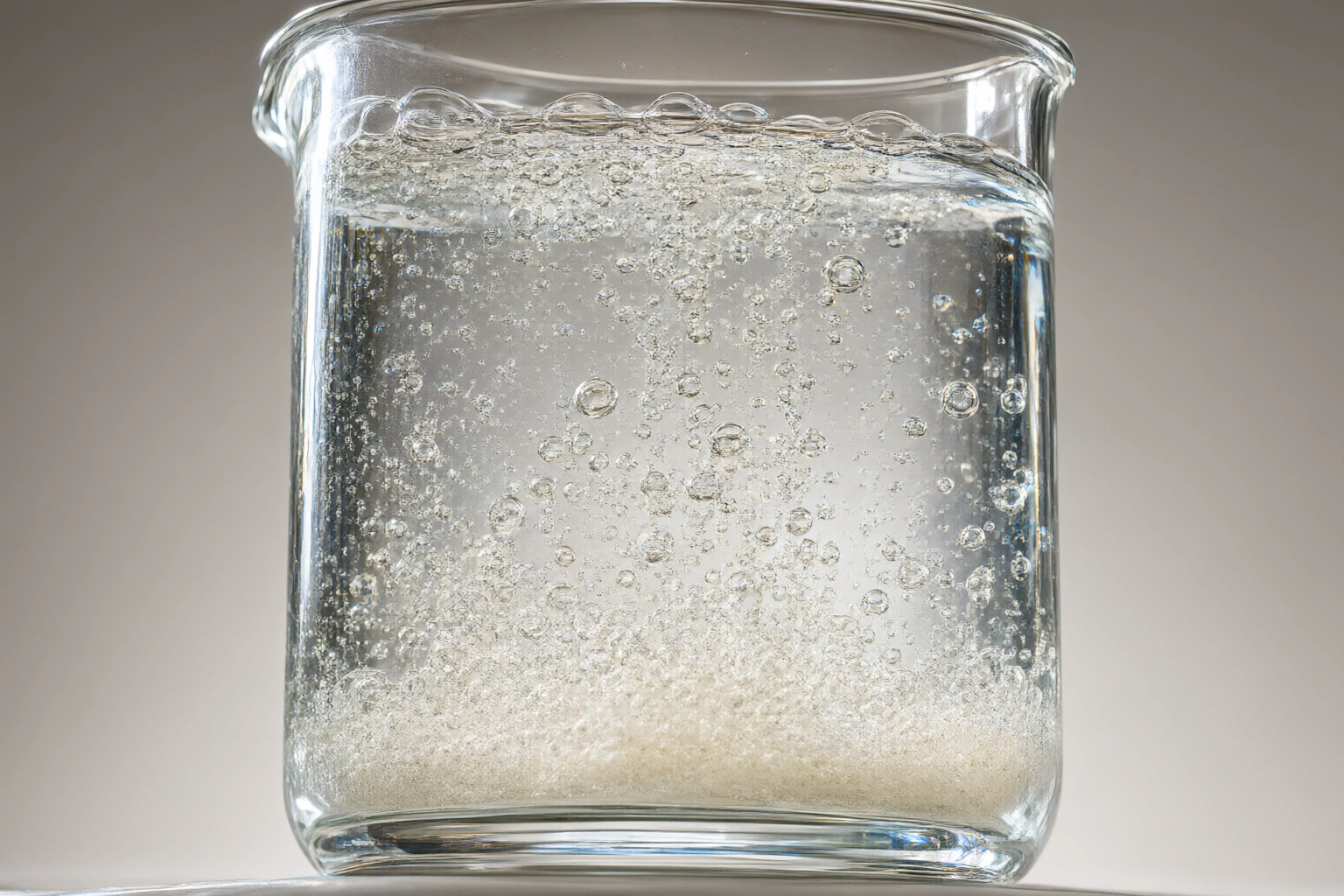
The fizzing happens because carbon dioxide gas is released during the reaction. Gas takes up space, so when it forms inside the liquid, it pushes upward and escapes as bubbles.
That visible bubbling is the part most people notice first. It is not “air” entering the mixture. It is new gas being made by the chemical reaction.
A helpful way to picture it is this:
- The acid and base react in the liquid
- One of the products is a gas
- The gas cannot stay dissolved forever
- It escapes through the liquid as bubbles and foam
The foam is often just liquid trapping those gas bubbles for a short time. More foam usually means more gas being released at once, not necessarily a different reaction.
Why the fizz may look stronger in a narrow container
If you use a tall narrow cup, the bubbles can seem more dramatic because the gas has less room to spread out. In a wide bowl, the same reaction may look less intense even though the chemistry is the same.
That is a useful reminder for demos: the container shape changes the appearance, but not the basic equation.
Why This Is an Acid-Base Reaction
This reaction is commonly taught as an acid-base reaction.
- Acetic acid acts as the acid
- Sodium bicarbonate acts as the base
When they react, they form a salt and other products, including carbon dioxide gas and water. In beginner chemistry, this is often described as an acid-base neutralization with gas evolution, which helps explain why carbon dioxide is produced.
You do not need to memorize a complicated mechanism to understand the idea. The important point is that the acid and base react in a way that releases carbon dioxide.
Why the acid-base label matters
Some people describe this only as a “fizzing reaction.” That is true, but incomplete. The fizzing is the visible effect; the acid-base chemistry is the reason it happens.
If you are writing for school, “acid-base reaction” is usually the stronger answer because it explains the chemistry, not just the observation.
Common Confusions: Vinegar vs. Acetic Acid and Baking Soda vs. Baking Powder
These two mix-ups cause a lot of incorrect answers.
Vinegar vs. acetic acid
Vinegar is the household liquid. Acetic acid is the chemical responsible for its sour taste and acidity. In a chemistry equation, acetic acid is the correct term to use.
If a worksheet says “vinegar,” it is usually asking for the household substance. If it asks for the chemical equation, it is better to write CH₃COOH.
Baking soda vs. baking powder
Baking soda is sodium bicarbonate. Baking powder is not the same thing. Baking powder already contains a base and an acid component, so it behaves differently.
That difference matters in baking and in science demos. If you want this exact vinegar reaction, you need baking soda, not baking powder.
A simple comparison:
- Baking soda: one ingredient, sodium bicarbonate
- Baking powder: a mixture that includes an acid and a base
If you substitute baking powder, the result will not be the same.
Simple Classroom or Home Demo Context
This reaction is often used in classroom demonstrations because it is easy to observe. A small amount of baking soda in a container, followed by vinegar, produces visible bubbling almost immediately.
That makes it useful for showing:
- a chemical reaction in real time
- gas production
- the difference between reactants and products
- the idea that atoms rearrange into new substances
A practical note: use small amounts for a demo, and do not seal the mixture in a closed container. Carbon dioxide gas builds pressure, and a closed container can become unsafe.
For a school project, the best approach is usually to focus on observation and explanation rather than trying to make the reaction “bigger.” Bigger is not better if it makes the experiment harder to control.
If you want a deeper step-by-step explanation of the reaction itself, see our related guide on the reaction of vinegar and baking soda.
Common Mistakes When Writing the Equation
Here are the most frequent errors and how to avoid them.
1. Leaving out carbon dioxide
This is the biggest mistake. The fizz happens because carbon dioxide is a product, so it must appear in the equation.
2. Writing only the household names
“Vinegar + baking soda” is fine as a casual description, but it is not the most accurate chemical equation. Use the chemical names or formulas when school accuracy matters.
3. Forgetting that vinegar is a solution
Vinegar is not pure acetic acid. It is acetic acid mixed with water. That is why the household term and the chemical term are not identical.
4. Calling baking soda an acid
Baking soda is a base, not an acid. The acid in the reaction is acetic acid from vinegar.
5. Treating fizzing as a physical change
The bubbles are evidence of a chemical change because a new gas is formed. The liquid is not simply being stirred or warmed; new substances are produced.
A Simple Way to Remember the Reaction
If you need a quick memory aid for school, use this sequence:
acid + base → salt + water + carbon dioxide
For this specific reaction:
acetic acid + sodium bicarbonate → sodium acetate + water + carbon dioxide
That pattern will help you recognize similar reactions later. It also makes it easier to check whether your equation is complete.
When the Reaction Matters in Baking
In baking, the same chemistry idea helps explain why some recipes rely on baking soda and an acid. The acid reacts with the baking soda to release carbon dioxide, which can help create lift in batter or dough.
That does not mean vinegar is a universal baking ingredient. In most baked goods, the acid is provided by another ingredient in the recipe, not plain vinegar. The key lesson is the same: carbon dioxide gas is what creates the bubbles.
This is also why baking soda is different from baking powder. Baking powder already includes its own acid, so it does not need vinegar to react.
Final Takeaway
The correct balanced equation for the baking soda and vinegar reaction is:
NaHCO₃ + CH₃COOH → CH₃COONa + H₂O + CO₂
In plain English:
sodium bicarbonate + acetic acid → sodium acetate + water + carbon dioxide
If you remember only one thing, remember this: the fizz comes from carbon dioxide gas, and the reaction is a classic acid-base reaction.

