Vinegar and Baking Soda Equation: The Balanced Reaction Explained Simply
Vinegar and baking soda are a classic kitchen science pair, but the fizz is only half the story. If you are trying to understand the vinegar + baking soda equation for school, a demonstration, or basic baking knowledge, the key is to know what each ingredient actually is and what the reaction makes.
Vinegar is not pure acetic acid. It is usually a dilute solution of acetic acid in water. Baking soda is sodium bicarbonate. When the two meet, they react as an acid and a base, and carbon dioxide gas is released. That gas is what creates the bubbling foam people notice right away.

What Vinegar and Baking Soda Are Chemically
Before writing the equation, it helps to name the ingredients correctly.
- Vinegar: a dilute solution of acetic acid
- Baking soda: sodium bicarbonate
That distinction matters because many beginners write “vinegar” in the formula itself, but chemistry equations usually name the actual compounds involved. In other words, vinegar is the household ingredient; acetic acid is the chemical inside it that does the reacting.
The same idea applies to baking soda. In recipes and experiments, you may see the common name, but the chemical name is sodium bicarbonate.
| Form | Equation |
|---|---|
| Word equation | acetic acid + sodium bicarbonate → sodium acetate + water + carbon dioxide |
| Formula equation | CH₃COOH + NaHCO₃ → CH₃COONa + H₂O + CO₂ |
| Balanced equation | CH₃COOH + NaHCO₃ → CH₃COONa + H₂O + CO₂ |
For a beginner, the word equation is easiest to read. For homework or science class, the formula equation is usually the better choice. The balanced equation is the one that shows the atom count is conserved on both sides.
The Balanced Equation for the Reaction
The balanced vinegar and baking soda equation is:
CH₃COOH + NaHCO₃ → CH₃COONa + H₂O + CO₂
This tells you that one molecule of acetic acid reacts with one molecule of sodium bicarbonate to form one molecule of sodium acetate, one molecule of water, and one molecule of carbon dioxide.
A balanced equation matters because it shows the reaction is not random. The atoms are rearranged, not created or destroyed. That is the core idea behind chemical equations in general.
If you are writing this for school, keep the formulas exact:
- CH₃COOH = acetic acid
- NaHCO₃ = sodium bicarbonate
- CH₃COONa = sodium acetate
- H₂O = water
- CO₂ = carbon dioxide
The visible fizz is not the equation itself. The fizz is the result of one of those products, carbon dioxide, escaping the liquid.
Why the Mixture Fizzes and Produces Gas
The fizz happens because carbon dioxide gas is formed during the reaction. Gas bubbles rise through the liquid and burst at the surface, which is what you see as foam or bubbling.
That bubbling can look dramatic, but the chemistry is straightforward: an acid-base reaction takes place, and the gas product leaves the mixture. Once the gas escapes, the reaction no longer looks as active.
This is also why the reaction is often used in classroom demonstrations. It gives a visible result quickly, so the underlying chemistry is easier to notice. A cup, tray, or bowl can make the bubbling easy to observe without needing special equipment.
What the reaction produces
The main products are:
- Sodium acetate: stays dissolved in the liquid or remains in the mixture
- Water: part of the liquid phase
- Carbon dioxide: the gas that causes fizzing
If you want a practical way to remember it, think of it this way: the solid baking soda and the acidic part of vinegar are transformed into a salt, water, and a gas. The gas is the part your eyes notice first.
Word Equation, Formula Equation, and Balanced Equation
Different situations call for different versions of the same reaction.
| Version | Best for | Example |
|---|---|---|
| Word equation | beginners, homework explanations, quick understanding | acetic acid + sodium bicarbonate → sodium acetate + water + carbon dioxide |
| Formula equation | chemistry class, more precise writing | CH₃COOH + NaHCO₃ → CH₃COONa + H₂O + CO₂ |
| Balanced equation | formal science work, showing conservation of matter | CH₃COOH + NaHCO₃ → CH₃COONa + H₂O + CO₂ |
The balanced form is also the formula form here because the reaction already balances neatly with a 1:1:1:1:1 relationship. That makes it a useful example for students learning how to read equations without getting lost in coefficients.
If you are teaching someone younger, the word equation is usually the clearest starting point. If you are turning it in for chemistry homework, the formula version is the safer choice.
How This Reaction Relates to Baking
This reaction is often mentioned in baking, but it is not a direct substitute for baking powder in recipes.
Baking soda needs acid to react. Vinegar can supply that acid, but in a recipe, timing matters. If the gas is released too early, much of it can escape before the batter or dough is baked. That is one reason this reaction is more useful as a science demo than as a reliable leavening method.
Baking powder is designed differently. It contains both an acid and a base in a controlled form, so it can release gas in a more predictable way during mixing and baking. Unlike a vinegar-plus-baking-soda reaction, baking powder is a built-in leavening system rather than an acid-base demo, and vinegar is rarely the main leavening acid in standard baking formulas.
For home bakers, the practical rule is simple: use baking soda when the recipe already contains enough acid, and use baking powder when the recipe needs built-in leavening. If you are unsure which one a recipe needs, the ingredient list usually gives the clue.
For a deeper look at baking soda’s role in recipes, see our guide to whether baking soda is alkaline and this explanation of baking soda pH.
Does Vinegar Strength Change the Equation?
The basic equation does not change if you use white distilled vinegar, apple cider vinegar, or another household vinegar. The chemistry is still acetic acid reacting with sodium bicarbonate.
What can change is the visible intensity of the reaction. A stronger vinegar solution may produce a more noticeable fizz, but common household vinegars are usually close enough in acidity that container size, temperature, and how much you use often matter more than brand choice. The exact appearance also depends on how much liquid you use, how much baking soda is added, and the size of the container.
That means a more vigorous-looking reaction does not necessarily mean “more correct chemistry.” It often just means the conditions made the bubbling easier to see.
If you are comparing vinegars for a science activity, the useful question is not which one is “better,” but which one gives the clearest demonstration in your container. White distilled vinegar is often chosen for that reason because its color does not distract from the fizz.
How Much Vinegar and Baking Soda to Use for a Demo
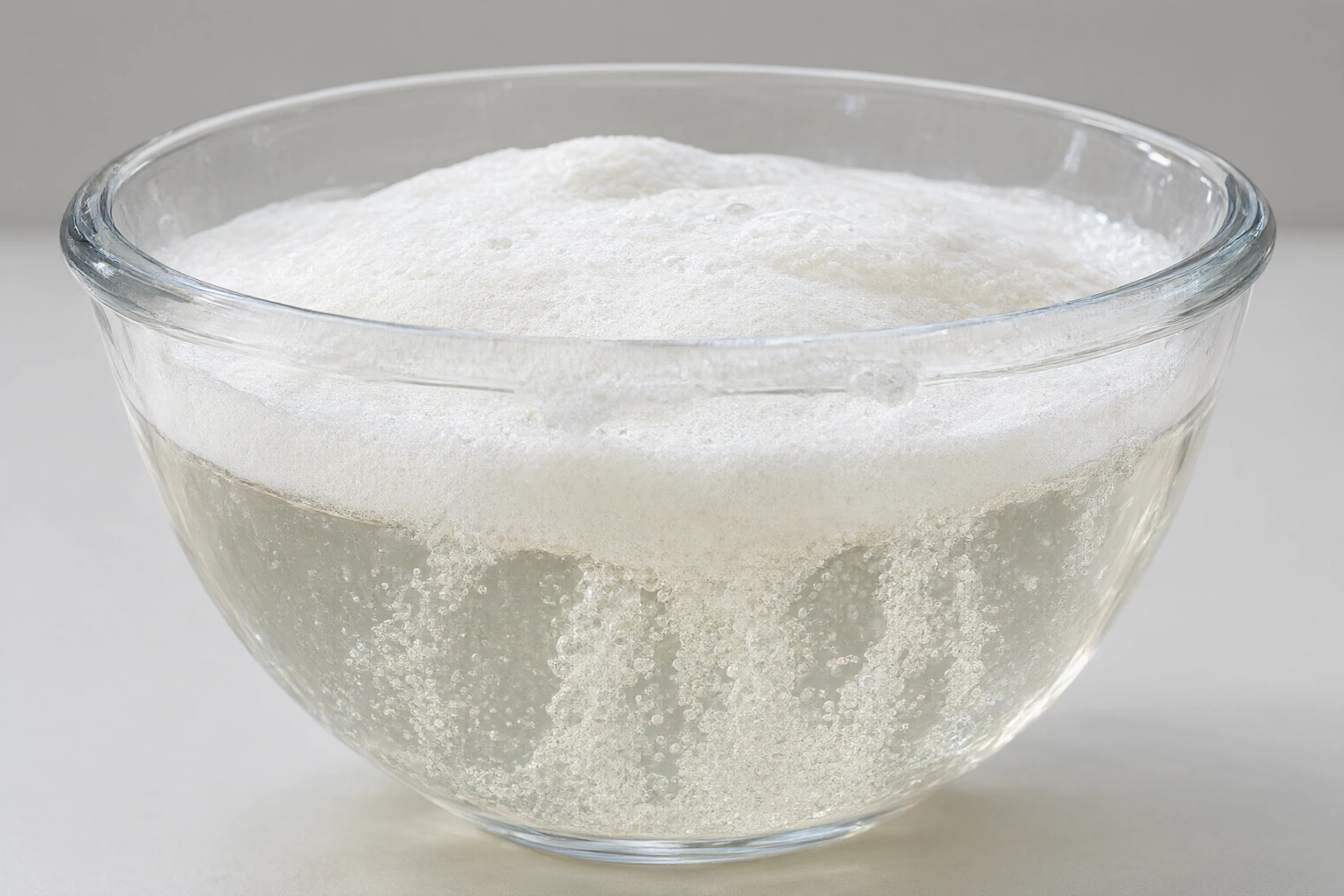
For a small demonstration, use a small, open container and keep the amounts modest. The goal is to see the reaction clearly without overflow.
A simple classroom or kitchen starter example is about 1 tablespoon of baking soda with 1/4 cup of vinegar, but you should adjust based on container size and the foam level you want. If you want a more controlled result, add the vinegar gradually instead of pouring it all in at once. That gives you more control over the foam.
The container matters as much as the ingredients. A narrow cup can overflow quickly because the bubbles need room to expand. A wider bowl gives the foam more space and makes cleanup easier.
A practical decision rule:
- Small cup: better for a quick, contained demo, but overflow is more likely
- Wide bowl or tray: better for observing the reaction safely and clearly
- Larger amounts: more dramatic, but harder to control
If you are helping children with a science activity, keep the setup simple and avoid sealing the container. Gas buildup in a closed container can create pressure.
For measuring baking soda accurately in the kitchen, this guide on converting teaspoons of baking soda to grams can help when a recipe or experiment needs more precision.
Common Misconceptions About the Reaction
A few mistakes come up again and again with this topic.
“Vinegar is pure acetic acid”
Not quite. Household vinegar is a dilute solution of acetic acid, not pure acetic acid. That is why it is safe to keep in a kitchen and why it behaves as a mild acid in simple experiments.
“The fizz is oxygen”
The gas is carbon dioxide, not oxygen. Oxygen is not the visible cause of the bubbling here.
“It works the same as baking powder”
It does not. Baking powder is formulated for leavening in recipes, while vinegar and baking soda react immediately when combined. That timing difference changes how useful each one is in baking.
“More of both ingredients always gives a better reaction”
Not necessarily. Too much liquid can dilute the reaction, and too much baking soda can leave an unpleasant taste or residue if used in food. For a demo, more can also mean more overflow rather than a better result.
“The reaction is only useful for baking”
The reaction is useful for learning chemistry, too. It is a clear example of an acid-base reaction that produces a gas, which makes it a common classroom demonstration.
Quick Takeaway
If you need the short version, here it is:
Vinegar is dilute acetic acid, baking soda is sodium bicarbonate, and their balanced equation is:
CH₃COOH + NaHCO₃ → CH₃COONa + H₂O + CO₂
The fizz comes from carbon dioxide gas. The other products are sodium acetate and water. In baking, this reaction can be useful for understanding acid and base behavior, but it is not the same thing as baking powder leavening.
FAQ
Is vinegar just acetic acid?
No. Vinegar is a dilute solution that contains acetic acid and water. The acetic acid is the part that reacts with baking soda.
What gas is produced when vinegar and baking soda react?
Carbon dioxide gas is produced. That gas creates the fizzing and bubbling.
Is the vinegar and baking soda equation balanced?
Yes. The formula CH₃COOH + NaHCO₃ → CH₃COONa + H₂O + CO₂ is balanced as written.
Can I use any vinegar?
Different vinegars still contain acetic acid, so the basic reaction is the same. The visible fizz may vary depending on acidity, color, and how much you use.
Is this a good substitute for baking powder?
Usually not. Baking powder is designed for leavening in recipes, while vinegar and baking soda react immediately and can lose gas before baking.
Why does the mixture foam so much?
Foam forms when carbon dioxide gas gets trapped in the liquid for a short time before escaping.
Is this reaction safe for a simple classroom demo?
It is commonly used for simple demos when handled in an open container with basic kitchen or classroom care. Avoid sealing the container because gas can build pressure.
What are the products of the reaction?
The products are sodium acetate, water, and carbon dioxide.