
Vinegar Baking Soda Equation: A Simple Guide to the Reaction, Products, and Science
If you have ever mixed vinegar and baking soda and watched it fizz, you have seen a classic acid-base reaction in action. For a school project, kitchen experiment, or baking curiosity, the useful question is not just “Why does it bubble?” but “What is actually happening?”
In simple terms, vinegar is the acid, baking soda is the base, and together they produce carbon dioxide gas, water, and a salt called sodium acetate. That gas is what creates the bubbling and foam. The chemistry is straightforward once you separate the household names from the chemical names.
This guide breaks the reaction down in plain language, shows the balanced equation, and explains when this reaction matters in baking and when it is mainly useful as a demonstration.
What Vinegar and Baking Soda Are
Vinegar is a diluted solution of acetic acid in water. In the kitchen, the most common type is white vinegar, though other vinegars contain the same main acid in different amounts and with different flavors. Vinegar is typically only about 5% acetic acid, which helps explain why the reaction is mild compared with using a concentrated acid.
Baking soda is sodium bicarbonate. It is a white powder commonly used in baking and science experiments because it reacts with acids and releases gas.
A quick way to think about the pair is this:
- Vinegar = acid source
- Baking soda = base source
That pairing matters because acids and bases can react with each other in a way that changes both substances.
| Ingredient | Chemical name | What it is in plain language | Role in the reaction |
|---|---|---|---|
| Vinegar | Acetic acid solution | Sour liquid used in cooking and experiments | Provides the acid |
| Baking soda | Sodium bicarbonate | Fine white powder | Provides the base |
| Reaction products | Carbon dioxide, water, sodium acetate | Gas, liquid water, and a dissolved salt | Cause the fizz and the leftover liquid |
If you want a deeper baking-side explanation of why baking soda behaves this way, our guide on why baking soda is alkaline is a useful companion.
Why They React: Acid and Base Basics
Acids and bases are opposite types of substances in chemistry. Vinegar is acidic because its acetic acid can donate a hydrogen ion in solution. Baking soda is basic because sodium bicarbonate can accept that hydrogen ion.
When they meet, the acid and base neutralize each other in a broad sense. That does not mean the mixture becomes perfectly neutral in every case, but it does mean the acid and base are reacting to form new substances.
The most noticeable result is gas formation. In this reaction, the gas is carbon dioxide.
That is why the mixture does not just become “wet powder.” It changes into something new, and the gas escapes quickly enough that you can see it as fizzing.
The Balanced Chemical Equation
For a school project, the balanced equation is often the part teachers want to see.
A common way to write the reaction is:
NaHCO₃ + CH₃COOH → CH₃COONa + H₂O + CO₂
Here is what each formula means:
- NaHCO₃ = sodium bicarbonate, or baking soda
- CH₃COOH = acetic acid, the main acid in vinegar
- CH₃COONa = sodium acetate
- H₂O = water
- CO₂ = carbon dioxide
The equation is balanced because the same number of each type of atom appears on both sides. That matters because atoms are not destroyed in a chemical reaction; they are rearranged into new substances.
For a student, the simplest way to remember it is:
baking soda + acetic acid → carbon dioxide + water + sodium acetate
That version is less formal, but it keeps the chemistry accurate.
What Products Are Formed
The reaction produces three main products.
Carbon dioxide
This is the gas that causes the bubbles and foam. It is the most visible sign that the reaction is happening.
Water
Water forms as part of the reaction. In a kitchen experiment, you usually do not notice it separately because vinegar already contains water.
Sodium acetate
This is a salt formed when the acid and base react. It stays dissolved in the liquid unless conditions change.
A useful comparison: the bubbles are not the product of “air getting in.” They are a new gas made by the reaction itself.
Why the Mixture Fizzes and Foams
The fizzing is caused by carbon dioxide gas escaping from the liquid. The foam happens when that gas gets trapped briefly in the liquid and around small particles, creating a frothy layer.
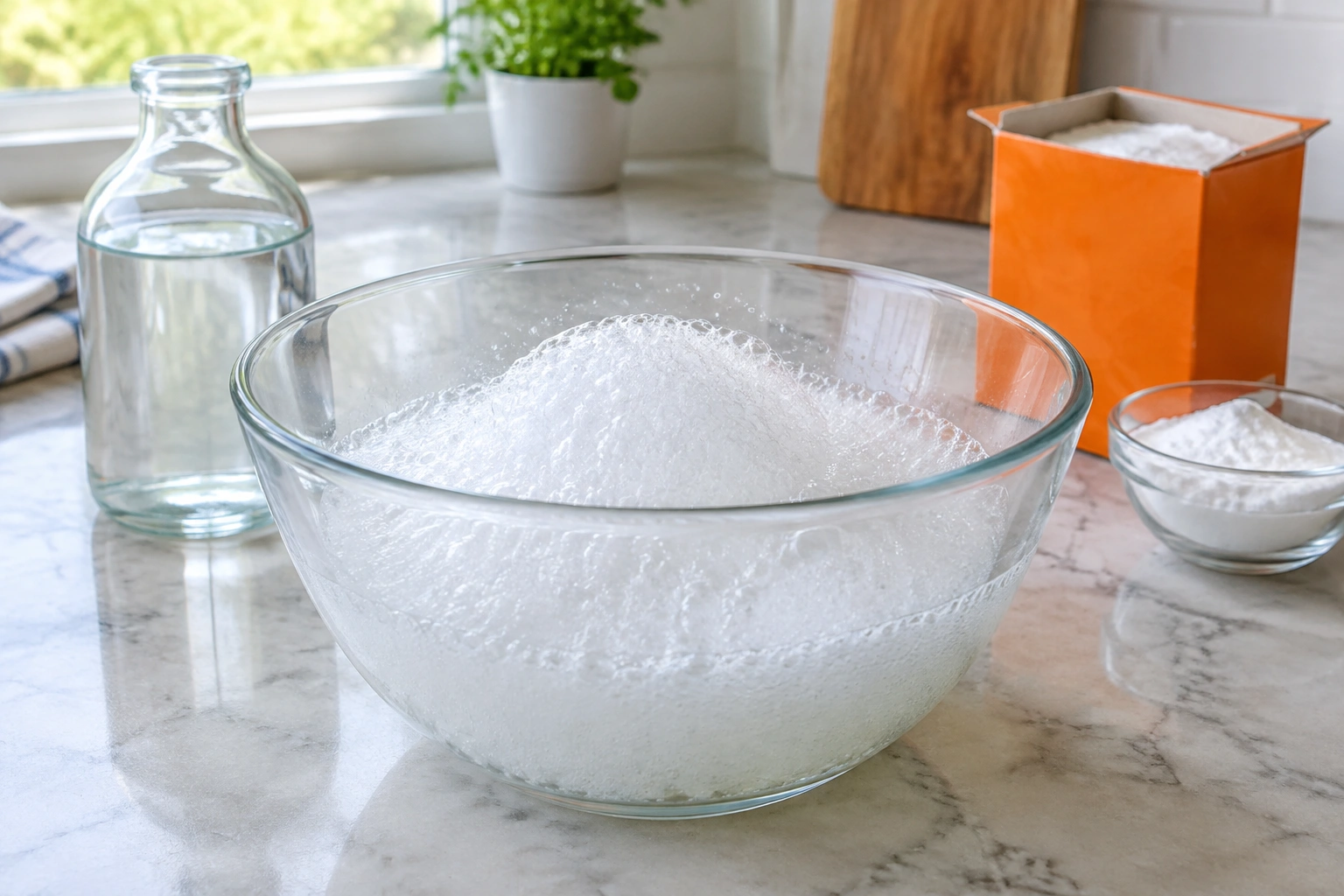
Several things affect how dramatic the foam looks:
- How fast the ingredients are mixed
- How much liquid is present
- Whether the container is narrow or wide
- Whether soap or other foaming agents are added
A narrow bottle can make the foam look more dramatic because the gas has less space to spread out, though the exact effect depends on the setup. A wide bowl usually gives a gentler reaction.
That is why the same chemistry can look mild in one container and more dramatic in another, even though the reaction itself is the same.
How Much Vinegar and Baking Soda to Use
If your goal is a visible reaction, small controlled amounts are usually better than large ones. The reaction happens quickly, so adding more of one ingredient does not automatically create more fizz once the other ingredient has been used up.
A practical rule is to use amounts that keep the reaction easy to observe and easy to clean up. If one ingredient is far in excess, you may end up with leftover vinegar or leftover baking soda rather than a stronger reaction.
At the chemistry level, the balanced equation is 1:1 by mole: one mole of sodium bicarbonate reacts with one mole of acetic acid. In household terms, the practical amounts vary because vinegar is dilute and usually only about 5% acetic acid.
For a simple classroom or kitchen experiment, a rough starting example is:
- 1 teaspoon baking soda
- a small splash of vinegar, then add more as needed
Because vinegar is mostly water, the liquid amount is usually much larger than the baking soda amount even though the chemical reaction itself is 1:1 by mole.
If your goal is to compare reactions, keep the container shape the same each time. That way, you are testing the ingredients rather than the vessel.
For measuring baking soda carefully, this guide on converting teaspoons of baking soda to grams can help if you need consistent results.
A Simple Example for a School Experiment
Here is a straightforward way to think about the reaction:
- Put baking soda in a bowl.
- Add vinegar.
- Watch the bubbles form right away.
- Notice that the foam rises and then settles.
What you are observing is the release of carbon dioxide gas. The reaction happens quickly because the acid and base are able to interact as soon as they touch in solution.
If a child asks why the foam stops, the answer is simple: one of the ingredients has been used up, so the reaction slows down and ends.
Is This the Same Reaction Used in Baking?
Not exactly.
Vinegar and baking soda can be used in some baking formulas, but this is not the default leavening method in most baking. In the bowl or cup, the reaction is immediate; in a recipe, the gas has to be produced at the right time and trapped by batter or dough long enough to help the structure expand.
That means the reaction is useful, but only in specific recipes designed for it.
A few practical differences matter:
- In a demo, the goal is to see fizzing immediately.
- In baking, the goal is to create lift in the finished product.
- In a batter, timing and structure matter as much as the gas itself.
In many baked goods, baking soda is used with acidic ingredients already in the recipe, such as buttermilk, yogurt, citrus, molasses, or cocoa processed in a way that leaves acidity behind. Baking powder is also common because it already contains both the base and an acid in measured amounts. That is why most baking relies on pre-measured acidic ingredients or baking powder instead of adding vinegar separately.
If the gas escapes before the batter sets, the rise may be weak. That is why a chemistry demonstration and a cake recipe are not the same thing, even though both may involve carbon dioxide.
Vinegar and Baking Soda vs. Baking Powder and Other Acids
Baking soda is only one part of a leavening system. It needs an acid to react with. Vinegar is one possible acid, but not the only one.
Baking soda vs. baking powder
Baking soda is pure sodium bicarbonate. Baking powder already contains both the base and an acid, so it can produce gas on its own when moistened and, in many cases, when heated.
That makes baking powder more self-contained and usually more convenient for recipes that do not include a separate acidic ingredient.
Vinegar vs. other acids
Vinegar is a liquid acid, so it mixes quickly and reacts right away. Other acidic ingredients in baking can behave differently because they bring their own flavor, moisture, and acidity level.
That trade-off matters. Vinegar gives a fast reaction, but it also adds liquid and a noticeable tang. In a recipe, that flavor may be welcome or it may be distracting.
For a broader baking context on acidity and leavening, our article on the pH of baking soda explains why alkalinity changes the way baking soda behaves in recipes.
Safety and Practical Handling
Because the reaction releases gas, it should be done in an open container or a well-ventilated setup. A sealed bottle or closed jar can build pressure quickly.
A few common-sense precautions go a long way:
- Use small amounts
- Keep the container open
- Avoid splashing into eyes
- Clean up spills promptly
These simple steps help keep the reaction controlled and reduce the chance of spills or surprise overflow.
Simple Takeaway
The vinegar and baking soda reaction is an acid-base reaction between acetic acid and sodium bicarbonate. The balanced equation shows that the ingredients turn into carbon dioxide, water, and sodium acetate. The fizzing and foaming come from the carbon dioxide gas escaping the liquid.
For a school project, that means you can explain both the visible reaction and the chemistry behind it. For baking, it means the reaction can help with leavening in the right recipe, but it is not the same as simply mixing the two ingredients in a cup.
If you remember one thing, remember this: the bubbles are carbon dioxide, and the reaction works because an acid and a base are rearranging into new substances.

