
The Chemical Reaction of Vinegar: What Happens, Why It Fizzes, and Where It Matters
Vinegar is one of those ingredients that looks simple on the shelf but becomes surprisingly interesting once you understand the science behind it. Household vinegar is typically a dilute solution of acetic acid in water, usually around 5% acetic acid, which makes it a mild acid rather than a strong one. In the kitchen, it can brighten flavor, help activate leavening, or create a dramatic fizz in a classroom experiment. The key is knowing what vinegar is, what it reacts with, and what the reaction actually produces.
At its core, the chemical reaction of vinegar is an acid-based reaction. Vinegar is mostly water with acetic acid dissolved in it, which makes it acidic enough to react with certain substances, especially bases such as baking soda. When that happens, the visible bubbles are not just “air” escaping. They are a sign that new substances are forming.
For home bakers and DIY learners, that distinction matters. If you know what vinegar is doing chemically, you can decide when it belongs in a recipe, when it is useful in a demonstration, and when it is better left out.
What Vinegar Is Chemically
Vinegar is not a single pure chemical. It is a mixture, and the important part for most reactions is acetic acid dissolved in water. That is why vinegar tastes sharp and behaves like a mild acid rather than a neutral liquid.

Different vinegars can vary in acidity and flavor. Distilled white vinegar is often preferred for its relatively neutral flavor in recipes and experiments, which makes it useful for baking and science demonstrations. Apple cider vinegar and other specialty vinegars still contain acetic acid, but they also bring their own aroma and flavor. That can be helpful in food, but less helpful when you want a clean, predictable reaction.
A simple way to think about it: vinegar is the acid source, while water is the carrier. The acid is what does the reacting.
Why Vinegar Reacts: The Basics of Acid-Base Reactions
Acids and bases are opposite sides of the same chemistry story. In plain language, an acid can react with a base and produce new substances. Vinegar is acidic, so it reacts most noticeably with basic ingredients.
This is why vinegar behaves differently from water or sugar syrup. Water usually just dissolves things. Vinegar can actively change them when a base is present. That difference is the line between a physical change and a chemical reaction.
A physical change alters form, not identity. Crushing ice is a physical change. Mixing vinegar with baking soda is a chemical reaction because the ingredients are transformed into new products. That is also why the result does not simply “go back” to vinegar and baking soda once the reaction is finished.
For kitchen use, the practical takeaway is simple: vinegar is useful when you need acidity. It is not useful when you need a neutral liquid.
What Happens When Vinegar Meets Baking Soda
The most familiar vinegar reaction is the one with baking soda, which is sodium bicarbonate. Baking soda is a base, and vinegar is an acid, so the two react readily.
When they combine, the reaction produces carbon dioxide gas, water, and a salt. The gas is the part you see first because it forms quickly and pushes through the liquid as bubbles. The salt stays dissolved or suspended in the mixture.
This is why the combination is so common in school experiments and homemade demonstrations. It gives a clear visual result without needing special equipment. If you want to show that a chemical reaction is happening, this is one of the easiest examples to observe.
In baking, though, the story is more nuanced. Vinegar and baking soda can be useful together when a recipe is designed to use that reaction for lift. But if they are added without balance, they can neutralize each other too early and reduce the effect you were hoping for. That is why the pairing works best when the recipe is written for it.
For a deeper breakdown of the equation and products, see our guide to the vinegar and baking soda equation.
Why the Mixture Fizzes and Bubbles
The fizz is the visible sign of carbon dioxide gas being released. It is not boiling, and it is not heat alone causing the bubbles. The gas forms during the chemical reaction and escapes through the liquid, creating foam and movement.
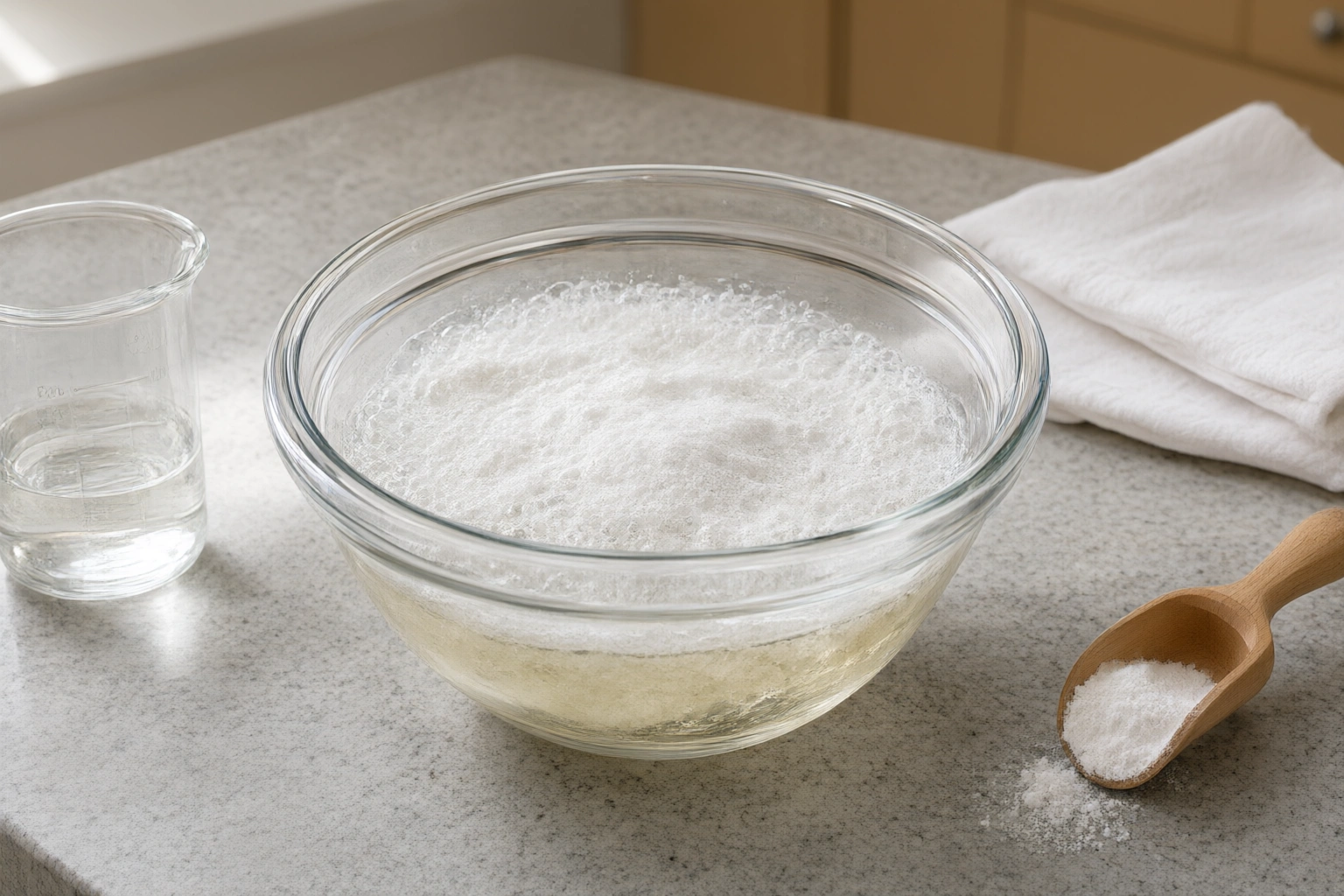
That distinction helps when you are judging whether a reaction is strong or weak. A lot of fizz usually means the acid and base are reacting actively. A smaller amount of fizz may mean one ingredient is limited, diluted, or already partly used up.
You can see this in a simple classroom-style test. Vinegar reacts strongly with baking soda, but it does not create the same effect with sugar or flour. That contrast makes the reaction easy to demonstrate and easy to explain.
If the fizz stops, it usually means one of the reactants has been used up. The reaction is not “broken”; it has simply run out of one ingredient to react with.
What Vinegar Reacts With in the Kitchen and Around the House
Vinegar reacts most noticeably with bases and with certain mineral deposits. In the kitchen, that means it can interact with baking soda and some residue that is alkaline or mineral-based.
It usually does not react dramatically with neutral ingredients like flour, sugar, oil, or plain water. Those ingredients may mix with vinegar, but mixing is not the same as reacting. If nothing acidic or basic is present, or if the other ingredient is too diluted, you will not see much fizzing.
Here is a simple rule of thumb:
- Strong visible reaction: vinegar + baking soda
- Possible mild reaction: vinegar + mineral residue or other alkaline material
- Little to no visible reaction: vinegar + sugar, flour, or oil
This is useful in practical settings because it keeps expectations realistic. Vinegar is not a universal “reactive” ingredient. It is selective. It shines when the other ingredient is basic or mineral-rich.
Vinegar vs. Lemon Juice and Other Acids
Vinegar is not the only household acid. Lemon juice is another common example, and it can sometimes play a similar role in recipes or experiments because it is acidic too.
The main difference is that vinegar has a sharper, more neutral acid profile, while lemon juice brings citrus flavor along with the acidity. That matters in baking. If you want acidity without lemon flavor, vinegar is often the cleaner choice. If citrus flavor is welcome, lemon juice may be the better fit.
For experiments, vinegar is often easier to use because its flavor and aroma are less distracting, especially in a classroom or kitchen demonstration. Lemon juice can still react, but the result may be less consistent depending on how much juice and pulp are present.
Here is a quick comparison to help with decision-making:
| Comparison | Vinegar | Lemon Juice |
|---|---|---|
| Acid source | Acetic acid in water | Citric acid and other compounds |
| Flavor impact | Sharp, usually neutral in baked goods when used lightly | Bright citrus flavor |
| Best use | Baking, simple experiments, some cleaning uses | Baking when citrus flavor is desired |
| Reaction with baking soda | Yes, visible fizzing | Yes, also acidic and reactive |
| Predictability | Often very consistent, especially white vinegar | Can vary more because of pulp and juice differences |
If your goal is a clean acid source for a baking soda reaction, vinegar is usually easier to control.
Chemical Reaction vs. Physical Change
This is one of the most useful distinctions for understanding vinegar.
A physical change is when something changes shape, state, or appearance without becoming a different substance. Stirring vinegar into water is a physical change. The liquids mix, but the vinegar is still vinegar.
A chemical reaction happens when the substances interact and form new products. Vinegar and baking soda do this. The carbon dioxide gas, water, and salt are not just the original ingredients sitting side by side.
That difference matters in the kitchen. If you are making a batter and you need acidity for a specific purpose, you have to know whether the vinegar is simply being mixed in or whether it is meant to react with a base. The result will be very different.
A common mistake is assuming every visible change means a chemical reaction. Not true. Some mixtures look dramatic without actually creating new substances. With vinegar, the reaction is real only when it meets the right partner.
How Reaction Strength Changes With Vinegar Type and Amount
Not all vinegar behaves exactly the same way. Different products can vary in acidity and flavor, and that changes how strong the reaction looks or tastes.
White vinegar is often preferred when you want a straightforward reaction with minimal flavor. Apple cider vinegar can work too, but it may add a noticeable taste. Specialty vinegars can be fine in food, but they are not always the best choice for a simple demonstration.
The key factor is acidity: the more acetic acid a vinegar contains, the more reactive it can be with a base like baking soda. In everyday cooking and basic experiments, though, most household vinegars are similar enough that the practical difference is usually small. For that reason, the choice is often about flavor and clarity rather than a major difference in reaction strength.
Amount matters as well. If there is too little vinegar, the reaction may stop early because the acid runs out. If there is too much, you may see more liquid than you need and a reaction that looks messy rather than controlled. The same logic applies to baking soda: too much can leave an alkaline taste or an unbalanced result.
For recipes and experiments, the goal is not the biggest possible fizz. It is the right amount of reaction for the job. A dramatic bubble show is useful in a volcano experiment, but in a muffin or cake batter, control matters more than spectacle.
Practical Uses in Baking, Cleaning, and Simple Experiments
In baking, vinegar is most useful when a recipe is designed to use an acid-base reaction. It can help activate baking soda and create lift, especially in batters that need quick expansion. The reaction is useful because it produces gas right away.
In simple science experiments, vinegar is popular because the reaction is easy to see, safe to observe in a controlled setup, and easy to explain. A bowl, tray, or container can catch the foam, and the result often appears quickly enough to hold attention.
In cleaning, vinegar may help with some mineral residue or alkaline buildup because of its acidity, but its usefulness depends on the specific residue. It is not a universal cleaner. The chemistry is specific, so it works best where an acid can actually interact with the residue present.
A practical decision rule:
- Use vinegar when you need mild acidity.
- Pair it with baking soda when you want a visible gas-producing reaction.
- Skip the combination when your goal is simply to add acidity without neutralizing it.
That last point matters in baking. If acidity is needed for flavor or structure, mixing vinegar and baking soda too early can cancel part of the effect.
Safety Rules and Common Mistakes
Vinegar is common and food-safe, but that does not mean every vinegar reaction is automatically harmless in every setting.
Do not mix vinegar with bleach or other unknown cleaners. That is a separate safety issue from the baking-soda reaction, and it should be avoided. If you are doing a home experiment, keep the setup in an open bowl or tray so the fizz has room to expand.
Avoid sealed containers. Gas buildup can create pressure, and pressure is the part that turns a simple reaction into a mess or a hazard. Supervise children closely during demonstrations, especially if the reaction is vigorous.
A few common misconceptions are worth clearing up:
- “More fizz means a better result.” Not always. In baking, balance matters more than drama.
- “All vinegars react the same way.” They do not. Flavor and acidity can vary.
- “Fizzing means boiling.” It does not. The bubbles come from gas production.
- “Vinegar reacts with everything.” It does not. It reacts strongly with some substances and barely at all with others.
The best habit is to match the vinegar reaction to the goal. Baking, cleaning, and experiments each ask for something slightly different.
FAQ
Is vinegar an acid or a base?
Vinegar is an acid. Its main reactive component is acetic acid dissolved in water.
Why does vinegar fizz with baking soda?
Because the acid in vinegar reacts with the base in baking soda and releases carbon dioxide gas, which creates bubbles and foam.
What gas is produced when vinegar reacts with baking soda?
Carbon dioxide is the main gas produced.
Does vinegar react with flour or sugar?
Not in any dramatic way. Those ingredients are not bases, so you usually will not see a strong reaction.
Is vinegar safe for home experiments?
Yes, when used carefully in a controlled, open container and kept away from unsafe chemical combinations.
Why does one vinegar reaction look stronger than another?
The strength can change with the type of vinegar, how much you use, and how much reactive ingredient is present on the other side.
Final Takeaway
The chemical reaction of vinegar is easiest to understand when you focus on one idea: vinegar is a mild acid that reacts most clearly with bases. That is why baking soda and vinegar fizz, why the bubbles are carbon dioxide, and why the same liquid can behave very differently depending on what it meets.
Once you understand that pattern, vinegar becomes easier to use with purpose. In baking, it can support a planned reaction. In experiments, it can demonstrate gas production clearly. In everyday use, it helps to know when it will react, when it will not, and when a different acid may be a better fit.

