
How Long Bread Dough Should Rise for Better Flavor, Structure, and Oven Spring

If you want the short answer, here it is: most bread doughs rise somewhere around 1 to 2 hours at room temperature for the first rise, and often 30 minutes to 1 hour for the second rise after shaping. But that clock is only a starting point. The dough itself decides when it is ready.
That is the big lesson behind proofing. A recipe can give you a time estimate, but your kitchen temperature, yeast strength, dough hydration, flour choice, and even the size of the dough batch all change the schedule. As King Arthur Baking puts it, timeframes in recipes are guidelines, not deadlines, and you should go by the look of the dough rather than the clock. See their guidance on judging bread dough by appearance.
Here’s the practical rule I teach home bakers and culinary students: use time to plan, but use the dough to decide.
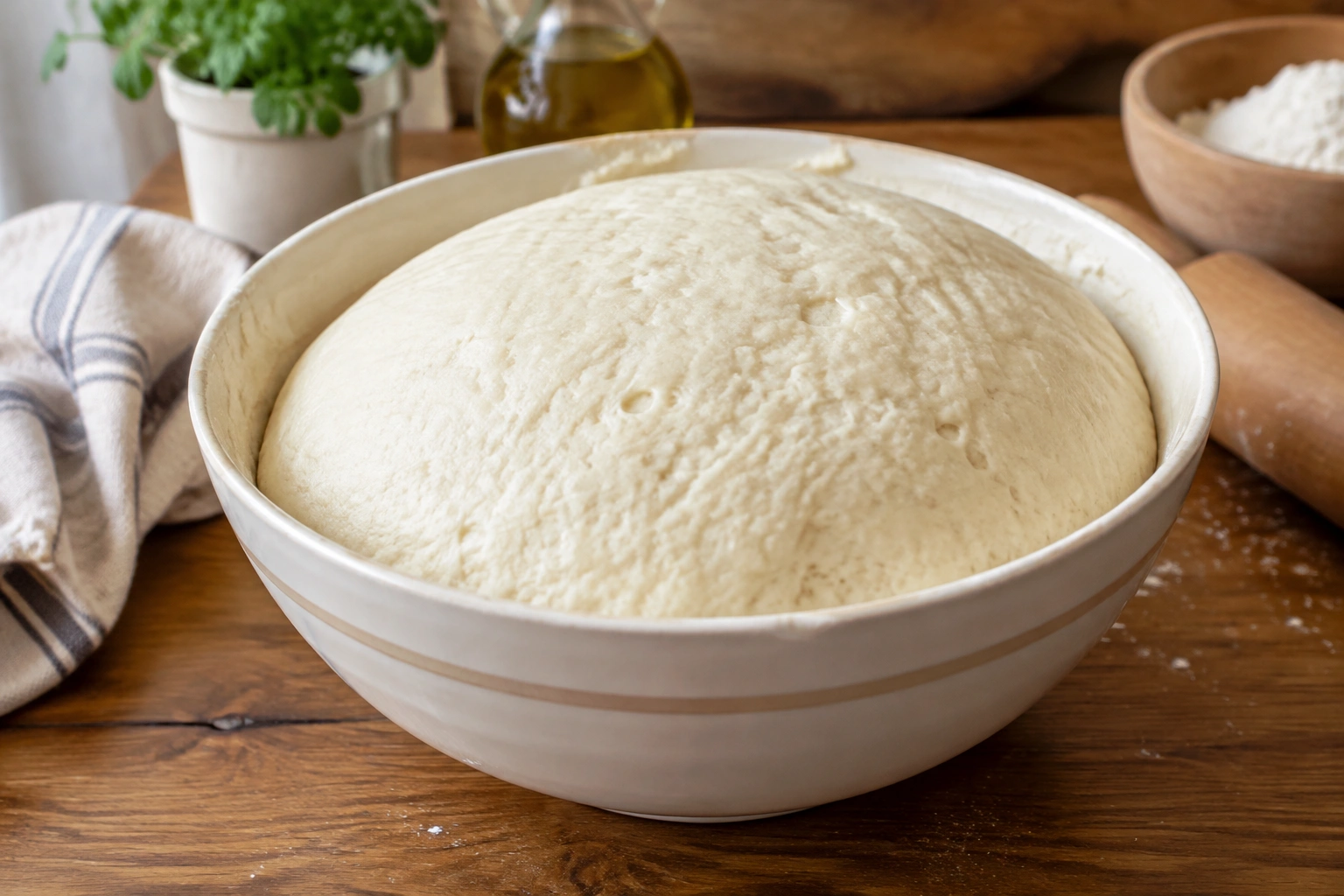
Quick Answer: How Long Bread Dough Should Rise
For most yeasted breads:
- First rise / bulk fermentation: about 1 to 2 hours at room temperature is common
- Second rise / final proof: often 30 minutes to 1 hour
- Cold or overnight proofing: many doughs can rise more slowly in the fridge, sometimes overnight, then finish at room temperature before baking
A useful example comes from a simple bread recipe that calls for a 10-hour slow rise overnight. That kind of long fermentation is not unusual when the recipe is designed for it. Bob’s Red Mill notes a 10-hour overnight rise in one bread recipe.
The real question is not “How many minutes?” but “What should the dough look and feel like right now?”
If you remember nothing else, remember this: a properly risen dough is puffy, enlarged, and responsive, not flat and tight, and not fragile and collapsing.
What Affects Bread Dough Rise Time
No two doughs rise at the same speed because fermentation is a living process. Yeast eats sugars, produces gas, and stretches the gluten network. Anything that speeds up or slows down that process changes the timeline.
Yeast amount and type
More yeast usually means a faster rise. Commercial yeast types also behave a little differently:
- Instant yeast often works quickly and can be mixed directly into dry ingredients
- Active dry yeast may need blooming or extra time to get going, depending on the recipe
The exact rise still depends more on the whole dough formula than on yeast alone.
Temperature
Temperature is one of the biggest drivers of rise time. A warm kitchen pushes fermentation forward, while a cool kitchen slows it down.
Brod & Taylor recommends fermenting around 85–90°F (30–32°C) when time is limited and notes that temperatures above 90°F (32°C) may harm the flavor of yeast bread. They also point out that cold dough often needs extra time to rise. Their bread rising tips are worth reading if your kitchen runs cool.
That means a dough mixed with cold ingredients in a chilly room may take noticeably longer than the same formula in a warm kitchen.
Hydration
Higher-hydration doughs often ferment differently from stiffer doughs. A wetter dough can feel more extensible and may seem to move faster because gas expands more easily through it. But it can also be trickier to judge by touch because it may spread rather than stand tall.
Flour type
White flour, whole wheat flour, and high-protein bread flour all rise a little differently.
- White flour usually gives the most predictable rise and often looks the lightest and most airy at the same stage of fermentation.
- Whole wheat flour absorbs more water and can ferment a bit faster at first, but the dough often feels denser and may not look as dramatically expanded as white dough.
- High-protein bread flour tends to build stronger gluten, so the dough can hold gas well and rise with more structure, especially in lean doughs.
Sugar, fat, and salt
These ingredients all affect fermentation:
- Sugar can feed yeast, but too much can slow it in enriched doughs
- Fat from butter, oil, milk, or eggs tenderizes the dough and often slows rise
- Salt strengthens gluten and controls yeast activity, which is helpful for structure but can slow fermentation if the formula is heavy on salt
If you want a deeper look at how salt affects bread dough, the balance matters more than people think. Too little salt can make dough rise too quickly and taste flat; too much can slow yeast noticeably. This guide to salt in bread dough explains the trade-offs well.
First Rise vs. Second Rise: What’s the Difference?
Many bakers use “rise” as a catch-all, but the two main stages do different jobs.
First rise: bulk fermentation
This happens after mixing and kneading, before shaping. The dough develops flavor, strength, and volume. During this stage, yeast activity builds gas throughout the entire mass.
Bulk fermentation is where dough often grows to about doubled size, though “double” is a guideline, not a law. Some doughs are ready before they double fully; others are ready when they are clearly expanded, airy, and domed.
Second rise: final proof
This happens after shaping. The dough has already been divided and formed into loaves, rolls, or boules. The final proof gives the shaped dough enough gas and structure to spring in the oven without collapsing.
A common mistake is treating both rises the same. They are not the same stage, and they do not always take the same amount of time. The first rise often takes longer because the dough is building its structure from scratch. The second rise can move faster because the dough is already developed.
Tools and Conditions You’ll Need for Reliable Rising
You do not need fancy equipment, but a few simple tools make proofing much easier to control.
Helpful basics
- A large bowl or container with room for expansion
- Plastic wrap, a damp towel, or a lid to prevent drying
- A warm spot in the kitchen
- A thermometer if you want more consistency
- Light oil for the bowl so dough releases cleanly
A sensible warm environment
If your kitchen is cold, you can create a gentle proofing spot. The key word is gentle. You want warmth, not heat. A covered bowl set in a slightly warm place can help, but do not expose dough to a hot surface or a temperature that feels uncomfortable to your hand.
The goal is a steady environment that encourages fermentation without damaging yeast or softening the dough too much.
How to Tell When Dough Has Risen Enough
This is the part that saves bread.
A risen dough should look fuller, lighter, and slightly domed. It often appears smoother and more elastic than when you first mixed it. The surface may show small bubbles underneath, and the dough should feel airy rather than dense.
Look for these signs:
- The dough has increased noticeably in size
- The surface looks puffy or domed
- The dough jiggles slightly when the bowl is moved
- It feels soft and alive, not tight and resistant
One source describes properly risen dough as staying indented when gently pressed, which is a helpful clue for home bakers. Susan’s Cooking School gives a practical example of dough rising until doubled and holding a finger indentation. Their explanation is a good visual reference.
That said, “double in size” is not always exact enough on its own. A rich brioche may not look dramatically doubled the way a lean sandwich dough does, and sourdough can be more subtle still. Use the overall feel of the dough, not just one number.
Quick decision guide by dough type
Readiness cues change a little depending on the dough:
- Lean doughs: look for a clear increase in volume, a domed top, and a poke test that springs back slowly. These doughs usually give the most obvious visual change.
- Enriched doughs: expect a softer, gentler rise. They may not look as dramatically doubled, so focus more on puffiness, lightness, and a delicate finger dent that fills in gradually.
- Sourdough: watch for visible aeration, bubbles along the sides or top, and a dough that feels lighter and more elastic. Sourdough often benefits from judging the dough’s overall activity rather than chasing a strict size target.
Use the Poke Test to Check Readiness
The poke test is one of the simplest ways to judge proofing.
How to do it
- Lightly flour your finger.
- Gently press into the dough about halfway down.
- Watch how quickly the indentation changes.
How to read it
- Springs back immediately: underproofed; needs more time
- Springs back slowly and partially: ready to bake or shape
- Stays dented and feels fragile: likely overproofed
The poke test works because gluten tension changes as fermentation progresses. Underproofed dough still has a lot of spring. Properly proofed dough has enough gas and strength to hold a gentle dent. Overproofed dough has stretched too far and may not recover well in the oven.
Step-by-Step: How Long to Let Dough Rise in Practice
Here is the decision process I use when I want reliable results.
1) Read the recipe, then read the room
Recipe times are your starting point. If the kitchen is cool, expect the dough to take longer. If the room is warm, expect it to move faster.
2) Watch for visual change

Do not wait for a stopwatch to finish if the dough already looks expanded and puffy. On the other hand, do not force the dough forward just because the recipe time has passed.
3) Check the dough with your hands
Use the poke test when the dough looks close. If it springs back quickly, give it more time. If the dent returns slowly, you are probably there.
4) Move to the next stage at the right moment
- If it is the first rise, shape the dough once it is airy and expanded
- If it is the second rise, bake when the shaped loaf is puffy and the poke test shows a slow spring-back
5) Adjust for your next bake
If the dough was sluggish, note the room temperature and how long it actually took. That habit builds real skill fast.
How Rise Time Changes for Different Bread Types
Not all bread doughs behave the same way.
Lean doughs
Lean doughs contain little or no fat or sugar. They usually rise more predictably and often faster than enriched doughs. Think sandwich bread with a straightforward flour-water-yeast-salt formula.
Enriched doughs
Brioche, milk bread, and similar doughs include butter, eggs, sugar, or milk. These ingredients make the dough richer and softer, but they also slow fermentation. Expect a longer rise and a softer, more delicate dough feel.
Yeasted doughs
Commercial yeast doughs are usually easier to time because the rise is more predictable than sourdough. Even then, the clock is only a guide.
Sourdough
Sourdough is less predictable because the starter’s activity changes with temperature, feeding, and formula. Baker’s timing matters, but the dough’s behavior matters more. If you bake sourdough, watch for volume, bubbles, and elasticity rather than expecting a fixed minute count.
Refrigerated or overnight dough
Cold proofing is useful for schedule control and flavor. BBC Good Food notes that many doughs can be refrigerated for the second rise overnight, then brought back to room temperature and allowed to finish rising for 45 minutes to 1 hour before baking. Their overnight proofing method is a practical reference.
That trade-off is worth understanding: cold proofing slows fermentation, but it can make baking more convenient and often improves flavor development.
Practical Examples of Real-World Rise Times
Here are a few realistic scenarios, not rigid rules.
A basic sandwich loaf in a cool kitchen
The recipe might say 1 hour, but the dough may need longer if the room is chilly or the ingredients were cold. The loaf is ready when it looks expanded and passes the poke test, not when the timer rings.
A brioche dough
Because of the butter, sugar, and eggs, brioche often rises more slowly than lean dough. If you rush it, the texture can suffer. Give it time and judge by softness and volume.
A sourdough country loaf
The rise may take much longer than a yeasted loaf, and the schedule can shift from batch to batch. Watch the dough, not the clock.
An overnight fridge proof
The dough can be shaped, covered, and chilled after the first rise or after shaping, depending on the recipe. In the morning, let it warm up and finish proofing before baking if the recipe calls for it.
Common Mistakes That Make Dough Rise Wrong
A few errors cause most proofing problems.
Using the clock alone
This is the biggest one. A recipe time is helpful, but it cannot account for your kitchen.
Proofing too hot
Too much heat can damage yeast or create poor flavor. Warm is good; hot is not.
Confusing the two rises
If you wait for the second rise to look exactly like the first, you may overproof it. The stages are different.
Ignoring dough type
A rich dough and a lean dough should not be judged by the same visual standard.
Cutting the rise short
If the dough is still tight and springs back aggressively, it needs more time. Baking too early can lead to dense crumb and tearing.
Troubleshooting: Dough Is Too Slow, Too Fast, or Not Rising
If your dough is not behaving, use this next-step checklist.
If the dough is underproofed
Signs:
– It feels tight
– It springs back quickly in the poke test
– It looks smaller and denser than expected
What to do next:
– Give it more time
– Move it to a warmer spot if the kitchen is cool
– Check whether the ingredients were cold
– Recheck in 15 to 30 minutes rather than guessing
If the dough is overproofed
Signs:
– It feels fragile or slack
– The poke test leaves a dent that does not recover well
– The dough looks overly puffy and may start to collapse
What to do next:
– Shape and bake sooner if it still has enough structure
– If it is very overproofed, gently reshape once and let it proof briefly again
– Handle it carefully so you do not knock out all the gas
If the dough has stalled or is not rising
Signs:
– Very little volume change after a reasonable amount of time
– Little or no bubble activity
– The dough stays heavy and inactive
What to do next:
– Check whether the yeast is still active
– Confirm that the dough was mixed correctly
– Make sure the salt level is not excessive
– Look at the room temperature
– Give it more time in a warmer spot before assuming it has failed
If the yeast is dead, the dough may never recover. If the yeast is fine but the room is cold, patience may solve the problem.
Simple Rules to Remember for Better Proofing
Here’s the compact version I want every baker to keep in mind:
- Use time as a guide, not a verdict
- Judge dough by size, softness, and spring-back
- Expect lean doughs to behave differently from enriched doughs
- Warm rooms speed fermentation; cold rooms slow it down
- The first rise and second rise are not the same job
- If the dough looks ready before the timer ends, trust the dough
Once you start reading the dough instead of chasing the clock, bread-making becomes much more consistent. That is when rise time stops feeling mysterious and starts feeling manageable.
FAQ
How do I know if bread dough has risen enough?
Look for a dough that is visibly larger, puffy, and slightly domed. Then use the poke test: a ready dough should spring back slowly and partially, not immediately.
Can bread dough rise too long?
Yes. Overproofed dough can become fragile, lose structure, and bake with less oven spring. If the dough stays dented and feels weak, it may have gone too far.
Why is my dough rising so slowly?
Common reasons include a cool kitchen, cold ingredients, not enough yeast activity, or a dough formula with a lot of sugar or fat. Give it more time and move it to a warmer spot if needed.
Does sourdough rise the same way as yeasted dough?
Not exactly. Sourdough often rises more slowly and can be less predictable, so volume, bubbles, and dough feel matter more than a fixed time.
Should I always wait until dough doubles in size?
Not always. Doubling is a useful guideline for many lean doughs, but enriched doughs and sourdough may not follow that rule as closely. Use the dough’s appearance and feel, not just the number.
What should I do if my dough is not rising at all?
Check the yeast first, then review the dough temperature, salt level, and mixing. If the yeast is inactive, the dough may need to be remade.
How long should bread dough rise in the fridge?
It depends on the recipe, but many doughs can cold proof overnight. Some still need a short final rise at room temperature before baking.
Is it better to proof bread warm or cool?
Warm usually speeds fermentation, while cool slows it down and can help fit baking into your schedule. The best choice depends on the recipe and the flavor you want.