
Is Metal Safe in an Air Fryer? A Practical Guide for Home Cooks
If you’ve ever paused with a metal pan, rack, foil tray, or skewer in your hand and wondered whether it belongs in the air fryer, the short answer is: usually yes, metal is safe in an air fryer if it is oven-safe, fits properly, and does not block airflow or touch the heating element.
That last part matters. In an air fryer, safety and cooking performance are related but not identical. A metal item can be perfectly safe and still cook poorly if it crowds the basket or blocks hot air from moving around the food.
In practice, the safest rule is simple: use only metal cookware or accessories that are heat-rated for high temperatures, leave space around them, and follow your air fryer’s manual. Manufacturer instructions always override general advice.
Quick Answer: When Metal Is Safe and When It Isn’t
Metal is generally safe in an air fryer when it meets three conditions:
- It is oven-safe or heat-rated for high temperatures
- It fits without touching the heating element
- It still allows air to circulate around the food
That includes many stainless steel pans, metal racks, and skewers. Aluminum foil can also be safe in some situations, but it needs a little more care because loose foil can shift and interfere with airflow.
Metal becomes a problem when it is too large, too tall, too loose, or not meant for high heat. A metal item that physically fits in the basket is not automatically a good choice if it blocks circulation or scratches the nonstick surface.
When Metal Is Safe to Use
The most common safe metal items are the ones designed for oven cooking. In general, oven-safe, heat-rated metal cookware can be acceptable in an air fryer when the appliance manual allows it. That includes many cast iron, stainless steel, and aluminum pieces, as long as they fit the basket and leave room for air to move around them.
Stainless steel pans and trays
A small stainless steel pan is often fine for air fryer baking tasks like custards, egg bites, or small casseroles, as long as it leaves room around the edges. For example, if a pan fills the basket wall-to-wall, the food may cook unevenly because air can’t move around it properly.
Metal racks
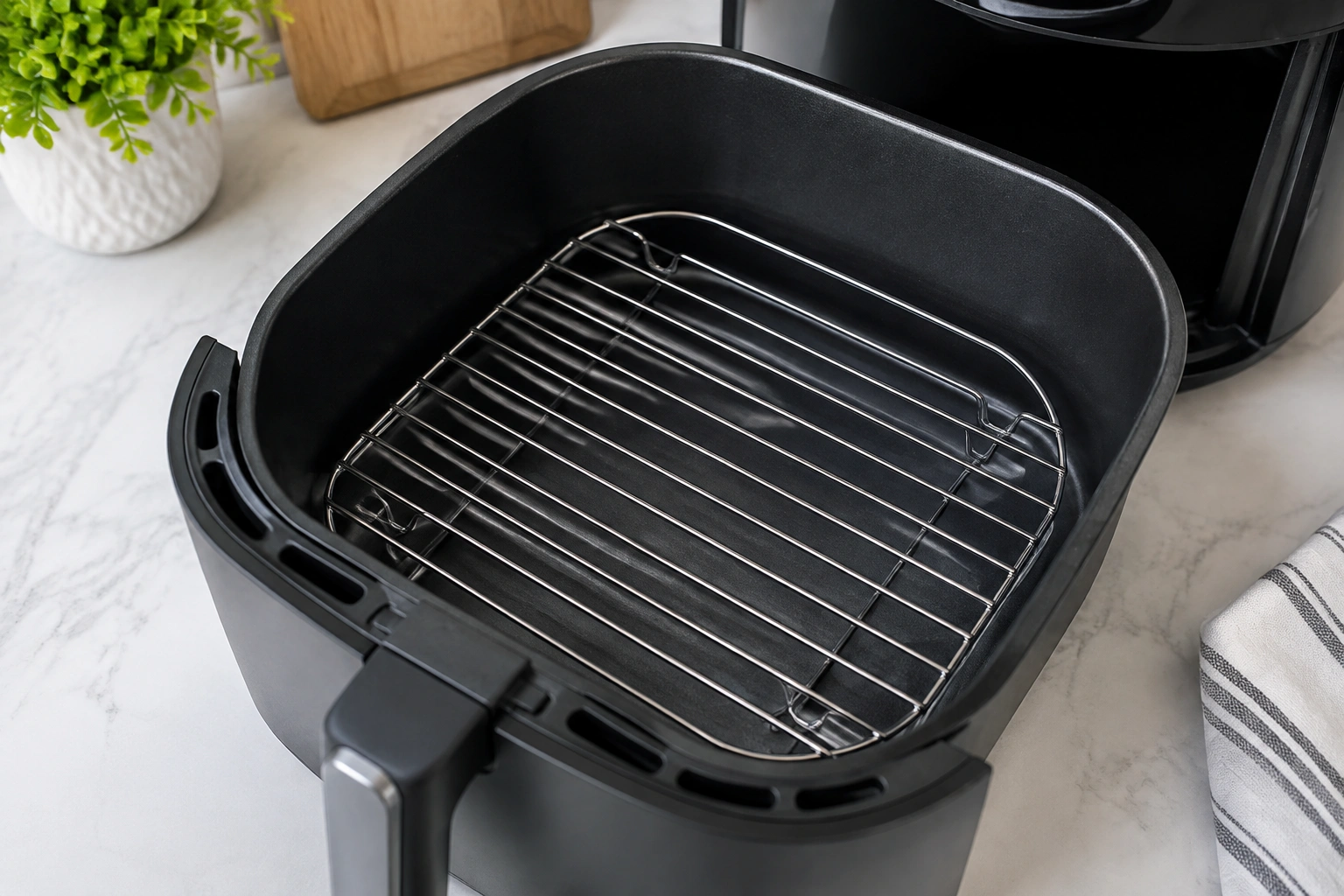
A rack can be useful when you want to cook on two levels or keep food above drippings. That said, the rack should be stable and sized for the basket. If it shifts when you slide the basket in and out, it is more likely to scratch the coating or tip food.
Skewers
Metal skewers are usually a practical choice for kebabs, shrimp, or bite-size vegetables. They work best when they sit flat and don’t rise close to the heating element. Long skewers that bow upward can create clearance problems in smaller air fryers.
Cast iron and aluminum cookware
Cast iron can work well for small portions if it fits. It holds heat strongly, which can be useful for dishes that need steady cooking. Aluminum cookware may also be fine if it is oven-safe and not oversized. The main issue with both is size and airflow, not the metal itself.
When Metal Is Not Safe or Not Recommended
Metal is not a good idea when it creates one of these problems:
- It is not oven-safe
- It is loose or lightweight and can shift during cooking
- It touches the heating element
- It blocks too much airflow
- It is oversized for the basket
- It has rough edges that could damage the nonstick coating
A common mistake is assuming “metal is metal.” That is not how air fryer use works. Thin decorative trays, novelty bakeware, or cheap accessories without heat ratings may warp, discolor, or become unsafe at air fryer temperatures.
Another issue is using metal to “line” the basket in a way that covers too much of the base. Even if the metal itself is safe, the food may turn out softer instead of crisp because hot air can’t move properly.
Can You Use Aluminum Foil in an Air Fryer?
Yes, aluminum foil can be used in an air fryer in some cases, but it should be handled carefully. If you want a deeper guide on that topic, I’ve covered it in this practical aluminum foil article.
Foil is most useful when you want easier cleanup or need to catch drips under messy foods like marinated chicken or salmon. It can also help protect delicate ingredients from overbrowning.
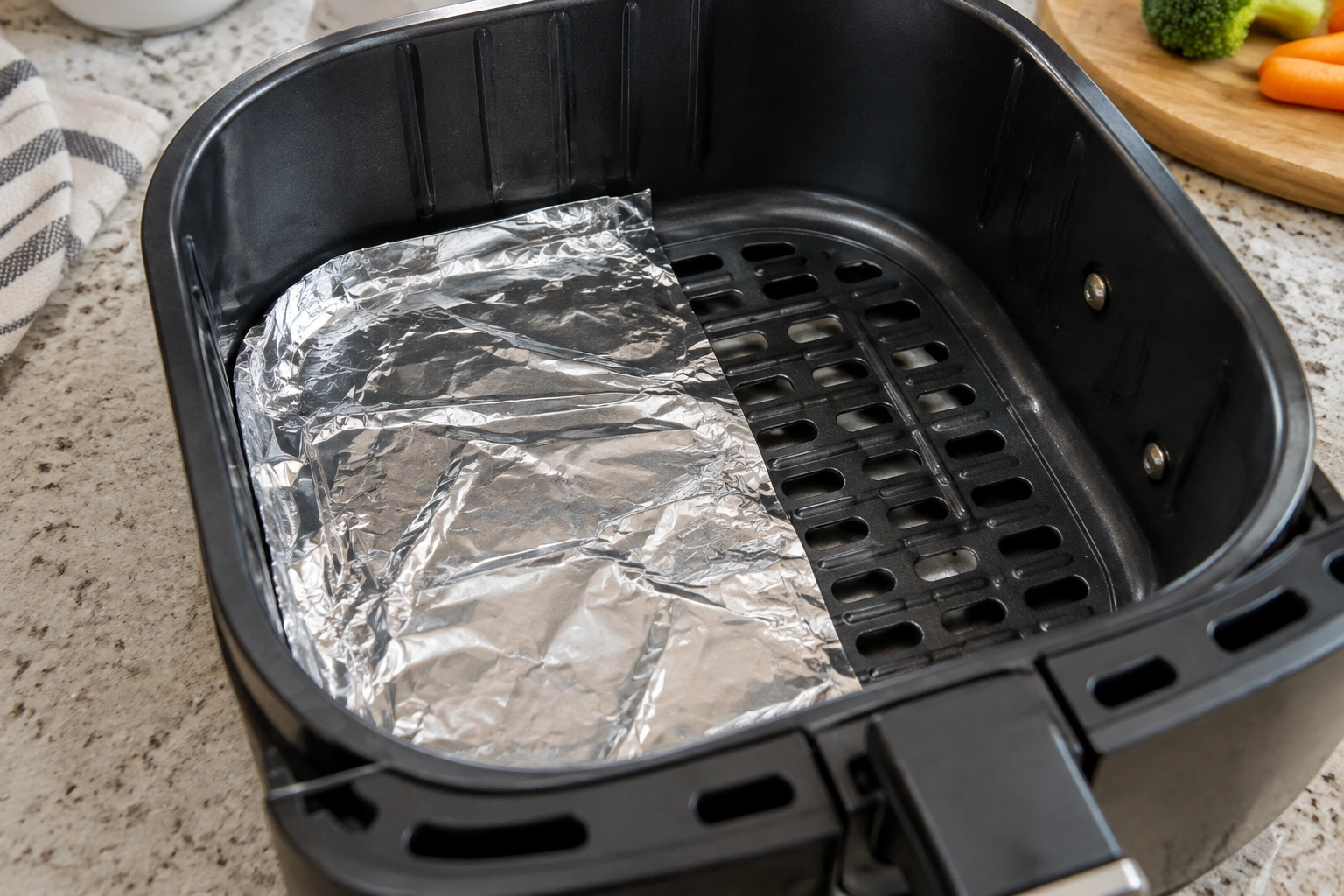
The caution is airflow. Loose foil can flutter around inside the basket, and large sheets can block circulation. Foil should never cover the entire basket base or block the fan or air intake. If you use it, keep it secured under food or shaped so it stays flat and leaves openings for air to move around the basket.
A few practical rules help:
- Don’t let foil rise toward the heating element
- Don’t cover the entire basket base
- Don’t use foil with very light foods that may blow around
- Use it only when the recipe still leaves room for crisping
Foil is a convenience tool, not a default liner for every air fryer recipe.
Using Metal Pans, Baking Trays, Racks, and Skewers Safely
Here’s how the most common metal accessories compare in real use.
| Item | Usually Safe? | Main Risk | Best Use Case |
|---|---|---|---|
| Stainless steel pan | Yes, if oven-safe and sized correctly | Blocks airflow if too large | Small bakes, custards, egg dishes |
| Metal baking tray | Sometimes | Can crowd the basket or overheat edges | Flat foods that need support |
| Metal rack | Yes, if stable and well-fitted | Scratching or tipping | Multi-level cooking, airflow under food |
| Metal skewers | Yes, if clearance is good | Touching heating element | Kebabs, shrimp, vegetables |
| Aluminum foil | Conditionally | Loose foil, poor airflow | Drip control, light cleanup |
| Silicone liner | Usually yes if air fryer-safe | Softer structure, less browning under food | Delicate foods, easier cleanup |
| Parchment paper | Usually yes if perforated or weighed down | Can fly up if unsecured | Sticky foods, quick cleanup |
My practical take on each one
A metal pan is best when the recipe needs structure. Think mini loaves, baked dips, or a small frittata. If the pan is so wide that it sits flush against the basket walls, choose a smaller one.
A metal tray is useful only when it still leaves open space around it. A tray that fits the basket but leaves no gap is often too tight for good air circulation.
A metal rack is one of the most useful accessories because it can improve airflow under food. Just make sure it is made for the appliance and doesn’t wobble when the basket moves.
Skewers are simple and effective, but they should not be so long that the tips sit close to the top of the cooking chamber.
How Metal Affects Airflow, Browning, and Cooking Results
This is where many people get tripped up. An accessory can be safe and still not be the best choice for the recipe.
Air fryers cook by moving hot air around food. If metal cookware takes up too much space, the food may steam more than it crisps. That means:
- Less browning on the outside
- Slower cooking in the center
- More uneven results between the top and bottom
For example, a small stainless steel pan holding a casserole may be fine, but the edges closest to the pan can cook differently from the exposed surface. A rack often performs better than a solid pan when you want maximum crispness.
So the decision is not just “Can I use metal?” It is also “Will this metal shape help or hurt the result I want?”
How to Protect the Nonstick Basket or Tray from Scratches
Most air fryer baskets have a nonstick coating, and that coating deserves a little care. Metal itself is not the only issue; rough handling is often what causes scratches.
A few habits help:
- Lift metal accessories instead of dragging them
- Choose smooth-edged pans and racks
- Avoid oversized pieces that scrape the sides
- Check for chips or rough spots before using an accessory
- Don’t force a tight pan into the basket
If your basket already has visible wear, be even more careful with metal accessories. In that case, a silicone liner or parchment can be a better choice for protecting the surface.
Does the Air Fryer Model Matter?
Yes, it matters a lot. The brand and model can change what is allowed, what fits, and how much clearance you have above the food.
Some air fryers have deeper baskets and more room for pans or racks. Others have compact chambers where a metal item that looks harmless can end up too close to the heating element.
The safest habit is to check:
- The user manual
- The accessory guide from the manufacturer
- Any temperature or size limits listed for the basket
If the manual says not to use a certain accessory, follow that over any general advice. Manufacturer instructions are the final word for that appliance.
Safer Alternatives if Metal Is Not the Best Choice
If your goal is easy cleanup, better protection, or less risk of scratching, non-metal options can be smarter.
Silicone liners
Silicone is flexible, reusable, and gentle on nonstick surfaces. It works well for sticky foods or delicate bakes. The trade-off is that silicone is softer than metal, so it may not give you the same rigid support for heavier batters or layered dishes.
Parchment paper
Parchment is useful for quick cleanup and can help with sticky foods. Perforated parchment is especially helpful because it lets air move through. The main caution is that parchment can shift if it is too light or not covered by food.
When to choose a non-metal option
Go with silicone or parchment when:
- The basket is already scratched
- The recipe is sticky or messy
- You don’t need rigid support
- You want less risk of scraping the coating
If you want more detail on other cookware types, you may also find these guides helpful: Is Ceramic Safe in an Air Fryer? and Is Glass Safe in an Air Fryer?.
Common Mistakes to Avoid
A few errors cause most of the trouble with metal in air fryers:
- Using a pan that is too big for the basket
- Letting foil float loose inside the chamber
- Placing accessories too close to the heating element
- Using metal that is not oven-safe
- Scraping the basket with rough edges
- Packing the basket so tightly that air cannot move
If you avoid those mistakes, metal accessories are usually straightforward to use.
Bottom Line
Metal is usually safe in an air fryer when it is oven-safe, properly sized, and placed so it does not block airflow or touch the heating element. Stainless steel pans, racks, skewers, and some aluminum cookware can all work well in the right setup. The real test is not just whether the item is metal, but whether it fits the appliance and supports the way air fryers cook.
When in doubt, check the manual first. If the accessory feels tight, unstable, or too close to the heat source, choose a smaller piece or switch to silicone or parchment instead.

