
How to Avoid Overcrowding an Air Fryer Basket for Better, Crispier Results
If your air fryer keeps giving you uneven browning, soft spots, or food that looks done on the outside but not quite right inside, the problem is often simple: the basket is too full. Air fryers work by moving hot air around the food. When pieces are packed tightly, that air cannot reach every surface evenly, and the food starts to steam instead of crisp.
The good news is that you do not need a complicated rulebook to fix it. A few loading habits make a big difference: keep food in a single layer when possible, leave some space between pieces, and cook in batches when the basket starts to look crowded. Those small changes usually improve texture more than adding extra cook time ever will.
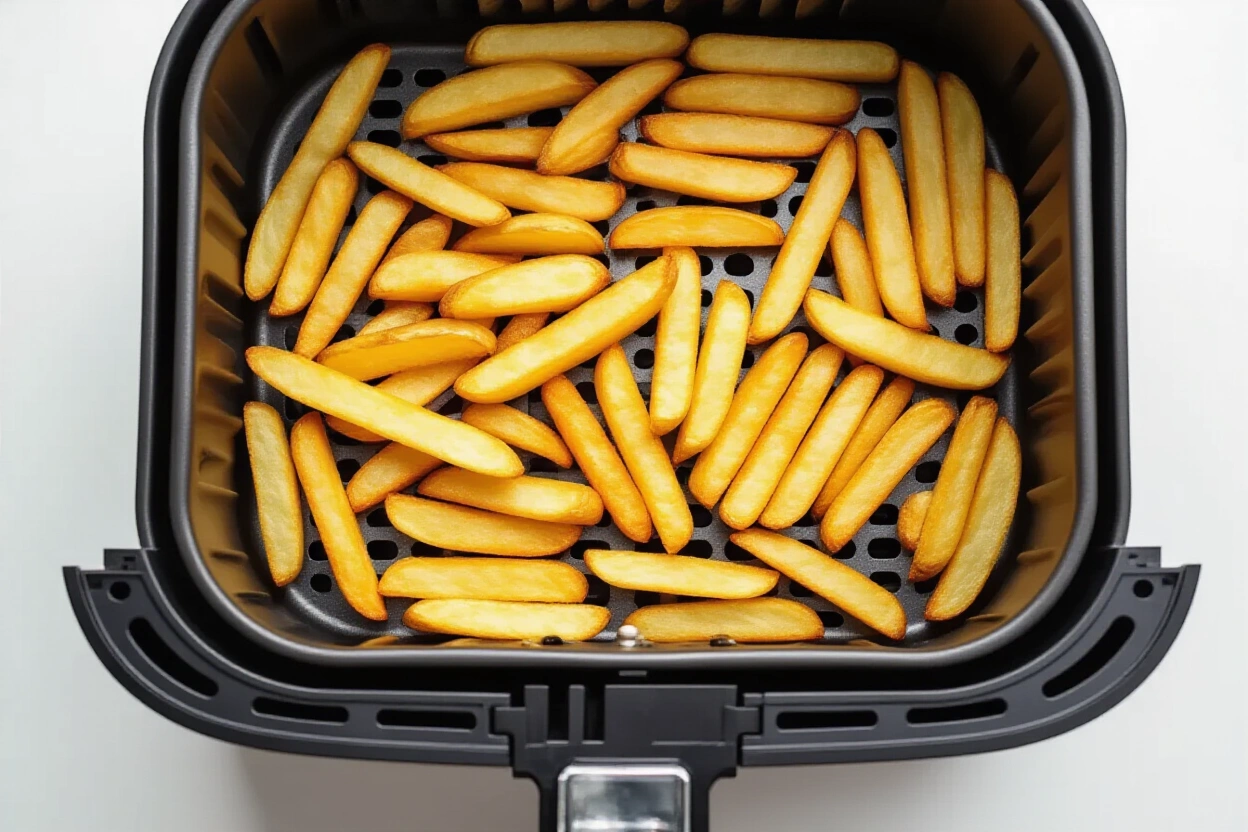
Why airflow matters in an air fryer
An air fryer is not magic; it is a small convection-style cooker. The fan moves hot air across the surface of the food, which helps the outside brown while the inside finishes cooking. That airflow is the reason air fryer fries can turn crisp and vegetables can roast rather than just soften.
When the basket is overcrowded, two things happen at once:
- Air cannot circulate freely around each piece.
- Moisture released from the food gets trapped in the crowded space.
That trapped moisture is the enemy of crisping. Instead of browning, the food can turn pale, soft, or unevenly cooked. This is especially noticeable with foods that already contain a lot of surface moisture, like frozen items or cut vegetables.
A useful way to think about it: the basket should give each piece room to breathe. If the food forms a dense mound, the air fryer has to work harder and the results usually suffer.
How to tell when the basket is too full
You do not need to measure every load to spot overcrowding. A few visual cues are usually enough.
Signs before cooking
The basket is probably too full if:
- food is stacked in more than one solid layer
- pieces are pressed tightly together across most of the basket
- you cannot see open spaces between most items
- the food fills the basket so high that tossing or shaking will be difficult
- smaller pieces are buried under larger ones
A good quick check is to look at the top of the load and ask whether hot air can reach the sides of the food. If the answer is no, the basket is crowded.
Signs during cooking
Sometimes the basket looks fine at the start but becomes crowded as food shifts or releases moisture. That is common with frozen foods and vegetables. If you open the basket and see a wet surface, pale patches, or pieces that are stuck together, that is a sign the load needs more space.
If you are halfway through cooking and the food looks more steamed than roasted, stop and spread it out. Even a quick rearrangement can help.
The best way to arrange food: single layer, spacing, and no piling
The simplest loading rule is also the most reliable: keep food in a single layer whenever crisping matters.
That does not mean every piece must be far apart. For some foods, light touching is acceptable if there is still room for air to move around the edges. But once pieces are piled on top of one another, the lower pieces lose direct contact with the moving air and brown more slowly.
A practical spacing rule
Use this as a simple guide:
- Good: food sits in one layer with small gaps visible between pieces
- Acceptable: pieces touch lightly in places, but the layer is still loose
- Too crowded: pieces are stacked, buried, or compressed into a mound
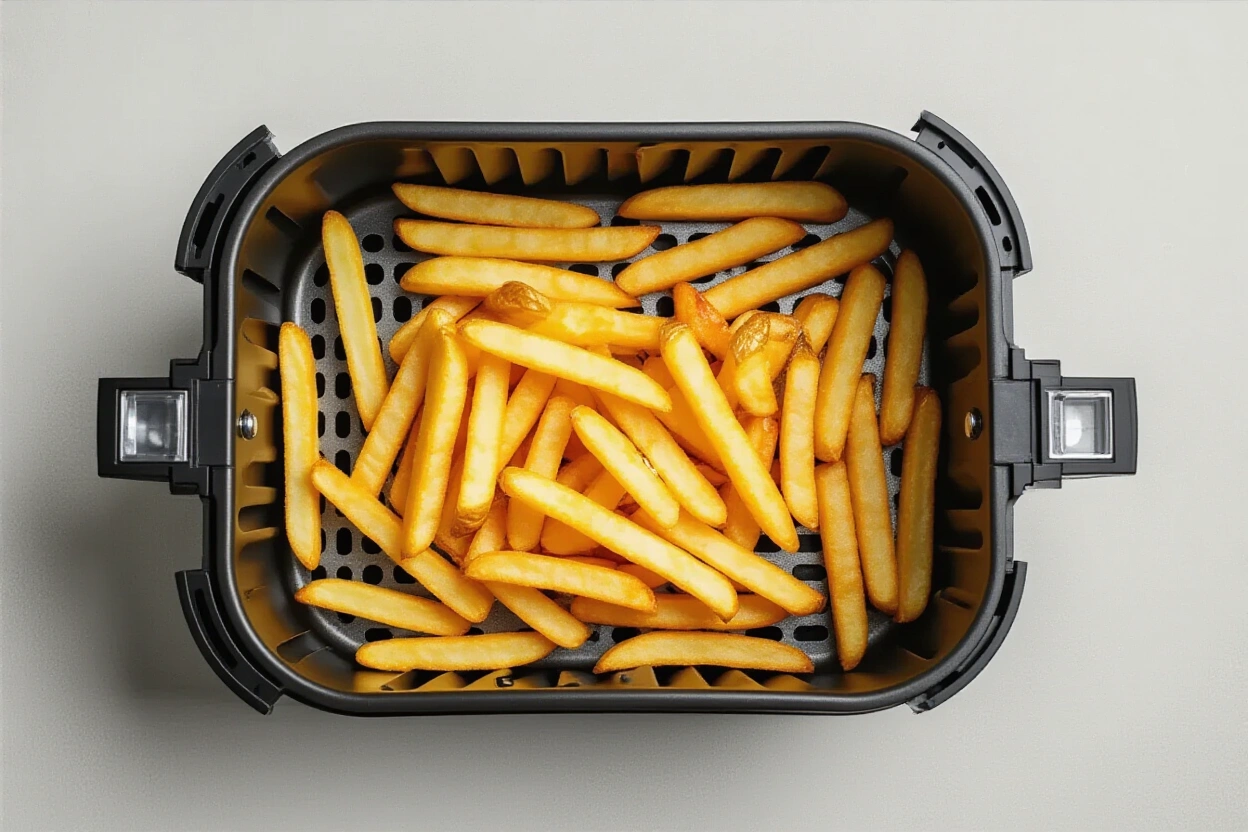
Frozen fries are a useful example. Spread loosely in the basket, they brown more evenly. Piled into a heap, they tend to soften and cook unevenly. The same idea applies to nuggets, onion rings, and breaded snacks.
When stacking is especially risky
Stacking becomes a problem when the food needs dry heat on all sides. Breaded items, small vegetables, and frozen snacks all benefit from open spacing. If you are tempted to pile food up because it “fits,” that is usually the point where batch cooking makes more sense.
How much food to cook at once in different basket sizes
Basket size changes how much food you can load, but the same principle still applies: the basket should not be packed so tightly that airflow stops moving through the food.
A small basket reaches its limit quickly, especially with bulky foods like broccoli florets or battered items. A larger basket gives you more room, but that does not mean it should be filled to the top. The question is not just how much fits; it is how much can cook evenly.
Quick rules of thumb by basket size
A helpful benchmark is how much of the basket base is covered:
- Small baskets: aim for about half to two-thirds of the base covered in a loose layer. If you need to pile food higher than that, it is usually better to split it into two batches.
- Medium baskets: a loose single layer can often cover most of the base, but try to leave visible gaps between pieces. If the food starts to overlap across much of the surface, the basket is getting too full.
- Large baskets: you can usually spread food across a wider area, but the same rule still applies: cover the base in a thin layer, not a thick pile. A broad spread is fine; a mound in the center is not.
Use the basket shape, not just the volume
A wide basket can sometimes hold more food in a single layer than a deeper, narrower basket. That is why two air fryers with the same overall size may perform differently. If your basket has a broad surface, take advantage of it by spreading food outward instead of stacking upward.
A better decision rule than exact measurements
Instead of trying to memorize a number, look for these signs:
- the food sits flat rather than mounded
- pieces are exposed on most sides
- you can shake or toss the basket without everything clumping together
- the basket still has visible open space
If those conditions are not true, the load is probably too large for one batch.
When to batch cook instead of filling the basket
Batch cooking is the simplest fix for overcrowding. It usually takes a little more total time, but it often gives you better texture and more even color.
Choose one batch when:
- the food already fits in a loose single layer
- the pieces are similar in size
- crisping is less important than speed
- you can shake or flip the basket easily
Choose multiple batches when:
- the food overlaps heavily
- the pieces are different sizes
- the food is frozen and releases a lot of moisture
- you want the best possible browning
The trade-off is straightforward: one large batch saves time at the start, but two smaller batches usually cook more evenly. If your first batch comes out better than the second usually does in the oven or on the stovetop, that is a strong sign batch cooking is worth it.
For mixed snacks, like nuggets and fries together, separate batches are often the cleaner choice. The two foods may not brown at the same rate, and crowding them together can make both worse.
Should you shake, toss, or flip food during cooking?
Yes, in many cases. Shaking or flipping helps expose more surfaces to the moving air, which is useful when the basket is not perfectly open or when pieces are likely to brown unevenly.
Foods that benefit most
Shaking or flipping helps most with:
- frozen fries
- nuggets and breaded bites
- onion rings
- small vegetables
- diced or chopped foods
These foods have multiple surfaces that need exposure to crisp well. A quick shake midway through cooking can move darker pieces away from hot spots and bring less-browned pieces closer to the airflow.
When agitation is not enough
Shaking is helpful, but it does not fully fix a crowded basket. If the food is packed tightly at the start, shaking may just rearrange the pile rather than solve the airflow problem. In that case, the better move is to split the load and cook in batches.
A practical habit
If the basket contains small pieces, pause once during cooking and look for clumps. Break them apart gently and spread them back into a looser layer. That simple step often improves the final texture more than extending the cook time.
Foods that are most likely to get soggy when overcrowded
Some foods are more sensitive to crowding than others. These are the ones most likely to disappoint if they are packed too tightly.
Frozen fries
Frozen fries are one of the clearest examples. They usually need room so the surface can dry and crisp. When they are piled up, they can come out limp or unevenly browned.
Nuggets and breaded snacks
Breaded foods can trap steam between pieces if they are stacked. The coating may lose its crisp edge before the inside is fully reheated.
Vegetables
Broccoli, cauliflower, Brussels sprouts, green beans, and similar vegetables often release moisture as they cook. If the basket is crowded, that moisture has nowhere to go, so the vegetables soften instead of roasting.
Mixed foods
Mixed loads are tricky because different ingredients brown at different rates. For example, sausage pieces may brown faster than chopped vegetables, and the vegetables may still be releasing moisture when the meat is already done. Separating them into batches usually gives better control.
Basket-style vs tray-style air fryers: does layout change?
Yes, but the core principle stays the same: hot air needs room to move around the food.
Basket-style air fryers
Basket-style models usually reward a looser, single-layer load. Because the food sits in a deeper basket, it is easier to accidentally pile items on top of one another. That makes spacing especially important.
Tray-style air fryers
Tray-style models can sometimes handle food more like a shallow sheet pan, so they may tolerate a wider spread across the surface without needing as much tossing or reshuffling. That can make them a little more forgiving when food is laid out loosely over a larger area.
But tray-style does not mean “thicker is fine.” Once food is stacked into a pile, airflow still gets blocked. That is especially true for frozen or breaded foods, which need the exposed surface area to dry and crisp. In other words, tray-style setups can usually handle a broader spread, but they still work best in a thin layer rather than a deep heap.
Which layout is easier for beginners?
Tray-style setups can feel more forgiving because the food is easier to see and spread out. Basket-style air fryers, on the other hand, often need more attention when it comes to shaking and rearranging. Neither design eliminates the need for spacing; they just change how you manage it.
If your appliance includes an air fryer rack or multiple levels, resist the urge to overload every surface at once. Multiple layers can work only when each layer still has room for air to move.
Common mistakes that cause uneven or undercooked results
A few loading mistakes show up again and again.
Packing food tightly to save time
This is the most common one. It feels efficient, but it usually creates the least even cooking.
Ignoring moisture from frozen foods
Frozen foods often shed water as they heat. If they are crowded, that moisture stays trapped and softens the surface.
Mixing foods with very different sizes
Small pieces can overcook while larger ones still need time. A crowded basket makes that mismatch worse.
Skipping the shake or flip
If the food stays in one position the whole time, the side facing the basket can brown differently from the side facing the fan.
Assuming more food just means more time
Adding time does not always fix a crowded basket. Sometimes it just dries out the outside while the inside or lower layer stays underdone.
Simple rules of thumb for better air fryer loading
Use these as your everyday checklist:
- Keep food in a loose single layer when crisping matters.
- Leave visible space between pieces when possible.
- If the food is stacked, separate it into batches.
- Shake, toss, or flip foods with multiple small surfaces.
- Be extra cautious with frozen foods and vegetables.
- Separate mixed foods if they brown at different rates.
- If the basket looks packed before cooking starts, it is probably too full.
A useful final test: if you would need to press the food down to close the basket comfortably, it is time to remove some of it.
FAQs
How full can I fill an air fryer basket?
Fill it only as far as the food can stay in a loose layer with enough open space for air to move around it. If the food is mounded or tightly packed, it is too full.
Can I cook in layers if I shake halfway through?
Sometimes, but it is less reliable than a single layer. Shaking helps redistribute food, but it does not fully replace open spacing at the start.
Why do my air fryer fries come out soggy?
They are often crowded or left in a pile. Fries need space so moisture can escape and the surface can crisp.
Do vegetables need more space than frozen snacks?
Often, yes. Many vegetables release moisture as they cook, so crowding them can make them steam instead of roast.
Is a tray-style air fryer easier to load evenly?
Usually, yes, because the food is easier to spread out. Still, the same rule applies: avoid piling food into the center.
What should I do if I need to cook a lot at once?
Split the food into two or more batches. That usually gives better browning and more even cooking than trying to force everything into one crowded load.
If you want to keep improving your results, it also helps to understand how the basket itself affects cooking and cleaning. You can read more about what to check before washing an air fryer basket and how to choose the right replacement basket fit.

