
How to Bake Muffins in an Air Fryer: A Practical Guide for Better Results
Air fryers can make muffins efficiently, but they also bake differently from a conventional oven. The hot air moves quickly, the space is smaller, and tops can brown before the centers are fully set. Once you understand those differences, the method becomes straightforward.
Here is the fastest practical starting point: use a slightly lower temperature than you might use in a standard oven, fill the cups only partway, and begin checking early. If the tops are browned and the center springs back lightly, you are close. If a toothpick still comes out wet, give the muffins a little more time rather than raising the heat.
For a reliable first batch, think in terms of a range, not a fixed rule. Every air fryer model behaves a little differently, especially between basket-style and oven-style units. If you want a deeper reference for muffin structure and mixing, our guide on why overmixing makes muffins tough is a helpful companion.
Quick Answer: Air Fryer Muffin Basics
If you want the simplest possible method, use these decision points:
- Choose a muffin recipe that is not overly delicate.
- Preheat if your model tends to cook unevenly or if the recipe benefits from a hot start.
- Use muffin liners, silicone cups, or a small muffin pan that fits with space around it.
- Fill each cup about two-thirds to three-quarters full.
- Bake at a moderate air fryer temperature, then check early and often.
- Pull the muffins when a toothpick comes out clean or with a few moist crumbs, not wet batter.
A practical starting point for most muffins is 325°F to 350°F in the air fryer. In many models, that means:
- Mini muffins: about 8 to 12 minutes
- Standard muffins: about 12 to 18 minutes
- Jumbo muffins: about 18 to 24 minutes
These are starting ranges, not guarantees. Basket-style air fryers often finish on the faster side, while oven-style units may need a little more time because they behave more like a small convection oven.
That last point matters more than the clock. In an air fryer, a muffin can look done on top while still being soft in the center. A few extra minutes at a gentler temperature usually gives a better result than blasting the heat and hoping the middle catches up.
What You Need: Muffin Cups, Pans, and Batter Setup
The container matters almost as much as the batter.
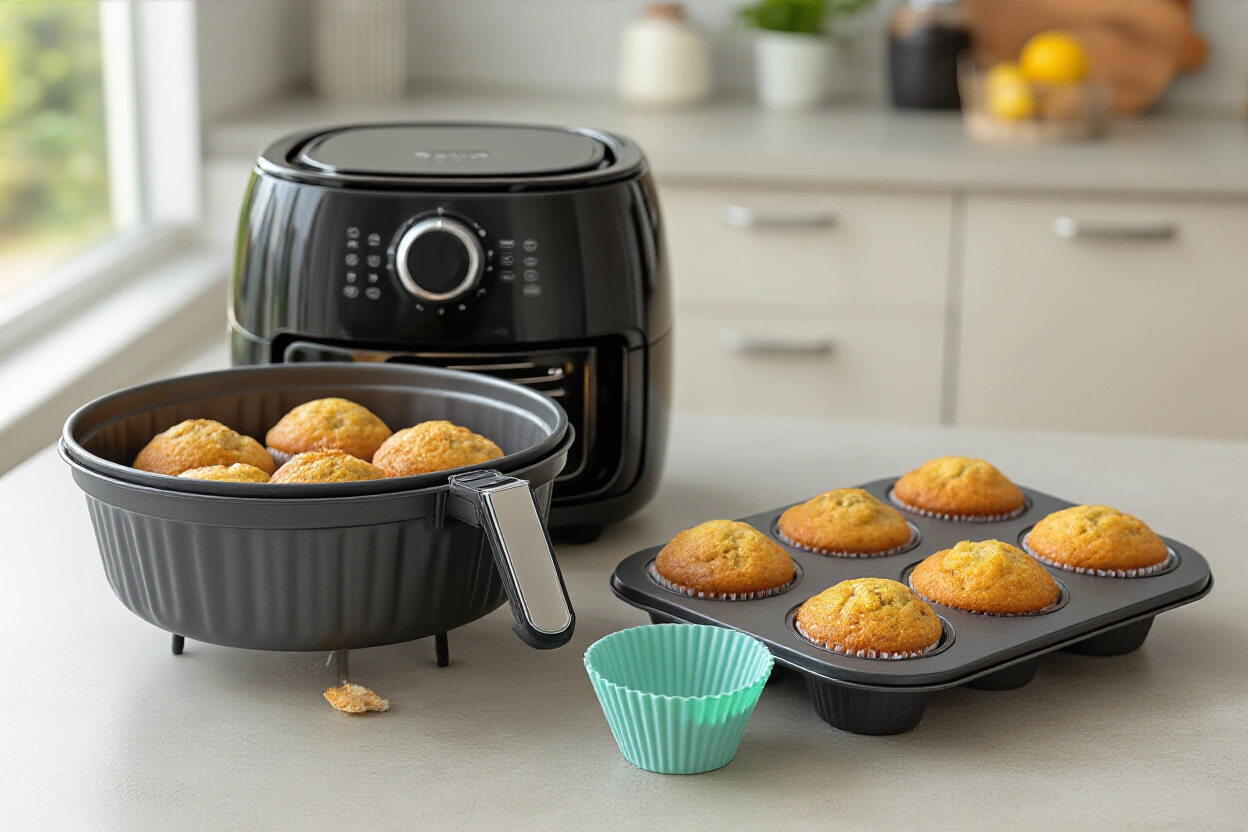
Paper liners
Paper liners are convenient and make cleanup easier, but they are not always the best choice in every air fryer. If the batter is light, liners usually work well. If the batter is greasy or the muffin top is tall and exposed to strong airflow, liners can brown quickly at the edges.
Silicone muffin cups
Silicone cups release easily and are useful for small batches. They also hold their shape well in compact air fryers. The trade-off is that silicone insulates the batter a bit, so browning may be softer and the bake can take a little longer than with metal.
Metal muffin pan
A metal muffin pan often gives the most familiar muffin structure because it conducts heat efficiently. It is a strong choice when the pan fits the basket or oven tray without crowding. The downside is that a pan that is too large can block airflow and leave the centers underbaked.
Quick comparison: which one works best?
- Paper liners: best for easy cleanup; decent airflow; can brown fast at the edges; release is easy if the muffin is fully baked.
- Silicone cups: best for easy release and small batches; slightly slower browning; airflow is decent if the cups are not packed tightly.
- Metal muffin pans: best for even structure and browning; airflow depends on fit; release is easiest if greased well or lined.
The practical rule is simple: use the smallest bakeware that still supports the batter neatly and leaves room for air to move around it. If the air fryer feels packed, the muffins usually bake less evenly.
Step-by-Step: How to Bake Muffins in an Air Fryer
1) Prepare the batter
Mix the batter just until the dry ingredients are moistened. Muffins are more forgiving when the batter is slightly uneven than when it is overmixed. If you see a few streaks of flour, that is often better than stirring until the batter looks perfectly smooth.
2) Set up the cups or pan
Place liners in a muffin pan, or set silicone cups on a stable tray or in a pan that fits your air fryer. If you are using individual cups, make sure they can sit flat. A wobbly setup can spill batter and bake unevenly.
3) Preheat when needed
Preheating is recommended in most cases for muffins, especially if you want more predictable rise and browning. It matters most when:
- your air fryer heats unevenly at the start,
- you are baking standard or jumbo muffins,
- or you want the first batch to match the rest of the batch more closely.
Some air fryers can still bake muffins well without a preheat, but the first batch may come out a little denser or less evenly browned. If your model runs very aggressively, a short preheat may help the bake start more consistently, but results still depend on the specific machine.
4) Fill the cups correctly
Spoon batter into each cup without overfilling. Leave room for rise, especially if your recipe includes baking powder or baking soda and a generous amount of fruit, chocolate, or nuts.
5) Bake and monitor
Place the pan in the air fryer with enough clearance around it for air circulation. Bake until the muffins are set and lightly browned. If your air fryer has hot spots, rotate the pan partway through.
6) Cool before removing
Let the muffins sit briefly before lifting them out. This helps the crumb set and reduces the chance of tearing the bottoms or sides.
If you want to save extra muffins for later, our guide on how to store muffins without getting soggy covers the cooling and container choices that keep texture better.
How to Choose the Right Temperature and Bake Time
There is no single temperature that works perfectly for every air fryer, but there is a useful pattern: air fryers usually need a gentler bake than a conventional oven for muffins, because the circulating heat is concentrated and can brown the tops quickly.
A practical starting approach:
- Use a moderate temperature rather than the hottest setting.
- Check earlier than you would in an oven.
- Lower the temperature if the tops are dark before the centers are set.
- Extend the bake time in small increments if the muffins are pale but still wet in the middle.
Here is a more practical starting guide:
| Muffin type | Starting temperature | Approximate bake time | Best fit |
|---|---|---|---|
| Mini muffins | 325°F to 340°F | 8 to 12 minutes | Basket-style or oven-style units with small cups |
| Standard muffins | 325°F to 350°F | 12 to 18 minutes | Most recipes and most bakeware |
| Jumbo muffins | 315°F to 335°F | 18 to 24 minutes | Best in oven-style units or well-fitting pans |
Basket-style air fryers often brown faster because the heat is compact and direct. For that reason, start near the lower end of the range if you are using a basket model. Oven-style models may fit more muffins, but the baking can feel closer to a small convection oven and may need a little more time. Treat any recipe time as a starting range, not a promise.
How Full to Fill Muffin Cups
A common mistake is filling muffin cups as if they were cake pans. Muffins need room to rise without spilling over.
For most standard muffins, fill cups about two-thirds to three-quarters full. That usually gives enough batter for a rounded top without overflow. Mini muffins need less batter, and jumbo muffins need more careful timing rather than more filling.
A more specific starting point:
- Mini muffins: fill about half to two-thirds full
- Standard muffins: fill about two-thirds to three-quarters full
- Jumbo muffins: fill about three-quarters full, but avoid going higher unless the recipe is very low-rise
The fill level affects three things:
- Rise — too full, and the batter can spill or form a lopsided dome.
- Texture — too little batter, and the muffins may dry out before they develop a proper top.
- Even baking — consistent filling helps all the muffins finish at the same time.
If your recipe includes chunky add-ins like blueberries or chocolate chips, keep the fill level slightly conservative. Those mix-ins can push batter upward in unpredictable ways.
How to Tell When Air Fryer Muffins Are Done
The best doneness check is still the simplest one: insert a toothpick into the center. If it comes out clean or with a few moist crumbs, the muffin is usually ready. Wet batter means it needs more time.
Use these additional cues:
- The top springs back lightly when touched.
- The edges look set and pull slightly from the cup.
- The surface is no longer glossy or wet-looking in the center.
- The muffin feels light but not fragile when lifted.
Do not rely on color alone. Air fryer muffins can brown quickly, especially on top, while the middle remains soft.
If the tops brown too fast
If the tops are getting too dark before the centers are done:
- lower the temperature by about 10°F to 25°F,
- move the pan to a slightly lower rack position if your model allows it,
- and cover the tops loosely with foil for the rest of the bake.
The goal is to slow browning without trapping too much steam.
If the centers stay wet
If the tops look finished but the center still feels loose:
- keep baking at a lower temperature rather than raising the heat,
- add time in short checks of 2 to 4 minutes,
- and make sure the pan is not crowding the basket or tray.
If the muffins are already dark on top, a lower temperature and a loose foil cover are usually better than trying to finish them with more intense heat.
How to Prevent Overbrowning and Uneven Baking
Overbrowned tops and underdone centers are the most common air fryer muffin problem. The fix is usually not complicated.
Lower the heat before extending the time
If the tops are darkening too fast, reduce the temperature rather than simply cutting the bake short. A gentler bake gives the center time to set.
Rotate the pan
If your air fryer has hot spots, turn the pan once during baking. This is especially useful in basket-style units or older models that brown unevenly from front to back.
Cover loosely if needed
If the tops are getting too dark before the centers are done, a loose piece of foil can help. Keep it secure and avoid blocking airflow more than necessary. The goal is to slow browning, not trap steam.
Use the right pan size
A pan that blocks too much of the basket or tray can reduce airflow and create pale, gummy centers. The fit should leave breathing room around the sides and above the pan where possible.
These fixes work best when used early. Once the tops are deeply browned, the muffins may already be close to dry.
Adjustments for Mini, Standard, and Jumbo Muffins
Muffin size changes the bake in a meaningful way.
Mini muffins
Mini muffins bake quickly and are often the easiest size for air fryer success. They are a good choice if you want speed or if your air fryer tends to run hot. Because they finish fast, they also need earlier checking. Start around 325°F to 340°F and begin checking near the 8-minute mark.
Standard muffins
Standard muffins are the most familiar size and usually the easiest to adapt from a regular recipe. They give you a good balance of rise, crumb, and bake time. Start around 325°F to 350°F and check around 12 minutes, then continue if needed.
Jumbo muffins
Jumbo muffins are the most likely to have a browned top and a soft center. They need the most attention because the batter depth is greater. If you make jumbo muffins in an air fryer, use a gentler bake, start around 315°F to 335°F, and expect a longer finish time.
A useful rule: the larger the muffin, the more you should favor lower heat and patience over speed.
Adapting a Regular Oven Muffin Recipe for the Air Fryer
Most conventional muffin recipes can be adapted, but not all without adjustment.
Here is the practical conversion process:
- Keep the ingredient list the same at first.
- Reduce the batch size if the air fryer basket or tray is small.
- Use a pan or cups that fit without crowding.
- Bake at a gentler temperature than your oven recipe would use.
- Check early, then continue in short increments if needed.
For most regular oven muffin recipes, the best first attempt is to keep the formula as written and adjust only the bake setup:
- Batch size: make fewer muffins per batch if needed so air can circulate.
- Fill level: stay near two-thirds to three-quarters full for standard muffins.
- Temperature: reduce the oven temperature by about 25°F as a starting point.
- Time: expect the bake to be a little shorter for mini muffins and similar to slightly shorter for standard muffins, but not always shorter for jumbo muffins, which often need extra time to finish in the center.
If the recipe is very wet, very dense, or packed with fruit, it may need a little more time. If it is a light, delicate batter, it may brown faster than expected. That is why the first batch should be treated as a test batch.
A standard 12-cup oven recipe can often be split into smaller air fryer batches. That may feel less efficient at first, but it usually gives better texture than trying to force too much batter into one crowded bake.
Basket-Style vs Oven-Style Air Fryers: What Changes
Basket-style and oven-style air fryers both use rapid hot air, but they behave differently with muffins.
Basket-style air fryers
These are compact and often heat aggressively. They are good for small batches and mini muffins. Because the heat is concentrated, they can brown muffin tops quickly. Rotation and careful temperature control help.
Oven-style air fryers
These usually offer more space and can fit a small muffin pan more comfortably. They are often better for baking several muffins at once. The trade-off is that they may bake more like a convection oven, so the timing can be slightly longer and less intense.
The decision comes down to batch size and airflow. If the pan fits loosely and heat can move around it, the muffins usually bake more evenly.
Common Mistakes to Avoid
A few errors show up again and again with air fryer muffins:
- Using oven timing without adjustment. Air fryer heat is more concentrated.
- Overfilling the cups. That leads to overflow and uneven domes.
- Crowding the basket or tray. Muffins need space for air circulation.
- Skipping the doneness test. Color alone is not enough.
- Using a pan that blocks airflow. A too-large pan can cause gummy centers.
- Ignoring model differences. One air fryer may run much hotter than another.
- Removing the muffins too soon. A pale center often needs a few more minutes even if the top looks ready.
The easiest way to avoid wasted batches is to make one small test batch and adjust from there.
Cooling, Storing, and Reheating Muffins
Let muffins cool briefly in the pan or cups before moving them to a rack. This helps the crumb set and keeps the bottoms from turning soggy. Once they are cool, store them in a container that matches how soon you plan to eat them.
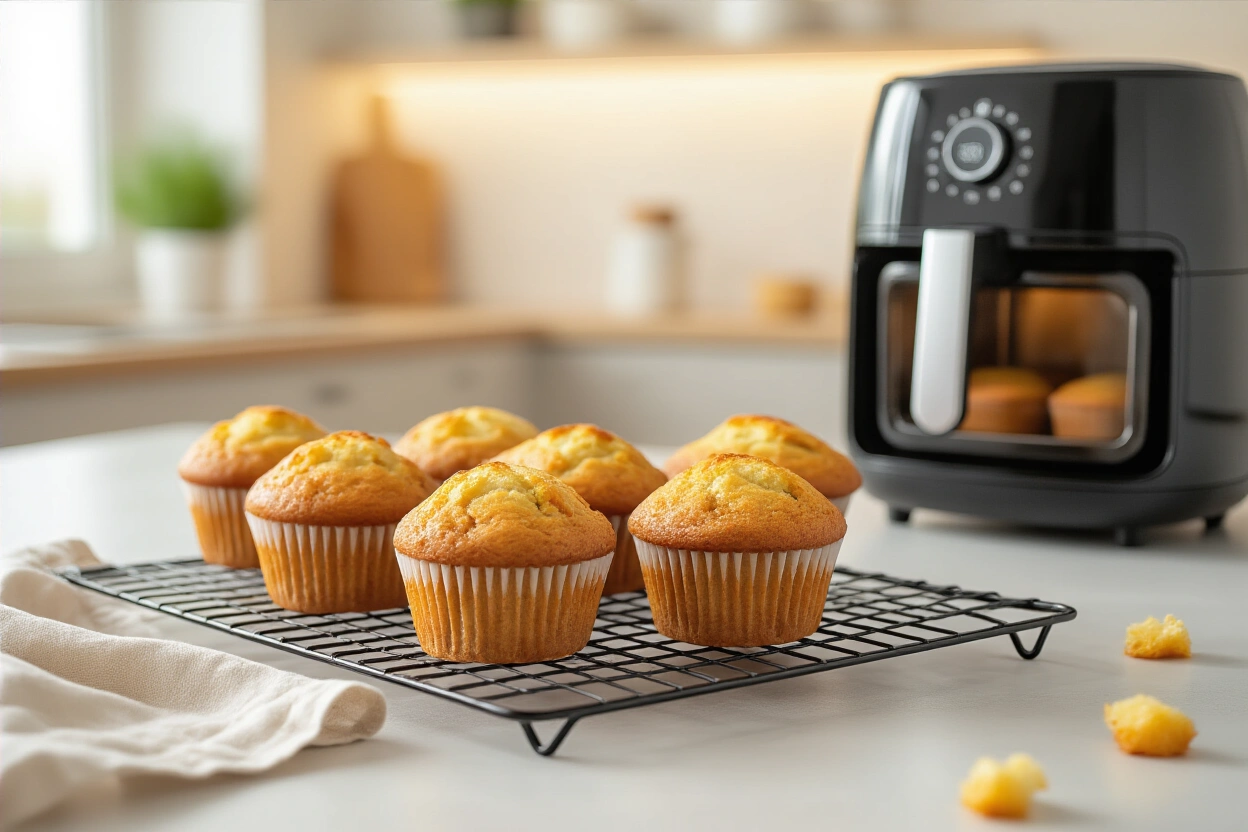
For same-day eating, room temperature storage is usually enough. For longer keeping, freezing is often the better choice because it preserves texture more reliably than holding muffins too long on the counter. If you want a detailed make-ahead method, see our guide on how to freeze muffins for meal prep without losing texture.
To reheat, use a gentle approach so the exterior does not dry out before the center warms. A short reheat is usually better than a long one.
Conclusion
Baking muffins in an air fryer works well once you respect the differences in heat, airflow, and pan size. Use a moderate temperature, avoid overfilling, and check for doneness with more than one cue. If the tops brown too quickly, lower the heat or cover loosely. If the centers stay soft, give the muffins a little more time rather than assuming the color tells the whole story.
With a few small adjustments, your regular muffin recipes can become reliable air fryer bakes.
FAQ
What temperature do you bake muffins in an air fryer?
A practical starting range is 325°F to 350°F for most standard muffins. Mini muffins often do well at the lower end of that range, while jumbo muffins usually need a slightly lower temperature and more time.
How long do muffins take in an air fryer?
As a starting point, expect about 8 to 12 minutes for mini muffins, 12 to 18 minutes for standard muffins, and 18 to 24 minutes for jumbo muffins. Always check early because air fryer models vary.
Do you need to preheat an air fryer for muffins?
Usually yes, preheating is recommended. It helps the muffins rise and brown more evenly, especially in basket-style units or any model that heats unevenly at the start. It matters less for some oven-style units, but it can still improve consistency.
Can I use a regular muffin recipe in the air fryer?
Yes, most regular muffin recipes work with only small adjustments. The usual changes are a slightly lower temperature, a smaller batch if space is limited, and earlier doneness checks.
Why are my muffin tops browning before the centers are done?
That usually means the temperature is too high for your model or the muffins are too close to the heating element. Lower the temperature, cover the tops loosely with foil, and keep baking until the center is set.
What is the easiest muffin container to use in an air fryer?
For easy release, silicone cups are convenient. For more familiar browning and structure, a small metal muffin pan often gives the best results if it fits without crowding. Paper liners are the easiest for cleanup, but they may brown faster at the edges.
How full should muffin cups be?
For standard muffins, fill cups about two-thirds to three-quarters full. Mini muffins usually need a little less, and jumbo muffins usually need careful timing rather than extra filling.
Can I bake jumbo muffins in an air fryer?
Yes, but they are the most likely to brown early on top while staying soft in the middle. Use a gentler temperature, check carefully, and expect a longer bake time.

