
How to Convert Oven Baking Time to Air Fryer Time Without Guesswork
If you already trust an oven recipe, converting it for an air fryer is mostly about respecting two differences: stronger airflow and a smaller cooking space. Those two factors usually mean faster browning and a shorter bake, but not always in the same way for every recipe.
The safest approach is to treat the oven recipe as a starting point, then adjust in small steps. For most baked foods, that means lowering the temperature a little, shortening the time, and checking doneness earlier than the recipe says. The exact adjustment depends on whether the original recipe was written for a conventional oven or a convection oven, plus the size and shape of the food.
Quick Answer: The Basic Oven-to-Air-Fryer Conversion Rule
For a conventional oven recipe, a practical starting point is to reduce the temperature and shorten the bake time. A common rule of thumb is to start by lowering the oven temperature by about 25°F and reducing the bake time by about 20% to 25%, then checking early.
That is not a universal formula, but it is a useful first pass when you want a fast conversion without a lot of trial and error. The exact amount depends on the recipe, the pan, and the air fryer model. Foods that brown quickly, such as cookies and muffins, often need the most careful timing.
If the recipe was already written for a convection oven, the change is usually smaller. Convection ovens already use moving air, so an air fryer may need only a modest adjustment.
A simple working rule:
- Conventional oven recipe: start with about 25°F lower and 20% to 25% less time
- Convection oven recipe: start with about 0°F to 15°F lower and 10% to 15% less time, then check early
- Any recipe in an air fryer: start checking doneness before the original bake time ends
How Air Fryers Bake Differently Than Conventional Ovens
An air fryer is not just a tiny oven with a different name. The cooking chamber is smaller, the fan is stronger, and the food sits closer to the heat source. That changes how quickly the surface browns and how evenly heat reaches the center.
In a conventional oven, hot air circulates more slowly and the larger cavity buffers temperature swings. In an air fryer, the compact space can cook food faster, especially on the top and edges. That is useful when you want speed, but it can also create a familiar problem: the outside looks done before the inside is fully set.
That difference explains why a straight copy of oven time often fails. A cookie tray that bakes evenly in the oven may brown too deeply in the air fryer if left unchanged. A loaf pan may look finished on top while the center still needs time.
The smaller chamber also means pan size matters more. A pan that fits an oven easily may block airflow in an air fryer basket or toaster-oven style unit, which can lead to pale spots or uneven baking.
How to Convert Temperature and Time Step by Step
Use this as a practical decision process rather than a rigid formula.
1) Identify the original oven type
First, check whether the recipe says conventional oven or convection oven.
- If it says conventional oven, plan on a more noticeable adjustment.
- If it says convection oven, the recipe is already closer to air fryer behavior.
This distinction matters because convection already relies on fan-driven airflow. Treating a convection recipe like a conventional one usually causes overcorrection.
2) Start with a temperature and time adjustment based on the recipe type
A useful starting formula is:
- Conventional oven recipe: reduce temperature by about 25°F and cut time by about 20% to 25%
- Convection oven recipe: reduce temperature by 0°F to 15°F and cut time by about 10% to 15%
- Very small portions or thin items: you may need less temperature change and more time reduction
- Deep, dense, or wet batters: keep the temperature conservative and avoid aggressive time cuts
For example, if a conventional oven recipe bakes for 30 minutes, a reasonable first test in an air fryer might be around 22 to 24 minutes at 25°F lower. If the recipe already uses convection, the starting point might be closer to 26 to 27 minutes with only a small temperature reduction, if any.
3) Adjust more carefully for the food category
Different baked goods need different starting moves:
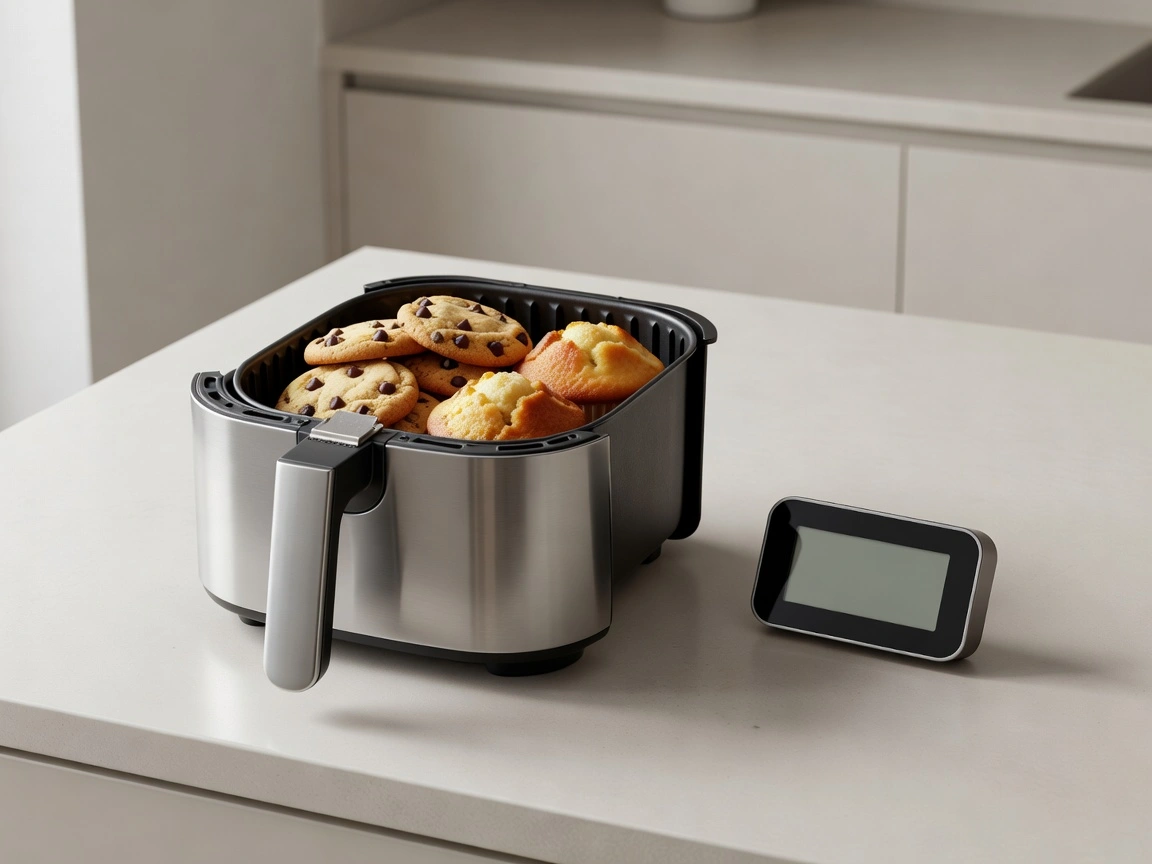
- Cookies: often need the full time cut, with early checking because edges brown quickly
- Muffins: usually do well with a moderate temperature drop and a modest time cut
- Brownies: often need a gentler temperature change and a smaller pan rather than a dramatic time cut
- Cakes: reduce time cautiously; very deep or large cakes may not convert well
- Bread and rolls: usually need less aggressive temperature reduction than cookies, but batch size matters
- Casseroles: use a shallow dish and expect to reduce time more than temperature if the dish is small
4) Reduce the time, but not all at once
Air fryer baking often needs a shorter cook time, but cutting too much can leave the middle raw or gummy. A better method is to reduce the time conservatively, then check early and add more time if needed.
That approach gives you control. If the top is coloring too fast, you can cover it loosely with foil or move to a slightly lower position if your model allows it.
5) Check early and in stages
Do not wait for the original oven timer to finish. Start checking earlier than you would in the oven, especially for small baked goods.
For example:
– cookies may need attention well before a standard oven bake ends
– muffins and brownies often need earlier checks at the center
– quick breads may need a gentler heat and a longer finish than cookies, even in an air fryer
The key is to treat time as a range, not a promise.
Conventional Oven vs. Convection Oven Recipes
This is where many conversions go wrong.
A conventional oven recipe was written for stiller air and a larger cooking cavity. It usually needs both a temperature adjustment and a time adjustment in an air fryer.
A convection oven recipe already assumes moving air. That means it may convert more easily, but it still needs caution because an air fryer’s fan is often stronger and the space is smaller.
A practical conversion rule for convection recipes is:
- start with little or no temperature change
- reduce the bake time by about 10% to 15%
- check early, especially for browning on top
Think of it this way:
- Conventional oven to air fryer: bigger change
- Convection oven to air fryer: smaller change, but still not identical
If a recipe already says to use convection, do not automatically apply the full “oven to air fryer” adjustment again. That can push the food too far in the other direction.
For readers who want a related conversion method, the same logic used for fan ovens can help here too. If you already know how to adapt a fan oven recipe, you are halfway to understanding air fryer baking. You can compare the logic with how to convert fan oven temperatures for baking.
Conversion Chart for Common Baked Foods
Use this chart as a starting reference, not a final rule. The best result depends on the size of the portion, the pan used, and your specific air fryer model.
| Baked food | Best starting approach | What to watch for |
|---|---|---|
| Cookies | Lower by about 25°F and cut time by about 20% to 25%; bake in small batches | Edges brown fast before centers set |
| Muffins | Lower by about 15°F to 25°F and cut time by about 15% to 20%; avoid overcrowding the pan | Tops can brown before the middle is done |
| Brownies | Lower by about 15°F to 25°F and cut time by about 10% to 20%; use a shallow pan | Center may look set before it is fully baked |
| Cakes | Lower by about 25°F and cut time by about 10% to 20%; small, shallow cakes work better than deep ones | Surface browning before the middle finishes |
| Bread | Lower by about 15°F to 25°F and cut time by about 10% to 15%; keep loaves small or use rolls | Bottom can color before the interior is ready |
| Casseroles | Lower by about 25°F and cut time by about 15% to 25%; use a shallow dish and smaller batch size | Edges may overcook before the center heats through |
A few practical examples
- Cookies: Good air fryer candidates because they are small and portioned. The main risk is overbrowning.
- Brownies: Usually work well in a smaller pan, but the center needs careful checking.
- Muffins: Often bake evenly if the pan is not overcrowded.
- Large cakes: More difficult, because a deep batter can brown on top while staying underdone inside.
- Casseroles: Work best in smaller portions rather than a full deep dish.
If you need a comparison point for pan behavior, the same logic that helps with dark metal pans also applies here: faster browning often means you need more caution with heat and timing. That is why a separate guide on how to adjust baking time for a dark metal pan can be useful when you are troubleshooting browning in any fast-cooking setup.
How to Check Doneness in an Air Fryer
Time is only a clue. Doneness is the real test.
Use the right doneness cue for the food
- Cookies: edges should be set; centers may still look slightly soft if the recipe is designed that way
- Brownies: a toothpick should come out with moist crumbs, not wet batter
- Muffins: tops should spring back lightly when touched
- Quick breads: a tester inserted into the center should come out mostly clean
- Cakes: the center should feel set, and a tester should not show raw batter
- Custard-style or egg-based items: use an internal temperature check when appropriate, because appearance alone can be misleading
Check earlier than you think
Air fryers can go from “almost done” to “too dark” quickly. Start checking before the recipe’s original oven time ends. If the outside is browning too fast, lower the temperature slightly on the next batch rather than simply shortening the time more.
Rotate or reposition if needed
Some air fryers cook more strongly at the back or on one side. If your model tends to brown unevenly, rotate the pan or basket contents partway through baking. Shaking is useful for small items, but not for batters or anything that needs to stay level.
Pan Size, Batch Size, and Airflow Rules
Airflow is the engine behind air fryer baking. If you block it, performance drops.
Use a pan that leaves space around the food
A pan that fits too tightly can slow circulation and create uneven results. Leave enough room for air to move around the pan or between portions.
That matters most for:
– muffin pans
– loaf pans
– small cake pans
– casserole dishes
Bake in smaller batches when possible
Smaller batches usually bake more evenly than one crowded batch. This is especially true for cookies and bread rolls, where spacing helps the surface brown without steaming the dough.
Match the food to the appliance style
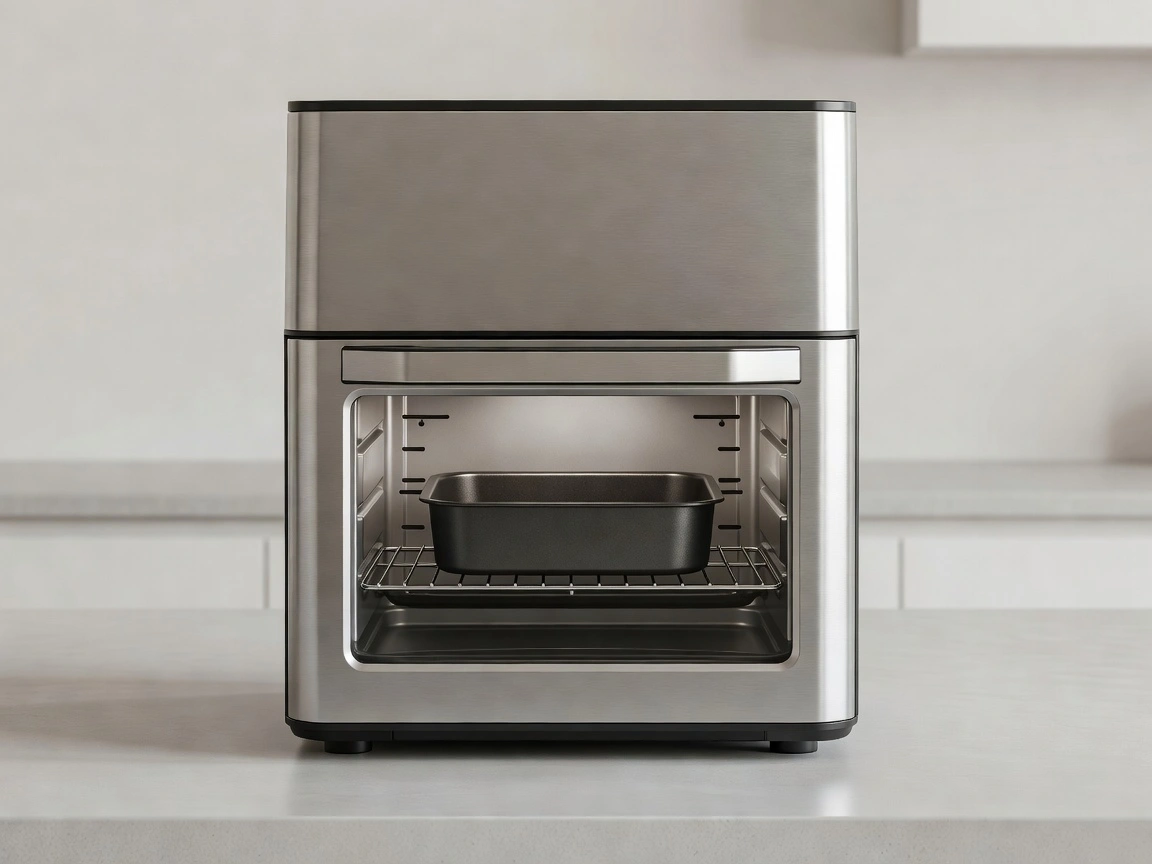
A basket-style air fryer usually works best for smaller pans and portioned foods. A toaster oven air fryer often gives you more room for shallow pans and better control for baked dishes.
If you are deciding between the two styles for a recipe, the toaster-oven format is often easier for casseroles, small cakes, and loaf-style bakes. The basket style is usually simpler for cookies, muffins, and small batches.
When to Preheat the Air Fryer
Preheating helps most when the recipe depends on quick surface setting or even initial rise.
It is especially useful for:
– cookies
– muffins
– brownies
– small cakes
– items where you want a consistent start
You can often skip preheating for denser or longer-baking items if the recipe is forgiving, but the first few minutes may behave differently than the rest of the bake. If you want the most repeatable results, preheat consistently and treat it as part of the recipe.
A practical habit is to preheat when you want repeatable results, then keep that step consistent from batch to batch. That way, if something goes wrong, you know the issue was probably the recipe conversion rather than the starting temperature.
FAQ
Should I preheat?
Usually yes, especially for cookies, muffins, brownies, and small cakes. Preheating gives you a more predictable starting point and helps the food set and brown more evenly. You can sometimes skip it for denser or longer-baking items, but the timing may be less consistent.
Do all air fryers cook the same way?
No. Air fryers vary by model, wattage, basket shape, fan strength, and how close the food sits to the heating element. That means two air fryers can produce different results even with the same recipe. Use the conversion rule as a starting point, then adjust based on your own machine.
What if the recipe already uses convection?
Start with a smaller adjustment than you would for a conventional oven recipe. In many cases, that means little or no temperature change and about 10% to 15% less time. Check early, because an air fryer can still brown faster than a convection oven.
Common Air Fryer Baking Mistakes to Avoid
Using the oven time unchanged
This is the biggest mistake. Even if the recipe looks simple, the air fryer usually needs a shorter bake.
Cutting the time too aggressively
Trying to save time can backfire. If the center is still wet, the outside may already be too dark by the time you catch it.
Ignoring pan depth
A shallow pan bakes differently from a deep one. Deep batters need more caution because the top can set before the center does.
Overcrowding the basket
Crowding blocks airflow and creates uneven browning. If food needs space in the oven, it usually needs even more space in an air fryer.
Checking too late
By the time the surface looks deeply browned, the food may already be overdone. Check early, especially with sugar-heavy batters and small portions.
Which Recipes Convert Well and Which Need Caution
Some recipes are naturally better suited to air fryer baking.
Usually convert well
- cookies
- muffins
- brownies in smaller pans
- rolls
- small quick breads
- single-serve or small-batch casseroles
These foods are relatively small and cook in a more uniform shape.
Need caution
- large cakes
- very wet batters
- deep casseroles
- recipes with delicate tops that brown quickly
- anything that fills the pan too deeply
The issue is usually not whether the food can cook at all. It is whether the outside and inside will finish at the same pace. The more depth and moisture a recipe has, the more carefully you need to manage temperature and time.
Practical Examples: Converting Real Recipes
Example 1: Chocolate chip cookies
A conventional oven cookie recipe is one of the easiest conversions. Lower the temperature modestly, shorten the bake, and check early.
What to expect:
– faster browning
– slightly crisper edges
– a shorter window between underbaked and overbaked
If the first batch spreads too much or colors too fast, reduce heat a little on the next round.
Example 2: Brownies in a square pan
Brownies often work well in an air fryer if the pan is small enough. Use a shallow pan and check the center with a toothpick before the recipe’s original oven time ends.
If the top looks done but the tester still shows wet batter, continue in short increments. Brownies are a good example of why visual cues and tester results matter more than the clock.
Example 3: Muffins
Muffins usually adapt well because they are portioned and relatively small. A muffin pan that fits the appliance can help them bake evenly.
Watch for:
– domed tops that brown quickly
– centers that need a little more time than the tops suggest
Example 4: Quick bread
Quick bread is where many beginners get surprised. The top may brown early while the center lags behind.
If that happens, lower the temperature slightly next time and consider a smaller loaf pan or a shorter loaf. Quick bread rewards patience more than speed.
Simple Troubleshooting Adjustments
If the top browns too fast and the center is still underdone:
– lower the temperature a little next time
– use a smaller or shallower pan
– check earlier
– cover loosely with foil if the model and recipe allow it
If the food is pale but cooked through:
– increase the temperature slightly next time
– give it a little more time
– make sure the pan is not blocking airflow
If the edges are done but the middle is not:
– reduce the batch size
– use a shallower pan
– avoid overcrowding
– give the center a longer finish at a slightly lower heat
If results vary from batch to batch:
– preheat consistently
– keep pan size the same
– place food in the same position each time
– note whether your model has hot spots
When to Consult a Pastry Chef
If you are adapting a delicate cake, a custard-based dessert, or a recipe with a very specific structure, a pastry chef or experienced baking instructor can help you judge whether the recipe is a good air fryer candidate at all. Some formulas are forgiving; others are not.
That is especially true when the recipe depends on precise texture, such as a tender crumb, a set custard, or a batter that rises in a very specific way. In those cases, the best conversion may be a small test batch rather than a full-scale attempt.
Final Takeaway
The best way to convert oven baking time to air fryer time is to think in terms of starting adjustments, not exact swaps. Lower the temperature when needed, shorten the bake conservatively, and check doneness early. Then use the food itself—its color, texture, and tester results—to decide whether it needs more time.
Once you understand how your air fryer handles heat, you can adapt familiar recipes with much less guesswork.

