How to Fix Brownies That Are Too Gooey in the Middle: A Practical Baking Guide
Brownies with a soft center are not automatically a problem. In some recipes, that dense, moist middle is exactly what you want. The challenge is knowing when the center is pleasantly fudgy and when it is simply underbaked.
A simple rule helps: when you remove brownies from the oven, the center should look set around the edges and only slightly soft in the middle, not wet, shiny, or batter-like. If it still looks like uncooked batter, it needs more time.
If you just pulled a pan from the oven and the middle looks wet, shiny, or almost batter-like, don’t panic. In many cases, the batch can still be saved. The key is to diagnose the texture before you decide whether to cool, bake longer, or repurpose the brownies.
How to Tell If Brownies Are Underbaked or Just Fudgy
A properly fudgy brownie should feel dense and soft, but not raw. When you press the center gently, it may yield, yet it should not slosh or wobble like liquid. The surface often looks set, and a toothpick inserted near the center comes out with moist crumbs rather than wet batter.

Underbaked brownies usually show a different pattern:
- The center looks glossy and wet, not just moist.
- The middle may jiggle like a loose custard.
- A toothpick comes out coated with batter, not crumbs.
- The brownies feel fragile enough to collapse when cut.
A fudgy brownie can be soft in the middle and still fully baked. The difference is that fudgy texture is dense and cohesive, while underbaked texture is unstable and wet.
| Texture clue | Likely fudgy brownie | Likely underbaked brownie |
|---|---|---|
| Center appearance | Matte or slightly glossy, but set | Shiny, wet, or batter-like |
| Toothpick test | Moist crumbs | Wet batter or thick smear |
| Feel when pressed | Soft but firming up | Jiggly or sloshy |
| Cutting result | Clean-ish squares after cooling | Smears, sinks, or falls apart |
| Final texture after cooling | Dense and rich | Still sticky or raw in the center |
A useful rule: if the brownies look soft but coherent, cooling may be enough. If the center still behaves like uncooked batter, they need more oven time.
What to Do Right Away If the Middle Is Too Gooey
Your first decision is whether the brownies are still in the pan and warm, already cooled, or already cut into pieces. That matters because heat rescue works best while the pan is still hot.
Quick rescue decision tree
- Underbaked and still warm: return the pan to the oven and bake in short intervals.
- Underbaked but cooled: rewarm the whole pan briefly if possible, then continue baking; if the edges are already delicate, use a looser rescue plan and check often.
- Already cut into pieces: if the pieces are still in the pan, press them back together and rebake briefly; if they are fully separated, individual pieces are harder to fix evenly.
If the brownies are still in the oven or just came out:
- Check the center with a toothpick or thin skewer.
- If you see wet batter, return the pan to the oven.
- Bake in short intervals so the edges do not dry out.
- Watch the top. If it is browning too quickly, tent it loosely with foil.
If the brownies are already out and the center is only slightly soft, let them cool before making a final decision. Brownies continue to set as they cool, and a batch that seems too loose at first may firm up enough to slice cleanly.
If they have already been cut and the center is clearly raw, you can still try to salvage them. Gather the pieces back into the pan if you can, press them together gently, cover loosely if needed, and return the pan to the oven for a brief additional bake. If the pieces are too separate to hold together, individual chunks are usually better repurposed than repeatedly baked.
How to Safely Bake Them a Little Longer
The safest fix is a short, controlled return to the oven. The goal is to firm the center without turning the edges dry or cakey.
Use this approach:
- Keep the brownies in the same pan unless they are falling apart.
- Lower the oven rack if the top is browning too fast.
- Cover loosely with foil if the surface is already dark enough.
- Add only a little more baking time at a time, then recheck.
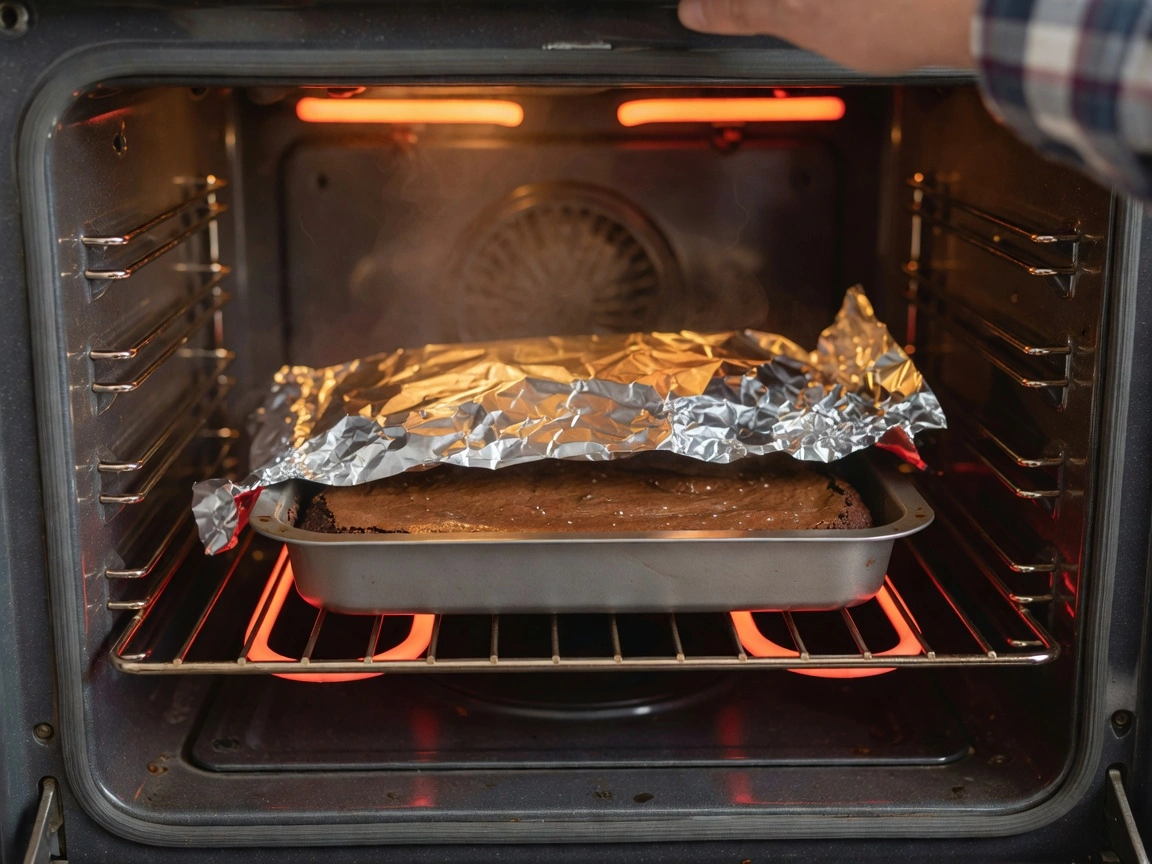
That last step matters. One long rescue bake can overcorrect the batch and leave you with dry corners and a tough top. Short checks give you more control.
For brownies that are still warm and obviously underbaked, start with a brief additional bake and recheck often. For brownies that have cooled, give them a short warm-up in the pan first if your oven and pan allow it, then continue in short intervals. If the edges are already set and fragile, stop as soon as the center looks set enough to cool rather than pushing for a perfectly dry toothpick.
If you are working with a dark metal pan, be extra cautious. Dark pans absorb heat more aggressively than light metal pans, so the edges and bottom may set faster while the center still lags behind. A glass baking dish can behave differently again, often heating more slowly and making timing less predictable from one recipe to the next.
When the top browns before the middle sets, foil is useful. It helps protect the surface while the interior finishes cooking. Just keep it loose so steam can escape; otherwise, the top may soften too much.
How to Test Doneness in the Center
The toothpick test is still the most practical tool for most home bakers, but it needs to be read correctly for brownies.
For a fudgy brownie, you are not looking for a completely clean toothpick. A few moist crumbs are a good sign. What you do not want is wet batter clinging to the pick.
A simple decision rule:
- Wet batter on the toothpick: bake longer.
- Thick, sticky smear with no batter-like flow: likely close, but check again after cooling a bit.
- Moist crumbs: likely done if the recipe is meant to be fudgy.
That sticky-smear detail matters. A fudgy brownie can leave a dense, tacky trace on the toothpick without being raw. Wet batter looks looser and more fluid, almost like the brownie mixture itself. If the pick comes out with a smear that looks paste-like but not runny, the brownies may be just shy of done rather than truly underbaked.
An instant-read thermometer can also help if you already use one in your kitchen. It gives you a more objective check than appearance alone. That said, brownies vary by style, so the thermometer should support your judgment rather than replace it. A brownie that is meant to be soft will not read the same way as a cakier version.
The most reliable approach is to combine cues: set edges, a center that is no longer liquid, and a toothpick that shows crumbs rather than batter.
Why Brownies Stay Gooey in the Middle
When brownies stay too soft in the center, the cause is usually one of a few practical issues.
The oven may not be heating evenly
Many home ovens run hotter or cooler than the dial suggests. If the oven is cooler than expected, the edges can look done before the center has had enough time to set. If it runs hot, the top may brown quickly while the middle stays behind.
The pan may be changing the bake
Pan material matters. Dark metal pans tend to brown faster. Light metal pans usually offer a more even, moderate bake. Glass dishes often heat differently from metal and can change how quickly the center sets.
Pan size matters too. A smaller pan makes the batter deeper, which usually means a longer bake. A larger pan spreads the batter thinner and can set more quickly. If you used a pan different from the one the recipe expected, that alone may explain the gooey middle.
The recipe style may be very fudgy
Some brownie formulas are designed to stay soft and dense. In those recipes, the center should be moist, not dry. If you expect a cakey brownie and use a fudgy recipe, it may look underdone even when it is baked correctly.
The batter may have been too rich or too loose
Too much fat relative to flour can slow setting. Too little flour can do the same. Extra liquid ingredients can also make the center take longer to firm up. You do not need to overhaul the recipe every time, but if the same problem keeps happening, the formula may be part of it.
How Pan Type and Oven Settings Affect Bake Time
This is where many brownie problems start.
A dark metal pan often gives you faster browning on the outside. That can be useful if you want a deeper crust, but it also means the center may need closer attention. A light metal pan usually bakes more gently and is easier to judge when you are trying to avoid an underdone middle.
Glass baking dishes are trickier. They often behave differently enough from metal that a recipe written for a metal pan may need a different bake rhythm. If you switch pan types, do not assume the timing will stay identical.
Rack position matters too. If the pan is too close to the top element, the surface can brown before the middle sets. A more centered rack position often gives you a better balance for brownies.
For future batches, keep notes on the pan you used, the oven rack, and how the center looked at the end of baking. That record is far more useful than guessing next time.
How Cooling and Carryover Cooking Change the Texture
Brownies keep cooking briefly after they leave the oven. This is called carryover cooking. The residual heat in the pan and the brownies themselves continues to set the structure for a short time.
That is why cutting too soon can make a brownie seem wetter than it really is. A batch that looks fragile right out of the oven may firm up enough to slice after cooling.
Here is the practical takeaway:
- If the center is only soft, let the brownies cool before judging them.
- If the center is visibly raw, cooling alone will not fix it.
- If the brownies are almost done, cooling may be exactly what they need.
This is one of the biggest mistakes home bakers make: they keep baking a batch that only needed time to set. The result is dry edges and a tougher texture than intended.
How to Prevent a Gooey Middle Next Time
The best prevention is a better system, not a more complicated recipe.
Match the pan to the recipe
If the recipe was tested in a light metal pan, use one if you have it. If you use a dark pan or glass dish, expect the timing to shift and watch the center more closely.
Check the oven before blaming the recipe
An oven that is off by even a noticeable amount can change brownie texture. If your brownies repeatedly come out gooey in the middle, the oven setting may be part of the problem.
Watch the batter depth
Thicker batter in a smaller pan needs more time. Thinner batter in a larger pan needs less. If you change pan size, adjust your expectations accordingly.
Use the right doneness cue for the brownie style
For fudgy brownies, look for moist crumbs and a set edge. For cakier brownies, you will usually want a drier toothpick. Using the wrong cue leads to either underbaking or overbaking.
Let the pan cool before slicing
Even when the brownies are baked properly, cutting too early can make the middle seem looser than it really is. Give the batch enough time to finish setting before you decide the texture failed.
If your brownies keep turning out underdone despite careful timing, it can help to compare the problem with other baking issues you know. For example, why too much flour makes cookies dry shows how small measuring errors can change texture in a major way.
When the Brownies Are Too Far Gone to Fix
Some batches are salvageable; some are not worth forcing.
If the center is still raw batter after a short, reasonable additional bake, the brownies may be too far gone to serve as brownies. At that point, further baking can dry the edges without fully correcting the middle. If the pan has already been cut into and the structure is collapsing, the batch may also be difficult to rescue cleanly.
A practical cutoff:
- If the middle is soft but set, keep cooling.
- If the middle is wet but the structure is intact, return it to the oven.
- If the center is still raw after a short rescue bake, or the batch is breaking apart, repurpose it rather than chasing a perfect slice.
Repurposing is not failure. It is a better use of the ingredients than overbaking a pan into dryness.
If you want to understand how pan choice changes bake behavior in other formats too, this guide on how to choose a baking pan that fits your air fryer is a useful comparison point for size, material, and fit.
Brownie Troubleshooting at a Glance
If your brownies are too gooey in the middle, use the symptom to guide the fix:
- Wet batter on the toothpick: return to the oven.
- Soft center that firms as it cools: wait before cutting.
- Top browning too quickly: tent loosely with foil.
- Edges done, center lagging: check pan type, rack position, and oven accuracy.
- Repeated gooey centers in the same recipe: review pan size and batter depth.
That approach keeps you from guessing. Instead of treating every soft center the same way, you match the fix to the actual problem.
FAQ
Are brownies supposed to be gooey in the middle?
Some are. Fudgy brownies are meant to be soft and dense in the center, but they should not look raw or behave like batter. The difference is set structure versus liquid texture.
Can I put brownies back in the oven after cutting them?
Yes, if they are clearly underbaked. If possible, press the pieces back together in the pan and bake briefly. Individual pieces can be rescued, but they are harder to heat evenly than a whole pan.
Should I wait for brownies to cool before deciding they are underbaked?
If they are only soft, yes. Brownies firm as they cool. If the center is wet and loose, cooling alone will not solve it.
Why is the top done but the middle still gooey?
That usually points to a temperature, pan, or batter-depth issue. The surface browns faster than the center sets, especially in darker pans or ovens that run unevenly.
What is the most reliable way to check brownie doneness?
Use the toothpick test first, then confirm with the texture of the center. Moist crumbs are a better sign than a clean pick for fudgy brownies, while wet batter means they need more time.
How do I keep the top from overbrowning while the middle finishes?
Cover the pan loosely with foil and continue baking in short intervals. That protects the surface while the interior catches up.
Final Takeaway
A gooey brownie center is not always a mistake, but it is a problem when the middle still looks or behaves like raw batter. The fastest fix is to judge the texture honestly, then use short, careful extra baking if needed. For future batches, match your pan, rack position, and doneness test to the style of brownie you are making. That is how you get a center that is soft, rich, and properly set.