
How to Knead Sticky Dough Without Overflouring It

Sticky dough can make even experienced bakers pause for a second. Your hands cling to it, the counter seems to swallow it, and suddenly the urge to add “just a little more flour” gets very strong. But in bread making, sticky is not automatically bad. In many doughs, especially higher-hydration ones, a tacky feel is part of the process.
The goal is not to eliminate every bit of stickiness. The goal is to handle the dough well enough to build gluten without drying it out. Once you understand what kind of sticky you’re dealing with, the rest becomes much more manageable.

Quick decision guide
- If the dough is sticky but cohesive: keep kneading, but use a scraper, damp hands, or a light oil film instead of adding flour right away.
- If the dough feels tight, rough, or resistant: rest it for 10 to 20 minutes and reassess.
- If it is extremely sticky and spreading: switch to slap-and-folds or stretch-and-folds; if it still will not hold together, check the formula before adding more flour.
- If it is truly wet and batter-like: stop kneading for now and verify the hydration, measurements, and recipe style.
What Sticky Dough Actually Means
Not all sticky dough behaves the same way.
Tacky, sticky, and truly wet are not identical
A dough that feels slightly tacky can still be perfectly on track. It may cling a little to your fingers, but it should also start to gather into a more cohesive mass as you work it.
A high-hydration dough will usually feel wetter and looser than a standard sandwich dough. That does not necessarily mean something is wrong. Some breads are meant to be handled with a light touch and a bit of patience.
A truly wet dough is different. It may spread quickly, resist holding shape, and feel more like a batter than a dough. If it never pulls together at all, the issue may be formula-related rather than just a kneading problem.
| Dough feel | What it usually means | Best response |
|---|---|---|
| Slightly tacky | Normal for many yeast doughs | Keep working it and use minimal flour for handling |
| Very sticky but cohesive | Often high hydration or early gluten development | Rest, then knead with wet hands or a scraper |
| Loose and slack | May need more gluten development or a formula check | Use folds, extra rest, or verify the recipe |
| Wet and batter-like | Likely too much water for the method | Reassess the dough formula before kneading harder |
A practical way to tell the difference is this: if the dough still gathers into a single mass and can be folded over itself, it is usually in the “normal sticky” range. If it smears, puddles, or will not stay together long enough to shape into a rough ball, it is probably too wet for the method or mismeasured. That distinction matters because the wrong fix can make the dough worse. Too much flour can turn a promising dough dry and dense. Too much force can leave you frustrated without improving structure.
Why Dough Gets Sticky
Sticky dough usually comes down to a few basic factors working together.
Hydration changes how the dough feels
Hydration is the amount of water relative to flour. More water generally means a stickier, softer dough. That is especially common in rustic breads, ciabatta-style doughs, and some enriched doughs.
A sticky dough is not automatically underdeveloped. Sometimes the recipe is simply designed that way. In fact, a dough that feels awkward at first may become much easier to handle after a short rest and some gluten development.
Flour choice changes absorption
Bread flour usually handles sticky dough better than all-purpose flour because it tends to have more protein, which helps build stronger gluten. All-purpose flour can still make excellent bread, but it may feel softer and more delicate during kneading.
If your dough feels unmanageably sticky, flour type is worth checking before you blame your technique. A recipe built for bread flour may behave differently if you substitute all-purpose flour.
Gluten needs time to organize
At the beginning, dough often feels rough, shaggy, and sticky. As gluten develops, it becomes smoother, more elastic, and easier to handle. That change does not happen instantly. Sometimes it starts to show after a few minutes of kneading; sometimes it needs a rest first.
Temperature and resting matter
Warm dough tends to feel stickier than cool dough. Resting also helps flour absorb water, which can reduce the “wet paint” feeling that many beginners notice right after mixing.
That is why aggressive flour dumping is often the wrong first move. The dough may simply need time.
What You Need Before Kneading
A sticky dough is much easier to manage when your setup is ready.
Keep these tools nearby
- A mixing bowl
- A bench scraper or dough scraper
- A clean work surface
- A little bench flour, used sparingly
- A small bowl of water for dampening hands
- Or a tiny amount of light oil for your hands, if you prefer that feel
A bench scraper is especially useful because it helps you lift, fold, and gather dough without tearing it or coating the counter in flour. If you want to see a wet-dough handling approach in action, a one-handed slap-and-fold method with a bench knife or scraper is a common reference point in baking guides. King Arthur Baking’s wet-dough handling guide is a helpful reference if you want to see that approach in action.
Choose your surface with care
A smooth counter is usually easier to manage than a rough one. If the dough is very sticky, lightly dampening your hands or using a whisper of oil can be more helpful than burying the dough in extra flour.
Use the lightest touch that keeps the dough workable. That small habit protects hydration, and hydration is often what gives bread its open crumb and pleasant chew. As a general rule, water is the better choice when you want to reduce sticking without changing the dough’s surface feel too much, while a tiny amount of oil is useful when dough clings so aggressively that damp hands still are not enough.
Step 1: Let the Dough Rest First
Before you decide the dough needs more flour, give it time.
A short rest allows the flour to absorb water more fully. That often makes the dough feel less tacky without changing the formula at all. If the dough is mixed but still shaggy, rest can do more for it than another handful of flour.
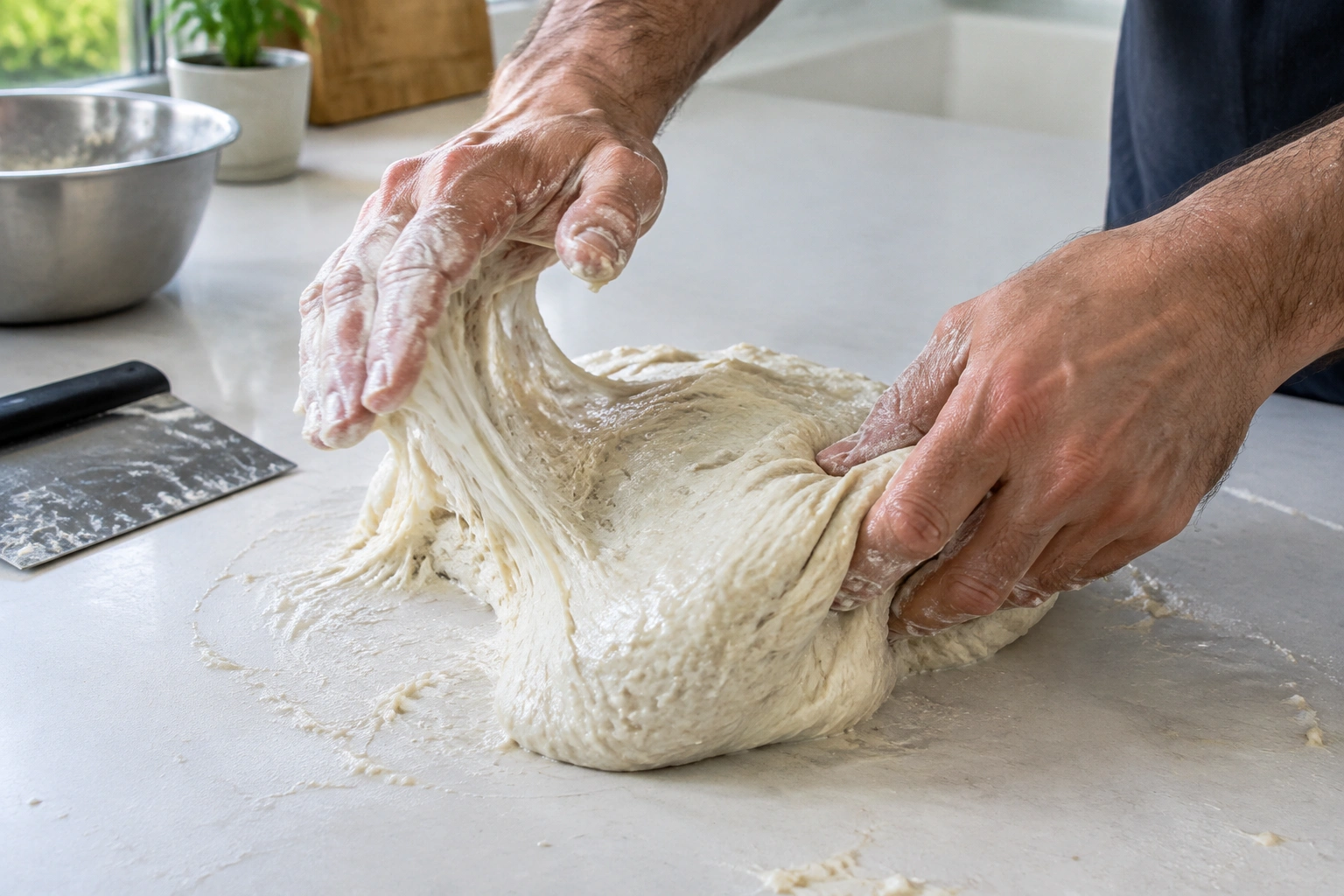
This is especially useful when the dough feels sticky immediately after mixing. What seems like a problem may just be the dough before it has had a chance to hydrate evenly.
If your recipe includes an autolyse, that step is working in your favor already. If it does not, a brief rest after mixing can still help. Cover the dough so the surface does not dry out, then come back and judge it again before adding anything.
Step 2: Choose the Best Kneading Method
The best method depends on how sticky the dough is and how much structure it already has.
| Method | Best for | Trade-off |
|---|---|---|
| Hand kneading | Moderately sticky dough that still holds together | More control, but more mess |
| Slap-and-fold / French fold | Very sticky or high-hydration dough | Efficient, but technique can feel awkward at first |
| Stretch-and-folds | Soft doughs that improve with time | Less mess, but slower development |
| Stand mixer | Sticky dough that is hard to manage by hand | Less physical effort, but you must watch the dough closely |
If the dough is cohesive enough to pick up and fold, hand kneading can work well. If it spreads too much and clings aggressively, slap-and-fold or fold-based handling may be a better fit. If your mixer is strong enough and the dough is not climbing the hook, that can also be a practical choice.
A useful rule of thumb is to switch methods when the dough is no longer cooperating with the one you started with. If hand kneading turns into smearing, move to folds or a mixer. If a mixer is just polishing the dough but not improving structure, stop and let rest or use stretch-and-folds during bulk fermentation instead.
The key is not forcing a method that fights the dough. A ciabatta-style dough, for example, often behaves better with folds than with traditional countertop kneading.
Step 3: Knead Sticky Dough by Hand Without Overflouring
Here is a practical hand method that keeps the dough workable without drying it out.
1. Use the smallest amount of flour needed for handling
Dust the counter lightly, not heavily. You want just enough to prevent total sticking during the first few movements. If the dough still clings, resist the urge to keep blanketing the surface. Too much flour changes the dough itself, not just the outside of it.
2. Lift, fold, and press with intention
Pull the dough toward you, fold it over itself, then press it away with the heel of your hand. Rotate it and repeat. This is the basic rhythm that helps gluten align and strengthen.
If the dough sticks too much, use the bench scraper to lift and release it. That keeps you from tearing the dough while you work.
3. Keep your hands lightly damp or lightly oiled
Wet hands can reduce sticking without changing the dough’s hydration. Light oil can do the same, though it gives a slightly different feel. Water is often cleaner if you want to keep the dough’s surface neutral. Oil can be useful if the dough is extremely soft and your hands are grabbing it too aggressively.
4. Pause when the dough fights back
If the dough is resisting and smearing instead of tightening, it may need a rest more than more kneading. A short pause lets the gluten relax and the flour continue absorbing moisture.
If that happens several times in a row, do not keep adding flour by reflex. Rest the dough, then try again with folds or a gentler motion. Only add flour in very small increments if the dough is so wet that it cannot be picked up or folded at all.
5. Judge the dough by feel, not by the clock
Some doughs become smoother quickly. Others need more time. Sally’s Baking Addiction notes that kneading can take anywhere from about 3 to 5 minutes and sometimes as long as 10 to 15 minutes, with the dough gradually becoming smoother and more elastic. That range is a reminder that timing alone is not the real test. Sally’s kneading video shows the kind of tactile change to watch for.
Step 4: Use the Right Technique for Very Wet Dough
When the dough is too soft for standard kneading, a slap-and-fold method can be more effective.
Jackson’s Job describes kneading sticky dough by slapping it on the table and folding it over repeatedly until it stretches easily without tearing. That approach can work well when the dough is too wet for a simple push-and-fold rhythm. Their sticky-dough guide gives a clear example of how that movement looks in practice.
How to do it
- Lightly moisten the work surface or use the faintest dusting of flour.
- Scoop the dough up.
- Slap it down so one end sticks briefly to the surface.
- Fold the free end back over itself.
- Repeat in a steady rhythm.
The motion looks messy at first, but it helps build structure quickly in dough that would otherwise smear around the counter.
If that still feels too difficult, use stretch-and-folds in the bowl or during bulk fermentation. That method is slower, but it is often easier for beginners and less frustrating for very soft doughs. For very wet dough, this can be a better path than trying to force a long kneading session.
Step 5: Check Gluten Development and Stop at the Right Time
The real question is not “Is the dough still sticky?” The question is “Has it developed enough structure to move on?”
Look for these signs
- The dough feels smoother than when you started
- It stretches farther before tearing
- It holds together as one mass instead of smearing apart
- It looks less rough and more elastic
- It springs back a little when pressed gently
Two tactile benchmarks help here: the dough should feel elastic when you stretch it, and it should gather back into a cohesive ball instead of oozing across the counter. A small amount of tackiness is fine if the dough is smoother and stronger than it was at the start.
A simple windowpane test can help. Take a small piece of dough and stretch it slowly between your fingers. If it can stretch into a thin membrane before tearing, gluten development is moving in the right direction. If it tears immediately, it likely needs more kneading or more rest.
Do not expect sticky dough to become perfectly dry in your hands. A well-developed dough can still feel tacky. What changes is its behavior.
When to Add Flour and When Not To
This is where many bakers go wrong.
Add flour only for a real reason
If the dough is so wet that it cannot hold together at all, a small adjustment may be justified. But if it is merely sticky, the better move is usually to continue kneading, rest it, or change your handling method.
A useful rule: add flour only when the dough is clearly too slack to work with, not simply because it clings to your fingers. If it is sticky but cohesive, keep going. If it is wet and spreading like a paste, stop and reassess the formula before adding more flour.
Why overflouring backfires
Every extra dusting changes hydration. That can lead to:
– a tighter dough
– a drier crumb
– less oven spring
– a heavier loaf
If you are trying to preserve an open, airy texture, too much flour during kneading can work against you.
Common Mistakes That Make Sticky Dough Worse
Sticky dough becomes much harder when these habits creep in.
Using too much flour too early
This is the most common mistake. Once flour is added, it is hard to take it back. If the dough is only sticky because it is still young, extra flour can ruin the balance.
Working on a dry surface with dry hands
That often causes the dough to tear and smear instead of tightening. A little water or oil can be more effective than flour in the early stages.
Kneading aggressively when the dough needs rest
If the dough is fighting you, more force is not always the answer. Sometimes the dough is asking for time, not pressure.
Misreading normal stickiness as failure
Some doughs are supposed to feel softer and wetter than beginners expect. High-hydration doughs often require a change in technique, not a fix to the formula.
Troubleshooting Sticky Dough That Won’t Improve
If the dough still feels wrong after kneading, use this decision guide.
If it is sticky but cohesive
Keep working it, but change your handling before you change the formula. Use a bench scraper, damp hands, or a short rest. If it becomes smoother and more elastic after a few folds, it is probably just underdeveloped, not overhydrated.
If it is wet and spreading
That is a different problem. Stop adding flour in large amounts. Check whether the recipe is meant for high hydration, whether the flour was measured correctly, and whether the dough needs stretch-and-folds instead of more kneading.
If it tears, smears, or stays gummy
That usually points to underdeveloped gluten or not enough resting time. Give it a pause, then resume with folds or gentle kneading.
If it gets stickier as you work it
That can happen when the dough warms up or when gluten is not yet organized enough to hold itself together. A short rest may help more than more flour.
If it never becomes smooth
At that point, look at the flour choice, the water amount, and the mixing method. A dough that refuses to improve may be telling you the formula needs adjustment, not just more kneading.
Practical Examples of Sticky Dough in Real Baking
Sandwich bread that loosens up after resting
A standard sandwich dough may feel sticky right after mixing, especially if the flour has not fully absorbed the liquid. After a rest, the same dough often becomes easier to knead and shape. In that case, patience is the fix, not more flour.
Ciabatta-style dough that needs folds instead of hard kneading
A very soft dough for ciabatta is often too wet for traditional countertop kneading. Slap-and-fold or repeated stretch-and-folds usually suit it better because the dough needs structure without being battered into dryness.
Mixer-made dough that looks messy at first
A dough mixed in a stand mixer can still look sticky early on. If it starts to clear the bowl and stretch better as mixing continues, that is a good sign. The dough may still cling a bit, but it can be ready once it has enough elasticity and passes a simple stretch test.
When to Consult a Master Baker
If your dough remains unmanageable after rest, gentle kneading, and a method change, the formula itself may be the issue. That is the point to compare the recipe against the flour you used, the water amount, and the style of bread you are trying to make. A master baker or experienced instructor can help you spot whether the dough is simply high-hydration or genuinely off balance.
The more you work with sticky dough, the more it starts to make sense. What feels chaotic at first often becomes predictable once you learn to read the dough instead of fighting it. That shift is one of the biggest steps from beginner bread making toward confident baking.
FAQ
Is sticky dough supposed to be sticky the whole time?
Not necessarily. Many doughs start sticky and become smoother as gluten develops and the flour hydrates. It is normal for the dough to remain a little tacky even when it is ready.
When should I add more flour?
Only when the dough is too wet to hold together or impossible to handle. If it is sticky but cohesive, rest it first and keep kneading with minimal flour.
Should I knead sticky dough by hand or use a mixer?
Use the method that matches the dough. Hand kneading works for moderately sticky dough, while a stand mixer or stretch-and-folds can be better for very wet dough that smears on the counter.
How do I know the dough is ready if it still feels tacky?
Look for elasticity, smoothness, and cohesion. If the dough stretches farther before tearing, holds its shape better, and passes a basic windowpane test, it is usually ready even if it is still slightly sticky.