How to Prevent Air Fryer Food from Cooking Unevenly: Simple Fixes That Work
Uneven air fryer cooking is usually not a mystery problem. In most cases, it comes down to airflow, basket loading, food size, or how the food is moved during cooking. Once you understand those pieces, you can fix the issue with a few repeatable habits instead of guessing from batch to batch.
If your fries brown on top but stay pale underneath, or chicken looks done outside but lags in the center, the air fryer is telling you something useful: the hot air is not reaching every surface evenly. The good news is that this is usually fixable without buying a new appliance.
Why air fryers cook food unevenly
Air fryers cook by moving hot air around food. When that air can circulate freely, you get more even browning and more consistent doneness. When airflow is blocked, some pieces get more direct heat than others.
The most common causes are simple:
- Overcrowding the basket: Food piled too tightly creates shaded spots where air cannot reach.
- Uneven food size: Large pieces finish later than small pieces, even in the same batch.
- Hot spots in the appliance: Many air fryers have areas that brown faster than others.
- Skipping movement during cooking: Small foods often need shaking; thicker foods often need flipping or rotating.
- Too much surface moisture: Wet food tends to steam before it browns, which can make results patchy.
A useful way to think about it: the air fryer is less like a still oven and more like a fast-moving convection system. Food needs space for that movement to do its job.
Set up the basket for even cooking
The basket setup matters before the air fryer ever turns on. If the food is packed into a mound, the outer layer may crisp while the middle stays soft or underdone.
Use a single layer whenever possible
A single layer usually gives the most even result because each piece has more access to circulating air. That does not mean every piece must be isolated with huge gaps, but it should not be stacked.
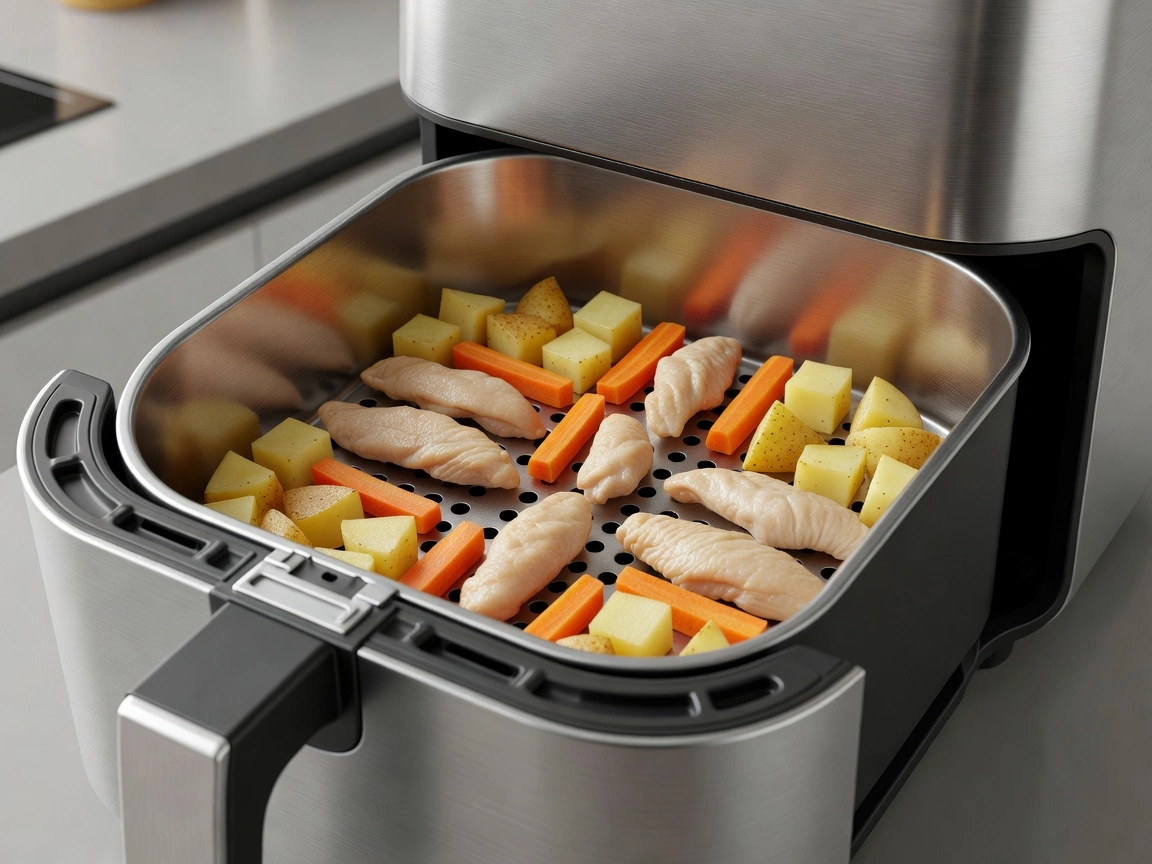
For example, a single layer of frozen nuggets will usually brown more evenly than a pile of nuggets dumped into the center of the basket. The same idea applies to vegetables, fries, and small breaded items.
Leave space between pieces
Spacing helps air reach the sides of the food. If pieces touch, the touching surfaces often stay pale while the exposed sides brown faster.
A practical rule: if you cannot see open space between most pieces, the basket is probably too full for even cooking. In that case, cook in batches. It takes a little longer, but the result is usually better and more consistent.
How to tell when the basket is too full
A basket is too full when the food sits in a solid mass instead of a loose layer. As a rule of thumb, you should still be able to see visible gaps between pieces, and the food should not press together in a solid block. If the pieces are touching across most of the surface, airflow is too restricted.
Watch liners and accessories
Parchment liners can make cleanup easier, but they can also reduce airflow if they cover too much of the basket or sit too high around the food. If you use a liner, make sure it does not block the holes or interfere with circulation. If food keeps browning unevenly after adding a liner, remove it and compare the result.
For a deeper look at liner issues, see how to prevent air fryer parchment from flying around.
Preheat, then use the right movement
Preheating can help when you want the food to start cooking right away and brown consistently from the beginning. It is most useful for foods that need fast browning or more predictable timing, such as breaded items, frozen foods, or anything where a crisp exterior matters.
When preheating helps
Preheating is useful when you want:
- More consistent browning from the first minute
- Better results with breaded or frozen foods
- Less variation between the first batch and later batches
It may be less important for very forgiving foods, but if your results are uneven, preheating is often worth trying.
Shake, flip, or rotate?
These are not interchangeable.
Shake works best for loose, small foods such as fries, nuggets, and vegetables. It redistributes pieces so the ones on the bottom get a turn near the hotter air.
Flip is better for foods with a clear top and bottom, such as chicken breasts, patties, sandwiches, or thicker cutlets. Flipping exposes the other side to direct heat and helps both sides brown more evenly.
Rotate is useful when the air fryer has a hot spot, or when the front and back of the basket brown differently. If one side of the basket consistently cooks faster, turning the basket or swapping the position of trays can help even things out.
A practical cue: if the food is loose and small, shake it. If it has a defined top and bottom, flip it. If one area of the basket is consistently faster than another, rotate.

How often should you move the food?
There is no universal schedule that fits every air fryer and every food, but if the batch looks uneven halfway through, that is usually the right time to intervene. For very small items, you may need more than one shake. For thicker foods, one flip may be enough.
The goal is not constant opening and closing. Too much interruption can slow cooking. The goal is to move the food at the point where one side is clearly getting ahead of the other.
Adjust temperature, time, and food size for better doneness
Sometimes uneven cooking is not about the basket at all. It is about the cooking pace.
Lower temperature, longer time vs. hotter, faster cooking
A hotter setting can brown the outside quickly, but that sometimes leaves the center behind. That is why some thicker foods look done on the surface but still need more time inside.
Lowering the temperature and extending the cooking time can improve evenness because heat has more time to move through the food. The trade-off is that crisping may take a little longer.
Use this approach when:
- The outside is browning too quickly
- Thick pieces are still underdone in the middle
- The food looks unevenly colored but not yet evenly cooked
Use a hotter approach when:
- The food is thin
- You want faster browning
- The pieces are already uniform and not crowded
Cut food into uniform pieces
Size differences are a major reason one batch finishes unevenly. Thick potato wedges, uneven chicken pieces, or mixed vegetable chunks will not cook at the same rate.
If you cut food to a similar thickness, you give each piece a better chance to finish at the same time. This is especially useful for root vegetables, potato wedges, and chicken pieces that vary in size.
Batch size matters
A smaller batch often cooks more evenly than a full basket. That is because each piece has more airflow around it. If even browning matters more than speed, batch cooking is usually the better choice.
| Situation | Best fix | Why it helps |
|---|---|---|
| Basket is crowded | Cook in batches | Restores airflow around each piece |
| Top browns, bottom stays pale | Shake or flip | Exposes hidden surfaces to hot air |
| One side cooks faster | Rotate basket or tray | Balances hot spots |
| Food browns too fast outside | Lower temperature and extend time | Gives the center more time to catch up |
| Frozen pieces clump together | Break apart and spread in a single layer | Prevents steam pockets and uneven browning |
| Thick pieces finish unevenly | Cut more uniformly | Helps pieces finish at the same rate |
How to keep common foods cooking evenly
Some foods are more likely than others to cook unevenly in an air fryer. The fix depends on the food, not just the appliance.
Frozen foods
Frozen foods often clump, release moisture, and start from a colder base than fresh foods. That combination can lead to pale spots or uneven crisping.
A better approach is to break apart frozen pieces before cooking and spread them in a single layer. If the food arrives in a block or clump, separate it as much as possible before it goes into the basket. Frozen nuggets, fries, and vegetables usually benefit from a mid-cook shake.
Chicken
Chicken is where uneven cooking becomes more than a texture issue. If the outside browns too fast while the center lags, the food may look finished before it actually is. That is why a food thermometer is important for poultry.
For chicken breasts or cutlets, use even thickness and flip during cooking. If one end is much thicker than the other, the thinner end may dry out before the thicker end is done. Pounding or trimming to a more even shape can help.
For official food-safety guidance on poultry doneness, see the USDA’s food safety resources.
Fries and potato wedges
Fries and wedges usually cook unevenly when they are stacked or cut inconsistently. The pieces touching the basket bottom may stay softer, while the top layer crisps too quickly.
Spread them out, shake them partway through, and keep the cut size consistent. If you like thicker wedges, expect a longer cook and more need for movement than with thin fries.
Vegetables
Vegetables can char on one side and stay soft on the other if they are not moved during cooking. This happens often with broccoli, Brussels sprouts, green beans, and mixed vegetable blends.
A light coating of oil can help vegetables brown more evenly, but too much oil can make them greasy instead of crisp. Use just enough to lightly coat the surface, then toss well so the coating is distributed evenly.
Breaded or coated foods
Breaded foods often show uneven browning when the coating is thick in some spots and thin in others. They also need space. When breaded items touch, the coating can stay pale where pieces meet.
Arrange them with room around each piece and avoid stacking. If the coating is very delicate, a gentler flip may work better than a vigorous shake.
When uneven cooking points to the air fryer itself
If you have already adjusted spacing, movement, and food size, but the same side keeps browning faster across different foods, the appliance may be part of the problem.
Start with the appliance itself:
- Check the vents for blockage. Air needs a clear path in and out.
- Listen to the fan. If it sounds weak, irregular, or unusually loud, airflow may not be working properly.
- Look for grease buildup on the basket, tray, heating area, or interior surfaces. Buildup can interfere with circulation and heat transfer.
- Check basket or rack placement. If a basket, tray, or rack is not seated correctly, air may not move through the unit as intended.
- Inspect the heating element if your model allows it. Dirty or coated elements can contribute to uneven heating.
That does not always mean the air fryer is broken. It may simply have a hot spot or a basket design that needs rotation to compensate. But if airflow seems weak, the fan sounds unusual, or the appliance no longer cooks the way it used to, the unit may need cleaning, inspection, or replacement.
Tray-style and multi-rack air fryers
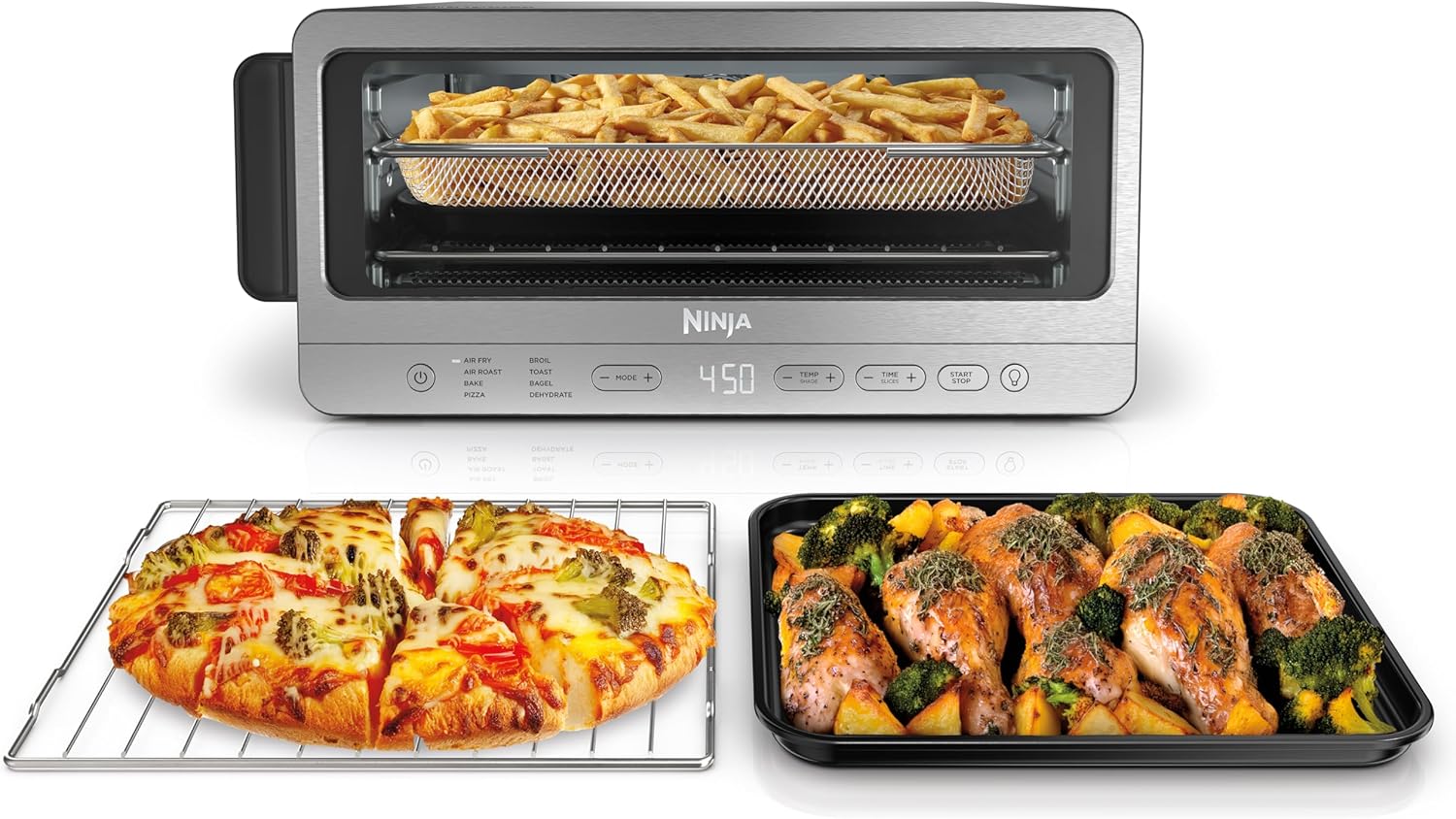
The same airflow rules apply to tray-style air fryers and multi-rack models, but the fix may be to swap tray positions or rotate racks instead of shaking a basket. If the top tray browns faster than the lower one, or the front of a tray cooks faster than the back, move the food to a different level or rotate the tray partway through cooking.
If you want a broader troubleshooting guide for browning and burning issues, you may also find why air fryer food burns helpful.
A simple troubleshooting order that saves time
When food comes out uneven, use this order:
-
Check the basket load
If it is crowded, cook less at once. -
Check the food shape
If pieces vary in size, make them more uniform next time. -
Check movement during cooking
Shake small foods, flip thicker foods, and rotate if one side cooks faster. -
Check the heat level
If the outside is browning before the inside is done, lower the temperature and give it more time. -
Check the appliance pattern
If the same area keeps cooking faster, treat it like a hot spot.
That sequence usually solves most uneven results without much trial and error.
When to clean, inspect, or replace the air fryer
If uneven cooking keeps happening even after you have corrected spacing, movement, and temperature, it is time to look more closely at the appliance itself.
Clean the air fryer if you notice grease buildup, blocked vents, or residue around the basket, tray, or heating area. Inspect it if the fan sounds different than usual or if the basket or rack no longer sits correctly. Consider replacing the unit if the same airflow problem keeps returning after cleaning and normal use adjustments.
For most home cooks, though, the fix is usually simpler than it feels at first. Give the food space, move it at the right moment, and match the cooking method to the shape and moisture level of the food. That is the foundation of more even air fryer results.
FAQs
Why does my air fryer cook one side faster than the other?
That usually points to a hot spot or uneven airflow. Rotate the basket or turn the food so the faster side does not stay closest to the stronger heat.
How full can I fill the air fryer basket?
Fill it only as far as you can keep food in a mostly single layer. If pieces are stacked or pressed together, airflow drops and cooking becomes less even.
Is shaking better than flipping?
They solve different problems. Shaking works best for small loose foods like fries or vegetables. Flipping is better for foods with a top and bottom, like chicken or patties.
Does preheating really help?
It can. Preheating is most useful for foods that need fast browning or more consistent timing, especially breaded or frozen items.
Why are frozen foods often uneven in the air fryer?
Frozen foods often arrive clumped together and release moisture as they cook. That combination can block airflow and create uneven browning unless the pieces are spread out and moved during cooking.
What if my food is browned outside but undercooked inside?
That usually means the temperature is too high for the thickness of the food. Lower the heat and give it more time so the inside can catch up.
Should I use parchment liners?
Only if they do not block airflow. If a liner covers too much of the basket or interferes with circulation, it can make uneven cooking worse.
How do I know if my air fryer has a problem?
If the same area cooks faster every time, even with different foods and proper spacing, the unit may have a hot spot or airflow issue. Cleaning and rotation can help, but repeated problems may point to a design limitation or malfunction.
Do tray-style air fryers need different handling?
The airflow principles are the same, but you usually fix uneven cooking by rotating trays or moving food between racks instead of shaking a basket.