
How to Test Baking Soda and Vinegar Reaction in an Open Bowl
If you want a quick way to check whether baking soda still reacts properly, an open bowl is one of the simplest setups you can use. It is also a useful classroom-style demo of an acid-base reaction: when baking soda meets vinegar, carbon dioxide is released, and you see the familiar fizz.
The open bowl matters. It lets the gas escape freely, so the reaction is easy to observe without building pressure. That makes it a practical choice for home bakers, parents, teachers, and beginners who want a clear visual test with minimal setup.
If you want a deeper explanation of the chemistry behind the fizz, you can also read our guide to the reaction of vinegar and baking soda.
What the baking soda and vinegar test tells you
This test is best used as a simple freshness check and a visual demonstration. If the baking soda is active, it should react quickly when vinegar is added, producing visible bubbling and foam.
A strong fizz usually means the baking soda is reacting well in this simple test, but it does not prove exact shelf life or guarantee baking performance in every recipe. A weak or delayed reaction can mean the baking soda has absorbed moisture, lost some effectiveness, or is being tested with too little vinegar to show the reaction clearly.
What this test does not do is give a precise measurement of baking performance. A visible fizz tells you the ingredient is reacting, but it does not guarantee how it will behave in every recipe. Baking is more sensitive than a bowl test alone.
For a fuller chemistry breakdown, this article on the balanced vinegar and baking soda equation can help connect the fizz to the reaction products.
What you need for an open-bowl test
You only need a few basic items:
- A small open bowl
- Baking soda
- Vinegar
- A measuring spoon
- A spoon or small scoop for adding the baking soda
- Paper towels or a cloth for cleanup
A shallow or medium-sized bowl is easier to read than a very large one. In a wide bowl, the fizz can spread out and look less dramatic even when the reaction is happening normally. A smaller bowl keeps the bubbling concentrated in one area, which makes the result easier to judge.
Use a modest amount of each ingredient. Too much vinegar can create a splashy mess, while too little can make the reaction hard to see. The goal is a visible fizz, not a dramatic eruption.
How to test baking soda with vinegar in an open bowl
Here is a simple method that works well in a kitchen or classroom.
1. Place the bowl on a stable surface
Set the bowl on a counter or table where it will not tip easily. If children are helping, keep the bowl centered and within easy reach.
2. Add the baking soda first
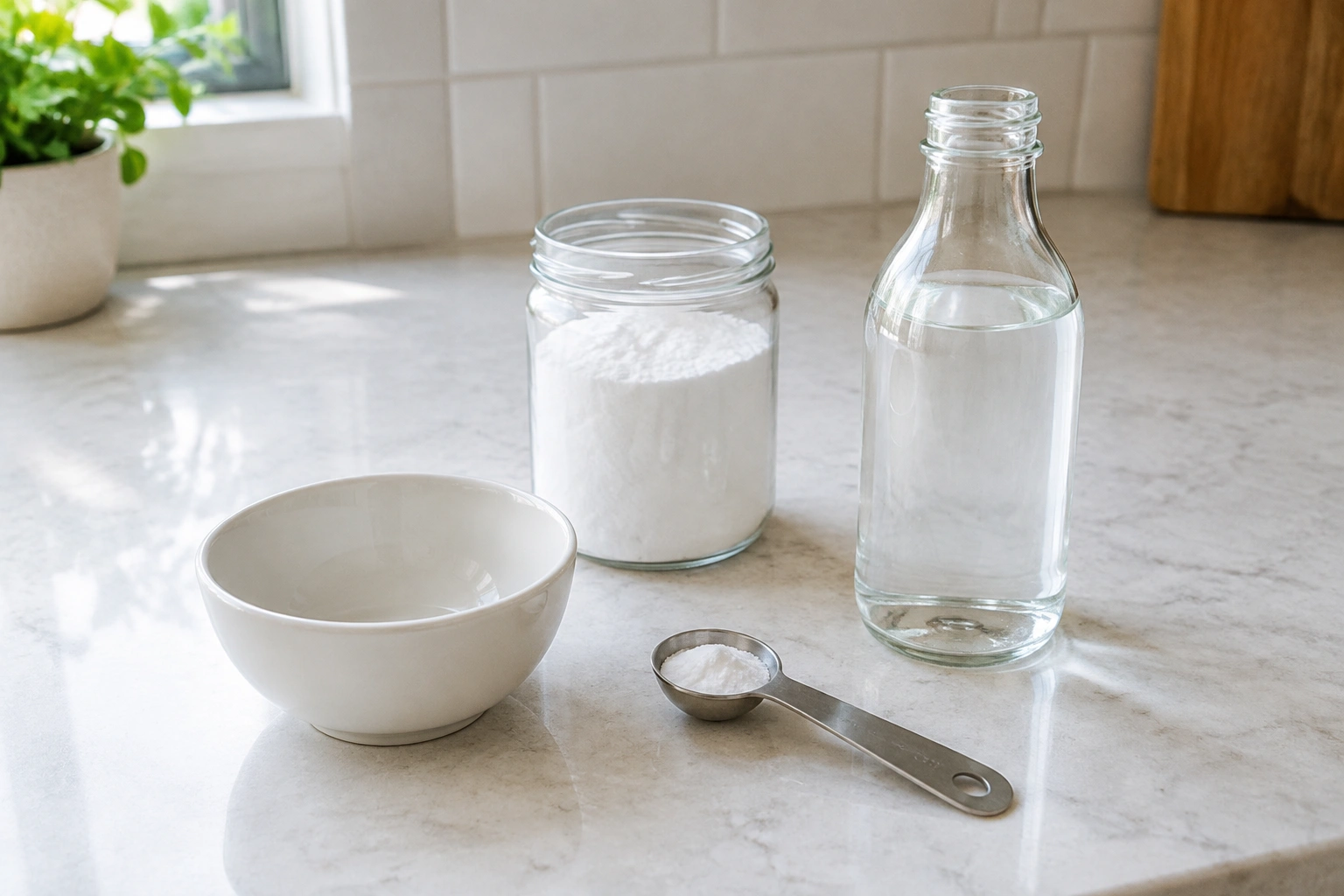
Put a small spoonful of baking soda into the bowl. A good starting amount is 1 teaspoon of baking soda. Keep it in the center if possible. That makes the reaction easier to watch.
3. Pour or spoon in the vinegar
Add about 1 tablespoon of vinegar directly onto the baking soda. Pouring it onto the same spot gives the clearest fizz. You should see bubbling begin almost immediately if the baking soda is active.
4. Watch the reaction
Look for bubbling, foam, and a quick release of gas. In an open bowl, the fizz may rise briefly and then settle as the gas escapes.
5. Judge the result right away
The strongest reaction is usually visible in the first moments after contact. If you wait too long, the reaction will naturally slow down and that can make the result look weaker than it really was.
A good way to think about it: the test is about the first burst of fizz, not the leftovers in the bowl.
What a normal reaction should look like
A normal reaction in an open bowl usually starts with immediate bubbling. You may see:
- Small bubbles forming right away
- A short burst of foam
- A hiss or fizzing sound
- The bubbling slowing after the first reaction
That quick, active bubbling is the sign most people are looking for. Since the bowl is open, the gas does not build up under pressure. Instead, it escapes into the air, so the reaction appears as surface fizz rather than forceful expansion.
A reaction does not need to be huge to count as normal. In fact, a small, steady fizz is often enough to show that the baking soda is still reacting.
How to tell if your baking soda is still good
Use this simple rule:
- Strong, immediate fizz: Baking soda is likely still active.
- Weak or delayed fizz: Check the setup, the vinegar, and the storage conditions before deciding.
- Little or no fizz: The baking soda may be old, damp, or less effective.
If you are testing baking soda for baking, a strong reaction in vinegar is a reassuring sign. If the fizz is minimal even after using a small bowl and a clear amount of vinegar, replacing the baking soda is usually the safest choice for reliable baking results.
A practical example: if you open a box that has been sitting in a humid pantry and the reaction is noticeably sluggish, that is a clue the ingredient may have absorbed moisture. Baking soda is good at picking up odors and moisture from its surroundings, which can affect performance over time.
Why the reaction may be weak or not fizz much
A weak result does not always mean the baking soda is bad. Several simple issues can make the reaction look underwhelming.
Old or moisture-exposed baking soda
Baking soda stored in a damp pantry or in a container that was not sealed well may lose some effectiveness. It can still react, but not as vigorously.
Vinegar that is too weak
If the vinegar is very diluted, the reaction may be harder to see. The test depends on an acid reacting with the baking soda, so the vinegar needs enough acidity to produce a clear fizz.
Too little of either ingredient
A tiny amount of baking soda or vinegar may react normally but still look unimpressive. The reaction is happening; it is just too small to see easily.
A bowl that is too large
In a large bowl, the fizz spreads out across a wider area. That can make the reaction seem weaker than it is. A smaller bowl usually gives a better visual result.
Expecting the wrong ingredient to behave the same way
Baking soda and baking powder are not interchangeable in this kind of test. Baking soda reacts directly with vinegar, while baking powder is a different leavening system and will not give the same result. If you are not sure which one you have, check the label before testing.
Strong reaction vs. weak reaction vs. no reaction
Here is a simple comparison to help you interpret what you see:
| Result | What it usually looks like | Likely cause | What to do next |
|---|---|---|---|
| Strong reaction | Immediate bubbling, visible foam, clear fizz | Baking soda is active and vinegar is acidic enough | Safe to use for a basic baking project |
| Weak reaction | Some bubbles, but not much foam or sound | Small test amount, weak vinegar, larger bowl, or slightly aged baking soda | Retest with a smaller bowl and fresh vinegar |
| No reaction | Little to no bubbling | Baking soda may be old, damp, or mislabeled; vinegar may be too weak | Replace the baking soda and check the container label |
This table is useful because it separates “not very dramatic” from “not working.” Those are not always the same thing.
Open bowl vs. closed container: what changes
An open bowl is the safer, simpler choice for most home and classroom tests. The gas escapes into the air, so there is no pressure buildup.
A closed container can make the reaction look more forceful because the gas has nowhere to go. But that also means pressure can build quickly, which is not what you want for a basic freshness test. For that reason, an open bowl is easier to control and easier to clean up.
There is one trade-off: because the gas escapes, the open-bowl reaction may look less dramatic than a sealed setup. That is normal. The point of this test is visibility and safety, not pressure.
If your goal is simply to see whether the baking soda is active, the open bowl gives you enough information without the extra risk.
Safety and cleanup basics
This is a low-risk kitchen test when you keep it small and controlled, but a few habits make it cleaner and easier.
- Use a stable bowl on a flat surface.
- Keep the amount of vinegar modest so the mixture does not splash over the edge.
- Supervise children closely if they are handling the ingredients.
- Avoid sealed jars, bottles, or other containers that can trap gas.
- Wipe up spills promptly so the counter does not become sticky or slippery.
If the mixture foams more than expected, let it settle before lifting the bowl. Then rinse the bowl with warm water and wash it as usual. A paper towel usually handles the small mess left by a basic test.
If you are using this in a classroom, placing the bowl on a tray can make cleanup easier and reduce the chance of drips reaching the table.
A practical way to use the test in real life
Here is the simplest decision process I use when teaching this to beginners:
- Test a small amount in an open bowl.
- Look for immediate fizzing.
- If the reaction is clear and active, the baking soda is probably fine for everyday baking.
- If the reaction is weak, repeat the test with a smaller bowl and fresh vinegar.
- If it still barely reacts, replace the baking soda.
That approach keeps the test practical. You are not trying to prove a chemistry theorem; you are deciding whether the ingredient is still worth using.
When to consult a pastry chef
If you are testing baking soda because a recipe keeps failing, the issue may not be the ingredient alone. A pastry chef can help you look at the full formula: leavening balance, mixing method, ingredient freshness, and whether the recipe actually calls for baking soda or baking powder.
That matters because a good fizz test does not guarantee a good cake, muffin, or cookie. Baking is a system, and one ingredient only tells part of the story.
FAQ
Can I test baking soda with vinegar in any bowl?
Yes, but a small open bowl is easiest to read. Very large bowls can make the fizz look weaker than it really is.
Does the bowl have to be open?
For this simple test, yes. An open bowl lets the gas escape safely and makes the reaction easy to observe without pressure buildup.
What if I only see a little fizz?
A little fizz may still mean the baking soda is active, but the setup may be too small, the vinegar may be weak, or the bowl may be too large. Try again with a smaller bowl and fresh vinegar.
Can I use this to check expired baking soda?
Yes, this is a common freshness check. A strong fizz suggests the baking soda is still active enough for basic use. A weak or absent reaction suggests replacing it.
Is this the same as testing baking powder?
No. Baking powder is a different leavening ingredient and does not respond the same way. This test is specifically useful for baking soda.
How much should I use?
Use about 1 teaspoon of baking soda with 1 tablespoon of vinegar. That is usually enough to see a clear reaction in a small open bowl without making a mess.
Can children do this safely?
Yes, with supervision. Keep the bowl on a stable surface, use small amounts, and avoid sealed containers.
Why does it fizz at all?
The vinegar provides acid, and the baking soda reacts by releasing carbon dioxide gas. That gas creates the bubbles and foam you see in the bowl.

