
How to Refrigerate Bread Dough for Better Timing, Flavor, and Results

If you’ve ever wished bread could fit your schedule instead of ruling it, refrigerating the dough is one of the simplest tools you can learn. The short version: yes, you can refrigerate bread dough, and in many cases you should. Chilling slows yeast activity rather than stopping it, which gives you more control over proofing time and can deepen flavor through cold fermentation.

That said, the fridge is not a magic pause button. Dough still changes cold, just more slowly. The real skill is knowing when to chill it, how to store it, and when to bake it so the loaf has enough rise without going slack or overproofed.
Can You Refrigerate Bread Dough?
Yes. Bread dough can be refrigerated before baking, and bakers use that technique for two main reasons: convenience and flavor.
Convenience is obvious. Maybe you mixed dough after dinner and want to bake in the morning. Maybe you need to split the work across two days. The fridge lets you do that.
Flavor is the quieter benefit. A slower fermentation gives yeast more time to develop aromatic compounds, which often makes bread taste fuller and less one-note. Cold fermentation is commonly used to stretch the proofing schedule and can work well anywhere from an overnight rest to a longer chill, depending on the dough and recipe.
The key idea to remember: refrigeration slows fermentation, but it does not stop it completely. That means the dough still needs attention.
When to Refrigerate Bread Dough
There isn’t one universal “best” moment. The right stage depends on what you want the dough to do next.
Best decision rule
- Refrigerate after mixing if you want the longest cold fermentation window and your recipe is designed for it.
- Refrigerate after the first rise if you want to build a little flavor first, then pause the process.
- Refrigerate after shaping if you want the loaf or rolls ready to bake later with minimal morning work.
For beginners, the simplest rule is this: follow the recipe stage first, then choose the fridge only if the dough is meant to keep fermenting before shaping or baking. If you’re unsure, refrigerating after the first rise is often the easiest middle ground.
After mixing
This works well when you’re planning a long, slow rise and the recipe can handle it. The dough goes into the fridge before much gas has formed, so you’re controlling the whole fermentation process from the beginning. This is useful for some lean doughs and for schedules where you want to mix one evening and shape or bake the next day.
The trade-off: the dough may need more total time later because it has done less warm fermentation up front.
After the first rise
This is probably the most familiar home-baking approach. Many recipes call for the dough to rise at room temperature until it has started to expand, then chill it. The exact timing varies by recipe, yeast amount, and room temperature, so it’s better to watch the dough than rely on a fixed clock. After the first rise, the dough is often deflated lightly, covered, and moved to the fridge.
This option is practical because you let the dough get moving first, then slow it down. It’s a good middle ground for many standard sandwich loaves, rolls, and pizza doughs.
After shaping
This is especially useful if you want to bake the next day with minimal handling. Shaped dough can go into the fridge in a pan, banneton, or covered tray. That makes the final bake easier because the loaf is already formed.
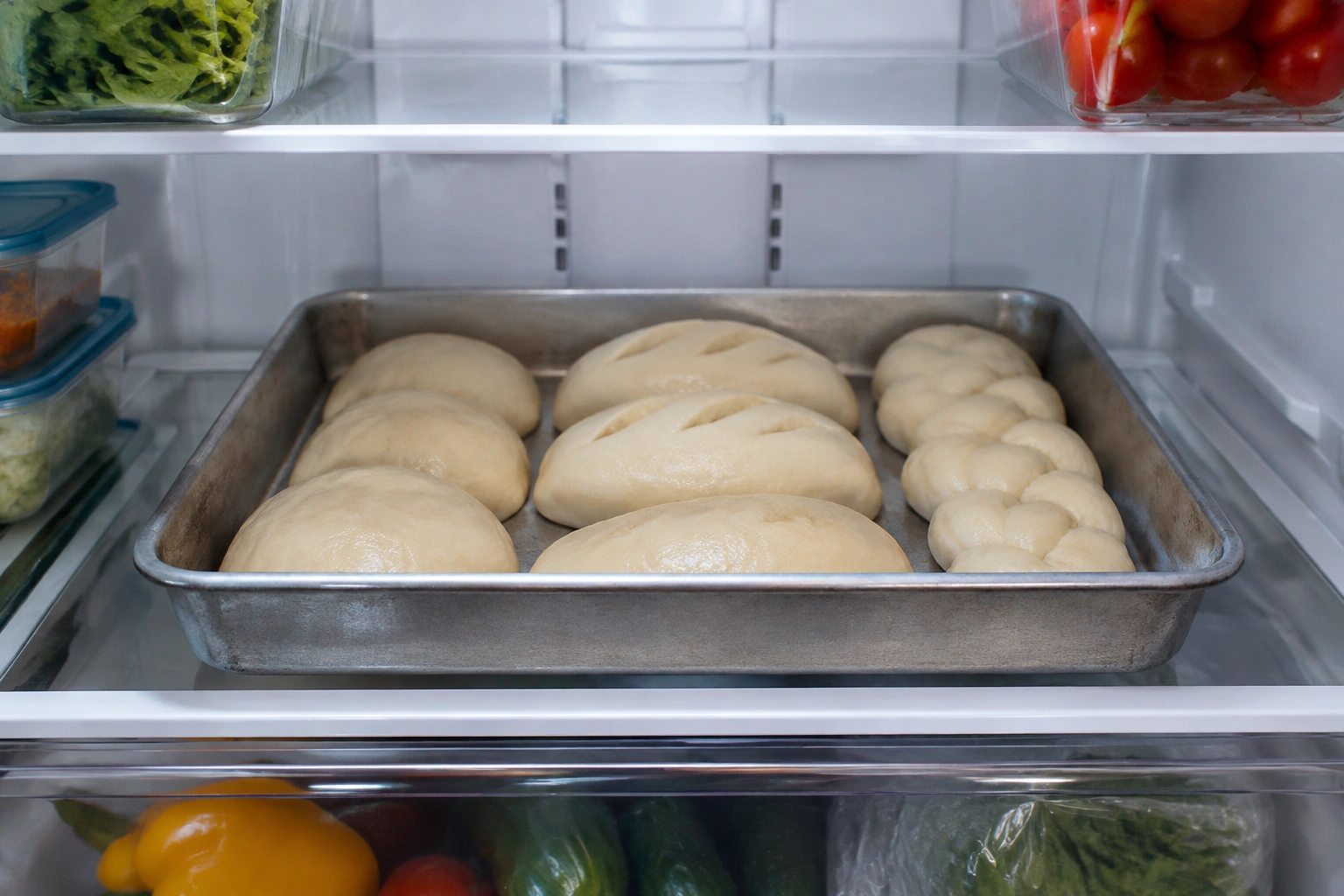
The trade-off is that shaped dough leaves less room for correction. If it was already near full proof before chilling, it may overproof while cold.
What You Need Before Chilling Dough
A little setup prevents most fridge problems.
You’ll want:
- A bowl, container, or tray with enough room for expansion
- Plastic wrap, a lid, or a reusable cover
- A light coating of oil or cooking spray if sticking is likely
- A label or note with the time you chilled it
- Clear fridge space so the dough isn’t squashed
The container matters more than many bakers realize. If the dough is packed too tightly, it can stick to the lid or get compressed as it expands. If it’s left too loose, the surface can dry out and form a skin.
For shaped dough, use a container or pan that supports the form. For bulk dough, choose a vessel with extra headroom.
How to Refrigerate Bread Dough: Step by Step
Here’s the cleanest method for most home kitchens.
-
Mix and knead the dough according to the recipe.
If the recipe includes a first rise at room temperature, let that happen unless the recipe specifically tells you to chill earlier. -
Decide whether to chill it in bulk or after shaping.
Bulk chilling gives you more flexibility. Shaped chilling gives you convenience later. -
Lightly oil the container if the dough tends to stick.
A thin film is enough. You’re not frying the dough; you just want a release layer. -
Cover the dough well.
Use a lid, plastic wrap, or a tight cover that still allows some expansion room. If you’re using plastic wrap, don’t stretch it so tightly that it clamps down on the dough. -
Leave room for rise.
The dough still expands in the refrigerator, just more slowly. An airtight container is fine if it has headroom. -
Label the time and recipe if needed.
This is especially helpful if you’re juggling multiple doughs or planning an overnight bake. -
Place it in the coldest stable part of the fridge.
Avoid the door if possible; temperature swings there are larger. -
Check it later by look and feel, not just the clock.
Dough that has chilled longer than expected may still be fine, but it should be judged by proofing signs before baking.
How Long Bread Dough Can Stay in the Fridge
This is where bakers get into trouble by looking for one exact number. The honest answer is: it depends on the dough, the yeast level, the refrigerator temperature, and how far along fermentation was before chilling.
Most home refrigerators run around 37 to 40°F (3 to 4°C). A colder fridge slows dough more and may extend the usable window a bit; a warmer fridge can let dough move faster, so it may reach full proof sooner than expected.
Here’s a practical way to think about it:
| Dough situation | Typical fridge use | Best stage to chill | Bake-from-fridge? |
|---|---|---|---|
| Lean dough, overnight | Very common | After mixing or after first rise | Often yes, with proof check |
| Lean dough, 24 to 72 hours | Works best with lower yeast and strong gluten | After mixing or after shaping | Sometimes yes, depending on proof |
| Enriched dough, overnight | Common, but needs closer monitoring | Usually after some room-temp rise | Often needs closer monitoring |
| Enriched dough, 24 to 48 hours | Possible, but more delicate | Usually after shaping only if well proofed | Often needs room-temp finishing |
| Shaped loaf or rolls, overnight | Convenient for next-day baking | After shaping | Sometimes yes, sometimes final proof needed |
| Shaped loaf or rolls, 24 to 48 hours | Best when dough was slightly underproofed before chilling | After shaping | Often yes if fully proofed |
| High-hydration dough | Can be sticky but workable | Usually after bulk fermentation | Often yes, if well supported |
A few practical guidelines:
- A few hours in the fridge is usually easy for most doughs.
- Overnight cold fermentation is a common and useful range.
- 24 to 72 hours can work for some lean doughs, especially when the recipe uses modest yeast and the dough was not close to full proof before chilling.
- Enriched doughs usually need a shorter window and closer monitoring, because sugar, butter, milk, and eggs can slow fermentation and make the dough less forgiving.
- Shaped loaves and rolls are often best for overnight refrigeration; longer storage is more likely to require a cooler fridge, less yeast, or a shorter warm-up before baking.
If a recipe was built for room-temperature proofing, don’t assume it can sit cold for days without changes. Dough with more yeast will move faster. Dough that started warm and already doubled may need less fridge time than you expect.
If you want to adapt a recipe for cold fermentation, the simplest approach is usually to reduce the yeast slightly and lengthen the schedule, rather than trying to force the same warm-rise timing into the fridge. The exact adjustment depends on the recipe, so start conservatively.
How Refrigeration Changes Rise, Flavor, and Texture
Refrigeration affects three things at once: speed, flavor, and structure.
Rise slows down
Yeast becomes much less active in the cold, so gas production slows. That’s useful when you need time. But it also means you may not see the dramatic doubling you’re used to at room temperature.
Flavor often improves
Slow fermentation gives enzymes and yeast more time to work. The result is often a bread with more complexity and less blandness. This is one reason cold fermentation is so popular for pizza dough, artisan-style loaves, and enriched breads that benefit from depth.
Texture can become better controlled
Cold dough is easier to handle in many cases, especially if it’s soft or sticky. Shape retention may improve because the dough is firmer. At the same time, if you chill too long or let the dough overproof, the gluten structure can weaken and the loaf may spread or bake dense.
The trade-off is simple: more time in the fridge usually means more flavor, but also more opportunity for the dough to drift past its best point.
How to Tell When Refrigerated Dough Is Ready to Bake
Use a combination of sight, touch, and timing.
Signs it may be underproofed
- It looks tight and dense
- It springs back very quickly when gently pressed
- It hasn’t expanded much in the fridge or after coming out
Underproofed dough usually needs more time, either cold or at room temperature, before baking.
Signs it’s ready
- It has expanded noticeably, though not necessarily doubled
- A gentle fingertip press springs back slowly
- The dough feels gassy but still holds shape
- A shaped loaf looks puffy and alive, not flat and slack
Signs of overproofing
- The dough looks fragile or collapsed
- It feels overly airy and may deflate easily
- The surface may wrinkle or flatten
- A finger press leaves a dent that doesn’t recover much
If dough is overproofed, you may still bake it, but the result is usually less dramatic oven spring and a flatter loaf.
Should You Warm Refrigerated Dough Before Baking?
Sometimes yes, sometimes no.
Bake straight from the fridge when:
- The dough is already well proofed
- The loaf is shaped and supported
- The recipe or method is designed for cold baking
- You want to score cleanly before it softens too much
This is the best option when the dough has clearly finished proofing in the fridge and holds its shape well. In that case, going straight from the fridge to the oven is usually fine.
Let it warm a bit when:
- The dough still seems underproofed
- The recipe expects a final proof at room temperature
- The dough is very stiff from the cold and needs a little relaxation
- You’re unsure whether the loaf has fully risen
A short warm-up can help the final rise finish, but don’t let dough sit so long that it becomes slack and overproofed. If you warm it, watch the dough rather than the clock.
Common Mistakes When Refrigerating Bread Dough
A few errors show up again and again.
Leaving it uncovered
This is the fastest way to get a dry skin. Even a short chill can dry the surface enough to interfere with oven spring and shaping.
Refrigerating too late
If the dough is already fully proofed or close to it, chilling may not save it. The fridge slows fermentation, but it won’t reverse overproofing.
Using one rule for every dough
Lean dough, enriched dough, and high-hydration dough behave differently. A rich brioche-style dough does not follow the same timing as a simple lean sandwich loaf.
Forgetting that the fridge is not a pause button
This is the biggest misconception. Dough still ferments cold, just more slowly. If you leave it long enough, it will keep moving.
Using a container that is too small
Dough needs room to expand. If it is squeezed, it may stick, tear, or distort.
Troubleshooting Refrigerated Dough Problems
If the dough is sluggish
Give it more time at room temperature, but only until it becomes active again. If it still feels tight and inactive, the dough may have been underproofed before chilling or the fridge may have been very cold.
If the surface dried out
Trim away a thin dry layer if needed, then proceed with shaping or baking. Next time, cover more tightly or oil the surface lightly before chilling.
If it overproofed
You can gently deflate it, reshape if the recipe allows, and give it a shorter final proof. The bake may not be perfect, but many overproofed doughs are still salvageable.
If it smells too sharp or sour
That usually means fermentation went long. Some breads can handle a stronger flavor, but if the dough is weakening, it’s probably time to bake.
Bread Dough Types That Refrigerate Well and Those That Need Care
Lean doughs
These usually refrigerate well. Think basic sandwich bread, baguette-style doughs, and many pizza doughs. They often tolerate cold fermentation beautifully, including overnight and sometimes longer cold holds.
Enriched doughs
Doughs with butter, milk, eggs, or sugar often ferment more slowly and need closer attention. They can still be refrigerated, but they are usually poorer candidates for very long refrigeration because the extra fat and sugar can slow yeast activity and make the dough more sensitive to overproofing or weakening.
High-hydration doughs
These can benefit from chilling because cold dough is easier to handle. The downside is that very wet doughs may spread if they are not supported well.
Shaped loaves and rolls
These are convenient to refrigerate, but only if they are not already overproofed. Once shaped, they have less room for correction.
Doughs that need extra care
Very rich doughs like brioche, heavily sweetened doughs, and doughs with a lot of butter or eggs are the ones to watch most closely. They can still be chilled, but they are less forgiving because the added fat and sugar slow fermentation and can make the structure softer. For those doughs, shorter refrigeration and tighter proof checks are usually safer than assuming they can sit for days.
If you want to understand why some doughs feel easier to manage than others, it helps to look at hydration too. Our guide on bread dough hydration explains how water content changes handling, texture, and crumb.
Practical Examples of Refrigerating Bread Dough
Overnight pizza dough
Mix the dough in the evening, let it begin fermenting, then refrigerate it overnight. The cold time improves flavor and makes the dough easier to stretch the next day.
Sandwich loaf for morning baking
Prepare the dough, let it rise once, then chill it after shaping or after the first rise depending on the recipe. In the morning, check proof and bake once it looks ready.
Dinner rolls for later in the day
Shape the rolls, cover them well, and refrigerate. Depending on how far along they were before chilling, they may need a short final proof before baking.
A dough that spent too long in the fridge
If the dough has become overly soft, gassy, or collapsed, treat it as a near-ready dough and move it toward the oven quickly. If it still has structure, a gentle reshape may help, but don’t expect a full recovery.
When to Consult a Master Baker
If you’re working with a rich dough, a very wet artisan dough, or a recipe you’re adapting for a long cold ferment, a master baker can help you adjust yeast, timing, and proof targets with more confidence. That’s especially useful when you’re baking for service, class, or an important event and cannot afford a weak loaf.
For most home bakers, though, the process is straightforward: chill at the right stage, keep the dough covered, and judge readiness by the dough itself rather than the clock alone.
FAQs
Can you refrigerate bread dough after kneading?
Yes. Many doughs can be chilled after kneading, especially if the recipe is designed for cold fermentation. Some recipes work better after a short room-temperature rise, so follow the method if it gives one.
Can you refrigerate bread dough before the first rise?
Yes. You can refrigerate dough right after mixing in recipes that are built for cold fermentation. This is a good option for lean doughs and for schedules where you want the longest possible chill. For beginners, though, refrigerating after the first rise is often easier to manage.
How long can bread dough stay in the fridge before baking?
A few hours to overnight is common. For lean doughs, 24 to 72 hours may also work if the recipe uses modest yeast and the dough was not close to full proof before chilling. Enriched doughs usually need a shorter window and closer monitoring.
Does refrigerated dough need to warm up before baking?
Not always. Some shaped doughs can go straight from the fridge to the oven if they are already fully proofed and supported. If the dough still seems tight or underproofed, give it a little more time before baking.
Will refrigerating dough improve flavor?
Usually, yes. Cold fermentation often gives bread a deeper, more developed flavor because fermentation happens more slowly.
Can all bread doughs be refrigerated?
Most yeast breads can be refrigerated, but enriched doughs and very delicate doughs need closer monitoring. The more sugar, butter, milk, or eggs in the dough, the more carefully you should watch timing.
How do I know if refrigerated dough is overproofed?
It may look flat, fragile, or overly puffy, and it can collapse easily when touched. If a gentle press leaves a deep dent that barely springs back, it may be past its best point.
Can I bake dough straight from the fridge?
Often yes, especially if it is already proofed and shaped. If it still seems tight or underproofed, give it a little more time before baking.
What’s the best way to keep dough from drying out in the fridge?
Cover it well. Use a lid, plastic wrap, or a sealed container with room for expansion. A light coat of oil on the container can also help prevent sticking.
Does fridge temperature affect how long dough can stay cold?
Yes. A typical refrigerator is around 37 to 40°F (3 to 4°C). A colder fridge slows proofing more, while a warmer fridge can let dough ferment faster, so timing may need to be shorter or longer depending on your appliance.