
Why Baking Powder Reacts Twice: A Clear Guide for Better Rise
If you have ever mixed a batter, watched it puff a little, and then wondered why the oven seems to make it rise again, you are looking at the two-stage behavior that gives baking powder its value in home baking. The short version is simple: baking powder is built to release gas once when it gets wet and again when heat reaches it in the oven. Baking powder reacts first when wet and again when heated, and that is why it can still rise in the oven after mixing. That timing is what helps cakes, muffins, pancakes, and quick breads rise without relying on yeast.
The part that confuses many bakers is that “reacts twice” does not mean every baking powder behaves exactly the same way in every recipe. It describes the typical action of double-acting baking powder, which is the most common type in home kitchens. Understanding that distinction helps you read recipes more confidently, mix with less guesswork, and troubleshoot flat or dense baked goods more accurately.
What “reacts twice” means in baking powder
When bakers say baking powder “reacts twice,” they mean it can create carbon dioxide in two stages.
- First reaction: happens when the powder is mixed with liquid.
- Second reaction: happens later, when heat from the oven activates more gas release.
That gas is what expands the batter or dough. As bubbles form and grow, the mixture lifts and sets into a lighter crumb.
This matters because rise is partly about timing. If the batter loses too much of that first burst before it reaches the oven, the final bake may not have enough lift left to produce a good texture.
For a simple mental picture, think of baking powder as a built-in leavener package. The first stage gives you immediate lift while mixing. The second stage gives the batter a boost after it is shaped and heated. That makes baking powder especially useful in recipes that do not have enough natural acidity to activate baking soda on their own.
What baking powder is made of
Baking powder usually contains three main parts:
- An alkaline base, usually baking soda
- An acid
- Starch, which helps keep the mixture dry and stable
In double-acting baking powder, there are typically two acid components: one that reacts when liquid is added and another that reacts more fully when heated. That is the reason it can produce gas in two stages. The starch helps prevent premature clumping and protects the mixture from moisture in storage.
This is the key reason baking powder differs from baking soda. Baking powder contains both an acid and a base, so it can work on its own in many recipes. Baking soda is only the base, so it needs acid from the recipe, such as yogurt, buttermilk, sour cream, citrus juice, or another acidic ingredient, to produce gas.
If you want a deeper comparison of the base ingredient itself, see our guide to whether baking soda is alkaline.
The first reaction: what happens when liquid is added
The first reaction begins as soon as baking powder is moistened. The acid and base start producing carbon dioxide gas, which forms tiny bubbles in the batter.
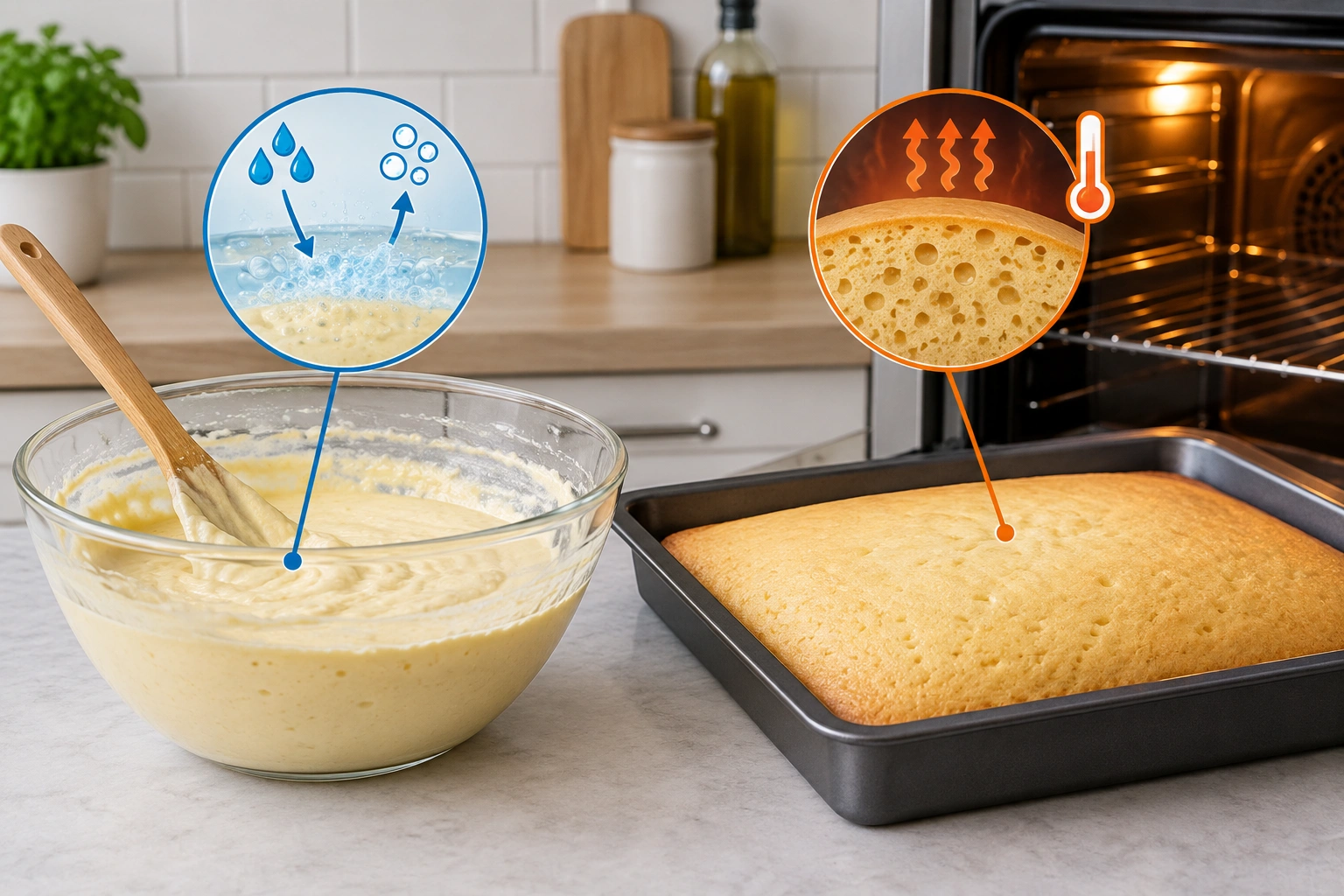
That initial reaction is one reason many quick breads and muffins seem to “wake up” as soon as they are mixed. You may notice the batter looks slightly aerated or fuller than it did in the bowl a moment earlier.
Here is the practical part: once that first reaction starts, the batter should not sit around for long. Bake soon after mixing, especially for pancakes and muffins, because waiting too long can reduce lift. Some recipes tolerate a short delay better than others, but recipes that depend heavily on baking powder usually perform best when they go into the oven promptly.
A pancake batter mixed early in the morning and cooked much later may not rise as well as one cooked soon after mixing. The same idea applies to muffins and cakes that depend on immediate oven time for their best volume.
The second reaction: what heat does in the oven
The second reaction happens when the batter enters the oven and the heat continues the gas release. This stage helps push the batter upward while the structure is still soft enough to expand.
As the batter warms, the bubbles inside the mixture expand and the crumb begins to set. That combination of gas production and setting structure is what gives baked goods their final shape.
This is why oven heat is not just about cooking the batter. It also supports the leavening process. If the batter is overmixed or delayed too long before baking, there may not be enough gas left to create a strong second rise.
In practice, the oven stage is what turns a foamy batter into a finished cake or muffin with volume.
Double-acting vs. single-acting baking powder
Not all baking powder behaves the same way. The most common type in home baking is double-acting baking powder, which is designed to react in two stages.
Double-acting baking powder
- Reacts once when mixed with liquid
- Reacts again when heated
- More forgiving for everyday home baking
This is the version most recipes assume unless they say otherwise. It gives you a little protection if the batter sits briefly before baking, because some lift remains for the oven stage.
Single-acting baking powder
- Reacts mostly once, usually when moistened
- Needs quicker handling
- Less common in standard home baking
Single-acting baking powder behaves differently because it does not reserve as much leavening action for the oven. That means timing matters more. If a recipe or product specifically calls for it, the formula is usually built around fast baking and minimal delay.
For most beginner bakers, the useful rule is straightforward: if a recipe simply says “baking powder,” it usually means double-acting unless the recipe notes otherwise.
Baking powder vs. baking soda: when each one is the right choice
This is one of the most common points of confusion, and it causes a lot of baking problems.
Use baking powder when:
- The recipe does not contain enough acid to activate baking soda
- You want a built-in leavener
- The formula is meant to rise without depending on acidic ingredients
Use baking soda when:
- The recipe contains enough acid to react with it
- The recipe is specifically formulated for soda’s stronger, faster reaction
- You want the acid-base balance of the recipe to stay in sync
The difference matters because baking powder already contains both an acid and a base, while baking soda needs acid from the recipe. That makes baking powder more self-contained and easier to use in cakes, muffins, biscuits, and pancakes where the ingredient list may be relatively neutral.
If you want a companion explanation of the base side of this comparison, our article on the pH of baking soda explains why it behaves differently in batter.
How timing and mixing affect the rise
Baking powder can only do its job if the batter is handled with the right timing.
The biggest issue is delay. If a batter depends on the first reaction for part of its lift, letting it sit too long can weaken the final result. This is especially noticeable in pancakes, muffins, and quick breads.
Mixing method matters too. Overmixing can knock out some of the bubbles already formed and can also develop too much gluten in wheat-based batters, which makes the finished texture tougher. A batter does not need to be beaten smooth for baking powder to work. It needs to be combined evenly, then baked in a reasonable window.
A practical example: if you fold a muffin batter until the dry ingredients are just incorporated and then spoon it into tins right away, you preserve more of the initial gas. If you keep stirring while you answer a text, preheat the oven, and line the pans later, you may lose some of that early lift.
How to tell if baking powder is still active
Expired or weak baking powder is one of the easiest reasons for flat baked goods.
Signs it may be past its best include:
– It has been open for a long time
– The container was stored in a warm, damp place
– Your recent bakes have been unusually dense or low-rising
A simple freshness test can help. Stir a small amount of baking powder into hot water. If it foams promptly, that is a good sign it is still active. If the reaction is weak or absent, it may no longer be reliable.
This test is useful because a recipe can be perfectly fine and still underperform if the leavener has lost strength. In that case, the problem is not technique alone.
For a precise measuring reference when you replace or compare amounts, our guide to converting baking powder teaspoons to grams can help.
How much baking powder to use and what happens if you use too much
Recipes usually give the best starting point, so it is wise to follow the formula rather than guessing. Baking powder amounts are typically calibrated for the recipe’s flour, liquid, structure, and bake time, so changing them should be done cautiously. Too little baking powder may leave the crumb dense. Too much can create a different problem: fast rise, uneven texture, or collapse after the structure cannot support itself.
Excess baking powder can also leave an unpleasant taste. That off-flavor is one reason “more lift” is not always better.
A useful decision rule is this: if a recipe already includes a balanced amount of baking powder, adding extra is not a shortcut to higher rise. It may simply push the batter past the point where the structure can set cleanly.
If a cake rises sharply and then sinks in the center, the cause may be too much leavener, but it can also be underbaking, weak structure, or a batter that was handled too aggressively. Baking powder is part of the equation, not the whole story.
Common baking problems caused by timing or freshness
Here is how the science usually shows up in real baking.
Flat muffins or pancakes
Often caused by batter that sat too long, weak baking powder, or too little leavener in the formula.
Dense cake crumb
Can happen when the baking powder is expired, the batter was overmixed, or the recipe was not baked promptly after mixing.
Over-risen then collapsed baked goods
Often points to too much baking powder, a structure that set too late, or a batter that rose faster than it could hold its shape.
Uneven tunnels or coarse texture
May come from excess leavener or uneven mixing, where pockets of gas form too quickly in some parts of the batter.
These are not the only causes, but they are common enough that baking powder should always be part of the troubleshooting checklist.
Quick comparison: baking powder choices and baking outcomes
| Decision point | What to know | Practical takeaway |
|---|---|---|
| Baking powder vs. baking soda | Baking powder contains its own acid; baking soda needs acid from the recipe | Use baking powder for neutral batters and soda for acidic formulas |
| Double-acting vs. single-acting | Double-acting reacts in the bowl and again in the oven; single-acting mostly reacts once | Double-acting is usually the safer choice for home baking |
| Fresh vs. expired baking powder | Fresh powder foams well in hot water; weak powder may not | Test old containers before blaming the recipe |
| Batter timing | The first reaction starts when liquid is added | Bake promptly when the recipe depends on immediate lift |
Quick decision guide for using baking powder correctly
When you are standing in the kitchen and trying to decide what to do, use this simple sequence:
- Check the recipe type. If it is a neutral cake, muffin, or quick bread, baking powder is often the right leavener.
- Look at the ingredient list. If there is plenty of acid, the recipe may be designed for baking soda instead.
- Confirm the baking powder is fresh. A quick hot-water test can save a batch.
- Mix just until combined. Avoid extra stirring after the dry ingredients are added.
- Bake without unnecessary delay. This protects the first burst of gas and supports the second one in the oven.
That approach takes the mystery out of the ingredient. You do not need to memorize chemistry formulas to use baking powder well. You only need to understand that it is built to work in two stages, and that both stages matter.
Troubleshooting takeaway for home bakers
If your baked goods are not rising the way they should, start with the basics: check freshness, follow the recipe amount as written, and get the batter into the oven promptly. Those three steps solve many common baking powder problems before you start changing the formula.
The main lesson is simple: baking powder works best when you respect the recipe, mix gently, and bake soon after combining the wet and dry ingredients.

