
Why Cake Batter Curdles and How to Fix It Without Ruining the Cake
If you’ve ever mixed a butter cake and watched the batter turn grainy, lumpy, or slightly separated, you’re not alone. That moment is unsettling, especially when you’ve followed the recipe carefully. The good news is that curdled batter is often a mixing problem, not a baking disaster.
In most butter-based cakes, curdling happens when the emulsion loses stability. Butter, eggs, milk, and sugar are supposed to blend into a smooth, unified batter. When that balance is disturbed, the mixture can look broken before it comes back together. Sometimes it does recover with a little more mixing. Sometimes it needs a small adjustment. And sometimes the batter is too far separated to fully smooth out, though it may still bake into an acceptable cake depending on the recipe and how badly it split.
This guide explains why cake batter curdles and how to fix it, how to tell normal roughness from a real problem, and how to prevent it the next time you make a butter cake.
What Curdled Cake Batter Looks Like
Curdled batter usually shows up as a batter that looks broken rather than creamy. You may see tiny lumps, flecks of butter, a grainy texture, or a mixture that appears to have both thick and loose parts at the same time. It can also look slightly greasy around the edges of the bowl.
A slightly curdled batter often still holds together as one mixture. A badly split batter tends to look more dramatic: the fat looks separated, the liquid seems to pool, and the mixture no longer looks cohesive.
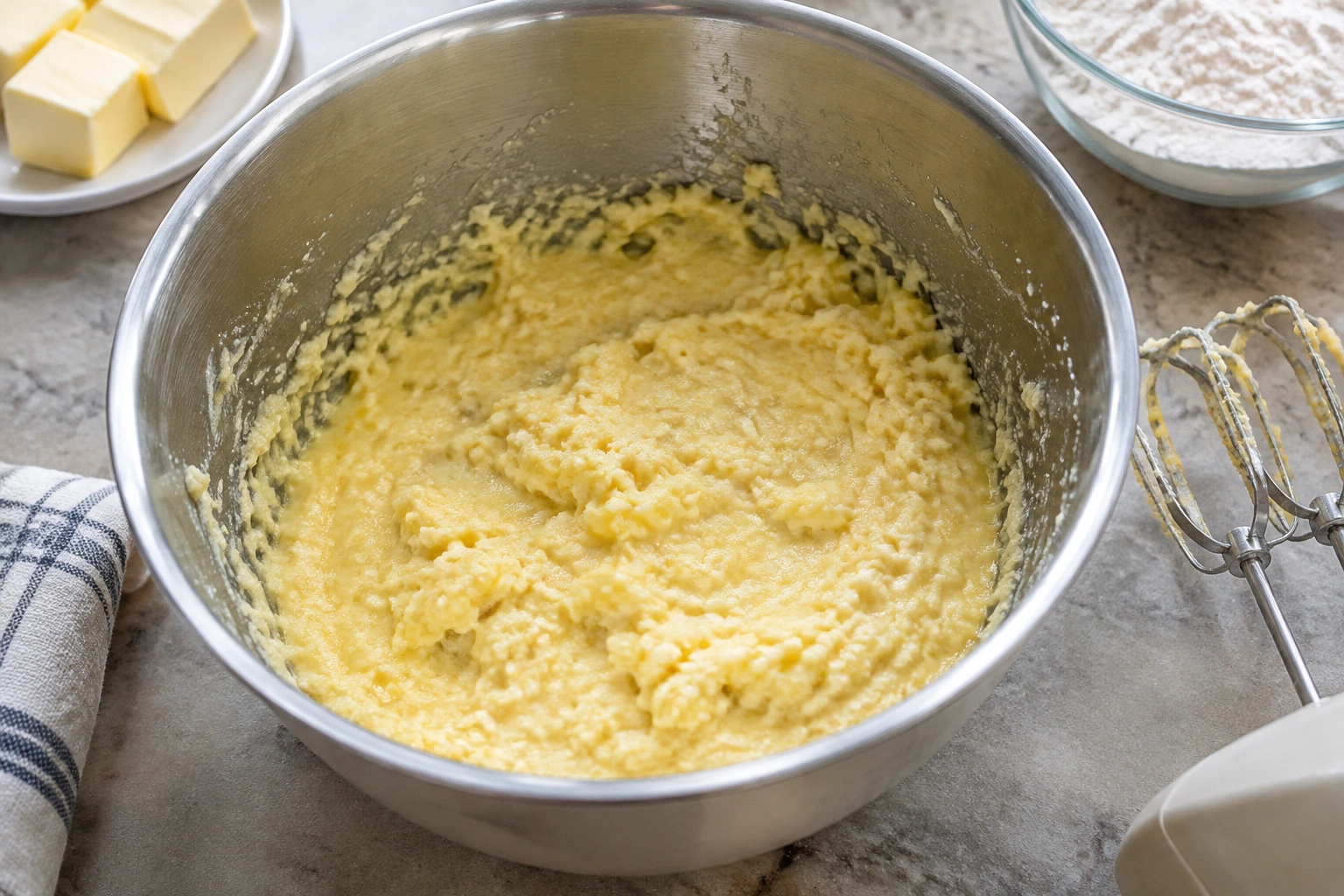
A useful visual test is this: if the batter still resembles batter, even if it is rough, it may be recoverable. If it looks like two different mixtures sitting in the bowl, the emulsion has broken more seriously.
Quick Triage: What to Do Right Now
- Stop and look at the batter.
- Check whether flour has already been added.
- Decide whether the batter is slightly curdled or badly split.
- Take the matching action below.
| Situation | What it looks like | What to do |
|---|---|---|
| Before flour, slightly curdled | Small flecks, graininess, batter still mostly unified | Mix briefly and reassess |
| Before flour, badly split | Oily sheen, clear separation, liquid pooling | Check ingredient temperature; warm gently if needed, then mix briefly |
| After flour, slightly rough | Not perfectly smooth, but still cohesive | Stop mixing once combined |
| After flour, badly split | Batter remains broken even after careful mixing | Do not keep beating indefinitely; decide whether to bake, adjust, or start over |
Why Cake Batter Curdles During Mixing
Butter cakes depend on a stable emulsion. In simple terms, that means fat and liquid need to stay blended instead of separating. The creaming method helps by beating butter and sugar together first, which traps air and creates a structure that can accept eggs and liquid later.
Curdling usually happens when that structure is overwhelmed.
Cold Ingredients Can Shock the Batter
One of the most common causes is temperature mismatch. If cold eggs or cold milk go into softened butter, the butter can firm up in small pieces instead of staying smooth. That makes the batter look curdled even if the recipe is otherwise sound.
Eggs Added Too Fast Can Break the Emulsion
Eggs are a major source of liquid in cake batter, and they need time to blend in. If you pour them in all at once, the batter can’t absorb them evenly. The mixture may look curdled because the fat and liquid have not had time to re-form a stable emulsion.
Too Much Liquid at Once Can Overload the Batter
Milk, cream, sour cream, or other liquids can also cause separation if they are added too quickly. A batter that was smooth a moment ago may suddenly look grainy or loose because the fat phase has been diluted before it can catch up.
The Batter May Simply Be at a Stage of Transition
Sometimes what looks like curdling is a normal stage in the mixing process. A batter can briefly look rough or broken after an addition, then smooth out after a short mix. That is especially true if the recipe uses the creaming method and the eggs are added gradually.
The key is to watch whether the batter is improving. If it becomes smoother after a little more mixing, you likely saw a temporary separation rather than a true failure.
Is It Really Curdled, or Just a Normal Stage?
Not every lumpy batter is a problem. Some batters look imperfect for a moment and then come together. Others are genuinely split and need intervention.
Here is a practical comparison:
| What you see | What it usually means | What to do |
|---|---|---|
| Slight graininess, small flecks, batter still mostly unified | Mild curdling or a temporary split | Mix a little longer and reassess |
| Visible separation, oily sheen, batter looks broken into distinct parts | Emulsion is struggling | Check ingredient temperature and consider gentle warming |
| Batter smooths out after a short mix | Normal recovery stage | Proceed once it looks cohesive |
| Batter stays broken and greasy after reasonable mixing | Serious splitting | Stop and evaluate whether it can be saved |
| Rough batter after flour is added | May be normal if it is just coming together | Mix only until combined |
A useful distinction: curdling happens before the batter is fully stable. Overmixing is different. Overmixing usually shows up later, after flour is added, and it can make the final cake tougher rather than merely broken-looking.
How to Fix Curdled Cake Batter
The right fix depends on how far the batter has separated. The goal is to restore the emulsion without pushing the batter into overmixing.
1. Stop and Assess First
Before you do anything else, pause and look at the batter. Ask two questions:
- Has flour already been added?
- Is the batter only slightly curdled, or is it badly split?
That quick check tells you whether to keep mixing, warm the batter gently, or stop and move on.
2. Mix a Little Longer if It Is Only Slightly Curdled
If the batter is only slightly curdled and still mostly unified, continue mixing briefly. Many batters come back together with a short additional mix after eggs or liquid have been added gradually.
Watch the bowl closely. If the mixture becomes smoother and more uniform, stop there. Once the batter has recovered, there is no advantage in beating it endlessly.
3. Warm Gently if the Batter Is Cold and Badly Split
If the mixture looks broken because the ingredients are too cold, gentle warming can help. Set the bowl over a barely warm surface for a brief moment, or let it sit at room temperature and mix again. The aim is to soften the butter in the batter, not melt it.
Be careful here. If the butter melts, the batter can become greasy and unstable in a different way. Gentle is the key word.
4. If Flour Is Already In, Stop Once It Comes Together
Once flour is added, the rules change. At that point, you want to mix only until the batter comes together. If you keep beating a flour-containing batter aggressively in the hope of fixing curdling, you may create a tougher cake.
If the batter is only slightly rough after flour is added, that may be acceptable. Many cake batters do not look perfectly silky at the final mixing stage.
5. Proceed As-Is if It Is Cohesive Enough
If the batter is mostly combined and only a little rough, it may be better to stop than to chase perfection. Slight curdling does not automatically ruin a cake. The main question is whether the batter is cohesive enough to portion and bake evenly. If it is, move on.
When to Keep Going and When to Start Over
This is the decision that matters most.
Keep going if:
– the batter is only slightly grainy or lumpy,
– the mixture still looks mostly unified,
– and a short extra mix is making it smoother.
Try gentle correction if:
– the batter looks broken right after eggs or milk are added,
– the bowl feels cold,
– and the recipe uses butter as the main fat.
Consider starting over if:
– the mixture is badly separated,
– oil or liquid is clearly pooling apart from the fat,
– and several careful mixing attempts have not brought it back.
A batter that remains badly split may still bake, but the finished cake can vary by recipe and by how severe the separation is. It may turn out dense, uneven, or slightly coarse in crumb, or it may be acceptable enough for a casual bake. If the recipe matters and you want a reliable result, restarting may be the better call.
How to Prevent Cake Batter from Curdling Next Time
Prevention is mostly about controlling temperature, mixing order, and how quickly ingredients are added.
Use Ingredients That Are Ready to Blend
Butter cakes are much easier to manage when the butter, eggs, and dairy are all in a similar state before mixing. That does not mean every ingredient must be identical, but they should not be dramatically different in temperature.
If one ingredient is icy and another is soft, the batter is more likely to split.
Follow the Mixing Order Carefully
In a creamed butter cake, the early stage matters. Butter and sugar should be properly creamed before eggs go in. That gives the batter structure and helps it accept the liquid phase.
After that, add eggs gradually. If the recipe alternates dry ingredients with milk or another liquid, follow that order rather than improvising. The sequence is there to protect the emulsion.
Don’t Rush the Early Stage
A batter that looks smooth at the start can still curdle if the ingredients are added too aggressively. The first few minutes of mixing set up the whole cake.
That does not mean you need to overbeat. It means you should give each addition time to blend before moving on.
Butter Cakes vs Oil-Based Cakes: Why Some Batters Curdle More Easily
Butter cakes are built around air, fat, and emulsification. That makes them tender and flavorful, but also more sensitive to ingredient temperature and mixing order.
Oil-based cakes usually mix more smoothly because oil stays liquid and disperses differently. They are less likely to show the same broken, curdled look during mixing. Butter batters, by contrast, can look stable one minute and split the next if the eggs or liquid are added too quickly.
That sensitivity is not a flaw. It is simply part of the method. Once you understand it, the batter becomes easier to manage.
What Happens to the Finished Cake If the Batter Stayed Slightly Curdled
If the batter was only slightly curdled and you baked it anyway, the cake may still turn out well. The crumb might be a little less even, but the difference is often minor.
If the batter stayed visibly broken, the finished cake may be denser or less uniform. In more noticeable cases, the texture can be coarse or slightly heavy. The cake may still be edible and usable, but it is less likely to have the fine, even crumb you want from a well-made butter cake.
That is why the decision point matters. A slightly rough batter is often fine. A badly separated batter is more of a gamble.
Practical Troubleshooting Example
Imagine you are making a vanilla butter cake. The butter and sugar cream well, but after the second egg goes in, the batter looks grainy and a little broken. You mix for another 20 to 30 seconds, and it smooths out. That is a normal recovery.
Now imagine a different batch. The butter is soft, but the eggs are cold from the fridge. You add them all at once, and the batter turns lumpy and oily. In that case, the batter likely needs gentle warming and slower mixing. If it still looks broken after that, you may need to accept a less-than-perfect result or start fresh.
Those two situations can look similar at first glance, but the response is different.
A Simple Rule of Thumb
If the batter is only slightly rough and still moving toward smoothness, keep mixing briefly and then stop.
If it looks broken, cold, and greasy, correct the temperature and the addition order.
If it stays badly separated after reasonable effort, do not keep beating it indefinitely. At that point, you are more likely to make the batter worse than better.
FAQ
Can I still bake curdled batter?
Yes, in many cases you can still bake it if the batter is only slightly curdled or if it becomes cohesive again after a short mix. If it stays badly split, the cake may still bake, but the result can vary by recipe and by how severe the separation is.
What does curdled cake batter look like?
It usually looks grainy, lumpy, or slightly broken, with tiny flecks of butter or a greasy sheen. A mildly curdled batter still looks like one mixture. A badly split batter looks like the liquid and fat have separated into distinct parts.
When should I stop mixing?
Stop as soon as the batter looks cohesive. If flour is already in the bowl, mix only until combined. If you keep beating after that, you risk overmixing the flour and making the cake tougher.
Is a slightly rough batter always a problem?
No. Some cake batters are not perfectly smooth at the end of mixing and still bake well. The main concern is whether the batter is stable enough to bake evenly.
Final Takeaway
Curdled cake batter usually means the emulsion has been stressed, not that the cake is ruined. Cold ingredients, fast additions, and butter-based formulas are the most common reasons it happens. In many cases, a little more mixing or a gentle temperature adjustment is enough to bring the batter back together.
The best habit is to watch the batter as you go. If it is only slightly rough, keep going carefully. If it is badly separated, stop and assess before making it worse. Once you learn the difference, this problem becomes much easier to manage.

