
Why Does Baking Soda React to Vinegar? A Clear Kitchen Science Guide
If you have ever mixed baking soda with vinegar and watched it foam up right away, you have seen a simple acid-base reaction in action. In plain terms, the vinegar and baking soda react because one is acidic and the other is alkaline. When they meet, they create carbon dioxide gas, and that gas is what makes the mixture fizz and bubble.
That reaction is easy to show in a kitchen, but it also causes a lot of confusion. Some readers want the science. Others want to know whether the same reaction helps a cake rise. And plenty of home bakers just want to know why the bubbles stop after a short burst.
Here is the short version: baking soda reacts to vinegar because the acid in vinegar and the base in baking soda neutralize each other and release gas. The visible fizz is the gas escaping through the liquid.
What baking soda and vinegar actually are
Baking soda is sodium bicarbonate. In baking, it acts as a base. Vinegar is mostly water with acetic acid, so it behaves as an acid.
That acid-base pairing is the key. Baking soda does not fizz just because it is “powdery,” and vinegar does not fizz on its own. The reaction happens because the two ingredients can interact chemically. When they do, they form new substances instead of simply mixing together.
A helpful way to think about it is this: baking soda is waiting for an acid. Vinegar provides that acid. Once they touch, the reaction starts quickly.
For readers who want a deeper look at the alkaline side of baking soda, this guide to baking soda pH connects the reaction to baking behavior in more detail.
Why the mixture fizzes and bubbles
The fizz is carbon dioxide gas.
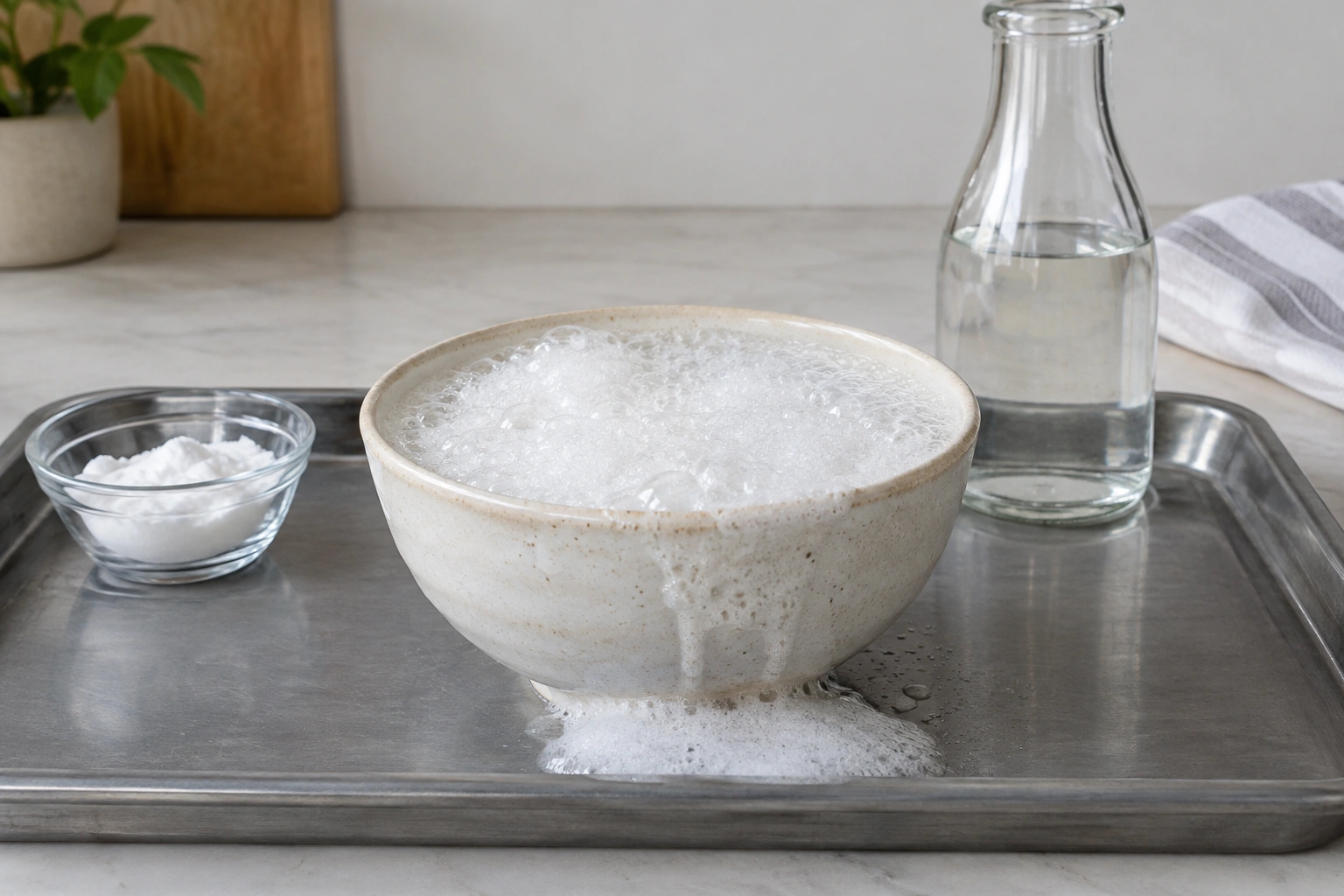
That gas forms during the reaction and tries to escape. Because it starts out trapped in the liquid, it shows up as tiny bubbles first. Those bubbles rise to the surface and burst, which is why the reaction looks foamy and active.
This is the part most people notice, but the gas is the real story.
A small bowl of vinegar with a spoonful of baking soda will give you a quick burst of fizz. A wider container usually makes the reaction easier to see because the foam has more room to spread out instead of climbing straight up.
The simple chemical equation
If you want the basic chemistry, the reaction is commonly written like this:
sodium bicarbonate + acetic acid → sodium acetate + water + carbon dioxide
In formula form, that is often shown as:
NaHCO₃ + CH₃COOH → CH₃COONa + H₂O + CO₂
You do not need to memorize the equation to understand the kitchen version of the reaction. The important part is that carbon dioxide is produced, and that gas creates the fizz. The other products are water and sodium acetate, which remain in the liquid after the bubbling slows down.
Why the reaction stops
The fizz does not keep going forever. It stops when one of the ingredients has been used up.
That is why leftovers matter. If you use too much baking soda, you may see white powder still sitting in the bowl after the bubbling ends. That means there was not enough acid in the vinegar to react with all of it. If you use too much vinegar, the mixture may stay liquidy and sour-smelling after the fizz fades because some vinegar is left over.
This is a useful rule for both science demos and baking: the reaction ends when the limiting ingredient is gone. More of the other ingredient will not restart the fizz unless there is still something left for it to react with.
How this reaction relates to baking
In baking, baking soda is not just a fizzing ingredient. It is a leavener when it reacts with an acid in a recipe.
That acid can come from ingredients such as buttermilk, yogurt, brown sugar in some formulas, citrus juice, molasses, or cocoa that has not been processed in a way that removes acidity. When baking soda meets one of those acidic ingredients, it can release carbon dioxide inside batter or dough. Those gas bubbles can help lighten the texture, depending on the recipe structure and mixing method.
That said, a vinegar-and-baking-soda experiment is not the same thing as proper recipe leavening. In a recipe, the goal is controlled gas production inside a batter that can trap and hold the bubbles long enough to bake into a lighter crumb. In a science demo, the goal is usually a dramatic, fast reaction that is easy to see.
For a concrete example, baking soda can work well in a recipe like chocolate cake or quick bread if the batter already includes an acidic ingredient such as buttermilk or yogurt. Baking powder is the better choice in a recipe like plain muffins or many sugar cookies when there is little or no added acid, because it brings its own acid and does not depend on vinegar or another acidic ingredient.
So if you are baking, follow the recipe. Do not swap in a vinegar fizz just because it looks similar.
Baking soda vs. baking powder
These two ingredients are easy to confuse, but they are not the same.
Baking soda is a single alkaline ingredient that needs an acid to react. Baking powder already contains baking soda plus an acid, so it can create gas on its own when moisture is added, and in many cases again when heated, depending on the type.
Here is a simple comparison:
| Ingredient | What it needs to react | What it does in a recipe | What it does in a demo |
|---|---|---|---|
| Baking soda | An acid | Neutralizes acidity and helps produce rise | Fizzes strongly when vinegar is added |
| Vinegar | A source of acid | Helps trigger baking soda in a formula | Provides the acid for a visible reaction |
| Baking powder | Moisture, and often heat | Provides controlled leavening without extra acid from the recipe | Usually not used for the classic vinegar fizz |
If a recipe calls for baking powder, do not replace it with baking soda and vinegar unless the recipe is specifically designed for that change. The balance will be off, and the final texture can suffer.
For a more detailed look at the alkaline side of baking soda in recipes, see Is Baking Soda Alkaline?.
What changes the strength of the fizz
Several practical factors affect how vigorous the reaction looks.
The amount of each ingredient
More baking soda or more vinegar can create a bigger reaction, but only up to the point where the other ingredient can still react with it. If one ingredient is in short supply, the extra amount just becomes leftover material.
Vinegar strength
Stronger vinegar generally gives the baking soda more acid to react with, so the fizz may look more active. Mild vinegar can still react, but the result may be less dramatic.
Container size
A small cup can make the foam climb quickly and overflow. A wider bowl spreads the reaction out and gives the bubbles more room. For a child-friendly demo, a shallow bowl is usually easier to manage than a narrow bottle.
Temperature
Temperature can influence how fast the reaction seems to move, but it is usually a minor factor compared with ingredient amounts and vinegar concentration. A warmer or cooler room may change the timing a little, but it is not the main driver of the fizz.
The main decision rule is simple: if you want a neat demonstration, use a wider container and smaller amounts. If you want a bigger visual effect, use a little more mixture, but be ready for more mess.
A safe at-home demonstration
A simple demo can be done with a bowl, a spoon, baking soda, and vinegar.
Put the bowl on a tray or sink-safe surface. Add a small spoonful of baking soda, then pour in a small amount of vinegar. Step back and watch the fizz.
For a small classroom or kitchen demo, a rough starting point is about 1 teaspoon of baking soda with 2 to 3 teaspoons of vinegar. That is enough to show the reaction clearly without making the foam too hard to manage.
A few practical safety points matter here:
- Use an open container, not a sealed one.
- Keep the amounts small so the foam stays manageable.
- Supervise children closely.
- Avoid eye contact and wash hands after handling the mixture.
- Clean up spills right away because the liquid can make the floor or counter slippery.
Do not put the mixture into a closed bottle or jar and cap it. Gas buildup can create pressure, and that is not a safe way to demonstrate the reaction.
If you want a simple kitchen experiment that is easy to control, a bowl is better than a narrow container. The wider surface gives the foam room to spread instead of shooting upward.
Cleanup and what is left behind
After the fizz ends, you may see one of three things: a clear liquid, leftover white powder, or both.
A clear or slightly cloudy liquid usually means the reaction finished and the products are left behind in the bowl. White powder means extra baking soda was not fully reacted. A strong vinegar smell or excess liquid usually means there was more vinegar than baking soda could use.
Cleanup is straightforward. Wipe the area with water and a cloth, then dry it so the surface is not slippery. If powder remains, dissolve or wipe it away with water rather than brushing it around the kitchen, which can spread the mess.
This is another reason small-scale demos work best. They show the chemistry without leaving a large cleanup job.
Common questions about baking soda and vinegar
Does the type of vinegar matter?
Yes, at least somewhat. Vinegar is an acid, but different vinegars can vary in strength and flavor. For a simple demo, plain household vinegar is usually the easiest choice because it is predictable and inexpensive.
What happens if I use too much baking soda?
You will likely see leftover white powder after the fizzing slows down. That means there was not enough acid to react with all the baking soda.
What happens if I use too much vinegar?
The reaction may still fizz, but you can end up with extra liquid and a stronger vinegar smell after the bubbling ends.
Is this reaction safe for kids?
It is generally a common home demonstration when done in small amounts and with supervision. The main risks are mess, slippery spills, and pressure buildup if the mixture is sealed in a container.
Is this the same thing as baking powder?
No. Baking powder is a complete leavening system. Baking soda and vinegar are a separate acid-base reaction that can be used for a demo or in a recipe only when the formula is designed for it.
When to use this reaction in baking, and when not to
Use baking soda with an acidic ingredient when a recipe calls for it. That is how the reaction becomes useful inside batter or dough.
Use baking soda and vinegar together mainly as a science demonstration unless the recipe specifically includes both. The fizz is fun to watch, but in baking, uncontrolled bubbling is not the goal. Texture, flavor, and timing matter too much for that.
A good baker learns the difference between a visible reaction and a useful one. The same chemistry can serve two very different purposes: a controlled rise in a recipe, or a simple fizz in a bowl.
Final takeaway
Baking soda reacts with vinegar because one is a base and the other is an acid. Their reaction produces carbon dioxide gas, and that gas creates the bubbles and fizz you can see.
Once you understand that, the rest becomes easier to predict. More of one ingredient does not make the reaction endless. Baking soda and baking powder are not interchangeable. And a vinegar fizz is a useful demo, but it is not a substitute for a properly balanced baking recipe.
If you can explain that in plain language, you already understand the kitchen science behind one of the most familiar reactions in baking.

