
Why Sourdough Bread Goes Flat — and How to Fix It for a Taller Loaf

A flat sourdough loaf can be frustrating because it usually looks like one problem, but it often comes from several small ones stacking together. Maybe the dough spread in the basket, maybe it felt slack during shaping, or maybe it rose well and then lost height in the oven. The good news is that flatness is usually diagnosable once you look at the loaf, the dough, and the process together.
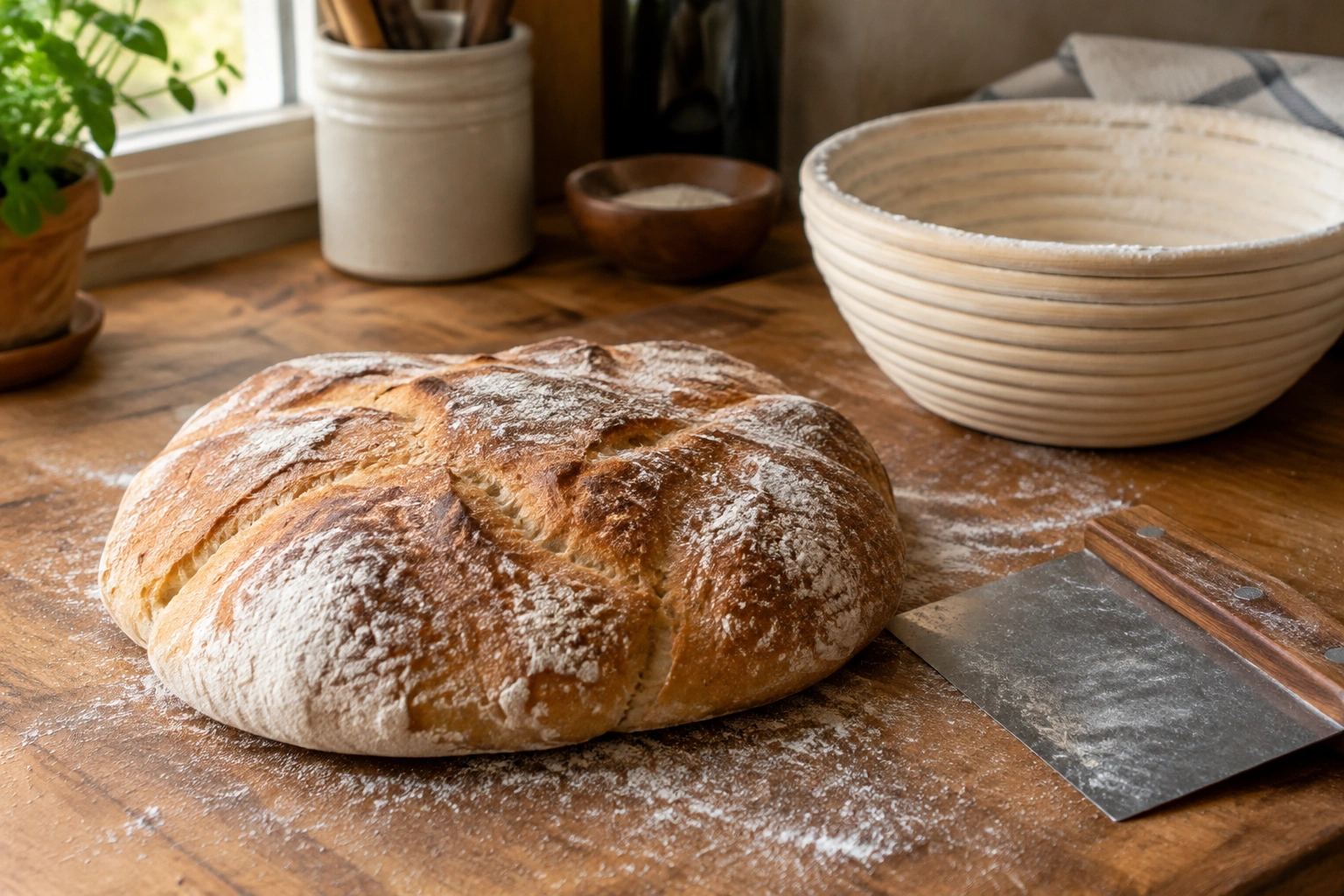
I like to think of sourdough structure as a three-part system: fermentation creates gas, gluten traps that gas, and baking locks everything in place. If any one of those pieces is weak, the loaf can spread instead of rising. That’s why the fix is rarely “just use more flour” or “just proof it longer.” The real answer depends on where the structure broke down.
Why sourdough bread turns out flat
A sourdough loaf goes flat when it doesn’t have enough strength to hold its shape before and during baking. That weakness can come from:
- Starter that isn’t active enough to ferment the dough consistently
- Hydration that’s too high for the flour strength
- Bulk fermentation that went too short or too long
- Weak shaping and poor surface tension
- Final proofing that pushed the dough past its limit
- Scoring, steam, or oven setup that limited oven spring
In other words, flatness is not one diagnosis. It’s a signal.
A loaf can be flat and still taste good. It can also be flat because it was underproofed, overproofed, or simply too weak to support the amount of water in the dough. That’s why the first step is to read the loaf carefully instead of changing five variables at once.
How to diagnose the problem by loaf texture and shape
The shape and crumb tell you a lot. Here’s a practical way to narrow it down.
| What you see | Likely issue | What it usually means | Best next adjustment |
|---|---|---|---|
| Flat loaf with a fairly open crumb | Often overproofed or weakly shaped | Gas was produced, but the dough lost strength before baking | Shorten fermentation slightly or improve shaping tension |
| Flat loaf with a tight, dense crumb | Often underproofed or underdeveloped | Dough didn’t ferment enough or didn’t build enough structure | Extend bulk fermentation or strengthen gluten development |
| Flat loaf with a gummy crumb | Fermentation imbalance or baking issue | The loaf may be over- or under-fermented, or baked without enough heat | Recheck proofing cues and baking setup |
| Loaf rose in the basket but spread after scoring | Weak surface tension or fragile dough | Shape held briefly, then collapsed when tension was released | Improve shaping and reduce slackness in the dough |
| Loaf looked good before baking, then stayed low in the oven | Limited oven spring | Steam, heat retention, scoring, or dough strength may be the bottleneck | Use better heat/steam support and score more decisively |
A useful rule:
– Flat + open crumb often points to too much fermentation or a dough that stretched beyond its strength.
– Flat + dense crumb usually points to not enough fermentation or not enough gluten development.
– Flat + gummy crumb often means the process was off somewhere between fermentation and bake.
That distinction matters because the fix for one can make the other worse.
Before you start: what to check first
Before changing your formula, check these basics:
- Starter readiness
- Flour type and protein level
- Hydration percentage
- Dough temperature
- Room temperature
- Your proofing vessel and baking setup
If you adjust everything at once, you won’t know what helped. For troubleshooting, change one major variable at a time. For example, if you reduce hydration and also extend bulk fermentation, you may get a better loaf but still not know why.
A simple notebook entry helps a lot: flour used, starter condition, room temp, bulk time, final proof, bake vessel, and whether the loaf spread or sprang.
Check your starter strength
A weak starter can absolutely contribute to a flat loaf, but it’s worth being precise about what “weak” means. The starter does two jobs: it produces gas and it helps acidify the dough, which affects fermentation and gluten behavior. If it’s sluggish, the dough may rise slowly and unevenly. If it’s overly acidic or past peak, it may not have the lift you expect.
A practical readiness test is simple: feed your levain and use it when it reliably doubles, or nearly doubles, after feeding under your usual conditions. That gives you a concrete benchmark instead of guessing based on smell alone.
Signs your starter may be too weak for dependable rise:
- It rises slowly after feeding
- It doesn’t show a clear, predictable peak
- It smells more sharp and tired than pleasantly fermented
- It struggles to double or near-double in a reasonable time under your usual conditions
A mature, ready starter should be active, predictable, and recently peaked or near peak when you mix the dough. If you’re unsure, build a levain and watch whether it rises consistently before you bake with it.
If your starter is sluggish, fix that before blaming shaping or hydration. A dough made with an underperforming starter can look fine early on and still fall flat later because fermentation never built enough gas or strength.
For a deeper starter refresher, see this guide to making sourdough starter at home or how to revive a sourdough starter without starting over.
Evaluate hydration and flour strength
Water affects both extensibility and structure. More water can help create an open crumb, but it also makes the dough softer and harder to hold upright. If your flour can’t build enough gluten strength for the hydration you’re using, the dough may spread even when fermentation is otherwise fine.
That’s why flour choice matters. Flour affects structure, but the right choice depends on the formula and the result you want. In standard sourdough bread, self-raising flour and cake flour are generally poor choices because they aren’t designed for strong gluten development. Bread flour or all-purpose flour is often a more practical starting point, depending on the hydration and handling style.
Here’s the trade-off:
- Higher hydration
- Pros: potentially more open crumb, softer texture, better extensibility
-
Cons: harder shaping, more spreading risk, less forgiveness if gluten is weak
-
Lower hydration
- Pros: easier shaping, better height retention, more predictable structure
- Cons: tighter crumb, less openness, sometimes a drier mouthfeel
A practical decision rule:
– If the dough feels slack, sticky, and hard to shape from the beginning, reduce hydration next time.
– If the dough feels manageable but still spreads after proper fermentation and shaping, the issue may be gluten development or shaping tension rather than water alone.
Also, some flour types are simply less forgiving for sourdough structure. One source notes that using the wrong flour can be a major reason a loaf turns out flat, and that bread flour, all-purpose flour, self-raising flour, and cake flour can all produce undesirable results in sourdough depending on the formula and goal. That’s not a universal rule, but it’s a useful reminder that flour choice is part of the diagnosis, not an afterthought. For a quick reference on flour behavior, King Arthur Baking’s flour and baking guides are a solid place to compare protein levels and bread performance.
Inspect bulk fermentation
Bulk fermentation is where the dough builds gas, flavor, and internal strength. If bulk ends too early, the dough may be too tight and underexpanded. If it goes too long, the dough can lose structure and spread.
This is where many flat loaves begin.
A few concrete cues help more than “it looks airy”:
- Visible bubbles at the sides or bottom of the container
- A domed or slightly rounded surface
- A noticeable but not excessive increase in volume
- A dough that jiggles lightly and feels aerated, but still holds together
Signs of underfermentation
- Dough still feels tight and resistant
- Volume increase is limited
- Surface looks smooth but not airy
- The loaf may burst at the side or score unevenly
- Crumb tends to be tight or uneven
Signs of overfermentation
- Dough feels fragile, very gassy, or slack
- It spreads when turned out
- The surface may look overly puffy but weak
- It loses shape easily during scoring
- Crumb can be open yet lack height, sometimes with a gummy feel
A helpful comparison:
– Underfermented dough often lacks enough gas and expansion.
– Overfermented dough often has gas but no longer has enough strength to hold itself up.
That’s why “more time” is not always the answer. If the dough already feels weak and airy, more bulk can push it past the point where it can hold itself up.
It also helps to check gluten development before bulk ends. The dough should feel smoother, more elastic, and able to hold some tension when you lift or fold it. If it tears easily or slumps immediately, it may need more strengthening before you move on.
Temperature matters here too. Warmer dough ferments faster; cooler dough takes longer. If your kitchen is cool, a timeline from someone else’s recipe may not match your dough at all. Judge the dough, not the clock alone.
Review shaping and surface tension
Even a well-fermented dough can bake flat if shaping is loose. Shaping is where you create the outer skin that helps the dough hold height. If that skin is weak, the loaf spreads outward instead of upward.
Surface tension matters because it gives the dough a kind of elastic shell. Without it, the dough relaxes too quickly in the basket and then collapses when it’s turned out.
Common shaping issues include:
- Not tightening the outer surface enough
- Degassing too aggressively and flattening the dough
- Using too much flour on the bench, which can prevent the dough from gripping itself
- Moving too quickly and not letting the dough rest between pre-shape and final shape
The goal is not to crush the dough into shape. It’s to create tension while preserving the gas you’ve built. Think firm, not rough.
If your loaf is consistently flat but the fermentation seems right, shaping is a strong suspect. A dough can look healthy in bulk and still lose height if it isn’t built into a tight, stable form before proofing.
Check final proofing cues
Final proofing is where a lot of good dough gets overextended. If the loaf proofs too long, it may lose the strength it needs to spring in the oven. If it’s underproofed, it may burst or stay dense.
Use a few cues together:
- Feel: The dough should feel airy but still supported
- Volume: It should look expanded, not fragile and overinflated
- Poke test: A gentle poke should spring back slowly, not instantly and not collapse
If it springs back fast, it may need more time. If the indentation stays and the dough feels delicate, it may be overproofed.
This is where flat loaves often happen even when bulk looked fine. A dough can be perfectly fermented in bulk and still overproof in the basket, especially in a warm kitchen or with a very active starter.
Improve scoring, steam, and oven spring
Oven spring is the final burst of expansion when heat hits the dough. If the loaf is well fermented and well shaped but still bakes flat, the issue may be in the oven.
Scoring
Scoring gives the loaf a controlled place to expand. If the score is too shallow, the loaf may tear unpredictably or spread outward. If it’s too late, the dough may deflate as you cut it.
A confident, clean score helps direct expansion upward.
Steam and heat retention
Steam keeps the crust flexible long enough for the loaf to expand. A Dutch oven usually helps because it traps steam and heat around the dough, which supports oven spring and loaf height better than many open-oven setups. Open baking on a stone or sheet pan can still work, but it generally gives you less steam retention and often less vertical lift unless you add a strong steam strategy.
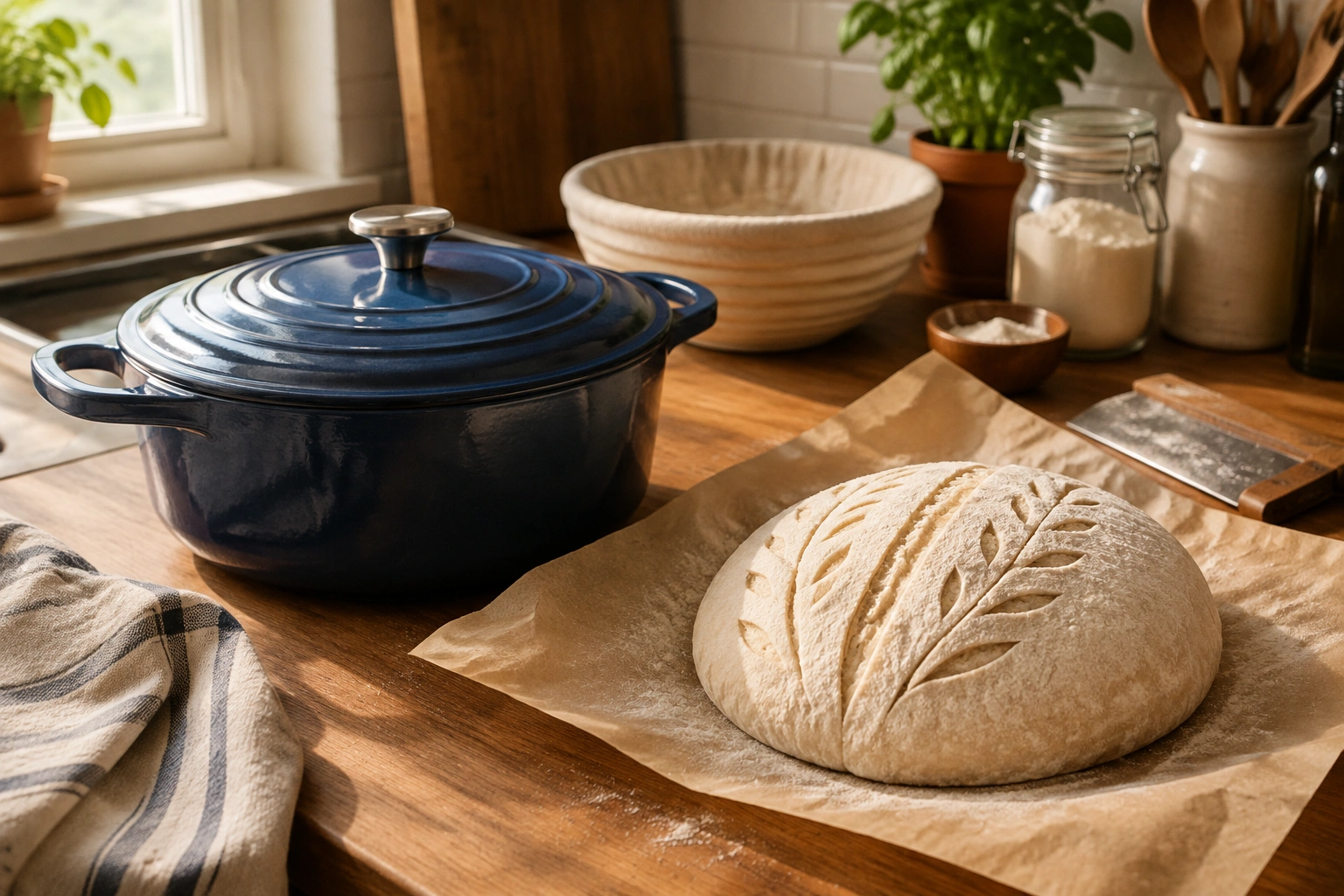
If your loaf bakes low and wide on a sheet pan with minimal steam, the baking setup may be limiting rise even when the dough itself is decent.
Bake vessel trade-off
- Dutch oven: better steam retention, usually stronger oven spring, less fuss, and often better loaf height
- Open oven: more flexibility and larger batch baking, but more dependent on steam and oven strength, with less reliable height for many home bakers
The vessel won’t fix a weak dough, but it can make a real difference when the dough is already close.
Common mistakes that make sourdough flat
Here’s the short list I’d check first:
- Starter wasn’t active enough at mix time
- Hydration was too high for the flour strength
- Bulk fermentation ran too long or ended too early
- Dough never developed enough gluten
- Shaping didn’t create enough surface tension
- Final proof went too far
- Scoring was timid or delayed
- Steam and heat retention were too weak
The important thing is not to assume every flat loaf has the same cause. Two loaves can look similar on the outside and fail for completely different reasons.
Troubleshooting by symptom: what to change next time
Use the loaf itself as your guide.
If the loaf spread wide but the crumb was open
Likely overproofed or shaped too loosely. Next time, shorten the final proof slightly and tighten shaping without squeezing out all the gas.
If the loaf was flat and dense
Likely underfermented or underdeveloped. Next time, extend bulk fermentation and make sure the dough has enough strength before shaping.
If the loaf was flat and gummy
Likely a fermentation imbalance or bake issue. Recheck starter strength, proofing cues, and oven setup before changing the recipe.
If the loaf rose in the basket but flattened after scoring
Likely weak surface tension. Focus on shaping and bench rest, not just fermentation time.
If the loaf looked good until it hit the oven, then stayed low
Likely limited oven spring. Improve steam, heat retention, and scoring.
Practical examples of flat loaves and likely causes
A loaf that spread out, had a very open crumb, and tasted a bit more sour than usual often points toward overproofing. The dough made gas, but it lost enough strength that it couldn’t stand up.
A loaf that burst at the side, felt heavy, and had a tight crumb usually points toward underproofing. It needed more time to expand before baking.
A dough that felt sticky and slack from the beginning, especially after extra water was added, may simply have been too wet for the flour strength and handling method.
A loaf that looked rounded in the basket but flattened after scoring often points to shaping tension rather than fermentation.
A loaf baked on a sheet pan with little steam that remained low despite decent fermentation may have been limited by the oven setup rather than the dough alone.
How to prevent flat sourdough on future bakes
The most reliable prevention plan is to make small, controlled changes:
- Use a starter that is active and predictable
- Keep notes on dough temperature and room temperature
- Choose a flour that can support your hydration level
- Watch the dough during bulk instead of relying only on the clock
- Shape with enough tension to support height
- Proof by feel and volume, not just time
- Score decisively and bake with enough steam or heat retention
If you want a practical approach, change only one major variable per bake. For example, keep the same flour and starter, but reduce hydration slightly on the next loaf. Or keep the formula the same and focus on better shaping. That kind of controlled troubleshooting teaches you far more than random adjustments.
Flat sourdough is frustrating, but it’s also one of the most useful learning signals in bread baking. Once you learn to read the loaf, you stop guessing and start diagnosing.
FAQ
Why is my sourdough bread flat even though it rose?
It may have overproofed, been shaped too loosely, or lacked enough gluten strength to hold the gas it produced.
How do I know if my starter is ready to bake with?
A practical benchmark is whether your levain reliably doubles, or nearly doubles, after feeding under your usual conditions.
What’s the difference between underproofed and overproofed sourdough?
Underproofed dough is usually tight, dense, and underexpanded; overproofed dough often feels fragile, slack, and prone to spreading.
Does a Dutch oven help sourdough rise more?
Usually yes. A preheated Dutch oven traps steam and heat better than many open-oven setups, which often improves oven spring and loaf height.
Can I bake sourdough on a stone or sheet pan instead?
Yes, but open-oven baking usually needs more steam support and tends to give less reliable height than a Dutch oven.
Should I always use bread flour for sourdough?
Not always, but bread flour is often more forgiving for structure. All-purpose flour can also work, while self-raising flour and cake flour are generally poor choices for standard sourdough because they are not designed for strong gluten development.