Baking powder to soda conversion works only when the recipe has enough acid to activate the baking soda. If the formula is low in acid or depends on double-acting lift, keep the original leavener.
Converting baking powder to baking soda can work well, but only when the recipe has enough acid to activate the soda and keep the flavor balanced. This guide explains how to make the swap without flattening your cakes, making cookies taste bitter, or changing the texture more than necessary.
- Acid matters: Baking soda needs acidic ingredients to create reliable lift and avoid off-flavors.
- Start small: A partial conversion is safer than replacing all baking powder at once.
- Measure precisely: Small errors can cause bitterness, flatness, or excess browning.
- Test first: A small batch helps confirm texture, rise, and flavor before scaling up.
What Baking Powder and Baking Soda Actually Do in a Recipe
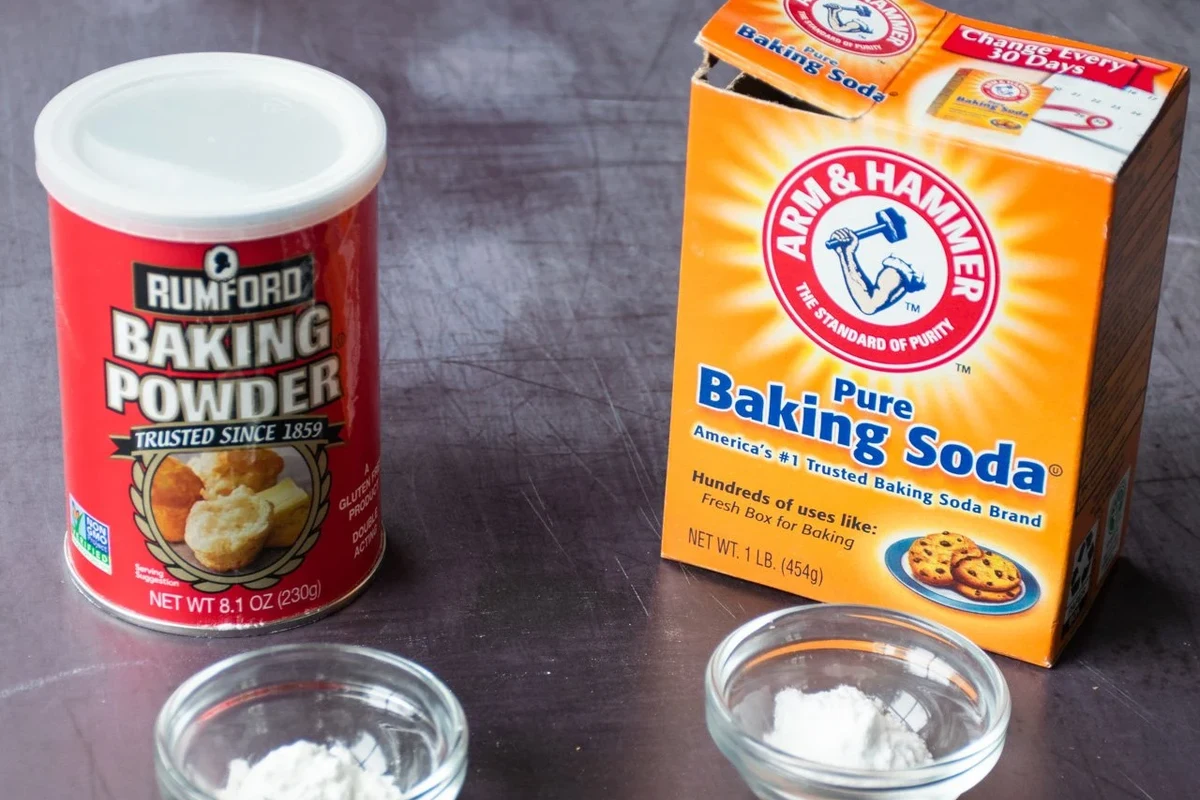
Baking soda and baking powder both help baked goods rise, but they do it in different ways. Baking soda is a pure alkaline ingredient, while baking powder is a packaged leavener that already contains both an acid and a starch to keep it stable.
Why baking soda needs an acid to work
Baking soda needs an acidic ingredient to create carbon dioxide gas, which is what helps batter or dough expand in the oven. If there is not enough acid, the soda may not fully react, and any extra can leave a soapy or metallic taste.
Common acidic ingredients include buttermilk, yogurt, sour cream, lemon juice, vinegar, molasses, brown sugar in some recipes, cocoa powder labeled natural rather than Dutch-processed, and fruit purées. The exact effect depends on the recipe, because ingredient brands, mixing time, and oven temperature all change how fast the batter sets.
Baking soda reacts quickly once it meets acid and moisture, so batters made with it should usually go into the oven soon after mixing.
How baking powder already includes an acid and starch
Baking powder is designed to be more self-contained. It usually includes baking soda, one or more acid salts, and starch, which helps keep the mixture dry and easier to measure.
Because it already carries its own acid, baking powder is safer in recipes that do not have many acidic ingredients. That is why a direct baking powder to soda conversion is not always one-to-one; the recipe may need extra acid or a different amount of leavener to keep the structure balanced.
How to Convert Baking Powder to Baking Soda Without Ruining Texture
The safest conversion starts with the recipe’s acidity, not just the amount of leavener. If the batter already contains enough acid, you can often replace some or all of the baking powder with a smaller amount of baking soda and keep a similar rise.
The basic substitution ratio and when it works
A common starting point is to use about one-quarter teaspoon of baking soda for each teaspoon of baking powder, but that only works when the recipe has enough acidic ingredients to activate it. In many recipes, especially simple cookies or quick breads, you may also need to reduce or adjust other acidic ingredients so the flavor does not become too sharp.
If the original recipe uses a lot of baking powder, replacing all of it with soda alone is usually not a good idea. For more background on the difference between the two ingredients, see our guide on baking soda and baking powder differences.
If you are unsure, test a small batch first. A half recipe is often enough to show whether the crumb, rise, and flavor stay acceptable before you scale up.
How to judge whether a recipe has enough acidic ingredients
Look for ingredients that are clearly acidic and present in meaningful amounts. A recipe with buttermilk, yogurt, sour cream, citrus juice, vinegar, molasses, or natural cocoa is a better candidate than a recipe built mostly from milk, butter, and sugar.
Also pay attention to the total balance. A small spoonful of lemon juice may not be enough to support a full baking powder to soda conversion, while a recipe with several acidic ingredients may handle the swap more easily. If you are replacing baking powder in a recipe that already contains baking soda, check the total amount carefully so you do not double the alkalinity.
Simple conversion examples for cookies, muffins, and quick breads
For cookies, a small amount of baking soda often helps with browning and spread, especially when brown sugar or another acidic ingredient is present. If the recipe depends on a tall, cakey cookie shape, though, too much soda can make the cookies spread too quickly.
For muffins, the conversion works best when the batter includes yogurt, buttermilk, sour cream, or fruit. For quick breads, the extra acid from bananas, pumpkin, applesauce, or molasses may support a partial conversion, but the loaf may still need some baking powder if the recipe is meant to rise high and stay tender.
Good candidates when the dough includes brown sugar, cocoa, or another acidic ingredient and you want more browning or spread control.
Often work well with yogurt or buttermilk, since the batter already has moisture and acid to activate soda.
When Baking Powder Cannot Be Replaced by Baking Soda Alone
Some recipes rely on baking powder because it provides lift without needing extra acid from the rest of the formula. In those cases, a full swap to baking soda can change both structure and flavor in ways that are hard to fix after mixing.
Recipes that depend on double-acting lift
Many modern baking powders are double acting, which means they release some gas when mixed and more when heated. That delayed lift helps batter rise in the oven after the structure has begun to set.
If you remove that function and use baking soda alone, the batter may rise too early, then collapse before the crumb can hold it. This is especially common in cakes, layered muffins, and batters that need a stable, even dome.
What happens when the acid balance is too low
When there is not enough acid, the soda cannot fully neutralize. The result may be a flat bake, a coarse crumb, or a lingering alkaline taste that shows up after the first bite.
Too much baking soda can also darken the crust faster than the center bakes. That can make the outside look done while the inside still feels gummy, which is a common failure pattern in quick breads and snack cakes.
Signs the conversion will change flavor, browning, or spread
Watch for recipes that already have a strong flavor balance, such as vanilla cakes, lightly sweet muffins, or delicate tea cakes. These are more likely to taste noticeably different if the leavener is changed.
Extra soda can increase browning, boost spread, and sometimes create a slightly rougher crumb. If you want a deeper explanation of why soda behaves differently in the oven, our article on using baking soda instead of baking powder safely covers the risk points in more detail.
Do not assume a recipe can be converted just because it contains one acidic ingredient. The type, amount, and pH of that ingredient all affect whether the swap will work.
Measuring the Conversion Accurately in Real-World Baking
Small measuring errors matter more when you convert leaveners. A little too much soda can create bitterness and excess browning, while too little may not produce enough rise.
How to scale small and large batches consistently
For small batches, use the smallest measure you can read accurately and level it off carefully. For larger batches, scale the formula by weight when possible so the ratio stays consistent from one batch to the next.
Batch size also affects mixing and oven behavior. A larger batter may hold heat differently, and a smaller batch may bake faster, so even the same conversion can behave differently across pan sizes and oven racks.
Using teaspoons, grams, and baker’s percentages for precision
Teaspoons are convenient, but grams are more precise. If you bake often, weighing ingredients helps reduce variation from spooning, packing, or humidity.
In professional-style baking, baker’s percentages make it easier to compare formulas and scale them up. That approach is especially useful if you are adjusting multiple ingredients at once, because the leavener amount stays tied to flour weight rather than a fixed household measure.
Common measuring mistakes that cause flat or bitter results
One common mistake is scooping directly from the container and compressing the powder. Another is confusing baking powder with baking soda on a busy prep counter, especially if the labels are similar.
Using an old or damp ingredient can also distort the result. If either leavener has absorbed moisture or lost strength, your conversion math may be correct but the bake still falls short.
Testing the Recipe Before Serving It to Customers or at Home
Whenever you change a leavener, treat the first bake as a test batch. You are checking not only rise, but also crumb, color, flavor, and how the baked good holds after cooling.
Visual cues for proper rise, crumb, and browning
A good result usually shows even lift, a tender crumb, and browning that matches the recipe style. In muffins and quick breads, the top should dome in a controlled way rather than burst sharply or sink in the center.
In cookies, the edges should set before the centers spread too far. In cakes, the crumb should look fine and even, not dense at the bottom or tunnel-like through the middle.
How to check doneness without overbaking
Use the recipe’s visual cues first, then confirm with a tester if appropriate. The center should feel set for cakes and quick breads, while cookies should look just firm enough at the edges because they continue to finish as they cool.
Overbaking can hide a conversion problem by drying out the crumb. If the recipe is already at risk from a leavener swap, baking too long can make the texture seem even more dense or crumbly.
What to adjust if the batter is too thick, too thin, or too acidic
If the batter is too thick, the leavener may not distribute evenly, and the finished product can rise in patches. If it is too thin, gas can escape before the structure sets, leading to a flatter result.
If the batter tastes too acidic, reduce the acidic ingredient in the next test batch rather than adding more soda blindly. If it tastes too alkaline, that usually means the soda amount is too high for the recipe’s acid level.
Troubleshooting the Most Common Baking Powder to Soda Conversion Problems
Most conversion problems come from one of three issues: the acid balance is off, the measurement is inaccurate, or the batter is handled differently after the swap. Knowing which one is happening makes it much easier to fix the recipe.
Dense texture, metallic taste, and yellowing
Dense texture often means the batter did not produce enough gas or the structure set too slowly. A metallic or soapy flavor usually points to excess baking soda that did not have enough acid to neutralize it.
Some batters also yellow slightly when too much soda is used. That color change can be subtle in pale cakes but more obvious in biscuits, cookies, and light-colored quick breads.
The bake tastes sharp, bitter, or slightly soapy.
Reduce the soda next time or increase the acidic ingredient only if the recipe can handle the added tang.
Over-spreading, collapse, and uneven doming
Over-spreading usually means the batter loosened before the structure set, which can happen when soda reacts too fast or the dough is too warm. Collapse often follows when the gas escapes before the interior has enough strength to hold it.
Uneven doming can come from poor mixing, pan hot spots, or an oven that runs hotter on one side. Oven calibration and rack position matter more than many home bakers expect.
How ingredient temperature and mixing time affect the outcome
Cold ingredients can slow the reaction and change how evenly the batter comes together. Very warm ingredients can speed up spread and make the leavener work too soon.
Mixing time matters too. Overmixing can develop too much gluten in wheat-based batters, which makes the crumb tougher and can hide the intended lift. Under-mixing can leave streaks of soda or acid, causing uneven rise and flavor pockets.
Storage, Shelf Life, and Safety for Leavening Ingredients
Good storage keeps your ingredients predictable, which is essential when you are making a conversion. A recipe that depends on precise lift is harder to judge if the leavener is old or contaminated by moisture.
How to tell if baking powder or baking soda is still active
Baking soda generally lasts a long time if kept dry, but baking powder loses strength more easily because it contains acid components that can be affected by humidity. If either ingredient has clumped, absorbed odors, or sat too long in a damp pantry, it may not perform well.
For a simple freshness check, compare the ingredient to the guidance on its package and replace it if the result is weak or uncertain. For more detail on replacement timing, see our guide on when baking soda expires and when to replace it.
Best storage conditions for freshness and moisture control
Store both leaveners in tightly sealed containers in a cool, dry place away from steam, flour dust, and strong odors. Avoid keeping them near the stove or dishwasher, where heat and humidity can shorten shelf life.
If you live in a humid climate, label the container with the purchase date so you can track freshness more easily. Moisture is the main enemy of predictable leavening, especially for baking powder.
Food safety and allergen considerations when modifying recipes
When you change a recipe, remember that other ingredients may also affect safety and allergen exposure. Cross-contact with wheat, dairy, eggs, nuts, or other allergens can matter just as much as the leavener swap, especially in shared kitchens.
For food safety questions involving eggs, dairy, or storage times, follow recognized guidance from official sources such as the USDA or FDA rather than guessing. If you are baking for someone with a serious allergy, check every label carefully and use qualified advice as needed.
Do not taste raw batter or dough that contains uncooked flour or eggs. If the recipe is being adjusted for safety or allergies, treat the label check as part of the recipe, not an optional step.
Final Decision Guide: Should You Convert or Keep the Original Leavener?
The best choice depends on the recipe’s acid level, the type of baked good, and how much change you can tolerate in flavor and texture. In many cases, the smartest move is a partial conversion rather than a full replacement.
Best situations for baking powder to soda conversion
Conversion works best in recipes that already contain clear acidity, such as buttermilk muffins, yogurt cakes, sour cream quick breads, or cookies with brown sugar and cocoa. It also works better when you want a little more browning or a slightly more tender chew.
If you are developing recipes or adjusting an older formula, a controlled test batch can help you see whether the change improves the crumb without adding off-flavors.
Cases where a recipe should be left unchanged
Leave the recipe alone if it depends on a strong double-acting lift, has very little acid, or already has a delicate flavor balance. Light sponge-style cakes, many boxed-style formulas, and some tender muffins are better left with their original leavener.
If the recipe is for a customer, a class demo, or a special occasion, consistency matters more than experimentation. In those cases, keeping the original formula is often the safest path.
Practical recap for choosing the right leavening strategy
Start by checking the acid in the recipe, then decide whether a partial swap makes sense. Use accurate measuring, bake a test batch, and watch the crumb, browning, and flavor before scaling up.
If you want a broader comparison of leavening choices, our article on the baking soda and vinegar reaction is a helpful next read. For most bakers, the safest rule is simple: convert only when the recipe has enough acid to support it, and keep the original leavener when the formula depends on exact lift.
Baking powder to soda conversion can work well in acidic recipes, but it should be done carefully and usually in small test batches first. When the recipe is delicate or low in acid, keeping the original leavener is usually the better choice.
Frequently Asked Questions
A common starting point is about 1/4 teaspoon baking soda for 1 teaspoon baking powder, but only if the recipe has enough acid. The exact result depends on the other ingredients and how the batter is mixed.
Look for ingredients like buttermilk, yogurt, sour cream, lemon juice, vinegar, molasses, or natural cocoa. If the recipe is low in acidic ingredients, baking soda alone may not work well.
No, some recipes need the double-acting lift that baking powder provides. Cakes, delicate muffins, and low-acid batters are especially likely to change in texture or flavor.
A bitter or soapy taste usually means there is too much baking soda for the amount of acid in the recipe. Reduce the soda or keep some baking powder in the formula.
Keep both in tightly sealed containers in a cool, dry place away from steam and odors. Moisture and heat can weaken baking powder and make results less predictable.
Yes, a test batch is the safest way to check rise, flavor, and texture after a leavener change. This is especially important for customer orders, classes, and special events.
