
How Long in an Air Fryer if 25 Minutes in Oven?
Quick Answer
If a recipe takes 25 minutes in a conventional oven, start with about 19 to 20 minutes in an air fryer and lower the temperature by about 25°F (14°C). Begin checking around 16 to 17 minutes because food type, basket size, thickness, and air fryer power can change the final time. This follows the general air fryer baking conversion guidance of cooking about 20% to 25% faster.
Quick 25-Minute Conversion
- Original oven time: 25 minutes.
- Air fryer estimate: About 19 to 20 minutes.
- First doneness check: Around 16 to 17 minutes.
- Temperature change: Reduce the oven temperature by about 25°F (14°C).
- Important: Don’t rely on time alone for meat or poultry.
Simple Formula
- Multiply the oven time by 0.75 to 0.80. For 25 minutes, that gives roughly 18¾ to 20 minutes.
If you’re staring at a recipe that says “bake for 25 minutes” and wondering what to enter on your air fryer, you don’t need to guess blindly.
Air fryers move hot air much more aggressively than conventional ovens, so both the time and temperature usually need adjusting.
In This Guide
- How does oven-to-air-fryer conversion work?
- How long should 25 minutes in the oven take in an air fryer?
- Should you lower the temperature too?
- Does the type of food change the conversion?
- What can make an air fryer cook faster or slower?
- How do you know when the food is done?
- Frequently asked questions
How Does Oven-to-Air-Fryer Conversion Work?
A useful starting rule is to reduce a conventional oven temperature by about 25°F and shorten the cooking time by roughly 20% to 25%.
That means a 25-minute oven recipe normally lands near 19 to 20 minutes in an air fryer.
An air fryer is a compact convection cooker. It uses a heating element and a powerful fan to circulate hot air rapidly around food, which encourages faster cooking and browning than a conventional still-air oven.
The calculation is simple. Cutting 20% from 25 minutes leaves 20 minutes, while cutting 25% leaves 18 minutes and 45 seconds.
I treat that calculation as a starting point rather than a finish-line timer.
- 20% reduction: 25 × 0.80 = 20 minutes
- 25% reduction: 25 × 0.75 = 18.75 minutes
- Practical target: Start around 19 to 20 minutes
- Early check: Look at the food around 16 to 17 minutes
King Arthur Baking recommends lowering the temperature by 25°F and baking about 20% to 25% less time when adapting many standard oven recipes to an air fryer.
That rule is especially useful for baked goods, but the exact result still depends on what you’re cooking.
How Long Should 25 Minutes in the Oven Take in an Air Fryer?
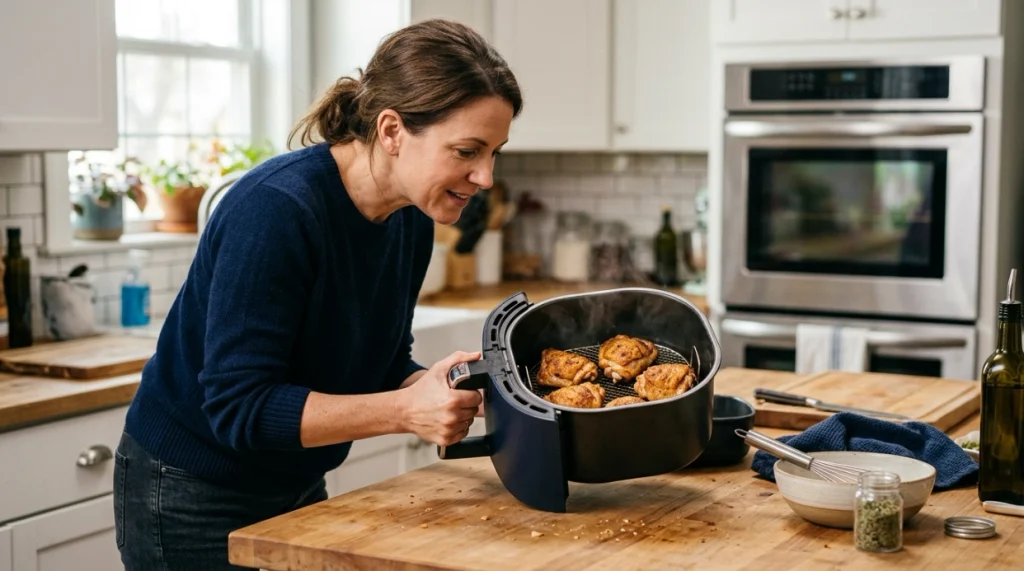
For most suitable foods, I would convert 25 oven minutes to about 19 to 20 air fryer minutes.
I would not set 20 minutes and walk away, though. Start checking several minutes earlier.
| Conventional Oven Time | 20% Less Time | 25% Less Time | Good Starting Range |
|---|---|---|---|
| 10 minutes | 8 minutes | 7½ minutes | 7½–8 minutes |
| 15 minutes | 12 minutes | 11¼ minutes | 11–12 minutes |
| 20 minutes | 16 minutes | 15 minutes | 15–16 minutes |
| 25 minutes | 20 minutes | 18¾ minutes | 19–20 minutes |
| 30 minutes | 24 minutes | 22½ minutes | 22½–24 minutes |
Consumer Reports also recommends checking air-fried food well before the original oven time because circulating hot air can cook and brown food more quickly.
For a 25-minute recipe, an early inspection around 16 to 17 minutes gives you room to adjust without overcooking the food.
Why not simply use 20 minutes every time?
Two foods requiring 25 minutes in an oven can behave completely differently in an air fryer.
A thin breaded chicken cutlet may brown quickly, while a dense casserole in a small baking dish may need nearly the original time.
- Thin foods usually cook faster.
- Dense foods often need more time.
- Small batches cook faster than crowded baskets.
- Foods in baking pans receive less direct airflow.
- High-moisture foods may need extra time to brown.
Should You Lower the Temperature Too?
Yes, for many oven recipes, dropping the temperature by about 25°F (14°C) is a sensible starting point.
If the oven recipe calls for 400°F, try about 375°F in the air fryer.
| Oven Temperature | Air Fryer Starting Temperature |
|---|---|
| 325°F | 300°F |
| 350°F | 325°F |
| 375°F | 350°F |
| 400°F | 375°F |
| 425°F | 400°F |
America’s Test Kitchen’s convection guidance explains why moving air changes both cooking speed and browning.
The 25°F reduction isn’t universal, however. Some foods benefit from staying at the original temperature for stronger crisping.
When might I keep the original temperature?
Frozen fries, breaded appetizers, and other foods designed to become crisp can sometimes handle the original temperature well.
Follow the package’s air fryer instructions first when they’re available.
When is lowering the temperature especially helpful?
- Cookies: Their surfaces can brown before their centers finish.
- Cakes: Strong top heat may set and darken the surface too early.
- Pastries: Delicate edges can color rapidly.
- Sugary glazes: Sugar can darken faster under intense circulating heat.
For baking, I would rather start slightly cooler and add another minute than discover the top has browned before the center sets.
Does the Type of Food Change the 25-Minute Conversion?
Absolutely. The 19-to-20-minute estimate is a starting point, not a universal cooking time.
Food thickness, moisture, breading, fat content, and container choice all affect heat transfer.
Frozen foods
Many frozen foods are excellent air fryer candidates because the strong airflow encourages surface browning.
Check the package first because manufacturers increasingly print dedicated air fryer directions.
Vegetables
Spread vegetables loosely enough for hot air to move around them.
Shaking or turning once or twice usually helps expose more surfaces to heat.
Consumer Reports notes that fuller baskets can take longer and may produce less crispness than smaller batches.
Baked goods
Cookies, muffins, pastries, and small cakes need closer attention because their tops may brown quickly.
King Arthur Baking recommends both temperature and time adjustments when adapting many conventional recipes.
- Preheat when consistent baking results matter.
- Use an air-fryer-safe pan that leaves room for airflow.
- Start checking noticeably before the original oven time.
- Record successful settings for your own machine.
Chicken, meat, and seafood
Time is useful for planning, but internal temperature decides whether many animal proteins are safely cooked.
A thick chicken breast may require a different time from thin chicken tenders even when both recipes suggest 25 oven minutes.
Pro tip: Use a food thermometer and follow FoodSafety.gov’s safe minimum temperature guidance rather than relying on cooking time alone.
What Can Make an Air Fryer Cook Faster or Slower?
Air fryers don’t all move the same volume of air or hold heat in the same way.
That is why two machines set to 375°F can finish the same food several minutes apart.
Basket size and food quantity
A small batch leaves more surface area exposed to moving hot air.
Overcrowding blocks circulation and can slow browning.
- Keep pieces in a single layer when practical.
- Leave small gaps between breaded items.
- Cook a second batch instead of piling food deeply.
Preheating
Preheating gives you a more repeatable starting temperature, which is especially useful for baking.
If you place food in a cold air fryer, the total elapsed cooking time may differ from a recipe tested in a preheated machine.
Basket-style vs. oven-style air fryers
Compact basket air fryers surround small batches with intense airflow.
Large oven-style models provide more space, but rack position and tray rotation can matter more.
Using a pan or baking dish
A solid pan shields part of the food from direct airflow.
A cake, baked pasta, or casserole may therefore need more time than loose food sitting directly in the basket.
Food temperature before cooking
Refrigerator-cold food contains less heat than room-temperature ingredients, so it can take longer to cook through.
Frozen food creates an even larger temperature difference.
Section Takeaway: Use 19 to 20 minutes as your first estimate for a 25-minute oven recipe, then adjust for your air fryer, batch size, container, and food thickness.
How Do You Know When the Food Is Done?
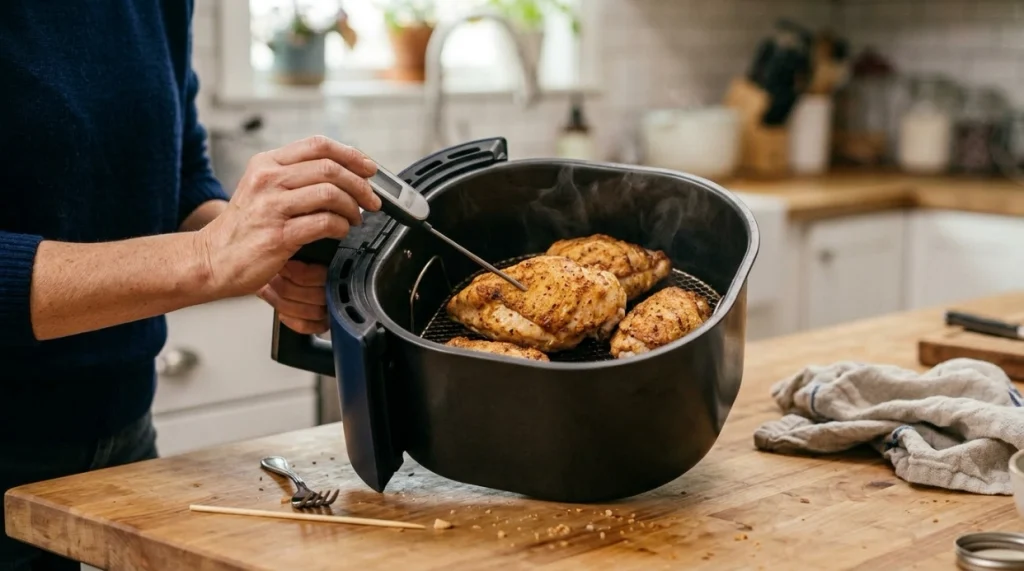
Don’t use the clock as your only signal. Look for the doneness cues that matter for the food you’re making.
For a 25-minute oven recipe converted to an air fryer, make your first check before the estimated finish.
- Check around 16 to 17 minutes. Look at browning and surface texture.
- Turn or shake if needed. This helps expose pale areas to circulating air.
- Test the center. Use a skewer, fork, or thermometer as appropriate.
- Add time gradually. Continue in 1- to 2-minute increments.
- Write down the final setting. Your next batch becomes much easier.
For baked goods
Look beyond surface color because an air fryer can brown the top while the center still needs time.
For cakes and quick breads, use the recipe’s normal doneness test and check the center carefully.
For crispy foods
Look for even browning, a dry-looking exterior, and the texture you’re aiming for.
If the outside is already dark but the center needs more time, lower the temperature slightly before continuing.
For meat and poultry
A digital food thermometer is far more reliable than judging by color.
FoodSafety.gov lists 165°F (74°C) for poultry, 160°F (71°C) for ground meats, and 145°F (63°C) plus a three-minute rest for whole cuts of beef, pork, veal, and lamb.
Those safety temperatures matter more than whether your converted timer says 18, 19, or 20 minutes.
Frequently Asked Questions
What is 25 minutes in the oven converted to an air fryer?
Start with about 19 to 20 minutes in the air fryer. That reflects a roughly 20% to 25% time reduction, but begin checking around 16 to 17 minutes because air fryer performance and food thickness vary.
What temperature should I use if the oven recipe says 400°F?
A good starting point is about 375°F in the air fryer. Reducing the temperature by 25°F helps compensate for the stronger circulating heat, especially with baked goods and foods that brown quickly.
Do I always reduce air fryer cooking time by 20%?
No. A 20% reduction is a useful starting rule rather than a guarantee. Dense casseroles, crowded baskets, thick pieces, or foods cooked inside pans may require more time, while small or thin foods can finish sooner.
Should I preheat an air fryer when converting an oven recipe?
Preheating isn’t essential for every food, but it can improve consistency. I find it most useful for cakes, cookies, pastries, and other recipes where the initial heat affects rising, structure, or browning.
Can I put an oven-safe dish in an air fryer?
Many oven-safe metal, ceramic, silicone, and tempered-glass dishes can work if the manufacturer approves them for the temperatures involved. Make sure the dish fits without blocking all airflow, and always follow both the cookware and air fryer manufacturer’s instructions.
Why is my food browning before the converted time is finished?
Your temperature may be too high, or your air fryer may circulate heat more aggressively than expected. Lower the temperature by about 15°F to 25°F, then continue cooking while checking the center for doneness.
Is air fryer time always shorter than oven time?
Usually, but not always. Thick foods, deep baking dishes, large batches, and heavily crowded baskets can erase much of the time advantage, so use the conversion formula as a starting point rather than an absolute rule.
The Simple Takeaway
If a conventional oven recipe says 25 minutes, set your air fryer for roughly 19 to 20 minutes as a first estimate.
Lower the recipe temperature by about 25°F, and start checking the food around 16 to 17 minutes.
- 25 oven minutes → about 19–20 air fryer minutes.
- Reduce temperature → about 25°F.
- Check early → around 16–17 minutes.
- Adjust → in 1–2 minute increments.
- For meat → verify safe internal temperature.
Once you’ve converted the same recipe once or twice, save the exact time and temperature that work in your machine. That personal conversion is more useful than any generic chart.
