
What Is the 25 Rule for Air Fryers?
Quick Answer
The 25 rule for air fryers is a simple recipe-conversion guideline: reduce a conventional oven temperature by about 25°F when moving the recipe to an air fryer. A practical starting point is also to shorten the cooking time by about 20%, which matches guidance from the University of Illinois Extension.
How to use the rule
- Lower the heat: Subtract about 25°F from the oven temperature.
- Shorten the time: Start with roughly 20% less cooking time.
- Check early: Look at the food several minutes before the calculated finish time.
- Leave airflow: Avoid packing the basket so tightly that hot air cannot circulate.
- Adjust your model: Basket size, wattage, fan speed, and food thickness can change the result.
Simple example
- A recipe calling for 400°F for 30 minutes becomes a starting point of about 375°F for 24 minutes in the air fryer.
If you’ve tried converting an oven recipe to an air fryer, you’ve probably seen the phrase “25 rule.” It sounds more technical than it is.
I treat it as a starting point, not a guaranteed formula. Air fryers move hot air aggressively around food, so temperature, cooking time, basket space, and food thickness still matter.
In This Guide
What Does the 25 Rule for Air Fryers Mean?
The 25 rule usually means reducing a conventional oven recipe’s temperature by approximately 25°F when cooking it in an air fryer. Many cooks also reduce the original cooking time by about 20%.
Definition: The air fryer 25 rule is a conversion guideline used when adapting conventional oven recipes for the faster, fan-driven heat of an air fryer.
For example, imagine a frozen-food package says to bake at 425°F for 20 minutes. A reasonable air-fryer starting point would be around 400°F and roughly 16 minutes.
That doesn’t mean you should automatically cook it for the full 16 minutes. I would start checking sooner, especially with thin or already-cooked foods.
- 400°F oven: try about 375°F in the air fryer.
- 375°F oven: try about 350°F.
- 350°F oven: try about 325°F.
- 30-minute oven time: begin around 24 minutes and check earlier.
The University of Illinois Extension gives a slightly broader temperature guideline of reducing conventional oven temperatures by 25 to 30°F. It also recommends cutting cooking time by about 20%.
So, despite the catchy name, 25 isn’t a magic number. It is simply an easy baseline for your first attempt.
Why Does the 25-Degree Rule Work?
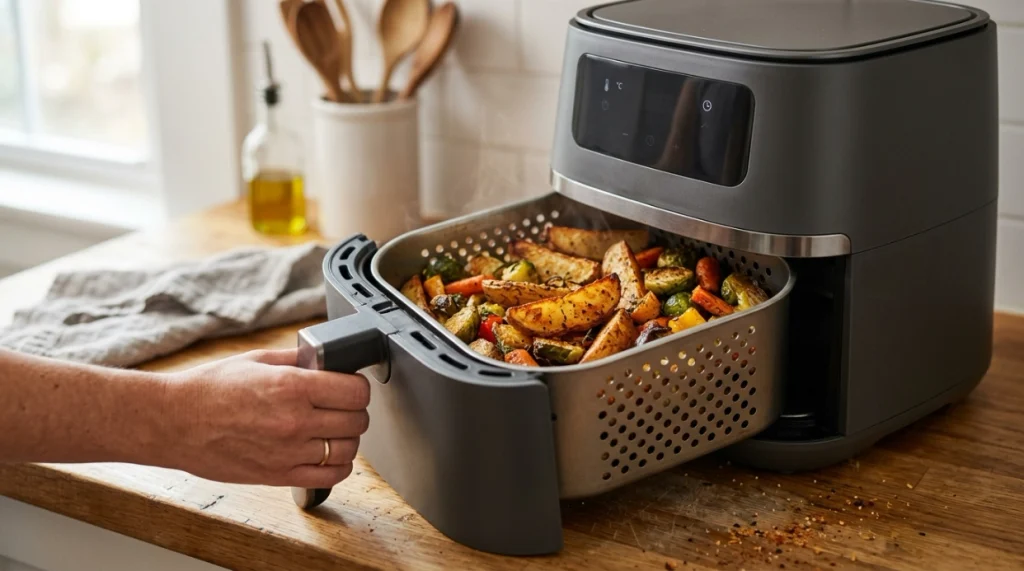
The rule works because an air fryer behaves like a compact convection oven. A heating element warms the air while a powerful fan moves that heat rapidly around the food.
The USDA describes air fryers as essentially countertop convection ovens. That moving air can cook and brown food quickly compared with a larger conventional oven.
You can read the USDA’s broader air-fryer food-safety guidance for additional information about airflow, basket capacity, and safe cooking.
Hot air reaches the food efficiently
In a standard oven, hot air surrounds the food with relatively little forced movement. An air fryer pushes heated air across the surface continuously.
This accelerates surface browning. It can also dry and crisp the exterior faster.
- Smaller cooking chamber: there is less empty space to heat.
- Strong airflow: moving hot air transfers heat efficiently.
- Food sits near the heat source: browning can happen quickly.
- Perforated baskets: hot air can reach several sides of the food.
The outside can finish before the center
This is why simply copying an oven temperature can sometimes produce dark edges before the middle is ready. Reducing the temperature gives the inside more time to catch up.
The effect becomes especially noticeable with thicker foods and baked goods. Cakes and cookies can brown on top while remaining soft or underdone in the center.
King Arthur Baking also recommends lowering air-fryer baking temperatures by about 25°F and generally shortening cooking time by roughly 20% to 25% when converting standard baking recipes.
Section Takeaway: The 25 rule compensates for the air fryer’s compact chamber and strong convection airflow. Lower heat helps balance fast surface browning with interior cooking.
How Do You Convert an Oven Recipe for an Air Fryer?
Start by reducing the oven temperature by 25°F and the cooking time by about 20%. Then treat those numbers as your first checkpoint rather than a guaranteed finish time.
- Read the original recipe. Note its oven temperature and cooking time.
- Subtract 25°F. A 400°F recipe becomes roughly 375°F.
- Multiply the time by 0.8. A 30-minute recipe becomes about 24 minutes.
- Check before the calculated time. Start inspecting several minutes early.
- Flip or shake when appropriate. Fries, vegetables, wings, and similar foods often benefit from redistribution.
- Record the final setting. Your own successful time is more useful than a generic conversion next time.
A practical conversion chart
| Conventional Oven | Starting Air Fryer Temperature | Oven Time | Approx. 20% Reduced Time |
|---|---|---|---|
| 425°F | 400°F | 25 minutes | 20 minutes |
| 400°F | 375°F | 30 minutes | 24 minutes |
| 375°F | 350°F | 20 minutes | 16 minutes |
| 350°F | 325°F | 40 minutes | 32 minutes |
For Celsius recipes, 25°F is approximately 14°C. In practical kitchen settings, reducing the temperature by about 15°C is an easy equivalent.
I prefer checking food before the mathematical endpoint. You can always add two more minutes, but you cannot reverse burnt edges or dried meat.
Section Takeaway: Subtract about 25°F, reduce the time by around 20%, and check early. Your specific air fryer and food should decide the final cooking time.
Does the 25 Rule Work for Every Food?
No. The 25 rule is most useful as a general oven-to-air-fryer conversion, but some foods need their own approach.
Manufacturer instructions should take priority when a package or recipe provides tested air-fryer settings. Delicate baking also deserves closer attention.
Frozen crispy foods
Frozen fries, breaded vegetables, nuggets, and similar foods are usually forgiving. Their small size and dry exterior work well with strong convection.
Many packages now include dedicated air-fryer instructions. Use those instead of converting the oven directions when available.
Cakes, cookies, and pastries
Baking is less forgiving because the surface can set quickly. A cake may look browned while the center still needs time.
King Arthur Baking’s detailed guide to baking in an air fryer also uses the lower-temperature, shorter-time approach as a starting guideline.
- Cookies: watch the tops closely because convection encourages fast browning.
- Cakes: use an appropriately sized pan and check the center for doneness.
- Pastries: allow enough basket space for air movement and expansion.
- Small baked portions: start checking several minutes before an oven recipe suggests.
Meat and poultry
Time calculations are only estimates when cooking raw meat. Thickness, starting temperature, bone structure, and portion size can all change how quickly the center heats.
Pro tip: Use a food thermometer rather than cooking time alone. USDA guidance lists 165°F for poultry, 160°F for ground meats, and 145°F with the appropriate rest period for whole cuts of beef, pork, veal, and lamb.
Section Takeaway: The 25 rule is a useful conversion baseline, not a replacement for package directions, recipe-specific testing, visual checks, or safe internal-temperature measurements.
What Mistakes Should You Avoid When Using the 25 Rule?
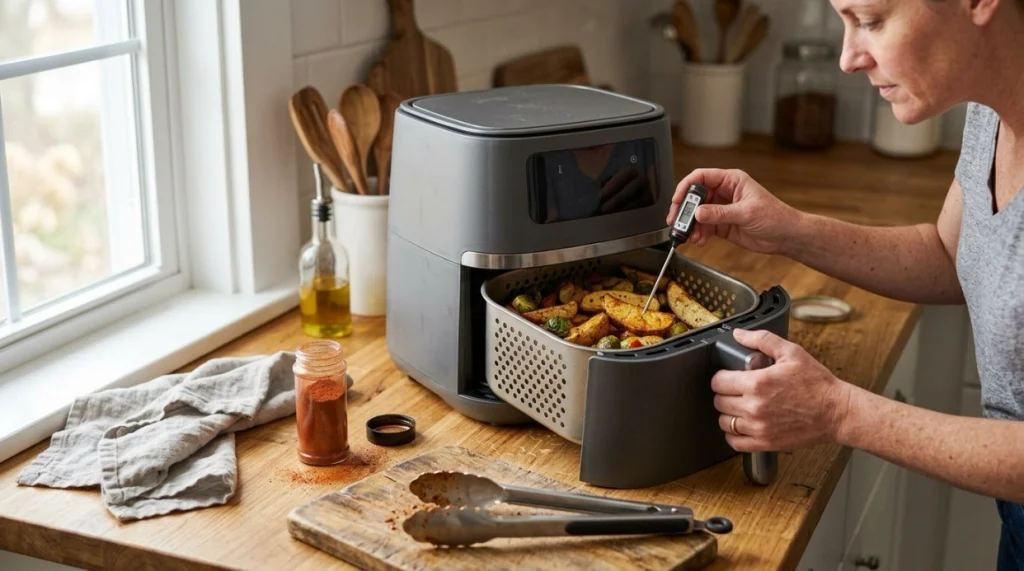
The biggest mistake is treating the calculation as exact. Air fryers vary enough that the same food can finish at different times in different machines.
Overcrowding the basket
Air frying depends on moving hot air. Packing food tightly blocks circulation and can create uneven browning or undercooked areas.
Spread pieces out when possible. For large portions, two batches often produce better results than one overloaded basket.
Ignoring food thickness
A thin chicken cutlet and a thick chicken breast should not share identical cooking expectations. The exterior may brown similarly while their centers heat at different rates.
Use the 25 rule to choose a starting setting, then judge doneness using the food itself.
Waiting until the timer ends to check
Air fryers can move quickly near the end of cooking. A few extra minutes may turn crisp food into dry food.
- Thin snacks: check several minutes early.
- Fries and vegetables: shake or stir during cooking.
- Baked goods: watch surface color before assuming the center is done.
- Raw meat: confirm doneness with a thermometer.
Assuming every air fryer needs preheating
Preheating recommendations vary by recipe and appliance. Some models and foods benefit from it, while others can start in a cold basket.
Check your owner’s manual first. A preheated air fryer may also cook the first batch faster than a cold-start calculation suggests.
Section Takeaway: Good air frying requires observation, not just arithmetic. Give hot air room to circulate, check food early, and adapt the setting to your appliance.
Frequently Asked Questions
Is the air fryer 25 rule 25°F or 25%?
The most common version refers to lowering a conventional oven temperature by about 25°F. Cooking time is often reduced separately by around 20%, although some informal guides describe slightly different percentages.
What is 400°F in an air fryer using the 25 rule?
If an oven recipe calls for 400°F, start your air fryer at approximately 375°F. If the original cooking time is 30 minutes, roughly 24 minutes is a reasonable first estimate, but begin checking before then.
Do I always need to reduce air-fryer cooking time?
No. The time reduction is a guideline rather than a guarantee. Dense, thick, frozen, or covered foods may need more time, while small or thin pieces can finish considerably earlier.
What is the 25 rule in Celsius?
A 25°F temperature difference equals about 14°C. For everyday cooking, reducing a conventional oven recipe by approximately 15°C gives you a convenient starting point for air-fryer conversion.
Should I use the 25 rule if the package already gives air-fryer instructions?
Usually not. If a manufacturer provides specific air-fryer directions, start with those because they are intended for that product. Use the 25 rule mainly when only conventional oven instructions are available.
Does the 25 rule apply to baking in an air fryer?
It can be a useful starting point. Baked goods need extra attention because strong convection can brown tops quickly, so check cakes, cookies, pastries, and breads before the converted cooking time expires.
Why is my food still not crispy after using the rule?
Temperature may not be the problem. Excess moisture, overcrowding, insufficient airflow, too much sauce, or food stacked in layers can prevent crisping even when your time and temperature are reasonable.
Final Takeaway
The air fryer 25 rule is easy to remember: reduce a conventional oven temperature by about 25°F and shorten the cooking time by roughly 20%. Think of those numbers as a starting point rather than a fixed law.
As of 2026, reputable guidance still emphasizes adjustment because air fryer size, design, airflow, and power vary. Food thickness and basket loading matter just as much.
When I convert a recipe, I calculate the lower setting first and then deliberately check early. After one successful batch, I write down the exact setting that worked so the next cook requires almost no guesswork.
That habit is more dependable than memorizing any universal chart. Use the 25 rule to get close, then let your food, thermometer, and specific air fryer guide the final few minutes.