
What Food Is Best Cooked in an Air Fryer?
Quick Answer
The food best cooked in an air fryer is food that benefits from a browned, crisp exterior and a tender or moist center. Potatoes, chicken wings, roasted vegetables, frozen breaded foods, salmon, pizza, cookies, and many leftovers are especially good choices because the appliance uses concentrated convection-style hot-air cooking.
Best foods to air fry
- Potatoes and fries: Strong airflow removes surface moisture and encourages crisp browning.
- Chicken pieces: Wings, thighs, tenders, and breaded cutlets suit fast circulating heat.
- Roasted vegetables: Broccoli, Brussels sprouts, cauliflower, carrots, and squash brown quickly.
- Frozen snacks: Nuggets, fries, breaded fish, and similar foods usually crisp without deep frying.
- Small baked foods: Cookies, rolls, biscuits, brownies, and personal pizzas fit the compact chamber well.
- Crispy leftovers: Pizza, roasted potatoes, and fried foods regain texture better than they usually do in a microwave.
Simple rule
- Choose foods that benefit from dry heat, browning, and airflow, and avoid packing the basket so tightly that hot air cannot circulate.
If you are wondering what food is best cooked in an air fryer, think beyond french fries. The best foods to air fry usually need crisp edges, concentrated browning, or fast small-batch cooking.
As of 2026, I find it more useful to think of the appliance as a compact convection cooker than as a miniature deep fryer. That distinction explains why some foods turn out exceptionally well while others are frustrating.
In This Guide
What Foods Work Best in an Air Fryer?
Foods with relatively dry surfaces and plenty of exposed area usually work best. Rapidly moving hot air can reach those surfaces, drive away moisture, and encourage browning.
Definition: An air fryer is a compact electric convection cooker that uses a heating element and fan to circulate hot air around food. Its small chamber and strong airflow help exposed surfaces brown and crisp quickly.
The appliance is especially useful when I want the contrast of a crisp outside and softer center. Think golden potato wedges, browned Brussels sprouts, juicy chicken with crisp skin, or a cookie with firmer edges.
Basket space matters just as much as temperature. When food forms a dense pile, pieces block airflow and trap moisture against one another.
- Excellent matches: fries, wedges, wings, breaded chicken, roasted vegetables, fish fillets, meatballs, pizza, cookies, rolls, and frozen snacks.
- Good with adjustments: cakes, muffins, pork chops, burgers, pastries, sandwiches, and reheated casseroles.
- Poor matches: loose wet batter, large amounts of liquid, oversized foods, and lightweight toppings that strong airflow can move.
What makes one food better than another?
The best air-fryer foods usually share three traits. They have exposed surfaces, benefit from browning, and fit comfortably without blocking circulation.
| Food category | Why it suits air frying | Main thing to watch |
|---|---|---|
| Potatoes | Dry heat encourages crisp edges and browning | Crowding and excess surface water |
| Chicken pieces | Skin and coatings can brown while the center cooks | Verify safe internal temperature |
| Vegetables | Edges roast quickly in concentrated hot air | Uneven piece size |
| Frozen breaded foods | Set coatings respond well to dry circulating heat | Overcooking thin pieces |
| Small baked goods | Compact batches heat and brown efficiently | Top browning before the center sets |
| Leftovers | Dry heat restores a crisp exterior | Drying food out during reheating |
Section Takeaway: The best air-fryer foods need airflow around their surfaces and improve when moisture is removed from the outside. Crisping, roasting, and reheating are the appliance’s strongest jobs.
Which Meat and Fish Are Best Cooked in an Air Fryer?
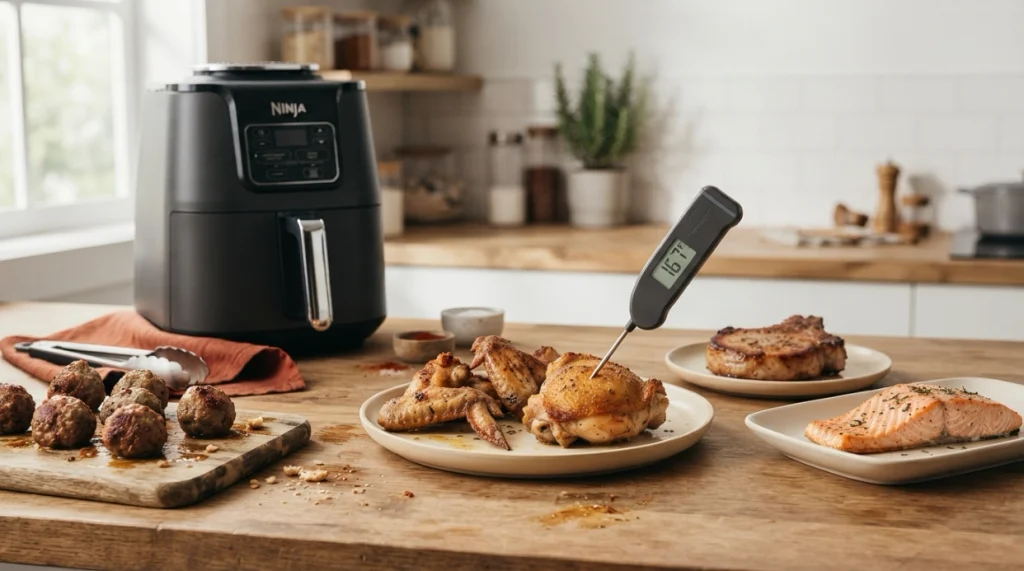
Smaller cuts of meat and fish are usually better suited to air frying than large roasts. Their size lets hot air brown the outside while heat reaches the center in a reasonable time.
Chicken is one of the easiest places to start. Wings, thighs, drumsticks, tenders, and breaded cutlets all offer enough exposed surface for effective browning.
- Chicken wings: The skin benefits from dry, circulating heat, especially when the wings are not stacked tightly.
- Chicken thighs: Their higher fat content makes them more forgiving than very lean poultry cuts.
- Breaded chicken: Dry crumbs or set coatings crisp more reliably than loose liquid batter.
- Meatballs: Hot air can reach most of their rounded exterior when they are spaced apart.
- Pork chops: Moderate-thickness chops can brown efficiently, but checking doneness early helps prevent dryness.
- Salmon: Individual fillets fit a basket well and cook quickly without requiring a large oven.
How do you know meat is safely cooked?
Do not use color, crispness, or cooking time alone to judge raw meat and poultry. Check the thickest part with a food thermometer and follow verified food-safety temperature guidance.
| Food | Safe minimum internal temperature |
|---|---|
| Chicken and other poultry | 165°F / 74°C |
| Ground meat | 160°F / 71°C |
| Beef, pork, veal, and lamb steaks, chops, or roasts | 145°F / 63°C plus a 3-minute rest |
| Fish | 145°F / 63°C |
Pro tip: For raw meat, poultry, and fish, use a thermometer and verified USDA or FoodSafety.gov guidance rather than relying on an air-fryer timer alone.
I also avoid judging a thick chicken breast by the surface. An aggressively browned exterior can appear finished while the thickest center still needs more cooking.
Section Takeaway: Individual portions of chicken, fish, pork, and meatballs are excellent air-fryer candidates. Space them for airflow and verify internal temperature before serving.
Which Vegetables and Potatoes Cook Best?
Vegetables that normally respond well to roasting are among the best foods for an air fryer. The circulating heat can brown edges while keeping thicker pieces tender inside.
Broccoli, cauliflower, Brussels sprouts, carrots, peppers, green beans, zucchini, sweet potatoes, and winter squash are all practical choices. Potatoes remain one of the appliance’s standout uses.
Why are potatoes so good in an air fryer?
Potatoes contain plenty of starch, and their cut surfaces can dry and brown under strong airflow. That makes fries, wedges, cubes, smashed potatoes, and small roasted potatoes natural candidates.
- Cut evenly: Similar-sized pieces finish more consistently.
- Dry the surface: Excess water creates steam and slows crisping.
- Use oil lightly: A thin coating can improve browning and help seasonings stick.
- Leave basket space: A shallow layer usually crisps more effectively than a deep pile.
- Shake or turn: Moving pieces during cooking exposes different surfaces to hot air.
Which vegetables benefit most from browning?
Dense vegetables such as carrots, cauliflower, and Brussels sprouts develop appealing roasted edges. Broccoli florets also expose many small surfaces to moving air.
Softer vegetables such as zucchini cook quickly, so I would check them earlier. Thin pieces can move from browned to dry faster than dense vegetables.
- Best for strong roasting: Brussels sprouts, broccoli, cauliflower, carrots, potatoes, and sweet potatoes.
- Best for shorter cooks: green beans, asparagus, peppers, mushrooms, and zucchini.
- Use extra care: lightweight leafy greens can blow around unless they are weighed down or prepared for the appliance.
You can also combine vegetables, but matching their size and cooking speed matters. Dense carrot chunks and delicate zucchini slices rarely finish at exactly the same moment.
Section Takeaway: Potatoes and sturdy roasting vegetables are among the most dependable air-fryer foods. Dry surfaces, even cuts, and open basket space matter more than complicated techniques.
Are Frozen Foods and Leftovers Good in an Air Fryer?
Yes. Frozen foods with dry or pre-set exteriors are among the easiest things to air fry because they are already shaped, portioned, and designed to be heated through.
Frozen fries, tater tots, nuggets, breaded fish, breaded vegetables, mozzarella-style snacks, and similar foods can benefit from strong dry heat. Many already contain some oil, so extra oil may be unnecessary.
Why does an air fryer work so well for frozen food?
Frozen breaded foods usually have a coating that stays in place as it heats. That is different from dipping raw food in a thin wet batter and placing it directly in the basket.
- Frozen fries: Air reaches many narrow surfaces and can restore crisp texture.
- Nuggets and tenders: Their set coatings suit circulating dry heat.
- Breaded fish: The coating can crisp while the interior heats.
- Frozen vegetables: Many can roast directly from frozen, though excess ice may add moisture.
- Snack foods: Small portions are easy to spread across a basket or crisper tray.
Exact cooking directions vary by product and air fryer. Start with package guidance when it includes air-fryer instructions, then check the food before the listed finish time if your machine cooks aggressively.
Which leftovers reheat best?
Foods that were originally crisp or roasted tend to benefit most. Pizza, fries, roast potatoes, breaded chicken, roasted vegetables, and some pastries can regain surface texture that a microwave often softens.
For more examples, Serious Eats regularly uses air fryers for foods including chicken, pork, seafood, potatoes, and vegetables.
- Pizza: The crust can re-crisp while the toppings warm.
- French fries: Moving hot air helps remove moisture picked up during storage.
- Fried or breaded foods: Dry heat is better suited to restoring crust texture than steam-heavy reheating.
- Pastries: Short reheating can refresh flaky exteriors, but sugary coatings need close attention.
I use a lower reheating temperature when food is already fully cooked. The goal is to warm the center without turning the exterior hard or overly dark.
Section Takeaway: Frozen breaded foods and crisp leftovers are two of the simplest air-fryer wins. They already have surfaces that respond well to dry, circulating heat.
What Baked Foods Work Best in an Air Fryer?
Small baked goods are often better suited to air frying than large, deep cakes. Cookies, rolls, biscuits, brownies, small pastries, and personal pizzas fit the compact chamber and benefit from quick browning.
An air fryer is not just for savory food. Its basic cooking method is convection, so it can bake whenever the pan, recipe, and airflow suit the appliance.
Which baked goods are easiest for beginners?
I would begin with shallow or individually portioned bakes. They are easier to cook through before the top becomes too dark.
- Cookies: Small batches fit easily, and the moving air can produce crisp edges.
- Dinner rolls: Their individual size allows heat to reach the centers quickly.
- Biscuits: Moderate thickness and exposed tops suit convection heat.
- Brownies: A small shallow pan can work well if it fits without blocking airflow.
- Personal pizza: The compact size can encourage crust browning.
- Small pastries: Puff pastry and similar doughs can brown efficiently when fillings are contained.
For detailed baking technique, King Arthur Baking recommends treating an air fryer as a small, powerful convection oven and adjusting conventional recipes rather than blindly copying oven settings.
How do you convert an oven recipe to an air fryer?
A practical starting point is to lower a conventional oven temperature by about 25°F, or roughly 14°C. Begin checking the food around 20% to 25% earlier than the original oven time.
| Conventional oven instruction | Air-fryer starting point |
|---|---|
| 350°F | About 325°F |
| 375°F | About 350°F |
| 400°F | About 375°F |
| 20-minute bake | Begin checking around 15 to 16 minutes |
| 30-minute bake | Begin checking around 22 to 24 minutes |
These numbers are starting points, not guarantees. Basket shape, fan strength, pan material, food depth, and the selected cooking mode can change the result.
Why are deep cakes harder?
A deep cake can brown on top before its center has set. The heating element and fan are often close to the surface, so the exterior experiences intense heat.
A smaller or shallower pan gives you a wider margin for error. Preheating can also be useful for baked goods that depend on yeast, baking powder, or baking soda for their initial rise.
Section Takeaway: Cookies, rolls, biscuits, brownies, and small pizzas are easier air-fryer bakes than deep cakes. Start cooler than a conventional oven recipe and check earlier.
What Foods Should You Avoid Air Frying?
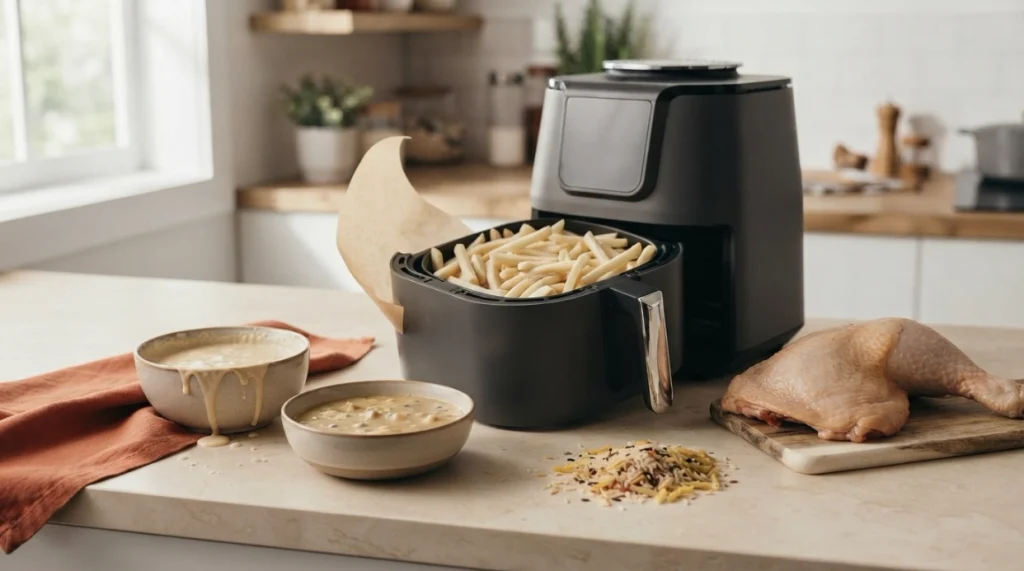
An air fryer is versatile, but its strong fan and small chamber create clear limitations. Foods that need lots of liquid, deep oil immersion, or a completely still cooking environment are usually poor candidates.
Why is loose wet batter difficult?
Thin batter can drip through a perforated basket or move before it has time to set. Deep frying works differently because hot oil surrounds the batter and sets the surface quickly.
Pre-breaded frozen foods are different because their coatings have already been formed. Dry breadcrumbs or flour-based coatings are generally easier to manage than a loose liquid batter.
- Loose wet batter: It may drip, smear, or fail to create a traditional fried crust.
- Large amounts of liquid: Soups and heavily sauced dishes do not match an open basket design.
- Oversized foods: Food pressed close to the heating element or walls may cook unevenly.
- Overcrowded batches: Too much food blocks the airflow needed for crisping.
- Loose lightweight toppings: Herbs, cheese slices, empty parchment, and similar items can move in powerful airflow.
- Recipes needing deep water: Dry rice or pasta generally need controlled liquid absorption, which is not the main job of a perforated basket.
Can parchment paper go in an air fryer?
Only use liners that are suitable for your appliance and follow the manufacturer’s instructions. Never place loose parchment in an empty preheating basket where airflow can lift it toward the heating element.
Food should normally hold an approved liner securely in place. You should also avoid blocking so much of the basket that air cannot circulate properly.
Does overcrowding ruin air-fried food?
Overcrowding is one of the most common reasons food stays soft. Packed pieces release moisture while preventing hot air from reaching their surfaces.
Two smaller batches can produce better texture than one overloaded basket. That tradeoff is worth remembering when cooking for several people.
Section Takeaway: Avoid recipes that fight the air fryer’s design. Loose batter, excessive liquid, blocked airflow, and oversized portions prevent the appliance from doing what it does best.
Frequently Asked Questions
What is the number one food to cook in an air fryer?
Potatoes are one of the most dependable choices because fries, wedges, cubes, and small roasted potatoes all benefit from circulating dry heat. Chicken wings are another standout because their exposed skin can brown while the interior cooks, provided the pieces have enough basket space.
What foods become the crispiest in an air fryer?
Foods with relatively dry surfaces become the crispiest. French fries, potato wedges, breaded chicken, frozen nuggets, roasted Brussels sprouts, and other coated or starchy foods respond especially well when they are spread out instead of piled deeply.
Can you cook raw chicken in an air fryer?
Yes, raw chicken can be cooked in an air fryer when you follow safe handling practices and cook it completely. The thickest part should reach at least 165°F or 74°C, measured with a food thermometer rather than judged by color or time alone.
Is an air fryer good for vegetables?
Yes. Broccoli, Brussels sprouts, cauliflower, carrots, peppers, green beans, potatoes, sweet potatoes, mushrooms, and similar vegetables can develop roasted edges quickly. Drying wet surfaces, cutting pieces evenly, and leaving space around them will usually improve browning.
Can you bake cookies in an air fryer?
Yes. Cookies are well suited to small-batch air-fryer baking because they are shallow and cook quickly. When converting a conventional recipe, start by lowering the temperature about 25°F and checking roughly 20% to 25% earlier than the original baking time.
Is air-fried food the same as deep-fried food?
No. An air fryer primarily cooks with rapidly moving hot air, while a deep fryer surrounds food with hot oil. Air frying can produce a browned, crisp exterior with much less oil, but it does not reproduce every texture created by true deep frying.
Do you need oil in an air fryer?
Not always. Frozen fries and breaded foods may already contain enough oil, while fresh potatoes and vegetables may benefit from a light coating for browning, flavor, and seasoning adhesion. Air frying does not require enough oil to submerge the food.
Final takeaway: If a food tastes better roasted, browned, crisped, or reheated with dry heat, it is probably a strong air-fryer candidate. Start with potatoes, chicken, vegetables, frozen foods, fish, pizza, cookies, and crisp leftovers, then adjust basket space and cooking time to your specific machine.
Once you understand that airflow is the key, choosing what to cook becomes much easier. Give food enough room, check doneness early, and use a thermometer whenever food safety depends on internal temperature.
